
Web Articles Business Knowledge, Business Efficiency, Advancement of Business Management, Others
Apr. 28, 2026
Supplier management starts with visualization of actual transactions. How to Eliminate Selection and Risk Concerns with Data
The importance of supplier management is widely recognized by many companies. From the perspectives of ensuring stable supply, optimizing costs, and maintaining quality, building and managing appropriate relationships with suppliers is an indispensable approach to support corporate activities. At the same time, however, many companies feel that they lack confidence in their ability to select suppliers strategically, or that they are unable to identify signs of risk in advance. Although they understand the importance of supplier selection, many companies are still unsure about the actual operation of their supplier selection process.
In this article, we will summarize the nature of these issues in supplier management, and then explain specific approaches to improve the accuracy of supplier selection and risk management.
Table of Contents
1. the true nature of supplier management concerns
Many companies understand the importance of supplier management, but are still uneasy or unsure about the final decision-making process. The reason for this is not because of a lack of indicators for evaluation, but rather because of scattered information that should be able to be converted into indicators.
Scattered performance data necessary for decision making
Many companies have basic supplier information such as company information, contract information, and various certifications. However, in many cases, the performance data that is truly necessary for decision making is scattered throughout the organization.
Even if the data appears to be well managed at first glance, it cannot be fully utilized as the basis for decision-making unless the information on quotations, orders, delivery dates, quality, prices, and the history of interviews and audits are linked to each other. As a result, even if the information exists, it becomes "unusable data.
One of the factors that create such a situation is the impersonal nature of transactions. In addition to the fact that each person in charge has a different way of holding and managing information, the data can easily become fragmented due to the use of disparate tools such as e-mail and Excel.
The true cause of anxiety in supplier management is not simply a lack of information, but the lack of consistent accumulation and visualization of the actual status of day-to-day transactions.
2. the ideal approach to supplier selection
So, how should suppliers be selected? Here, we will explain the concept of evaluation necessary for supplier selection and the importance of performance data.
Evaluation Approach for Supplier Selection
Quality, cost, and delivery time are of course important, but they are not enough. In addition to the technical and operational aspects, it is also necessary to confirm the management system and financial base that will enable the company to fulfill the contract. In other words, the starting point is not simply to select the "cheapest company," but to select a company that can continuously deliver the expected results.
Importance of performance data in evaluation
To enhance the accuracy of supplier selection, quantitative data based on actual transaction history, rather than subjective opinions or impressions, is essential. In order to minimize variation due to the experience and sensibilities of the person in charge, it is necessary to clearly define the evaluation axis and judgment criteria.
Specifically, it is important to eliminate ambiguous elements such as "past relationships," and to make objective judgments based on multifaceted analysis of actual results, including delivery date compliance rates, defect rates, and price trends.
Examples of Evaluation Axes and Criteria Based on Performance Data
| Evaluation Axis | Performance data to be checked | Criteria |
| Delivery date compliance | On-time delivery rate (%) | Stability of supply is determined from the percentage of on-time delivery against the specified delivery date. |
| Quality control | Defective rate/Inspection rejection rate | Judges the stability of quality based on the frequency of non-conforming products relative to the number of deliveries. |
| Price appropriateness | Price trends and history of quotation responses | Determine objectively the appropriateness of quoted prices based on past unit price trends and comparisons with other companies. |
| Quote response time | Response lead time (days) | Judges responsiveness and speed of initial response based on the time required from the request to the response. |
| Supply risk | Concentration of specific locations after the second contract | Visualize the degree of dependence on a specific region or company to determine the magnitude of supply disruption risk. |
By conducting evaluations based on performance data, suppliers can be viewed separately as strategic partners, critical suppliers, and general suppliers. As a result, it is easier to optimize how to deal with each supplier and allocate investments.
3. risks that should be captured in supplier management
The value of supplier management is not in responding to problems after they occur, but in catching the signs before they occur. Supply disruptions are not the only risk to watch in today's supply chain. The scope of monitoring has expanded to include quality, finance, compliance, human rights and environment, geopolitics, climate, cyber, and regulatory changes.
What are the major supplier risks that procurement departments should be aware of?
Risks that procurement departments must manage include supply disruptions, quality degradation, financial deterioration, legal violations, and geopolitical risks. Supplier management needs to be aware of these risks on a daily basis.
How to find risk signs in daily transactions
Even major risks such as supply disruptions and quality degradation may appear in the early stages as small changes in daily transactions. For example, an increase in delivery delays, late responses to quotations, and changes in defect rates are signs that should not be overlooked. These tend to be overlooked on a one-off basis, but early detection becomes possible through continuous accumulation and analysis of data.
Visualization including secondary contractors and beyond enhances risk responsiveness
In a complex supply chain, it is not enough to look only at direct suppliers. Understanding the supply network, including secondary suppliers and beyond, leads to proactive responses to procurement risks. By making visible where dependencies are concentrated and at what stage they are vulnerable, alternative procurement, inventory strategies, and BCP moves can be easily thought of ahead of time.
4. the limitation of supplier management based on e-mail and Excel
So why is visualization not progressing in many companies? In many procurement departments in Japan, procurement operations are still conducted mainly by e-mail and Excel. However, traditional management methods are limited in their ability to fully utilize the information necessary for supplier management.
Data history is fragmented in Excel, e-mail, and paper operations
For example, quotation is done by e-mail, order is done on a separate form, delivery reply is done in a separate file, and acceptance inspection is done on paper, and so on. In addition, if the details of the process leading to a quotation or price negotiation are managed separately by each person in charge, it will be difficult to confirm the reasons for past decisions later. As a result, even if information is accumulated, it is difficult to fully utilize it as the basis for decision-making.
Fragmentation of "static" and "dynamic" information
Here, it is important to distinguish between "static information" and "dynamic information. Static information refers to basic information that changes relatively little, such as company profile, contract information, authentication information, and account information. Dynamic information, on the other hand, is information that is updated in the course of daily transactions, such as quotations, orders, delivery responses, acceptance, payments, inquiries, and corrective action history.
Even if the supplier's basic information is managed, the actual status of transactions cannot be understood unless such dynamic information is linked to it. As a result, it is difficult to make judgments that can be used for analysis and improvement, and as a result, decision-making tends to depend on experience and intuition.
5. the starting point of the solution is the centralization from sourcing to purchasing
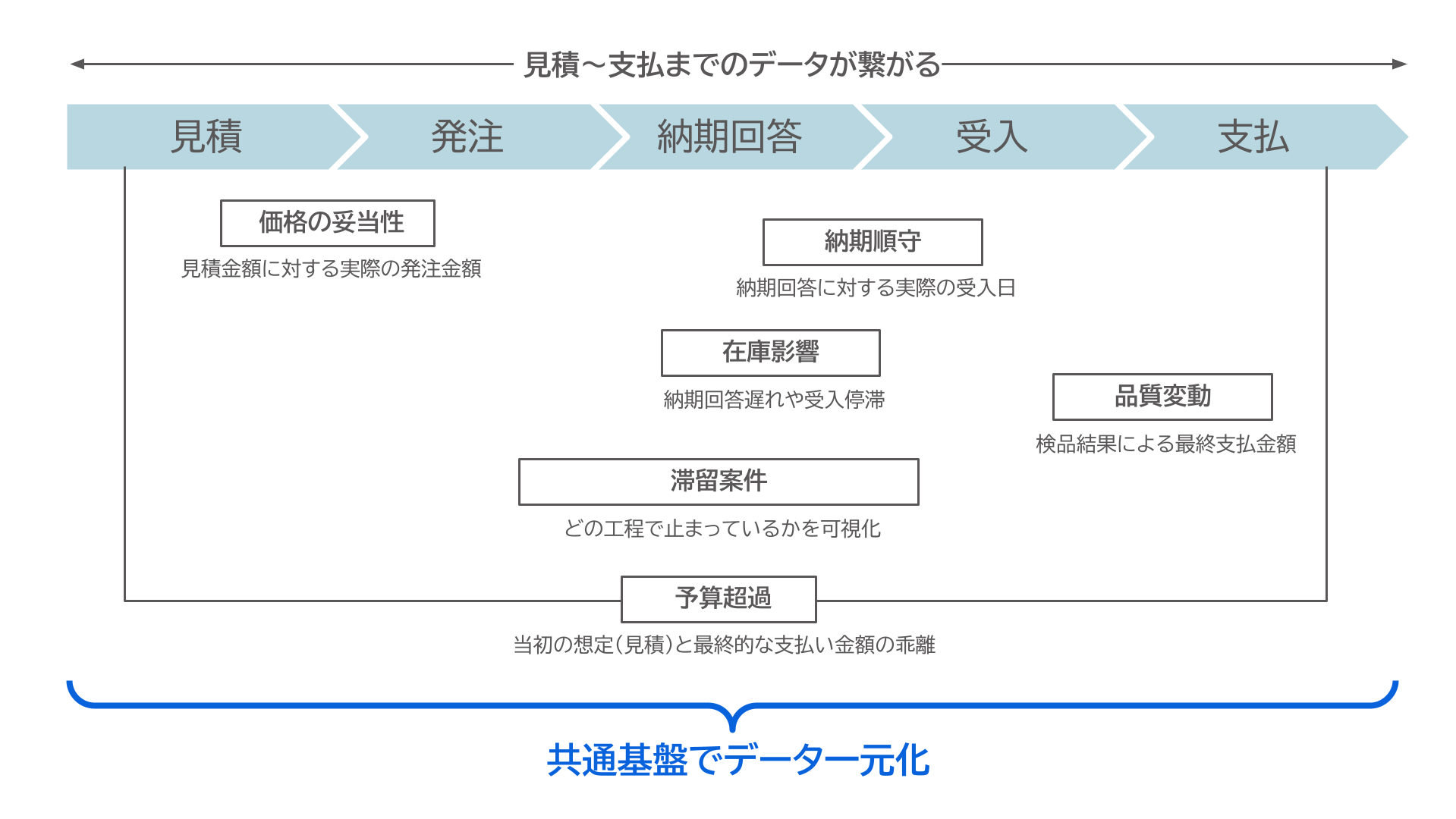
The starting point for resolving supplier management issues is to centralize the entire process from sourcing to purchasing. Instead of managing individual operations and information separately, it is important to create a state in which the entire transaction can be handled as connected data.
Centralization of data for strategic supplier management
The essence of centralization is to turn transactions into data assets that can be reused, rather than simply being a trail. If everything from quotation, order placement, delivery date response, acceptance, and payment is connected, it will be possible to view price appropriateness, delivery date compliance, quality fluctuations, backlogs, budget overruns, and inventory impact in the same flow.
With this common foundation, both improved selection accuracy and early identification of risks can be achieved for the first time. Furthermore, it leads to the realization of a procurement organization that does not belong to any particular department, and the larger the size of the company, the greater the effect.
6. summary: supplier management concerns can be resolved by accumulating and utilizing performance data
Anxiety in supplier management is not caused by a lack of information itself, but by "data fragmentation. If evaluation criteria can be established in a measurable form so that risks in finance, quality, delivery, compliance, and supply chain can be continuously tracked, and if data on actual transactions can be centrally managed as a prerequisite for this, both selection hesitations and delays in responding to risks can be reduced. The starting point for strategic procurement is not the superior intuition of individuals, but connected performance data.
HUE Purchase" for strategic supplier management
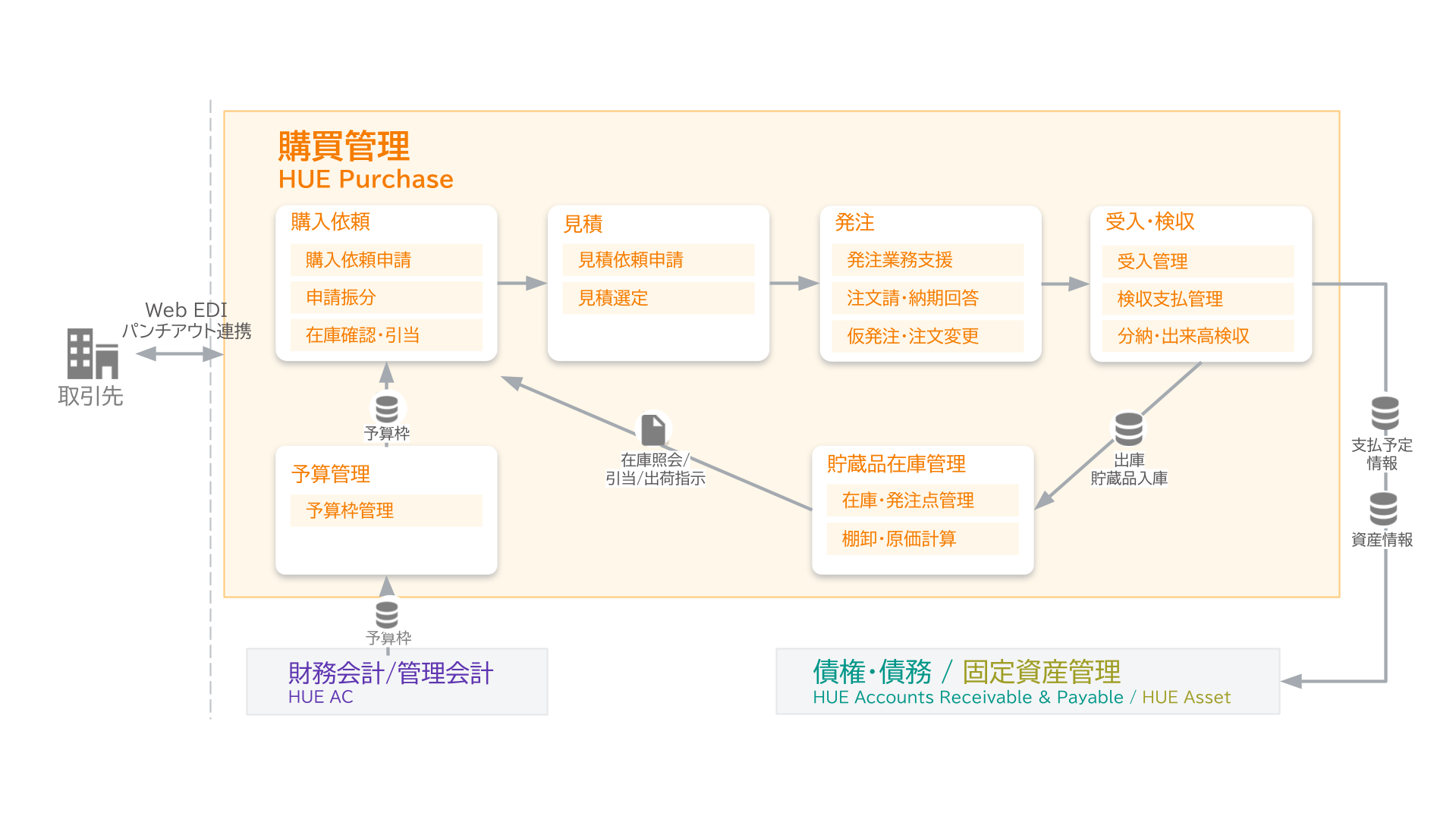
HUE Purchase is a purchasing management system for large companies that centralizes the purchasing process and supports sophistication from sourcing to purchase. It covers a wide range of operations and can collectively manage various data generated in the purchasing process. The system can manage not only the basic information of each supplier, but also the information accumulated during daily transactions, thus supporting the realization of strategic supplier management.
For more detailed information, please refer to the product pages below.
Related Useful Information
Web Articles
2026/04/09
Why does "Fit to Standard" fail? The Key to Avoiding Add-on Hell is ERP's "Acceptability
Web Articles
2026/03/30
What is AI that can really be used in the accounting field? What was important in HUE's "AI Application Review

Web Articles
February 24, 2026
What has changed from the Act against Delay in Payment of Subcontract Proceeds, Etc. to Subcontractors (Act against Delay in Payment of Subcontract Proceeds, Etc. to Subcontractors)? What has changed from the Act against Delay in Payment of Subcontract Proceeds, Etc. to Subcontractors?

Related Case Studies
Nankai Electric Railway x WAP talks about the "overwhelming return generated by 'add-on zero ERP'".
Nankai Electric Railway Co.

Nankai Electric Railway introduces HUE DI and upgrades HUE, Building a Management Foundation that Continues to Adapt to Change
Nankai Electric Railway Co.
Paperless and business reform one step at a time! Effects of HUE implementation and future prospects
Yanase Corporation
