
Accounting / Fixed Assets / Cash & Treasury Management / Purchasing / Digital Invoice
Nankai Electric Railway Co.
Nankai Electric Railway Builds Management Foundation to Continue to Adapt to Change by Introducing HUE Digital Invoice and Upgrading HUE
~Completing a Difficult Parallel Project and Achieving a Paperless System of Approximately 20,000 Papers~!

Since its establishment in 1885, Nankai Electric Railway Co., Ltd. has been a pioneer in privately owned railroads and has grown together with the local community with the railroad business at its core. The Nankai Group's enterprising spirit and corporate stance of developing a succession of progressive and topical businesses are unique to the company, and the company is working to enhance the value of its rail lines by leveraging these strengths.
In February 2025, the company introduced HUE Digital Invoice (HUE DI), a cloud-based invoice sending and receiving service, to accelerate DX promotion and build a management foundation that is resistant to change. In addition, the ERP package "HUE Classic Series (hereafter HUE Classic)," which had been used since 2015, was upgraded to "HUE AC Series (hereafter HUE)," and seven products were put into operation.
The seven products that went live this time are
HUE Digital Invoice, a cloud invoice sending/receiving service
HUE Financials & Strategy, a financial and management accounting system
HUE Accounts Payable/Receivable, a receivables/payables management system
Fixed Asset Management HUE Asset
HUE Treasury, a financial and cash management system
HUE Purchase, a purchase management system
HUE EBM, an electronic voucher data management service
In this article, we will discuss the background behind the introduction of HUE DI and the upgrade to HUE, the current state of utilization, and future prospects. This article introduces the background of the introduction of HUE DI and the upgrade to HUE, the current utilization status, and future prospects.
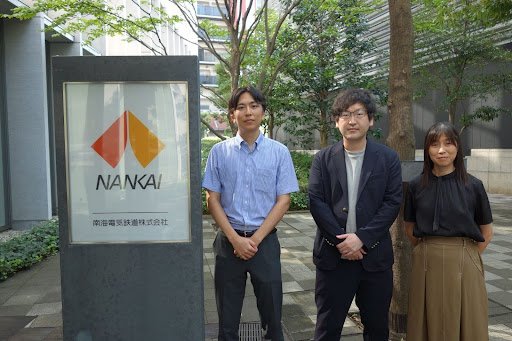
Interview participants:
Mr. Takashi Urata, Manager, Finance & Accounting Department, Nankai Electric Railway Co. and Nankai Management Service Co.
Mr. Takashi Urata, President (center photo)
Mr. Yuya Mizutani, Manager, Nankai Group Accounting Service Department, Nankai Management Service Co.
(left photo)
Mr. Kazumi Adachi (right photo)
Nankai System Solutions Co. Ms. Michiko Harada (Web)
Ms. Mayumi Nakamura (Web)
)
Background] Legal revision and DX Background: Building a foundation that is resilient to change in anticipation of legal reform and DX
-What was the background behind the introduction of HUE DI and the upgrade to HUE, having used HUE Classic since 2015?
Ms. Urata:
HUE Classic has been used without any problems since its introduction. However, nine years have passed since its introduction, and the environment surrounding accounting and finance has changed dramatically, including legal revisions and DX promotion. The environment surrounding accounting has changed drastically, with legal revisions and the promotion of DX. We also wanted to utilize the data accumulated in the system through HUE to improve the efficiency of voucher operations. During the consideration stage, we compared other companies' systems, but decided to upgrade to HUE because of its wide range of standard functions and excellent future expandability.
Mr. Mizutani:
In promoting a paperless system, we placed importance not only on the ability to attach files, but also on the ease of viewing the application and approval screens, the ease of checking work, and technologies such as AI-OCR. We were also attracted to the flexibility of HUE DI because it is a new service released in 2023.
Mr. Urata:
WAP's assurance that they would proceed with the modifications with a sense of speed was also a deciding factor in our final decision.
Mr. Mizutani:
We also took this opportunity to take on the new challenge of revamping our workflow and linking it with the group's shared services. WAP listened to us and provided not only suggestions but also opportunities for direct dialogue with the development staff, and the implementation went smoothly.
Background Introduction of HUE DI Key to Success Achieved on-time operation with flexible support.
-This was a challenging implementation project with seven products, please tell us about the project structure, how you proceeded, and any difficulties you encountered.
Mr. Mizutani:
As for the project structure, five people who had experienced the previous system implementation were again involved in the project and had a certain level of experience. The members were grouped by product and communicated on a group basis. The progress of each group was reconciled once a week at the level of responsibility, and overall progress sharing and reporting proceeded once a month.
Mr. Harada:
As we proceeded with the HUE DI implementation and HUE upgrade in parallel, some of the members said, "Since we have the opportunity, we would like to improve the current system," and the scope of consideration naturally expanded. Midway through the project, we decided that we would not be able to meet the schedule as it was, so we proceeded to place the highest priority on getting the system up and running first.
Mr. Nakamura:
As we proceeded with the project, issues emerged in the requirement definition and configuration stages, but we worked with WAP to strengthen the system and address each issue one by one. Especially in the latter half of the project, we communicated with each other on a daily basis to ensure that no gaps in understanding occurred.
Mr. Urata:
There was a time when we faced a schedule barrier, but we switched to a policy of clearly defining the required functional level and gradually revising it after the start of operations. I think the fact that we did not seek perfection at the time of implementation, but worked on the project in separate phases, led to the successful implementation by the deadline we set.
Effectiveness] HUE DI has made it possible to go paperless with approximately 20,000 invoices per year.
-Do you feel any changes or effects from the actual implementation of the system?
Mr. Mizutani:
This has led to the paperless processing of approximately 20,000 invoices per year. We have realized a certain level of effectiveness, as there is no longer a backlog of paperwork or paper binding. Since the vouchers can be searched within the electronic workflow, we no longer see the same situation as before, where the person in charge is in a hurry to find the voucher after receiving an inquiry.
Mr. Urata:
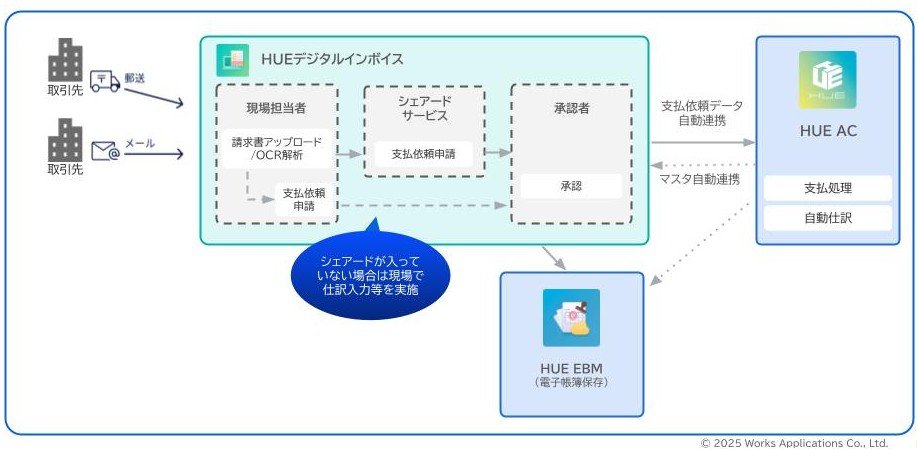
One of the most significant effects of the introduction of HUE DI is the combined operation of HUE DI and shared services. Until now, each department created their own vouchers, but this led to increased mishandling due to personnel turnover, and a lot of time was spent making corrections. This allows us to process the invoices more efficiently.
Mr. Mizutani:
The OCR input control function has also been very effective. The system detects input errors and omissions and alerts the user, reducing the burden of checking. In addition, the attached vouchers are easy for approvers to check, making the approval process smoother, which has been well received internally. In addition, the online processing of vouchers has enabled the shared services team to telework three days a week. This is thanks to the ability to have paper-based invoices uploaded electronically through HUE DI, whereas previously they had to receive them in person. We would like to take this opportunity to promote even more flexible work styles in the future.
Mr. Harada:
The upgrade to HUE has allowed us to integrate our accounting and purchasing management systems. Previously, each system had its own master registration system, but this is no longer necessary, leading to improved work efficiency and reduced man-hours. Immediately after the upgrade, there was a reorganization in April, and the process went so smoothly that two people could handle the work that was previously handled by four people. Previously, we had to work frantically for two full days during the accounting period to limit operations, but we were finally freed from that burden.
Future Prospects Aiming for a foundation that continues to evolve together with HUE
-What are your future prospects and requests?
Mr. Mizutani:
In light of the remarkable evolution of AI, we feel the need to actively utilize AI in accounting operations as well. Since it is still a hurdle to tackle AI utilization on our own from scratch, we hope that HUE will provide it as a standard feature in an easy-to-use form. I would like to take advantage of the evolution of HUE so that we can utilize new technologies onsite without missing a beat.
Mr. Urata:
With an eye on shared service promotion and Peppol support, we intend to continue to expand the scope of our use of HUE DI. The railroad industry handles a wide variety of industries, so it is an area where it is difficult to establish rules, such as different subjects for the same abstract. That is why we would like to expand the areas that can be automated in the future, while creating a system for efficient operations.
Message] Don't get caught up in the ideal form, but start with a steady step forward.
-Please give a message to companies that are facing similar issues or are considering implementing the system.
Mr. Urata:
Our ultimate goal is to fully automate journalizing by utilizing AI, but if we pursue too many ideals, we will not be able to take the first step. The more users utilize HUE, the more it will grow and evolve into something better. It would be a great honor for us if this happens, so please help us!
*This article is current as of August 2025
Related Case Studies
Nankai Electric Railway x WAP talks about the "overwhelming return generated by 'add-on zero ERP'".
Nankai Electric Railway Co.

Nankai Electric Railway introduces HUE DI and upgrades HUE, Building a Management Foundation that Continues to Adapt to Change
Nankai Electric Railway Co.
HUE" reduces the man-hours required to prepare for inventory significantly. HUE" reduces it to a few hours.
Huis Ten Bosch Corporation