
Web Articles AI utilization, business efficiency, etc.
2026/03/30
What is AI that can really be used in the accounting field? What was important in HUE's "AI Application Review
While expectations for the use of AI are growing, many in the accounting field are concerned about whether AI can really cope with complex internal rules and operations. This article discusses how HUE's AI functions. In this article, we will introduce the AI function of HUE, "AI Application Review," to show what AI is truly usable in the accounting field, and what we have valued in realizing it. 1.
Table of Contents
1. the "AI application review" function replaces the "eye" of accounting
HUE has been progressively incorporating AI functions as a standard feature, and in January 2026, will be offering a new AI function for expense reimbursement and payment requests, which is one of the most time-consuming processes in the accounting operations of major companies.Released "AI Application Review" to Support Various Application Checks The new version of the AI is designed to be more efficient and easier to use than the previous version.
What we have pursued in this update is not limited to rule-based checks, AI has entered the realm of qualitative judgments such as "Is this application valid?" AI has stepped into the realm of qualitative judgments such as "Is this application appropriate? The AI checks the attached receipts against the input and determines if there are any discrepancies in the items or if there is any missing information in accordance with company regulations. It even offers specific advice for improvement based on an "understanding of context," which was not possible with conventional rule-based systems. This allows applicants to make correct applications without hesitation, and relieves approvers of the psychological burden of questioning all items.
AI Master Automatic Entry] "Entry" support to reduce input errors and deficiencies.
Based on the information of the applicant and other items entered in the expense application form, this function automatically enters highly probable candidates for expense types and other master items, or suggests options.
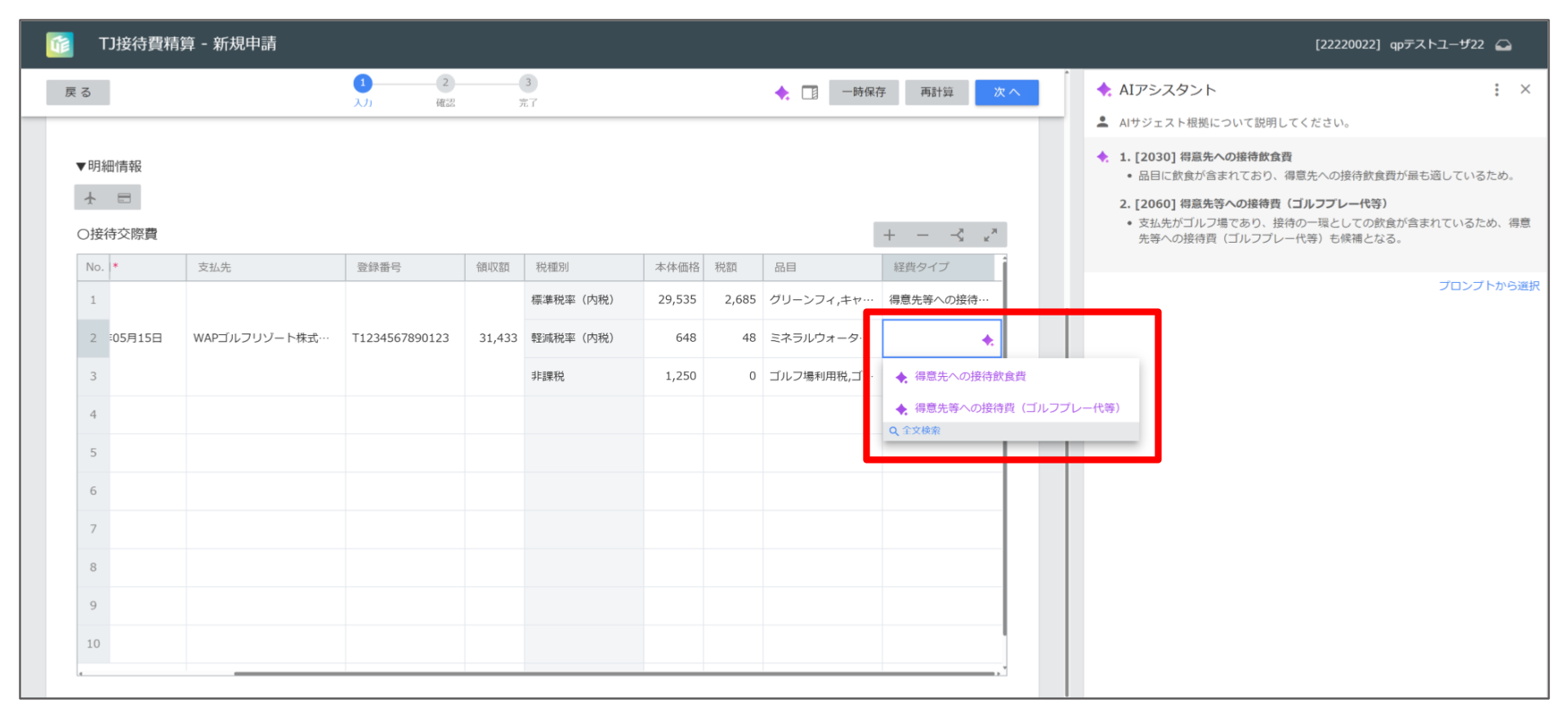
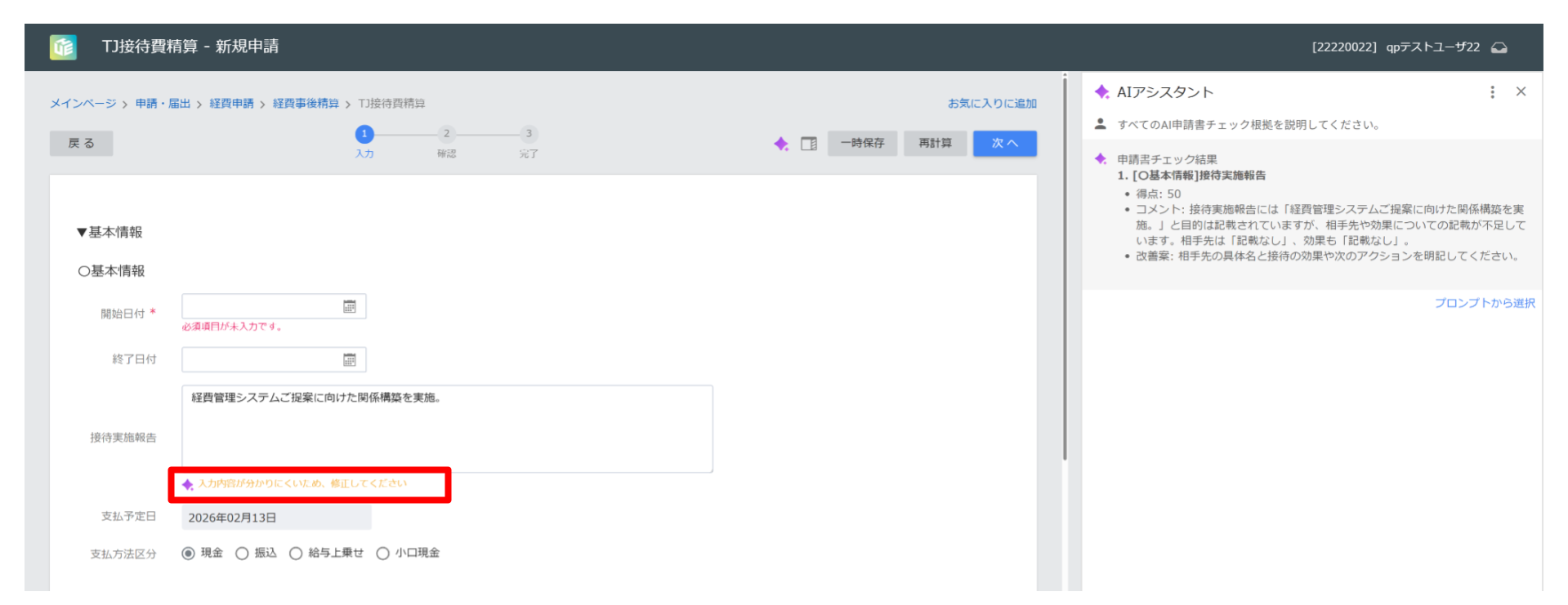
AI Application Check】 "Checking" support for detecting deficiencies and inconsistencies
This function checks the validity of an item by itself and its consistency with other items in the application form by reading the wording entered in the expense application form and the contents of attached receipts, and offers advice on how to improve the item.
Reference: HUE provides AI functionality to review accounting and finance applications (Press Release)
Can AI really be used in practice? -What we valued in the field of implementation
When introducing AI, many people may have concerns about whether it can really be used in practice. To address these concerns, we interviewed the developer of "AI Application Form Review" to find out what he thought about the product and his thoughts on its implementation.
Why do we need "AI" when we have existing system checks?
Conventional system checks are based on predetermined "rules," such as the presence or absence of blank spaces and the range of numerical values.
However, What really causes difficulties in practice are areas that involve "qualitative judgments" that cannot be fully defined by rules. is.
For example, rule-based checks could check whether or not each item "contains text," but could not determine the consistency of the correctness of its contents, and thus missed deficiencies.
HUE's AI function, therefore, provides a mechanism to perform "qualitative checks" by means of prompts.
Specifically, the AI compares the "attached receipts" and "inputted application details" to determine if there are any discrepancies in the items or if information is missing in light of company regulations.
AI supports "understanding of context," which people have been doing unconsciously. By doing so, it detects deficiencies that were previously missed, aiming to reduce the number of returned applications and improve the decision-making speed of the entire organization.
Why do we need "AI" when we have existing system checks? How can we make AI follow our own rules?
Since AI is based on general knowledge, it may miss rules that are unique to the company.
For example, even if the cost of a boxed lunch is generally considered a "food cost," in some cases a food manufacturer's purchase of prepared food at a supermarket is treated as a "research cost" for market research.
With conventional AI, it was difficult to make decisions tailored to such individual operations, and in the end, a person had to check all cases.
This is where HUE's AI functionality comes in, A system that allows each company to adjust "prompts," which are written instructions to AI to make it possible to make the same decision for each case.
Specifically, By having the prompts reflect the company's own regulations, it is possible to infer the "expense type" in accordance with the company's own operations from the store name and the wording of the abstract, and to directly educate the customer on the "company's rules" for this.
Instead of continuing to manually define a vast number of combinations, such as "food expenses for this store" and "meeting expenses for this wording," the company ensures practical accuracy by directly teaching "its own rules" through prompts.
Why do we need "AI" when we have existing system checks? How to control AI's "mistakes" and ensure governance?
AI is not a panacea, and sometimes there is a risk of "halucinations" (plausible lies).
That is why, We are committed to making sure that AI is not a black box and that it provides a basis for people to make the final decision. HUE's AI function is not a black box.
HUE's AI function automatically leaves a score determined by the AI and a "critique" that serves as the basis for the score as the approver's comment.
In conventional rule-based checks, the choice is "OK" or "NG," but the AI adds supplementary information such as "Risk is a concern for the reason of 00.
A person can look at this critique and decide, "This case is acceptable," and proceed with the process as is.
Visualization of AI's decision-making process, and keeping a "log" that allows people to hold the reins at all times, to achieve both high governance and a sense of trust in the field.The person is allowed to do so.
What kind of efficiency improvement can be expected by introducing AI?
It is not just a matter of automating numerical values such as "how many minutes of work can be saved, We focus on changing the actual operation of the case itself. The new version of the AI is designed to be more efficient and easier to use than the previous version.
Specifically, the AI first points out inconsistencies such as "inconsistencies with receipts" at the stage before the applicant submits the application.
By doing so, we aim to reduce unnecessary communication costs involved in sending applications back and forth, and to reduce the number of incomplete applications themselves.
And the greatest practical effect in the approval process, we believe, is to free the approver from the psychological burden of "doubting all applications.
By having the AI make a risk judgment with a "critique," the approver no longer needs to review all applications with the same degree of enthusiasm.
People will focus only on high-risk cases that the AI determines "need to be checked," while low-risk cases will be simplified for checking.
This By creating "checks with a high degree of accuracy", governance can be maintained and efficiency improvements that truly work in practice can be realized. is what we consider to be the best way to achieve this.
3. the vision of AI beyond "practical functions
In the development of HUE's AI, the emphasis is on "practical functions" that smoothly integrate technology while respecting the company's existing business operations.
In the first step, rather than demanding 100% accuracy from AI from the start, we dare to think of it as a "newly assigned new member," and believe it is important to first teach the company's own senses by having people check AI critiques in the "AI application review" process.
Then, as the next step, we are looking to provide "AI approvers" in July 2026, where the AI itself makes decisions and takes charge of practical operations. After the first step, when trust has been built up, the AI will gradually be entrusted with practical operations such as automatic approvals, HUE's concept of "AI as a new team member" is to cooperate with people without breaking the existing flow. This is the way of the future.
The next step is to confirm the reasons for the AI's judgment (critique), and then to "feed back" those reasons into the system's settings. By repeating this cycle, we will eventually expand the "areas where human confirmation is unnecessary," aiming to achieve true governance enhancement and efficiency.
About HUE AC
This is the accounting series of "HUE" that covers the high-level business requirements unique to major Japanese companies with standard functions.
By continuing to grow with the voices of its customers, HUE AC has been able to meet a wide range of business requirements regardless of industry or business category, and its reliability and high reputation are supported by its track record of being implemented by more than 2,400 companies.
The "AI Application Review" introduced this time and other AI technologies that match practical needs support further advancement of accounting operations.

Related Useful Information
Web Articles
2026/04/09
Why does "Fit to Standard" fail? The Key to Avoiding Add-on Hell is ERP's "Acceptability

White Paper
2026/03/30
New Lease Accounting Standards System Evaluation Checklist

White Paper
2026/02/06
The new lease accounting "business flow" design guide with sample flows.

Related Case Studies
Nankai Electric Railway x WAP talks about the "overwhelming return generated by 'add-on zero ERP'".
Nankai Electric Railway Co.

Nankai Electric Railway introduces HUE DI and upgrades HUE, Building a Management Foundation that Continues to Adapt to Change
Nankai Electric Railway Co.
Inventory preparation man-hours drastically reduced. HUE" in a few hours
Huis Ten Bosch Corporation