
ERP / Accounting / Fixed Assets / Cash & Finance / Expense Reimbursement
YANASE & CO.,LTD.
Paperless and business reform, one step at a time!
Effects of HUE Implementation and Future Prospects

YANASE & CO.,LTD. has been using HUE Classic series for many years. We interviewed them about the background of their new introduction of HUE Expense and HUE Accounts Payable and its effects.
Yanase's corporate philosophy is "To provide the highest quality products, services, and technology with gratitude, and to create a 'Life with Cars' full of dreams and excitement. Based on this corporate philosophy, we are developing our business based on the trust we have earned over our more than 100-year history and the deep relationships we have developed with our customers. Through its diverse businesses, including new and used car sales, after-sales service, finance and insurance, and mobility, the company provides high-quality experiences that are tailored to the needs of each individual customer, while flexibly responding to rapid changes in the automotive industry, such as the use of DX in the IoT society, to create further added value.
Products
・HUE Classic Financial Management
・HUE Classic Business Management
・HUE Classic Assets Management
・HUE Classic Cash Management
・Electronic
HUE Expence ("HUE EX")
・HUE Accounts Payable ("HUE AP")
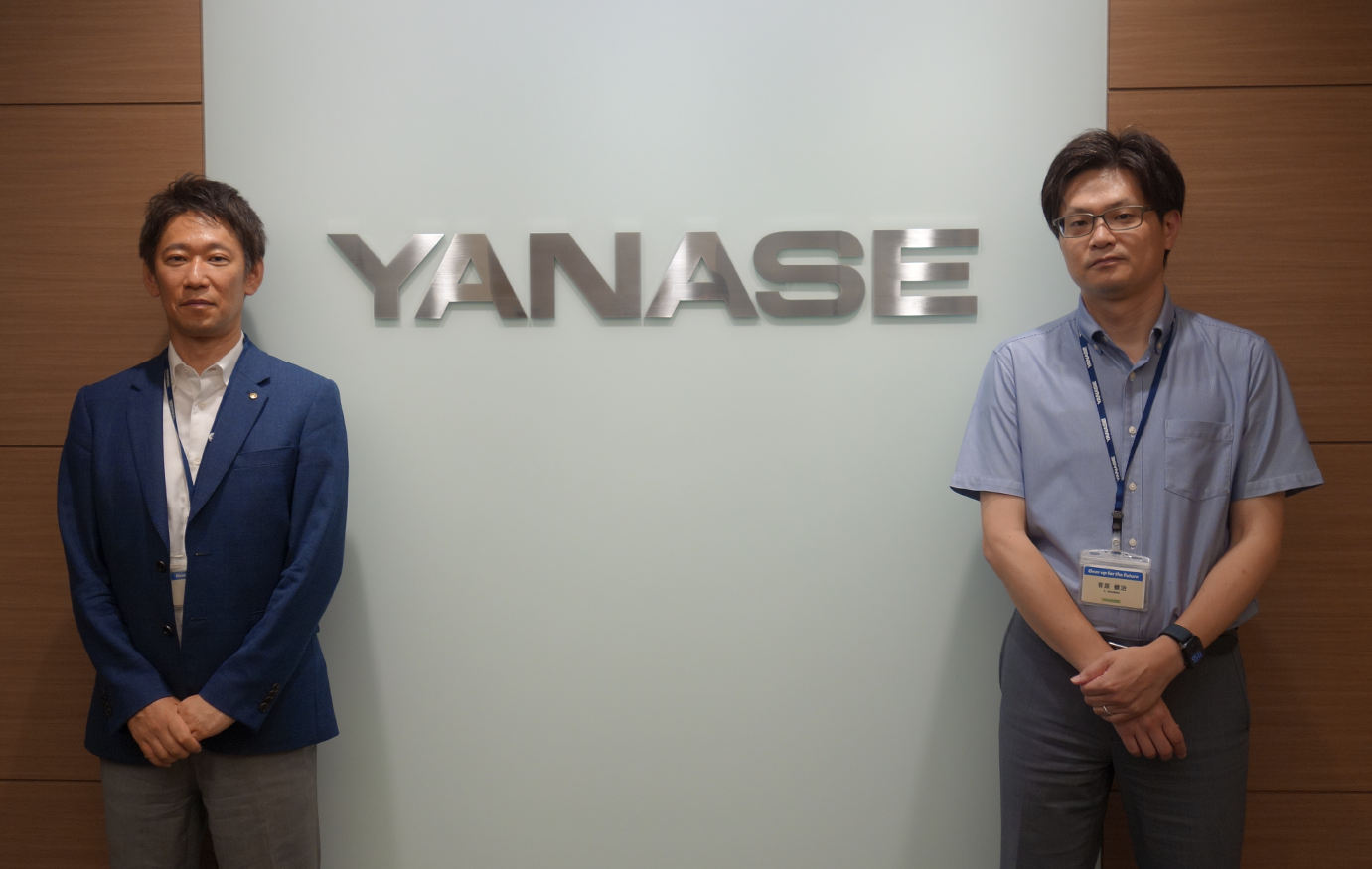
Interview participants:
From left: Mr. Yukinari Tamaki, Manager, Accounting Section, Accounting Department, YANASE & CO.,LTD. and Mr. Kenji Sugawara, Accounting Section, Accounting Department, YANASE & CO.,LTD.
[Background and motivation for introduction] [Effectiveness
-First of all, please tell us about the background and motivation behind the introduction of HUE EX/HUE AP.
Mr. Tamaki:
The biggest trigger was the revision of the Electronic Bookkeeping Act in 2022. The accounting department has long felt the need to go paperless, but we thought it would be difficult to proceed smoothly if we were to unilaterally impose it on the field. Another reason was to review the operation of reimbursement of sales personnel's replacement expenses. In the past, sales employees would give receipts to the accounting staff at each store, and the accounting staff would handle the rest. However, such an operation tended to make the work more personalized, and the workload was unevenly distributed among the accounting staff at each store. Therefore, we wanted to switch to a policy of "reimbursement of one's own expenses by oneself" and review the roles of each store's accounting staff so that they could devote their time to other tasks as well. This need to comply with the law and improve operational issues led to the decision to implement HUE EX and HUE AP.
Effectiveness
-Please tell us about the effect of introducing HUE EX/HUE AP.
Digitization of 90,000 receipts and 150,000 invoices, reducing on-site processing time
Mr. Sugawara:
In the past, sales employees submitted receipts in batches at the beginning of each month for expense reimbursement, and the store accountant pasted the receipts onto a paper application form and noted the details of the transaction. This was a large workload, as it sometimes took up to 30 minutes per application, depending on the person in charge. In addition, the need to remind the staff to submit receipts in case of omissions, to check the use of old receipts, and to communicate with them on a case-by-case basis was also time-consuming.
HUE EX eliminated the need to paste paper receipts on application forms, making it possible to go paperless for approximately 90,000 sheets per year. The company has also been able to reduce the number of paper-based receipts by 90,000 per year. In addition, the electronic system has also made it easier for us to level out our operations even during the busy season at the beginning of each month, as we can now submit, check, and circulate receipts and invoices electronically, which was previously done on a paper basis. Although it is not a complete early closing of accounts, I think it has improved our operational efficiency.
Mr. Tamaki:
At our company, the accounting department is responsible for final approval of expense reimbursements, so we had to send expense application forms to the head office by mail, which caused a time lag.
The introduction of HUE AP has also made it possible for us to go paperless for about 150,000 invoices per year, greatly improving the speed at which we process invoices.
Steadily achieved compliance with the Electronic Bookkeeping Act
Mr. Sugawara:
The completion of our response to the Electronic Bookkeeping Act on schedule was a great relief. There was a lot of pressure to be compliant because of the fixed date for compliance with the revision, but now that we have successfully met the requirements, the accounting department feels that we have reached a milestone.
In addition, we feel that the use of HUE EX mobile is effective as a means for sales staff to efficiently apply for expense reimbursement. However, I think it would be better if the UI were a little easier to use. Many of our employees are not very good at using smartphones. Since the devices provided are small, we currently operate on the basic principle of "use your smartphone only for taking pictures, and use your PC for inputting data," but there are a certain number of people who would like to complete everything on their smartphones. In particular, we feel that it would be more convenient if smartphones could handle just the approval process.
Future Prospects
-What operational issues or operational concerns do you have that you would like to further improve in the future?
Mr. Sugawara:
Because of the variety of ways to receive invoices, the scanning workload is significant, and improving the efficiency of the entire receiving process is an issue. We are aiming to move to a system that minimizes scanning work in the future. In addition, we still need to check the original invoice against the application data, and we would like to review our internal control system to make it possible to dispose of the original invoices.
While the approval process for invoices is becoming increasingly electronic, there are still some difficulties in processing invoices, and we are currently seeking ways to make the approval process smoother. We are also looking for ways to make the expense reimbursement process more efficient by reviewing the flow where the accounting department is responsible for final approval and making it a field-complete process.
Mr. Tamaki:
Our accounting department is very strict in checking expense reimbursement and invoices, and we spend a considerable amount of man-hours on it, but we feel that it is not necessarily correct to check everything exhaustively. In the future, we would like to shift to a role that supports management decision making by assigning a weighting of importance, for example, small amounts of replacement expenses can be handled on-site, and the accounting department can detect abnormal values from the processed data, and the man-hours freed up can be used for core operations. With limited manpower, I think the time has come to review the nature of the business itself.
-What are your future plans for the accounting department as a whole, not limited to the implementation project?
Mr. Sugawara:
We are currently paperless for receipts and invoices, but we would like to make the billing requests, request posting, and other processes used in HUE Classic paperless in the future as well. We are aiming to eventually complete all accounting operations in a paperless system.
Message】 【Message】 -Introduction, HUE EX/AP
-Please let us know if you have any message for companies that are looking to go paperless and reform their business operations.
Mr. Tamaki:
We are really glad that we introduced HUE. I think it was an effective first step to break away from the paper culture in the accounting department. We don't want to change everything at once, but rather to start small, starting with what we can do first, so that we can become aware of the actual operations onsite and the wasteful work being done.
Mr. Sugawara:
I think the purpose of introducing the system is not simply to digitize current operations, but to use it as an opportunity to review the operations themselves. If we think about it from the perspective of whether it is really necessary to continue with the current way of doing reimbursement and checking operations, I feel that it will not only improve efficiency, but also lead to stronger internal control and governance.
*This article is current as of July 2025.
Related Case Studies
Nankai Electric Railway x WAP talks about the "overwhelming return generated by 'add-on zero ERP'".
Nankai Electric Railway Co.

Nankai Electric Railway introduces HUE DI and upgrades HUE, Building a Management Foundation that Continues to Adapt to Change
Nankai Electric Railway Co.
HUE" reduces the man-hours required to prepare for inventory significantly. HUE" reduces it to a few hours.
Huis Ten Bosch Corporation