
Web Articles Legal revision, Business knowledge
February 24, 2026
What has changed from the Act against Delay in Payment of Subcontract Proceeds, Etc. to Subcontractors (Act against Delay in Payment of Subcontract Proceeds, Etc. to Subcontractors)? What has changed from the Act against Delay in Payment of Subcontract Proceeds, Etc. to Subcontractors?
On January 1, 2026, the Act on the Proper Treatment of Small and Medium-sized Entrusted Business Transactions (commonly known as the "Take-Appropriate Act") came into effect, amending the Act against Delay in Payment of Subcontract Proceeds, Etc. to Subcontractors. The practical rules have been changed to be more extensive and stricter. This article will focus on the major changes so that busy staff can grasp the whole picture in the shortest possible time.
Table of Contents
Overview: From the Act against Delay in Payment of Subcontract Proceeds, Etc. to Subcontractors (background and name change)
Why was it changed to "Torihiki Law"?
In addition to the recent sharp increases in raw material and energy prices, rising labor costs are putting pressure on corporate profits. However, if the ordering side (suppliers) is unable to pass on the cost increases to the price due to their weak position, wage increases and capital investment will stagnate, and the entire supply chain will be exhausted. The revision, which will take effect on January 1, 2026, will prevent such "unilateral price determination" and "refusal to discuss" so that appropriate price shifting will be promoted throughout the supply chain, The amendment is intended to promote appropriate transactions and price pass-on. The purpose of the revision is to prevent such "unilateral price fixing" and "refusal to discuss" and to promote appropriate price shifting throughout the supply chain.
Change in the name and terminology of the law
From the name of the law The term "subcontractor" has been eliminated and replaced with "small- and medium-sized contract transactions. The law has been revised. Also, The terminology used in practice has also been updated. It has been This redefines the business relationship as one of "equal partners" aiming for coexistence and co-prosperity, rather than a hierarchical relationship.
| Revision [Previous |
Amendment [After |
| Act against Delay in Payment of Subcontract Proceeds, Etc. to Subcontractors | Act on Prevention of Delay in Payment to Small and Medium-sized Entities Entrusted with Production Contracts, etc. |
| Commonly known as the Act against Delay in Payment of Subcontract Proceeds, Etc. to Subcontractors | (Commonly known as the "Takefu Law") |
| Parent company | Contracting business operators |
| Subcontractor | Small and medium-sized commissioned business operators |
| Subcontract proceeds | Payment for manufacturing consignment, etc. |
2. "Three major points of change" directly related to practice
Change 1: Expansion of types of "transactions" subject to the Act
As the subject of the transaction, The following two items were added
-
Addition of Category 5 "Specified Transportation Consignment
-
Manufacturing consignment of molds, jigs, etc. other than metal molds (wooden molds, jigs, etc.)" added to the scope of manufacturing consignment, etc.
The past regulatory targets (Subcontract Act)
4 types of transactions Manufacturing, Repair, and Information: Manufacturing, repair, information deliverables, and provision of services.
In the logistics field, consignments (including re-consignments) between transportation companies are mainly treated as "service provision consignments.
Subjects of future regulation (Law against Delay in Payment of Subcontract Proceeds, Etc. to Subcontractors)
5 types Manufacturing, Repair, and Information: Manufacturing, repair, information deliverables, and provision of services. "Specified transportation consignment
*Transactions in which an originating shipper (manufacturer, wholesaler, etc.) places an order directly with a transportation company are also subject to the regulation.
Manufacturing consignment of molds, jigs, etc. other than metal molds (wooden molds, jigs, etc.)" is added as an object of manufacturing consignment, etc.
Key Points
- In the field of logistics, a new In the field of logistics, the area of "shipper's direct orders" will be added to the scope of regulation. This will directly bring a scalpel to shipper-dominated business practices such as "long waits for cargo" and "off-contract cargo handling (loading and unloading)," which have become the norm in the logistics field.
- In the manufacturing field as well, the new system will not only negotiate the unit price of products, but will also directly address the issue of "jigs, molds, and wood" that have tended to remain unresolved in the past. In the field of manufacturing, the shipper is strongly required to pay appropriate compensation for the storage and maintenance costs of jigs, molds, and wooden molds, etc., which have tended to be ignored in the past. Refusal to comply with these demands, or unilateral cost-bearing, may fall under the prohibition of the Law.
Change 2: Expansion of criteria for "companies" subject to the law
-
New "employee standard" introduced.
Previous standard (Subcontract Act)
Judgment is based only on the "capitalization standard.
[Standards to be applied from now on (Exchange Control Law)] "Employee standards
In principle, the "capitalization standard" is used for judgment, and when the capitalization standard is not applied, judgment is made based on the "capitalization standard". Employee standards In principle, judgment is made based on the "capitalization standard.
Even if the capital is low, if the number of employees exceeds a certain number, the business is subject to the regulation (consignee).
What is "the number of employees regularly employed"?
The number of employees is determined based on "the number of people who are continuously employed by the company and are listed in the wage ledger (excluding directors, including part-time workers, etc.). The count will be made on a "corporate unit" basis, not on a group-wide basis.
Key Points
- Practitioners should pay particular attention to how the "number of employees" is interpreted. It is not merely the number of full-time employees, The "number of employees" is calculated based on the number of employees on the "wage ledger" who are actually continuously employed (part-time employees are not included). (Part-time employees are included, but temporary employees are not included in the "number of regular employees" of the client company, since the client company is the employer of the temporary staff.)
- For example, even if the capital is kept low through a holding company structure, etc., if the "number of employees regularly employed" exceeds the standard, the company can be classified as an outsourcing business operator. Even if the other party has a large amount of capital, if the number of employees meets the criteria, it will fall under the category of "small and medium-sized fiduciary business operator," which should be protected. It is necessary to properly manage and grasp information on suppliers, including not only capital but also the number of employees.
In the case of "manufacturing consignment," "repair consignment," "information deliverables creation consignment (programs)," "service provision consignment (transportation, warehousing, information processing)," and "specified transportation consignment
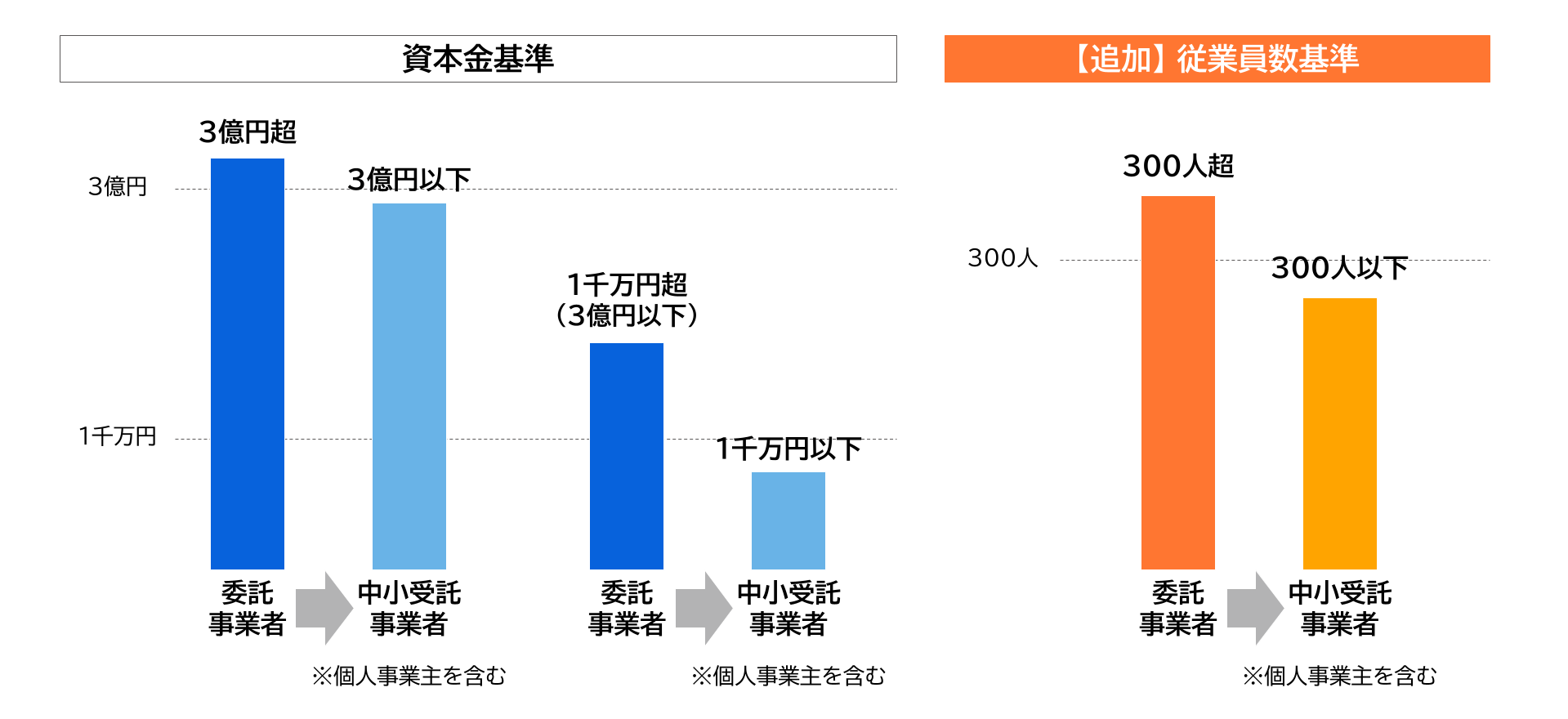
| Contracting business operators |
Small and medium-sized commissioned business operators Including sole proprietorships |
| Capital over 300 million yen | Capital less than 300 million yen |
| Capital over 10 million yen but less than 300 million yen | Capital of 10 million yen or less |
| More than 300 full-time employees | Less than 300 regular employees |
In the case of "information deliverables creation consignment" and "service provision consignment (excluding transportation, warehousing, and information processing)
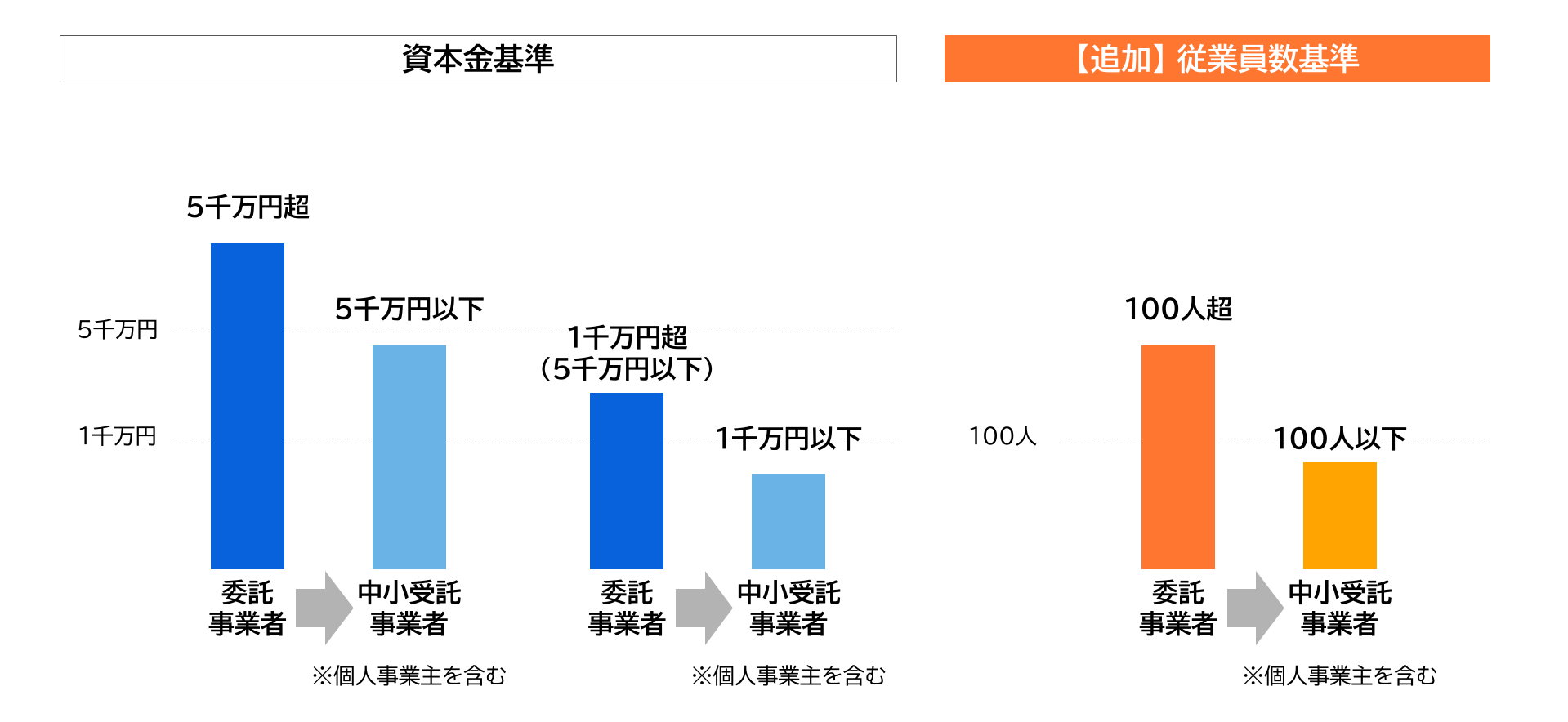
| Contracting business operators |
Small and medium-sized commissioned business operators Including sole proprietorships |
| Capital over 50 million yen | Capital 50 million yen or less |
| Capital exceeding 10 million yen but not exceeding 50 million yen | Capital of 10 million yen or less |
| More than 100 regular employees | Less than 100 regular employees |
Change 3: Addition of prohibitions on price negotiation and payment methods
The following two points have been added as prohibited acts.
- Unilateral price determination without consultation (response to price deferral transactions)
-
Prohibition of bill payment in principle (applicable to delayed payment)
| Item | Up to now (Act against Delay in Payment of Subcontract Proceeds, etc. to Subcontractors) | From now on (Exchange Control Law) |
| Price negotiation | There is no explicit provision that directly prohibits refusal of consultation itself, which could be a problem within the framework of "purchase and sale" etc. in the past. | Prohibition of unilateral determination of price without consultation. Prohibition of ignoring a request for consultations or leaving the price unchanged without explanation or rationale. |
| Means of payment | Bills that are difficult to be cashed before the due date could be a problem. | Payment by bill is prohibited as a means of payment. Electronically recorded receivables, factoring, etc., which make it difficult to obtain the full amount of payment (including fees, etc.) by the due date, are also prohibited as means of payment. In addition, it is also prohibited to make small and medium-sized fiduciary institutions bear bank transfer fees. |
Key Points
- The act of unilaterally determining the price on the consignment side without responding to the consultation despite the supplier's offer to negotiate the price is subject to the regulation.
- Since bill payments at long-term sites may be subject to guidance in practice as "notes that are difficult to discount, etc.," a shift to cash payments, electronically recorded credits, etc., and optimization of payment sites are strongly required.
Reference: Fair Trade Commission "Explanatory Meeting on Key Points of Amendment" materials
https://www.chusho.meti.go.jp/keiei/torihiki/2025/251014_01.pdf
Summary|Important Points in Practice
The revision expands the criteria for judgment to dynamic information such as "number of employees," and expands the types of transactions and business requirements to be covered, making it necessary to consider the applicability of the new rules to a wider range of transactions than in the past.
In addition, the number of items to be managed has greatly increased, including records of the price negotiation process and appropriate means of payment. It is not realistic to continue to check these items completely by hand. In the unlikely event of a violation, the Fair Trade Commission will issue a recommendation or public announcement, which may affect the company's credibility outside the company and its business relationships.
Thus, it is important in dealing with increasingly complex regulations, The compliance with laws and regulations is not to be left to individual efforts, but to be established as a "system" of the company. Specifically, it is essential to establish "digital governance" that leverages technology such as automatic linkage of trading partner information, automatic detection of payment sites, and digital recording of the negotiation process. This is the critical infrastructure of our time to protect organizations from unforeseen compliance risks.
Related Useful Information
Web Articles
2026/01/21
Explanation of the 2026 Tax Reform Proposal for Accounting and Finance - What will change from a practical perspective? What are the changes from a practical perspective?

White Paper
2025/09/18
Case Studies of Purchasing and Procurement Systems in the Manufacturing Industry

White Paper
10/21/2024
Purchasing Digitalization Case Studies

Related Case Studies
Nankai Electric Railway x WAP talks about the "overwhelming return generated by 'add-on zero ERP'".
Nankai Electric Railway Co.

Nankai Electric Railway introduces HUE DI and upgrades HUE, Building a Management Foundation that Continues to Adapt to Change
Nankai Electric Railway Co.
HUE Purchase supports 180,000 sheets paperless & invoice system
Kyokuyo Industries Corporation