Web Articles Advanced Business Management, Business Knowledge, Others
2026/04/09
Why does "Fit to Standard" fail? The Key to Avoiding Add-on Hell is ERP's "Acceptability
Why do so many projects hit the wall of add-on hell in achieving "Fit to Standard"? We will explain the "importance of information organization" and "ERP conditions," which are the turning points in this process.
Table of Contents
1. Ideal and reality of "Fit to Standard
In recent years, many companies have been aiming to utilize standard functions in their ERP revamps, but Cases in which a company is faced with a gap between its business and its actual operations once a project starts, and is forced to rely on a huge amount of add-ons and customizations in the end However, there is no end to the number of "problems" that occur. Many companies are troubled by this discrepancy between ideal and reality.
Why is the utilization of standard functions not progressing? One of the major reasons is "the structure that tries to absorb the data form the existing system as it is on the ERP side.
The conventional approach to ERP implementation has generally been to retain the existing data format as it is in the ERP without considering the original meaning of the data. This means trying to reproduce the controls and complements that have been in place in the existing system as they are in the add-on. However, this approach, which does not consider the ideal state of the system, is the root cause of add-on proliferation. If you try to reproduce the past without taking advantage of the package's original capabilities, the number of add-ons will continue to increase without limit, resulting in higher maintenance costs.
2. Importance of organizing information in accordance with your company's business reality
As a first step toward achieving ERP renewal without relying on add-ons, it is important to first organize data through MDM (master data management) and other initiatives. A process to organize the company's "business" and "data" is necessary.
Organizing data is not simply a matter of cleaning up the code; it is a matter of redefining the granularity at which your company's operations should be managed.
For example, in the past, information on categories, specifications, dimensions, etc. were forcibly crammed into a single "product code," and there were many cases where the code was overflowing with digits. Through the process of breaking down and organizing this information into independent attributes (items) such as "category," "specifications," and "dimensions," the business definition of "which unit of the product does the company want to identify and analyze" becomes clear for the first time. In the case of business partner management, instead of managing by a single name, the "business partner master" under the "corporate master" is hierarchically linked to the "business partner master" under which orders and payments actually occur, enabling both an understanding of the total amount of transactions (receivables and payables) for the entire company and detailed management of sales activities for each site.
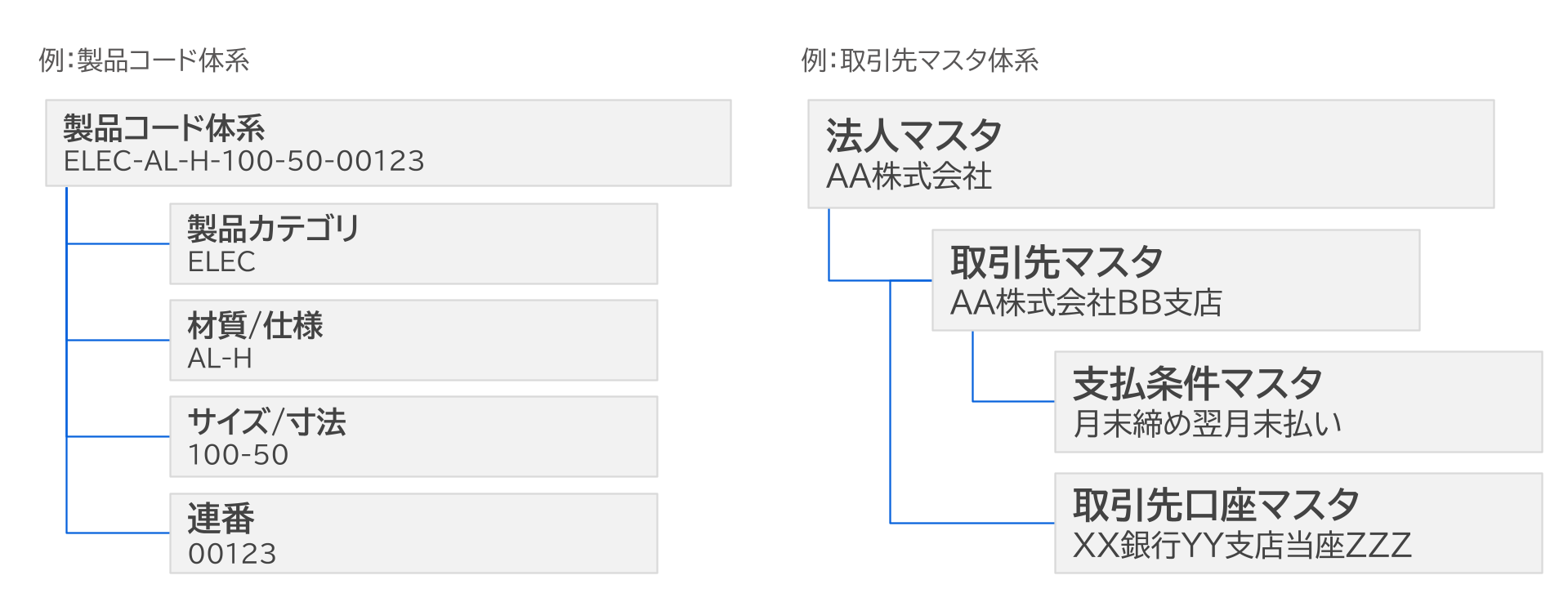
In this way, the process of unraveling disparate information into meaningful units leads directly to the visualization of the company's business processes.
The key to avoiding add-on hell is to be able to incorporate this organized information into the system as it is. If the company's ideal state, which has been defined with great effort, is reduced due to restrictions on the system side, add-ons will eventually be necessary to compensate for the shortfalls.
Archive distribution is underway.
ERP Tech Journal" reports on the latest technology trends for ERP renewal in Japanese companies.

3. 3 conditions of "ERP to migrate to" to avoid add-ons
When evaluating the ERP to be migrated, it is important to check the following three perspectives
3-1. "Boxes" that contain the necessary items must be available.
It must have a sufficient number of items to hold organized master items and flexibility in terms of number of digits, etc. Lack of generic spare items will eventually result in additional development (add-ons) to create "boxes".
3-2. Functions that correspond to the business meaning of the items
It is important not only to store the data, but also to understand how the items function within the business process. For example, for budget items, it is necessary not only to have the amount of money, but also to be able to reverse the budget in real time when placing orders or making purchases, and to alert the user when the amount exceeds the budget, thereby enabling "business governance" to take effect.
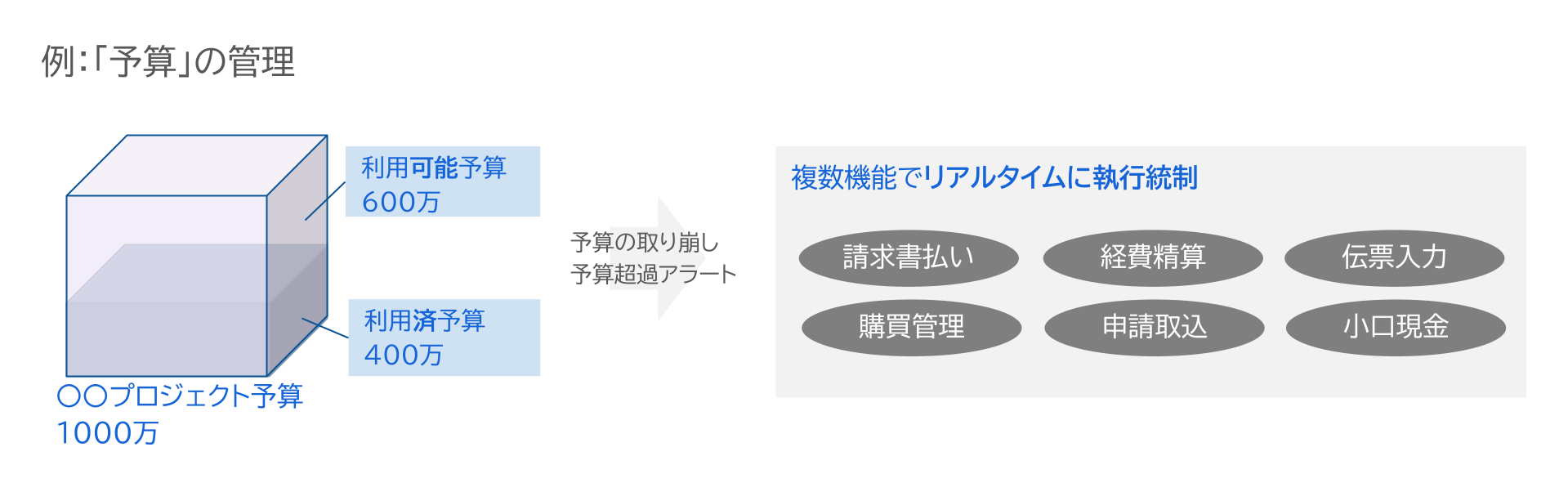
If the system does not allow such automatic control, such as automatic setting of payment dates according to payment conditions, a human being will end up having to visually check the data or create add-ons to compensate for the lack of such control.
3-3. Usability must be ensured.
Even if there is a data box and the system is equipped with business functions, if it is not easy to use, the field will not input accurate data. If it is not easy to enter and manage, the data will end up being managed outside the system and become a skeleton. It is essential to have a system that allows users to feel that there is meaning to their input and naturally collects accurate data, such as communication via in-system chat, immediate reference to manuals, and a system that allows drill-down analysis to be completed within the system, like BI.
If you choose an ERP that lacks the ability to serve as a "receptacle" for such data, you will end up in a negative spiral of add-ons in order to make use of the information that has been organized.
4. How "standard functions" should be optimized for the operations of Japanese companies
How to achieve "Fit to Standard" in ERP renewal? It is extremely important that the standard functions themselves are designed with deep consideration of the "business reality of Japanese companies.
There are decisive differences in business processes and business environments between Europe and the United States. For example, Japan's elaborate corporate tax system, complex business practices, and granularity of input based on the high level of education of on-site staff do not necessarily match the standard design philosophy of foreign ERPs.
The following elements are required for standard functions suitable for Japanese companies.
-
Comprehensiveness" and "Trackability" to Japan-specific requirements
The system must be comprehensive enough to handle Japanese business practices and tax laws without add-ons. For example, in the case of fixed asset management, the system must not only be able to perform depreciation calculations for financial accounting purposes, but also provide a variety of "information boxes," including information management that is in line with the Japanese corporate tax system and items related to physical asset management. The ability to respond quickly to changes in the law by updating the product itself, rather than developing individual products, will be the difference between maintaining "Fit to Standard" over the long term. -
Capability to respond to the precision of internal rules and controls
Internal application approval workflows and other control aspects are likely to require extremely precise responses compared to those overseas. Various requirements must be met, such as the maximum number of steps in the route, the ability to respond to requests such as "I want to add this person only this time," and the ease with which changes can be made in the event of organizational changes. Even if the functionality exists, there may be problems such as not being able to grant accounts to applicants due to the licensing system. I think it is important to confirm whether the functionality can be used in a practical manner. -
Response to Technological Trends.
While it is important to respond to "Japan-specific" issues, it does not mean that we do not need to take into account the technological advances that are being made internationally. In fact, as Japanese companies face an increasingly severe labor shortage, there is no time to spare to improve business productivity. While the stability of dead technologies is attractive, it is also important to consider whether the product is compatible with cloud infrastructure and whether it can improve efficiency by utilizing the latest technologies, such as generation AI.
In this way, a product that can respond to Japan-specific points and also respond to trends will be important in achieving "Fit to Standard" without difficulty.
ERP "HUE" for major companies
HUE," the cloud ERP for major companies provided by Works Applications, was developed by standardizing the business processes and business know-how of Japanese companies in all types of industries and business categories. This allows the product to continue to evolve without add-ons/customization for each individual company. It also continues to incorporate the latest technologies, including generative AI, as standard features to support further advancement of business operations.

Related Useful Information
Web Articles
Apr. 28, 2026
Supplier management starts with visualization of actual transactions. How to Eliminate Selection and Risk Concerns with Data

Web Articles
2026/03/30
What is AI that can really be used in the accounting field? What was important in HUE's "AI Application Review

Web Articles
2026/01/21
Explanation of the 2026 Tax Reform Proposal for Accounting and Finance - What will change from a practical perspective? What are the changes from a practical perspective?

Related Case Studies
Paperless and business reform one step at a time! Effects of HUE implementation and future prospects
Yanase Corporation

Reduced 1 million documents per year and realized a paperless office.
Kajima Corporation
Optimizing the entire ERP system with HUE's standard functions by moving away from customization
EXSOL Corporation