
Web Articles Electronic Bookkeeping
2020/12/25
Is it possible to go paperless under the Electronic Bookkeeping Act? Thorough explanation of the effects of compliance on expense reimbursement operations!
Due to the recent deregulation and revision of the law, there is a growing interest in companies going paperless in accordance with the Electronic Bookkeeping Act. In many cases, the mission of the accounting and systems departments is to "go paperless" and comply with the Electronic Bookkeeping Act, especially in conjunction with the timing of system renewal.
However, can we really eliminate "paper" by complying with the Electronic Bookkeeping Act?
In this article, we will take expense reimbursement operations as an example, organize operations when complying with the Electronic Bookkeeping Act, and explain the actual situation and benefits of going paperless.

Table of Contents
What is the Electronic Bookkeeping Act? Review of the contents of the law
The Electronic Bookkeeping Act is a law that allows national tax-related books and documents to be stored as electronic data (electromagnetic records) rather than in paper form. The scanner preservation system stipulated in Article 4.3 allows national tax-related documents prepared and received on paper to be digitized with a scanner or mobile camera and stored in electronic file format.
For example, in the case of expense reimbursement operations, electronic data of receipts as vouchers can be handled as originals. This will reduce the need to save paper copies of original receipts, and for transactions settled electronically, it will be possible to use the electronic payment record as the basis for the transaction.
Is it possible to go paperless by complying with the Electronic Bookkeeping Act?
So, can we achieve paperless transactions by complying with the Electronic Bookkeeping Law?
The following explanation is divided into two patterns: 1) Cases where receipts can be received in electronic form and 2) Cases where receipts cannot be received in electronic form.
1) Cases where receipts can be received in electronic form
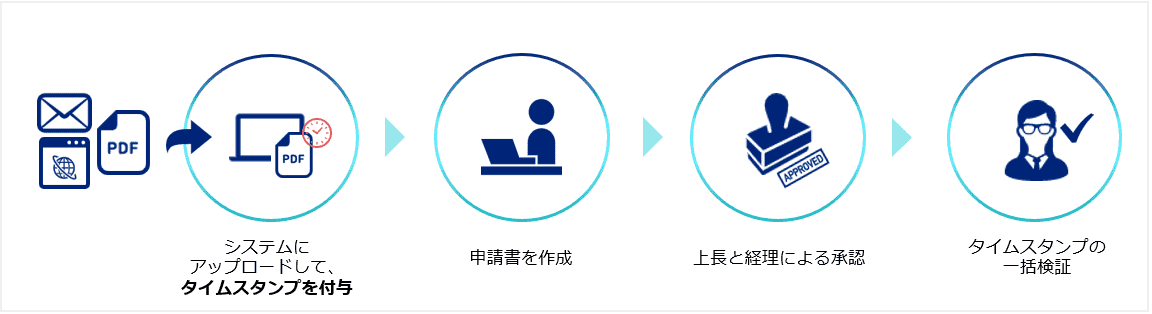
When receipts are received in electronic format (e.g. PDF), the data is uploaded to the system and used as the basis for expense reimbursement applications and approvals.
In this case, only the data needs to be attached to the application and approval for expense reimbursement, and the original document is also digitized from the beginning, Paperless operation can be realized throughout the entire business.
The same operation is also possible when cashless payment is used by using the payment data.
(2) Cases where receipts cannot be received in electronic data
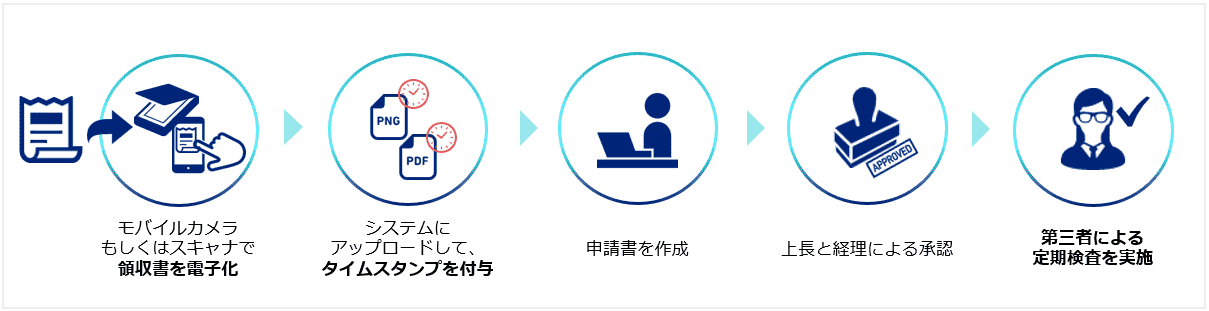
If receipts are received in paper form, they must be converted to electronic data using a mobile camera or scanner, etc., and then uploaded to the system. By meeting the requirements for scanner preservation under the Electronic Bookkeeping Act (i.e., meeting the requirements for pixel count and resolution, etc., and providing a time stamp), the original document will be allowed to be destroyed.
However, there is a pitfall here,Since original paper receipts cannot be immediately destroyed, paper storage costs remain. This is because the destruction of originals is only allowed once a year or more. After periodic inspections are conducted by a third party. The reason is that the destruction of originals is limited to
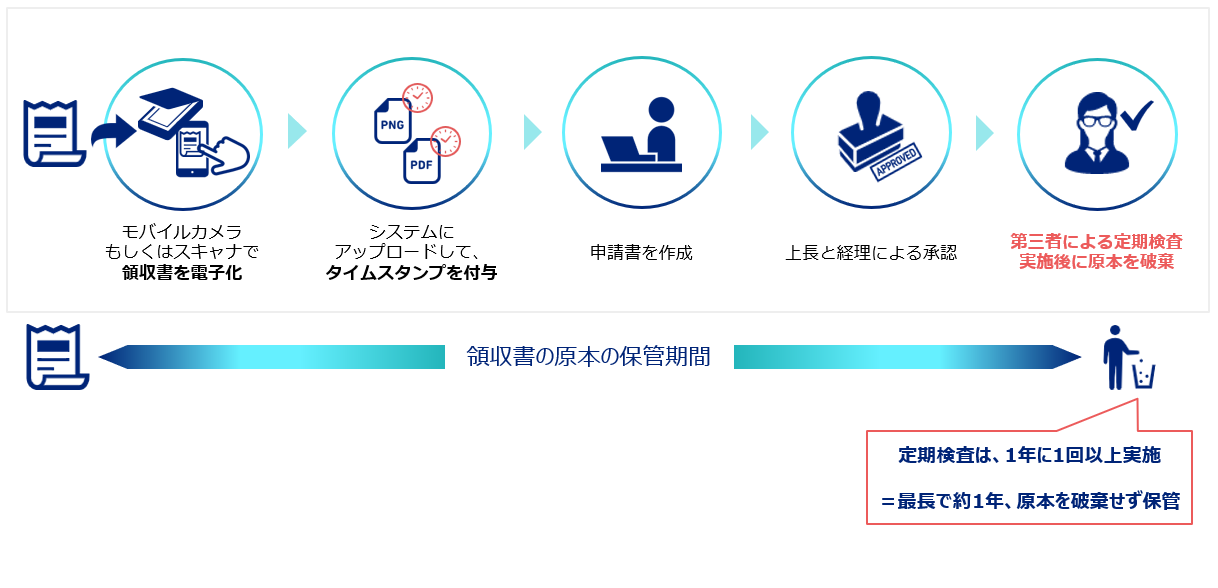
In other words, in the current situation Even when complying with the Electronic Bookkeeping Act, paper receipts must be kept until periodic inspections are conducted, and a completely paperless system cannot be achieved.
Effects of going paperless in expense reimbursement operations by complying with the Electronic Bookkeeping Act
Thus, at present, the Electronic Bookkeeping Act still leaves some issues to be solved in order to fully realize the paperless system. However, the 2021 tax reform is expected to include the perspective of "making it easier to destroy documents," which is expected to lower the hurdle for compliance with the Electronic Bookkeeping Act. It is said that this will be a great tailwind for many companies aiming to realize new business forms and paperless systems in response to the Corona Disaster. A general outline has also been announced, which we will introduce in another article.
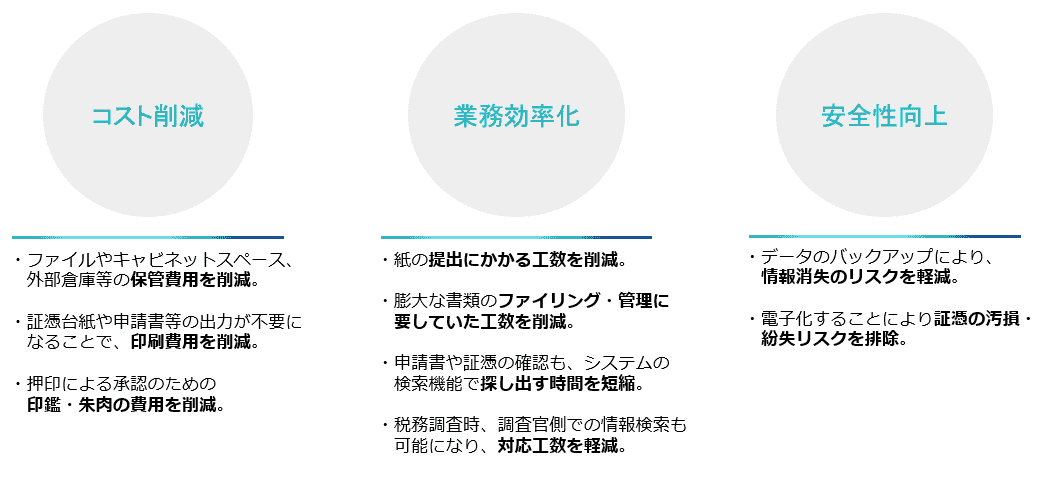
The following effects are expected if the electronic storage of vouchers is promoted, and there are high expectations that many companies will be able to benefit from the revised law.
What is the system that can realize compliance with the Electronic Bookkeeping Act? JIIMA Certification" is a landmark
As mentioned above, the Electronic Bookkeeping Act still has challenges to overcome in order to fully realize the paperless system. However, the legal system is gradually changing, and it is possible to quickly realize business improvement by using a system that is compatible with the system.
One criterion for selecting a system that complies with the Electronic Bookkeeping Act is whether or not it is "JIIMA certified. JIIMA (Japan Institute of Information Management for Industry) has established the "Certification System for Legal Requirements of Scanner Storage Software under the Electronic Bookkeeping Act" and certified products are endorsed as "compliant with the legal requirements required by the Electronic Bookkeeping Act. Certification is indicated by the logo mark below.
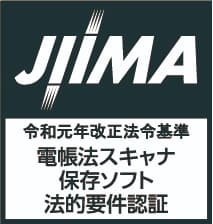
The following logo is provided by us Expense reimbursement system "HUE Expense is an electronic management tool for vouchers, which has also acquired JIIMA certification. Electronic Book Maintenance By seamlessly interfacing with the "Electronic Bookkeeping Act" and the "Electronic Reimbursement System", we are able to comply with the Electronic Bookkeeping Act and achieve paperless expense reimbursement operations.
The system enables smooth uploading of vouchers from the expense reimbursement screen, as well as automatic checks to ensure that the requirements of the Electronic Bookkeeping Act are met.
If you are considering compliance with the Electronic Bookkeeping Act, please contact us.


For product inquiries, please contact us at
HERE
Related Useful Information
Web Articles
2026/01/21
Explanation of the 2026 Tax Reform Proposal for Accounting and Finance - What will change from a practical perspective? What are the changes from a practical perspective?

Web Articles
2025/08/01
Behind-the-scenes of the implementation of generative AI functionality in ERP "HUE" for major companies

White Paper
2025/07/24
Introduction to the "Entire Base Establishment Accompaniment Service
Related Case Studies
Paperless and business reform one step at a time! Effects of HUE implementation and future prospects
Yanase Corporation

Reduced 1 million documents per year and realized a paperless office.
Kajima Corporation
Optimizing the entire ERP system with HUE's standard functions by moving away from customization
EXSOL Corporation