
Web Articles AI Application, Others
2025/08/01
Behind-the-scenes of the implementation of generative AI functionality in ERP "HUE" for major companies
In July 2025, we officially released a new function that utilizes generative AI in the business functions of HUE, our ERP for major companies. In this article, the engineer who developed the generative AI function himself will introduce the path from conception to implementation and the behind-the-scenes process.

Table of Contents
How did we start thinking about developing a generative AI function?
We are pleased to announce the release of HUE AssetHUE Asset HUE Asset", HUE's asset management module. My name is Yamamoto, and I was in charge of the development.
I am in charge of developing and maintaining the "Fixed Asset Management" function of HUE Asset.
I usually develop additional functions, fix bugs, and investigate customer inquiries as a person in charge of fixed asset management functions.
The trigger that made me think of incorporating a generative AI function into our product was the release of GPTs by OpenAI at the end of 2023.
GPTs is a function that allows you to customize ChatGPT to your liking, such as loading a file into ChatGPT as knowledge or pre-configuring how to answer a question.
I started thinking, "Couldn't this work well for HUE Asset?" This was the trigger for the development of the Generate AI function.
The first idea "Asset Validator
The first function that came to mind that uses generative AI was the "Asset Validator" function that utilizes GPTs.
HUE Asset implements a function to check if the input contents are correct when registering information on fixed assets.
Therefore, we conceived of a system in which the input check rules for "fixed asset registration" are loaded as knowledge in GPTs in advance. We thought it would be easy to create custom checks using the asset information to be registered and the knowledge rules.
At first, we thought this would be a revolutionary feature, because if it could be realized, various checks could be added at almost zero cost of developing logic for each check. However, as we proceeded with the verification using GPTs, we realized that it would be quite a hurdle to realize it using generative AI.
In fact, even within the company, there were opinions such as, "The check function is useless unless the accuracy is 100%," and "Wouldn't users be happier if we enhanced the function using normal logic?" We decided to abandon the development of the "Asset Validator" because we felt that it was impossible to create a function that could withstand actual operation.
What is Generative AI good at?
Although we had given up on the project, we continued to think that there must be more that can be done with generative AI.
So, when I reconsidered the question, "What is it that generative AI is good at?" We arrived at the "proposal-based" approach.
If the AI suggests values to be entered or changed next according to the values entered in the fixed asset registration, 100% accuracy is not always required. Even if the AI only suggests hints in situations where the user is not sure about the input, it is still valuable enough for the user.
The proposal we put together using this proposal-based approach was highly evaluated within the company, and its practicality and ease of implementation were recognized, leading us to actually start development.
Start of Generative AI Function Development!
Before starting development, we first considered what we wanted the AI to propose.
The fixed asset registration function is a prerequisite for accounting processes such as depreciation cost calculation, journal entry preparation, and tax reporting, so there is a very wide range of input items. Since it would be impractical to handle all of them at once, we decided to have the client make proposals focusing first on the major items that would be most effective.
The first target we chose was Fixed Asset Classification Master The first target we chose was the "Accounting and Tax Information Master". This master is an important input item that complements accounting and tax information, and is designed so that even users unfamiliar with input can easily register the necessary information by simply selecting a code. Since all users are required to use this field, we thought it would be a great improvement in convenience if we could offer suggestions for input.
For these reasons, we first need to develop the following functions Fixed Asset Classification Master Selection Suggestion Function We focused on developing a function to present candidate selections for the fixed asset classification master.
Breakthrough from a setback
Now that "what to propose" has been decided, the next step is to decide "how to propose.How to propose? We then considered "how to propose".
At first, we considered a method of learning existing asset information and suggesting input values based on trends. However, WAP's policy regarding the implementation of generative AI functionality was not to use pre-learning on the Azure OpenAI Service side for security reasons. Therefore, we considered the idea of passing asset information at every prompt, but the amount of data would be enormous and not suitable for actual operation.
We then changed our mindset and organized the thought process of how users actually input the information.
- If the input value is not known, select the asset by guessing from the name of the fixed asset classification.
- Search for past assets and refer to similar assets.
Based on the hints we obtained from this organization, we devised a system that combines the following two elements.
-
Compare the name of the asset with the name in the fixed asset classification master and present a candidate that is close in meaning
-
Display reference information (similar assets, etc.) for judgment at the same time
By combining the two, it is expected that suggestions will be made in a form close to the way the user thinks when he/she inputs the information. Furthermore, we designed the system to leave room for the user to make a choice by selecting multiple values to be proposed by the generated AI.
The following is an actual screen that achieves this.
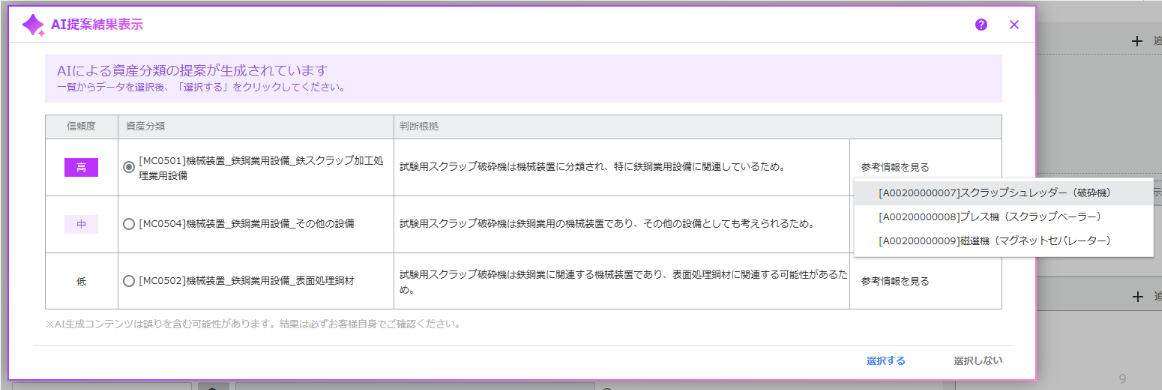
Based on the asset information entered by the user, the generated AI suggests multiple candidates for classification. The screen displays the rationale for each candidate and reference information for similar assets, allowing the user to select the most appropriate one.
By organizing the actual workflow, we were able to go beyond the mere use of the generated AI and realize ease of use that is in line with practical operations.
Conclusion: AI is only effective when it understands the business
Finally, through the development of the generative AI " Even if technology evolves, no practical functionality can be created without an understanding of business operations. Finally, through the development of generative AI, we realized once again that "even if technology evolves, practical functions cannot be created without understanding of business operations.
In incorporating generative AI into HUE for the first time, we are proceeding with development, placing the highest priority on practicality in line with business operations.
We hope to further develop this function into a valuable feature through actual use by our users. We welcome your comments and requests.
Related Useful Information
Web Articles
2026/01/21
Explanation of the 2026 Tax Reform Proposal for Accounting and Finance - What will change from a practical perspective? What are the changes from a practical perspective?

White Paper
2025/07/24
Introduction to the "Entire Base Establishment Accompaniment Service

Web Articles
2025/01/20
Trend Words from an Accounting and Finance Perspective - Part 4: "Accounting and Finance x Automation

Related Case Studies
Paperless and business reform one step at a time! Effects of HUE implementation and future prospects
Yanase Corporation

Reduced 1 million documents per year and realized a paperless office.
Kajima Corporation

Optimizing the entire ERP system with HUE's standard functions by moving away from customization
EXSOL Corporation