
Web Articles Business Knowledge, Business Efficiency
2026/05/22
Recommendations for Development Purchasing|How to create a "system" that eliminates rework and reworked quotations
Redoing estimates each time they are made, and making costs unreadable each time design changes are made - these issues are common to many companies. The concept of "development purchasing" can help solve these problems. In this article, we will explain the "development purchasing" approach, from understanding the basics of the concept to points to keep in mind when introducing it into practice.
Table of Contents
1. What is development purchasing?
Many of you may have heard the term "development purchasing," but may not have a clear idea of what exactly it entails.
What is development purchasing? Developmental purchasing is "an approach in which the purchasing department is involved from the early stages of design and development to optimize cost, quality, and supply. refers to the process of purchasing and developing products and services. This is not simply a matter of expanding the scope of procurement operations, but is intended to prevent rework and cost increases in later processes by being involved from the stage of examining product and service specifications. Therefore, this is an indispensable approach, especially in the manufacturing industry, where product strength and cost competitiveness are directly linked. This is an indispensable approach in the manufacturing industry This is especially true in the manufacturing industry, where product competitiveness and cost competitiveness are directly linked.
In order to understand this concept, it is easier to understand the difference from conventional purchasing.
What is the difference from conventional purchasing?
In conventional purchasing, procurement basically starts after the design is finalized. The design department determines the specifications and parts configuration, and the purchasing department obtains quotations based on those specifications and parts configurations, and then selects the supplier. In this case, the purchasing department is responsible for "how to procure what has been decided.
On the other hand, in development purchasing, the purchasing department is involved from the stage before the design is finalized. For example, at the stage of parts selection and specification study, the purchasing department makes decisions together with the design department, taking into account such aspects as procurement feasibility, price level, and supply risk.
This difference becomes clearer when viewed as a work flow.
- Conventional purchasing: Finalize design → Obtain quotation → Check cost and delivery date → Send back quotation if necessary
- Development purchasing: Design review stage → Reflect procurement viewpoint → Confirm quotations and conditions in parallel with design
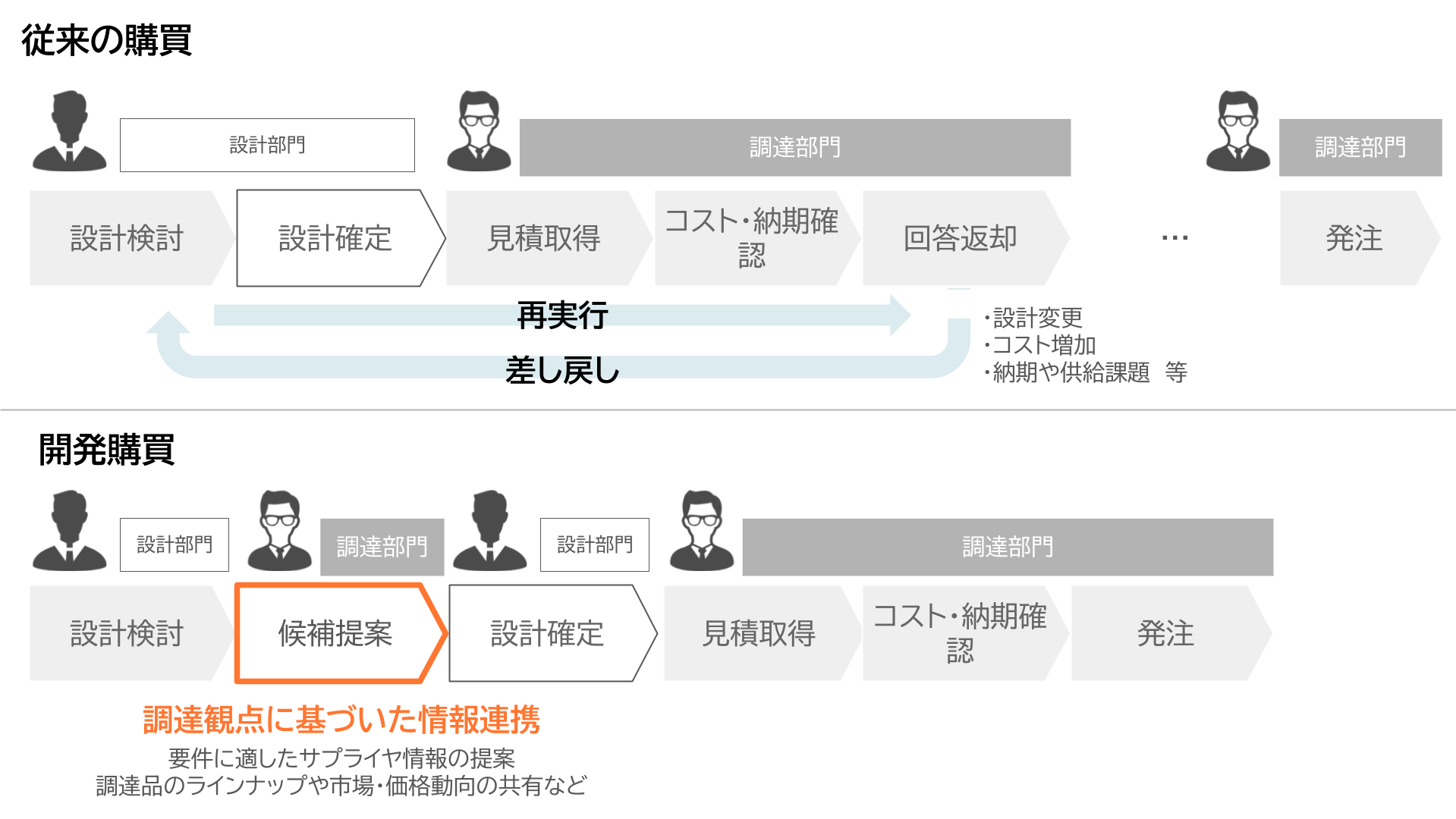
In other words, Whereas conventional purchasing is "optimized in the back-end process, Development purchasing is an "upstream optimization" approach. is
This difference significantly changes the burden of adjustment and the frequency of rework in the back-end process. Development purchasing is a way of thinking that not only expands the role of the procurement department, but also rethinks the way work itself is performed.
2. Why development purchasing is necessary
Procurement departments are swamped by rework and reworked quotations
In actual procurement work, it is not uncommon to face the following situations.
- A design change is made after obtaining a quotation, and the quotation is re-estimated.
- Delivery date or supply problems are discovered just before procurement.
- Every time the conditions change, the procurement details and ordering party are re-examined.
The accumulation of such interactions can lead to the following problems Procurement departments are pressed to coordinate and rework more than the original "procurement" work. For example, a quotation for a certain component configuration may be changed to a different one.
For example, if a specification change occurs after obtaining a quotation for a certain component configuration, the assumptions for that quotation change. As a result, not only re-quotation but also re-selection of suppliers and reconfirmation of delivery dates become necessary. Furthermore, if other constraints are found in the process, it will be necessary to go back to the design stage again.
This repetitive process of "design change → re-quotation → readjustment of procurement conditions → delay in order placement" puts the procurement department in a state where it is constantly asked to follow-up. The time that would normally be spent on future-oriented initiatives such as examining procurement strategies and finding new suppliers is instead spent on immediate adjustments and rework, making it difficult to have the time to improve the quality of operations.
Development purchasing is the solution to the "fragmentation" that causes these problems.
The reason behind this problem is not so much the departments in charge of specific tasks such as design or procurement, or the way they are carried out, but rather the fact that design, estimating, and purchasing tasks are carried out independently of each other, which makes it difficult to improve the quality of the work, A "fragmented structure" in which information from front-end and back-end processes is not utilized. in the field.
In many workplaces,
- Designs are reviewed in the design department.
- Quotations are exchanged with suppliers on a case-by-case basis
- Costs are revealed only after quotations are obtained
and each process proceeds independently.
This makes it difficult to know in advance how changes in one process will affect other processes. As a result, problems become apparent in later processes, resulting in adjustments and rework.
It is important to note that these problems are not caused simply by a "lack of coordination" among the various departments. Since operations are not designed on the premise that information is connected in the first place, there is a limit to what can be done to improve individual operations.
To this structure, Development purchasing" is an approach that incorporates the perspective of procurement operations from the design stage and utilizes information in operations. Development Purchasing The purpose of the management is to manage the monthly rent of the property. Instead of proceeding with design and procurement as separate processes, the two can be examined as an integrated process from the upstream, making it possible to change the process to one that is less likely to cause rework or reestablish estimates. In order to do so, these Establish a "mechanism" to realize the linkage of operations This is important.
3. How to make development purchasing successful
How can we establish a "mechanism"?
What is important in realizing development purchasing is that it is not enough to think that the procurement department should be involved in the upstream process. In actual practice, the fragmentation of business processes and information creates a situation in which it is impossible to get involved even if one wants to.
Therefore, in order for development and purchasing to function, it is essential to develop a "structure" that links operations based on cooperation between departments. Here, we will summarize the typical points required for this purpose.
(1) Accumulate information on estimation and selection, and make it reusable.
In development purchasing, it is required to support decision-making at the design stage while utilizing past procurement results and quotation information. In reality, however, there are many cases where quotation and supplier selection information is dispersed in personal Excel files or e-mails, and cannot be reused by the organization.
What is important is not only the quotation results, but also "what was the specific breakdown of the quotation and the conditions of the offer," "what points were important in selecting the supplier," etc. (2) Accumulate information including detailed information and decision-making process This is the most important part of the process. This eliminates the need to start over from scratch for similar projects, leading to more accurate quotations and shorter study times.
Prevent rework in back-end processes by understanding costs upstream
If information is separated between the design and procurement phases, costs will only become clear after the quotation is obtained. As a result, the cost may turn out to be higher than expected, and rework such as design changes or re-quotation is likely to occur.
To avoid this, it is necessary to (2) Prevent rework in back-end processes (3) Create an environment where costs can be understood from the early design stage is necessary. For example, by proceeding with design with an understanding of estimated costs based on budget information and past procurement results, optimization can be achieved upstream, rather than by making adjustments later.
(3) Speed up information sharing with suppliers to prevent delays in decision making
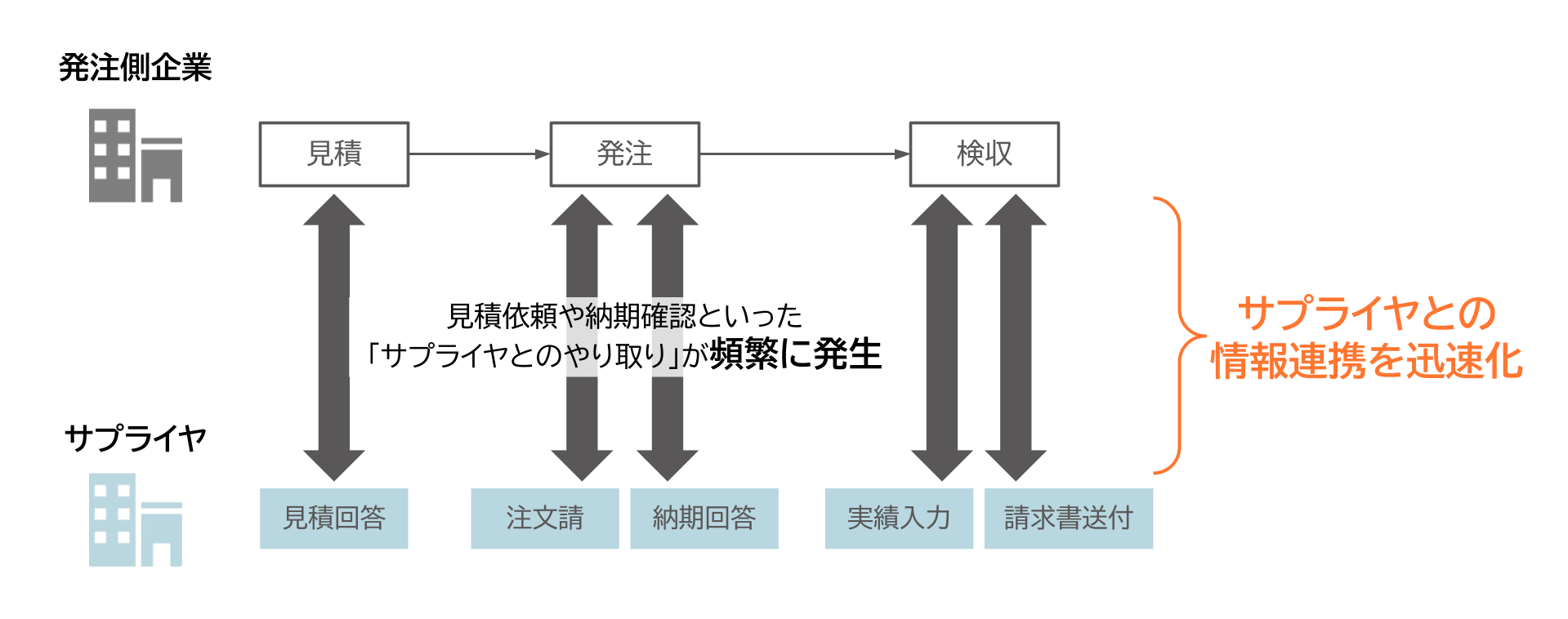
In development purchasing, procurement decisions must be made in parallel with design. In such cases, time-consuming communication with suppliers, such as requesting quotations and confirming delivery dates, can delay decision-making and, as a result, increase the risk of rework.
Therefore, the following is required, (4) Mechanism to link information with suppliers as quickly as possible The following are some of the requirements. By creating an environment in which information such as quotations and delivery dates can be obtained in a timely manner, design and procurement decisions can be made simultaneously.
Summary
Development purchasing is an approach that bridges the "disconnect" between design and procurement to realize a business process that is less prone to rework. In order to achieve this, it is essential to develop a "mechanism" based on the business linkage.
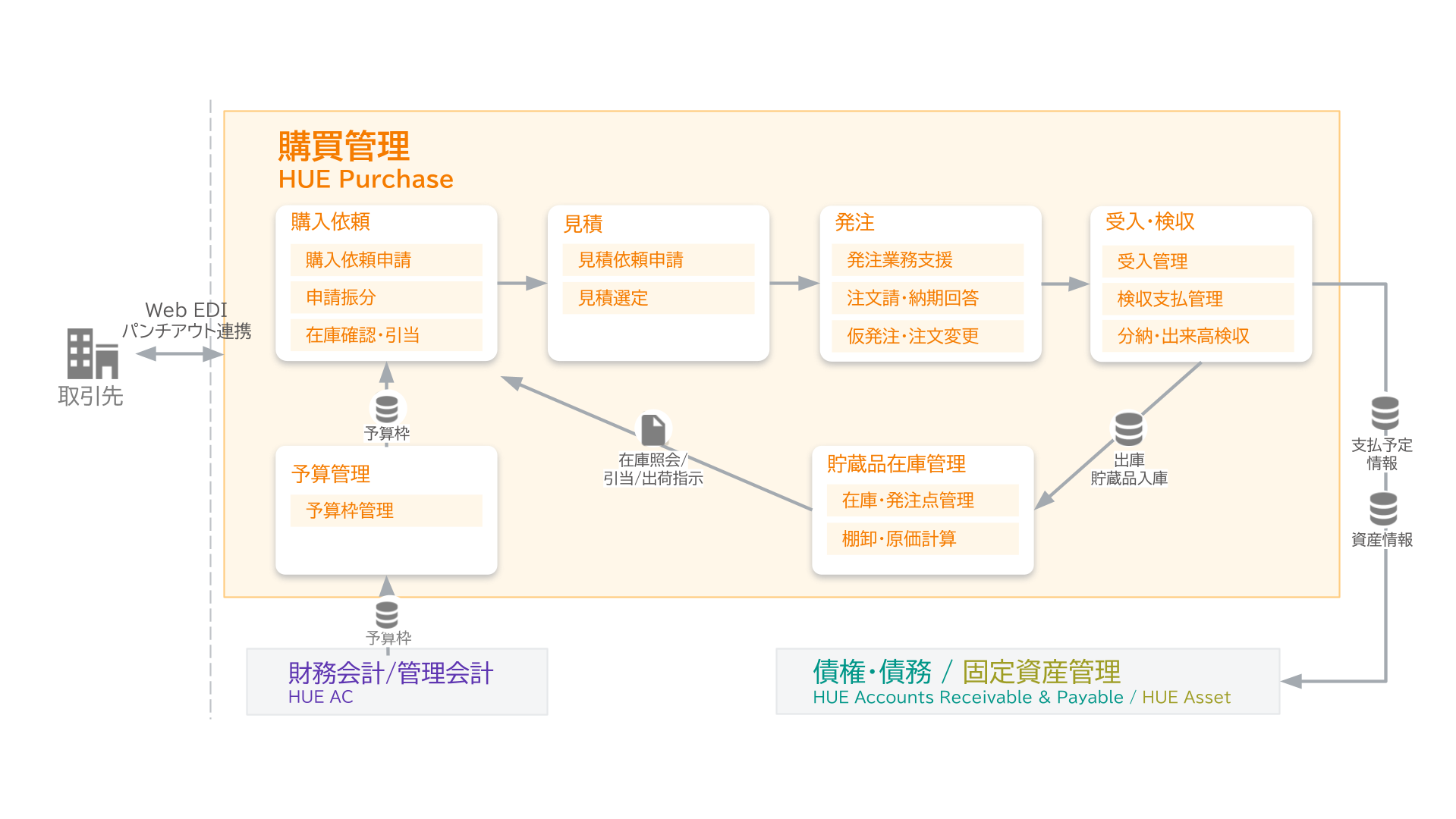
One concrete means of fulfilling these requirements is the use of a platform that enables cross-sectional management of purchasing operations and the utilization of data. HUE Purchase" supports the practice of development purchasing as a platform for building such an environment.
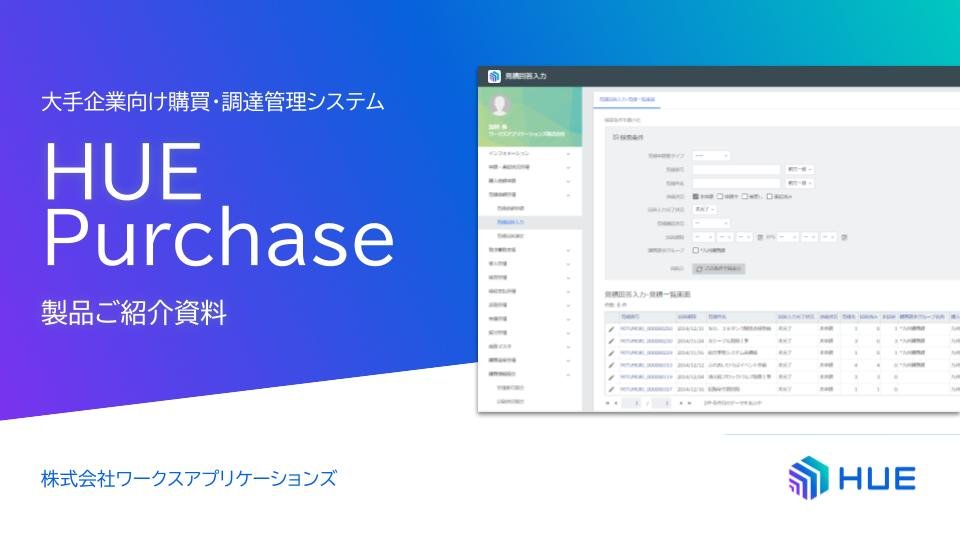
For more information on HUE Purchase, please refer to the product page below.
Related Useful Information
Video
July 29, 2026
[WAP Procurement Insight]
Rethinking Procurement Processes in Light of the Situation in the Middle East

Web Articles
June 25, 2026
[Starting in Fiscal Year 2026] How Will the Security Measures Evaluation System Change Practical Procedures for System Procurement?

Web Articles
June 12, 2026
Why Isn’t AI Adoption Spreading Within Companies? How to Establish AI Adoption: Lessons from the WAP Accounting Department

Related Case Studies
Nankai Electric Railway x WAP talks about the "overwhelming return generated by 'add-on zero ERP'".
Nankai Electric Railway Co.

Nankai Electric Railway introduces HUE DI and upgrades HUE, Building a Management Foundation that Continues to Adapt to Change
Nankai Electric Railway Co.
HUE Purchase supports 180,000 sheets paperless & invoice system
Kyokuyo Industries Corporation