Web Articles Digital Invoice
2023/02/20
What is Digital Invoice? The Future of Fully Automated Monthly Settlement of Accounts
Under the invoice system that will start in October 2023, electronic invoices will be included in the requirements for purchase tax credit. This is expected to change the premise of business from paper to data and promote the digitization of accounting operations.
However, since there is always a counterparty to the invoice processing business, it is necessary to digitize accounting operations between companies in order to fundamentally improve the efficiency of accounting operations. The key word here is "digital invoice.
In this article, we will explain the concept of digital invoicing, the future that can be realized, and how to move forward from a state where paper and electronic files are mixed to a state where they can be handled in an easy-to-understand manner.
Table of Contents
Invoicing system changes the premise of business from "paper" to "data.
1. Electronic invoices (electronic data) can also be used for purchase tax credit
Companies are probably busy with system modifications and changes in practices in preparation for the qualified invoice system (invoice system) for consumption tax that will start in October 2023.
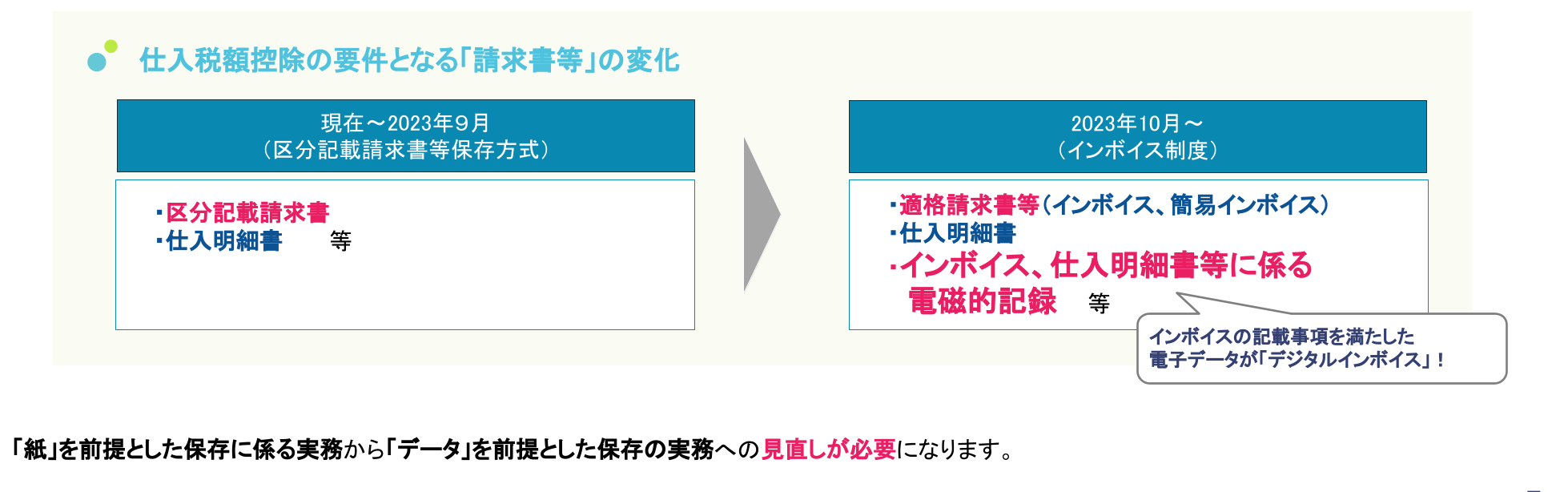
After the launch of the invoice system, both "ledgers containing certain information" and "invoices, etc." must be preserved in order to receive the tax credit for purchases. In other words, the invoicing party is now required to submit an invoice.
In other words, the invoicing party can provide electronic data (hereinafter referred to as "electronic invoice") that meets the description of an invoice, and the receiving party can also receive a purchase tax credit by storing the electronic data.
Please refer to the following article if you want to know more about the invoice system.
What is the invoice system? What will happen to accounting operations?
2. Points to keep in mind when storing electronic invoices
The inclusion of electronic invoices in the requirements for tax credits for purchases will require accounting practices to be revised from "paper" to "data" based preservation practices, but there are some points to note.
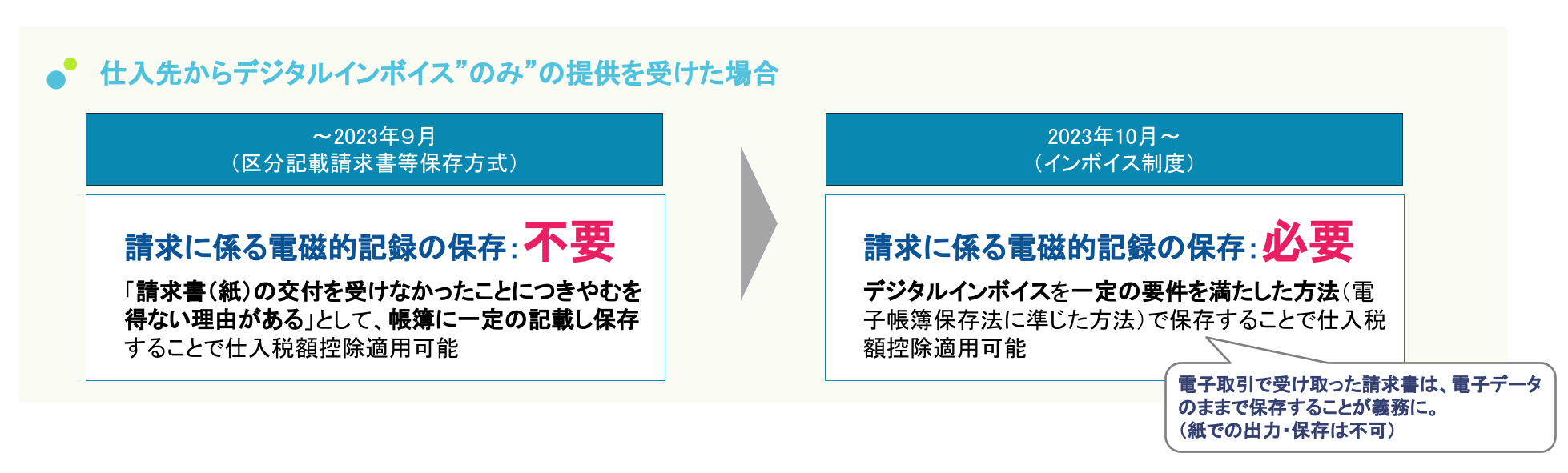
After the launch of the invoice system, electronic invoices must be stored in a manner that conforms to the Electronic Bookkeeping Act in order to be eligible for the tax credit for purchases.
At that time, invoices issued or received through electronic transactions, including electronic invoices, cannot be printed out and stored on paper, but must be stored as electronic data. Furthermore, both the seller and the buyer must retain the invoice or its copy for seven years.
3. Don't forget to check if the supplier is a qualified business.
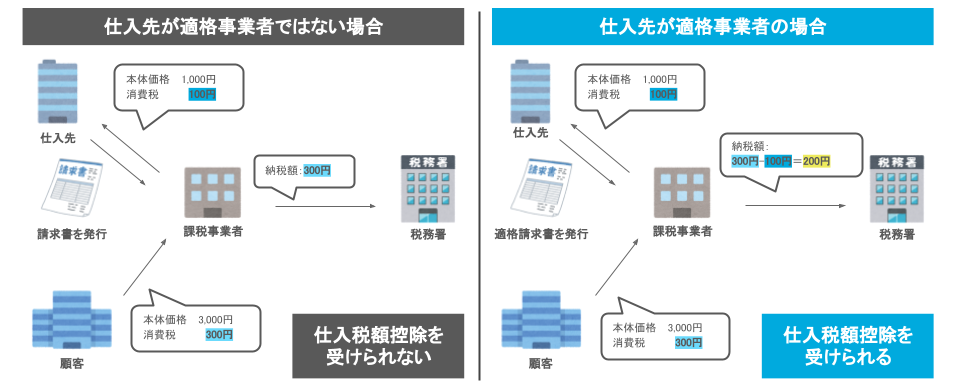
In addition, after the start of the invoice system, suppliers, including individuals and freelancers, must be qualified businesses in order to receive the credit for taxable purchases.
If the supplier is not a qualified business, it cannot issue a qualified invoice, but it is the responsibility of the recipient of the invoice to determine whether it can receive the purchase tax credit.
However, it is not practical to download the supplier's registration number from the IRS data to check whether the supplier is a qualified business entity or not, and to match each supplier's registration number one by one.
Therefore, If you have a large number of business partners, such as a large company, we recommend that you consider using a service that can match data for the matching process of registration numbers.
What is Digital Invoice that changes the business process and does not end with data conversion?
The invoice system and the Electronic Bookkeeping Act have led to the digitization of paper-based business processes, but in fact that alone is not enough.
In order to fundamentally improve the efficiency of accounting operations, "digitization," in which the business process itself is reviewed based on the assumption of an electronic state, is indispensable. The keyword we need to understand for this purpose is "digital invoice.
This chapter explains the concept of digital invoice and the future that digital invoice will bring.
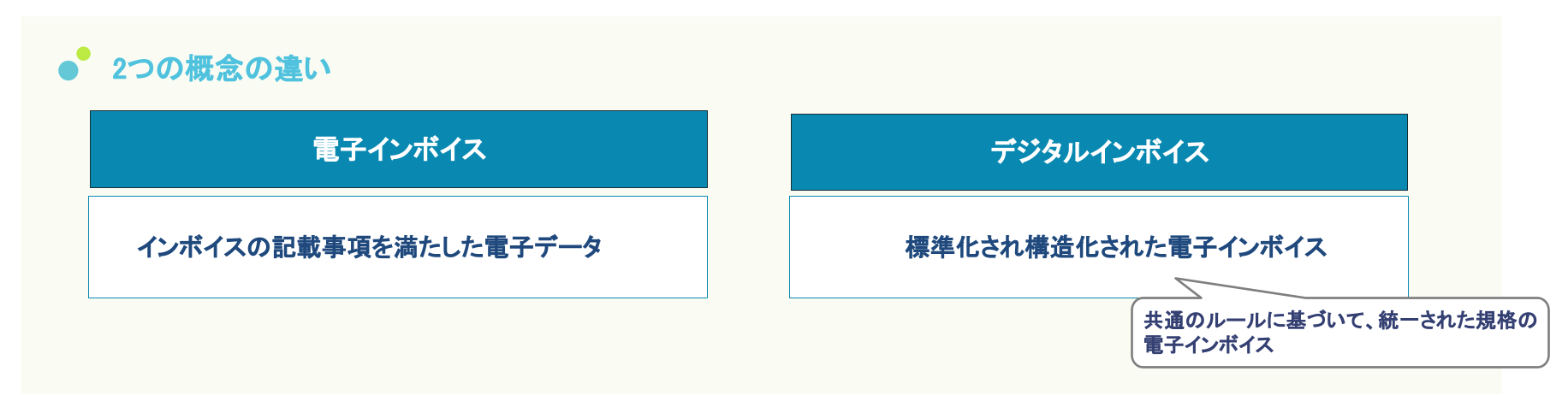
First of all, a digital invoice is defined as a standardized and structured electronic invoice.
It is a bit confusing, but in other words, it refers to a standardized standardized electronic invoice based on common rules.
An electronic invoice is "electronic data that satisfies the description items of an invoice." Conversely, as long as the description items are satisfied, the invoice system can be used even if the specifications and other items are different.
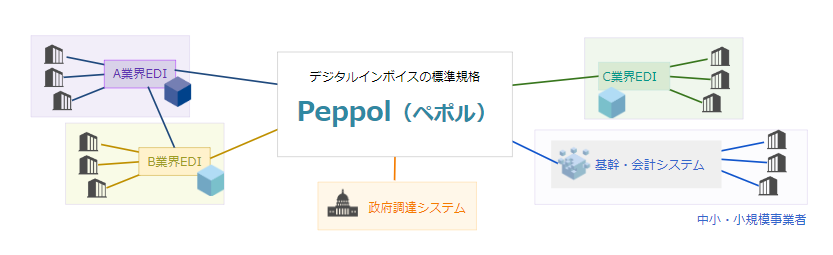
Therefore, in order to improve the efficiency of inter-company operations, an international standard called Peppol is being promoted to standardize electronic invoices in Japan.
Peppol is a global standard specification for "document specifications," "operating rules," and "networks" for exchanging electronic documents over networks, and is used in many European countries.
In Japan, Peppol is currently being promoted by the Digital Invoice Promotion Association (EIPA), and vendors that are members of EIPA have begun to release products that support Digital Invoice Peppol.
*To learn more about Pepol, please also see the following articles.
What is Electronic Invoice? What is Peppol? A simple explanation of the latest trends and the benefits it brings
So, what are the benefits of utilizing this Pepol-standardized digital invoice? It is the realization of an input-less world and DX of business-to-business commerce.
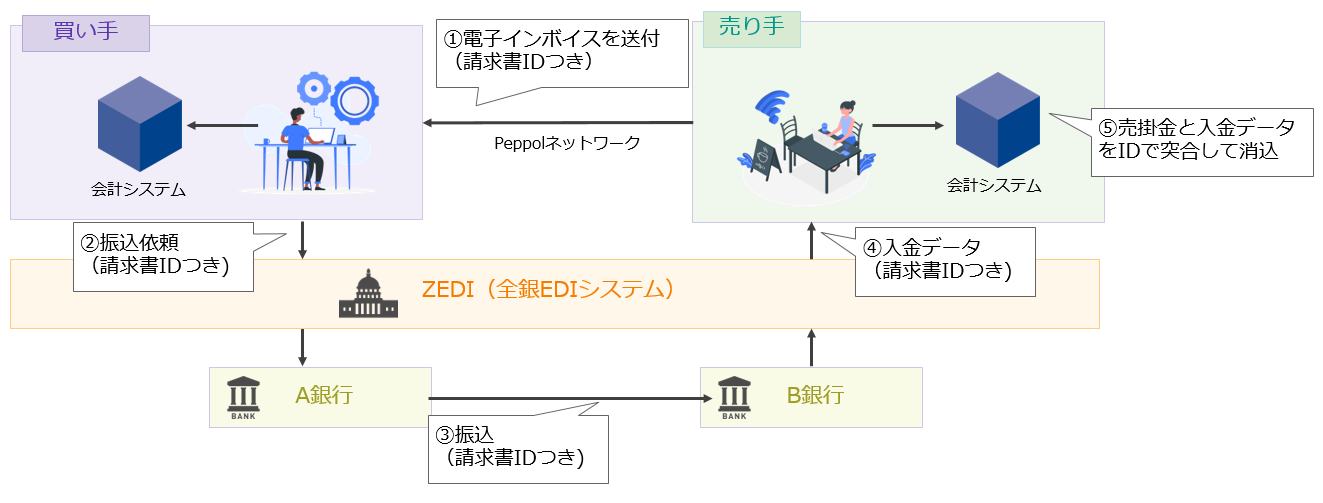
There is the Zengin EDI system (ZEDI) promoted by the Financial Services Agency, and right now we are creating a new mechanism called "New ZEDI" that allows digital invoice invoice information to be attached to bank deposit information.
It is said that the complete automation of monthly closing will be possible in the near future when the new ZEDI and Peppol-based digital invoice are widely used together.
Furthermore, the increasing digitization of information transmission between companies will lead to the realization of DX in business transactions.
*As shown in the figure below, if the new ZEDI becomes widespread, all exchanges, including those between sellers, buyers, and banks, will use a common ID (assigned to standardized digital invoices), which will enable automatic processing of matching and erasure of accounts receivable and payment data by sending and receiving data alone, without human intervention.
Start now! Points to keep in mind when promoting Digital Invoice
Although the use of digital invoicing offers great advantages, it is said that the spread of digital invoicing itself will take some more time.
In addition, many companies may say that they have not even caught up with the digitization of their business operations in the first place.
So, finally, with an eye on digital invoicing in the future, I would like to introduce how companies should promote DX from invoice support now.
1. Use agency services wisely to get through the mixed periods of paper and electronic reporting.
Many companies probably need to process both paper and electronic invoices due to the circumstances of their business partners. In such a mixed period, it is very time-consuming to deal with each legal revision such as the invoice system and the Electronic Bookkeeping Act.
For example, invoices issued and received in paper form must comply with the requirements for scanner storage, while invoices issued and received in electronic files must be stored in electronic transaction data.
In addition, the invoice system will make invoice processing more complicated than before for both sides, as the issuing side will need to develop a system to issue qualified invoices and the receiving side will need to inquire about the registration number of the qualified business that received the invoice.
Ideally, it is necessary to review the workflow, assuming various cases such as paper and electronic, etc. However, if it is difficult to devote man-hours to these tasks and you want to handle them as easily as possible, we recommend using an outside agency service to handle the receipt, issuance, and storage of invoices together.
For example, you can simply mail paper invoices to a service that will scan and convert them into data on your behalf, or receive electronic files such as e-mails on your behalf and manage the invoices for you. Of course, they can also handle invoicing.
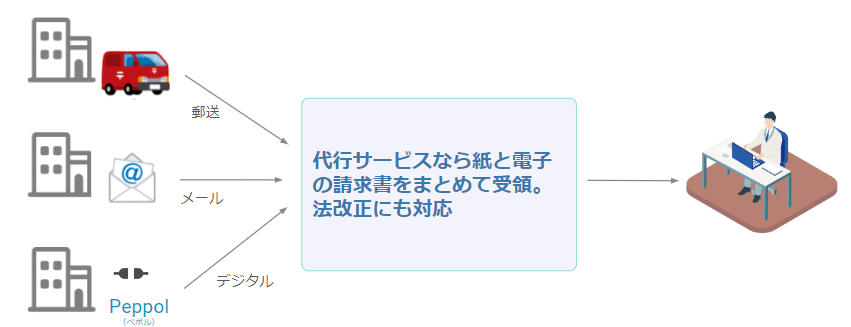
However, there are some points to keep in mind when using this service.
One is to select an agency service that is compliant with Peppol, an international standard that will be widely used in Japan. Once you start using a service, it will be difficult to make changes later, so it is essential to select a service now with an eye to the future.
Another point that is often overlooked is the ability to link with in-house systems. For example, linking with the accounting system or purchase/sales management system used within the company will expand the scope of business automation.
2. Consider streamlining the entire back office, including workflow integration
Many companies have complex internal application and approval processes for creating and issuing invoices, and checking and paying received invoices.
However, in such companies, it tends to be time-consuming for department staff and the accounting department to enter the same information twice into the billing and workflow systems in order for it to be included in the approval flow.
Therefore, by introducing digital invoicing and integrating it with workflow systems at the same time, invoice-related operations can be performed seamlessly, further improving efficiency.
*Paper applications can be converted directly into electronic form with easy operation "HUE Workflow"
For more information, please click here.
Conclusion: DX your accounting operations with measures for digital invoicing!
With the revision of the Electronic Bookkeeping Law and the start of the invoice system, the premise of accounting operations will change from "paper" to "data," and it will be necessary to review practices based on data in the future.
In addition, the spread of digital invoices based on Peppol will digitalize the communication of information between companies, bringing us closer to a future in which the monthly closing of accounts will be fully automated.
Of course, it will take a certain amount of time for digital invoicing to become widespread, but we hope that the accounting staff of each company will start with the elimination of paper and work to solve immediate problems with an eye to the future.
HUE AC" and "HUE Digital Invoice" for invoice and Pepol support
If you are looking for a solution to the invoice system, we recommend Works products that are EIPA members.
The HUE AC accounting system is designed for major Japanese companies. With a wide range of product lineup, it can respond to system revisions such as the invoice system and digital invoices without omission.
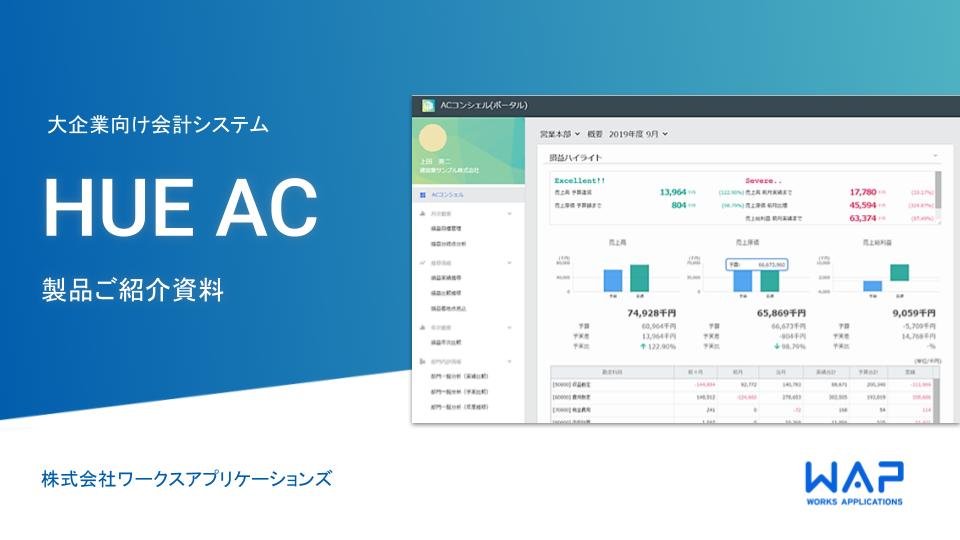
In addition, for cases where immediate support is difficult with the accounting system in use or for those who want to support digital invoicing at a small cost, we recommend "HUE Digital Invoice". In addition to Pepol support, a wide range of system integration is possible, enabling faster digitalization. For more details, please take a look at our materials.

To request Products / Services, please visit
Related Useful Information
White Paper
2026/03/30
Case Studies of Invoicing Receipt and Issuance Systems
White Paper
2026/03/16
Geopolitics of "Digital Invoice" that Accounting Departments Should Know
Video
February 24, 2026
Growth Engine of Accounting]
What should accounting department do to comply with the Takeover Bills Act?
Related Case Studies
Nankai Electric Railway introduces HUE DI and upgrades HUE, Building a Management Foundation that Continues to Adapt to Change
Nankai Electric Railway Co.

Peppol streamlines both sending and receiving invoices
HAMASPI Corporation
Works Applications, Inc.