Web Articles Digital Invoice
2025/01/07
Achieving Efficient Business! Points for Introducing a System for Receiving Invoices
In today's world, where external factors such as a shrinking workforce are forcing businesses to become more efficient, companies are constantly having to understand and utilize new technologies and systems. In this context, invoice receipt systems are now attracting attention as playing an important role. By reducing manual labor and errors, this system saves time and money and is key to keeping the entire business process running smoothly. This article explores the effective use of invoice receipt systems and how they can contribute to efficient business operations.

Table of Contents
What is an invoice receipt service?
Invoice receipt services are designed to digitize invoices and streamline a series of tasks. The services offered vary in size, but include the ability to automate the processing of received invoices and to link with other systems to generate data for accounting journal entries and transfers.
By utilizing this service, it is possible to significantly reduce the workload from receiving invoices to subsequent processing, which used to be complicated. In addition, it is important to understand the correct way to store invoices to meet legal requirements and points to consider when sending receipt emails.
Problems when receiving invoices
Depending on the client, invoices are provided in different formats, such as paper or PDF, and there is a wide variety of ways to receive invoices, such as by mail, fax, or e-mail. It is very time-consuming to deal with invoices in different formats each time, and to check and input data. Especially during the Corona disaster, we often found ourselves in situations where we had to come into the office just to receive an invoice, even though we were working from home.
A wide variety of receipt methods complicate the process.
A major challenge is the variety of ways to receive invoices, which differ for each supplier. Invoices are usually passed on to purchasing or accounting personnel, who receive them in a variety of ways, including by mail, e-mail, website download, or even by delivery of a written notice of payment at the end of each month (so-called "invoice-less transactions").
Variations in these receipt methods can hinder the smooth processing of payments from purchasing or accounting personnel to the next step in the process.
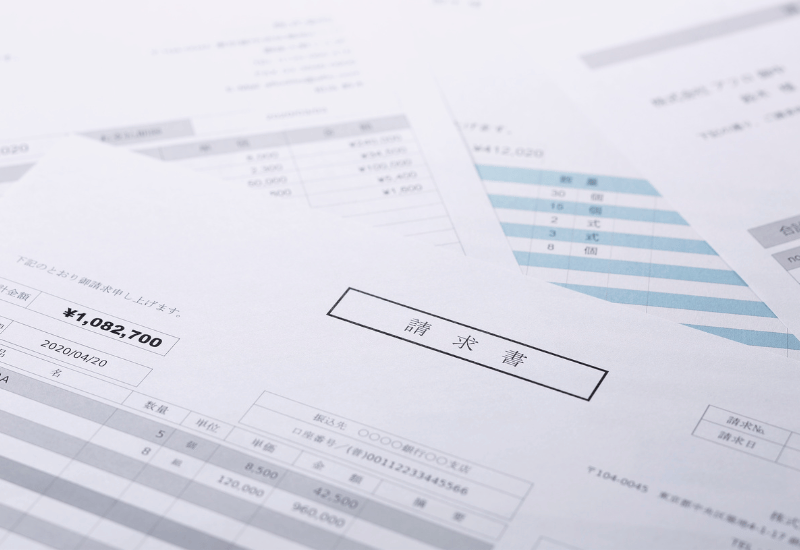
Complicated process of obtaining approval in accounting
The first step in processing invoices in accounting to obtain approval for payment is to circulate them to the relevant departments. Once received, a number of complex steps must be taken, such as checking the description and recording the transaction by the accountant.
Because invoices do not always come in a certain format, some experience and skill are required to complete these processes quickly and accurately.
Ambiguity in response process
Because there are many steps in the invoice process, it is not always easy to know when an invoice is received and when it is reviewed by the accountant.
Because it is unclear who is currently processing a particular invoice, it is difficult to quickly ascertain the current status without a system when a problem arises.
Barriers to flexible work styles
In the wake of the new coronavirus, many companies have been strengthening remote work and telecommuting. However, if you receive paper invoices in the mail, you will need to come into the office to process them.
The method of receiving invoices is often an obstacle to achieving flexible work styles.
Increased workload due to introduction of invoice system
An invoice system will be introduced in Japan on October 1, 2023. This new system will add new mandatory items to invoices and make it mandatory to issue and keep proper invoices. The accounting department will need to adapt to the new tasks, as the new system requires a different method of creation and storage than the old invoices. This is expected to increase the workload of the accounting department.
In addition, the invoice system will be enforced from October 1, 2023, requiring registration as a qualified invoicing business and compliance.
Transitional measures for tax credits on purchases for transactions with tax-exempt businesses are applicable until September 30, 2026, but after that date, tax credits will not be allowed at all, so it is necessary to take action as soon as possible. Therefore, it is necessary to take action as soon as possible.
Advantages of introducing an invoice receipt service
Here are four advantages of introducing an invoice receipt service.
(1) Reduce workload by digitizing invoices
One of the key features of the invoice receipt service is the automation of invoice data. This feature allows for the smooth capture of company names and invoice amounts without the need to look at the originals and manually enter them into accounting software or workflow systems. This allows for rapid data processing and eliminates the worry of input errors. The result is faster invoice payment and smoother transactions with business partners.
2) Payment details simplifying internal application and approval process
Many invoice receipt services have the ability to provide a submission and approval process for managing payment requests. Some services can even automatically set up the appropriate approval process based on departmental information and payment amounts. Thus, multi-step approvals, such as payment requests from other departments to the accounting department, can be smoothly submitted and approved in the cloud.
Furthermore, each invoice can be checked in real time to see "who applied and approved it, when, and who is waiting for approval in the future," which can significantly reduce the time and effort required for internal application procedures.
(iii) Quick response to updates in legal systems
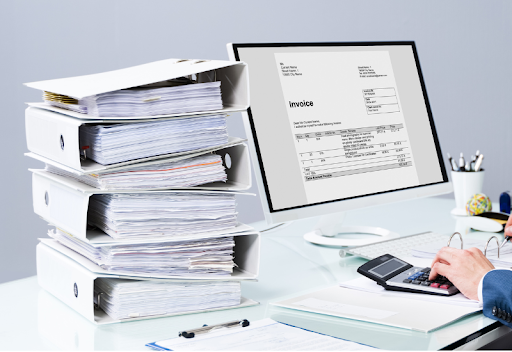
The legal system for processing invoices has been undergoing significant changes in recent years against the backdrop of ongoing digitization and changes in the business environment. 2022 will see the revision of the Electronic Bookkeeping Law, which will revise the requirements for electronic storage of invoices, and the invoice system will come into effect on October 1, 2023, requiring the registration of qualified invoicing businesses In addition, the electronic storage requirement for invoices will be revised in accordance with the revision of the Electronic Bookkeeping Act in 2026.
In addition, a transitional measure for the deduction of taxes on purchases for transactions with tax-exempt businesses is in effect until September 30, 2026, but after that date, the deduction of taxes on purchases will be completely prohibited, so early action is required.
Latest Trends in Electronic Bookkeeping Law
In 2022, the Electronic Bookkeeping Law will be revised, and electronic data storage will be required. Companies will need to introduce electronic invoicing to comply with this.
From January 1, 2024, data storage of electronic transactions will become fully mandatory, and paper storage will no longer be allowed. Currently, it is recommended to use a cloud-based invoice management system that complies with the requirements of the Electronic Bookkeeping Law.
From 2023, an invoice system was introduced that requires the preservation of "qualified invoices".
While it is possible to comply with these legal requirements in-house, it can require a great deal of man-hours. This is where a cloud-based invoice receipt service comes in handy, which is updated as new laws and regulations come into effect. It is quite possible that new legislation will emerge in the future. The ability to constantly adapt to invoice-related laws and regulations is one of the benefits of using an invoice receipt service. The ability to integrate with various services, including the
(4) Integration with other services to generate transaction data and remittance information
API, to generate journal entries and transfer data is another advantage of implementing an invoice receipt service.
Generation of accounting data
After receiving invoices from suppliers and completing payment, the information needs to be recorded in the accounting software. If there are many invoices, it is easy for input errors and omissions to occur.
Therefore, an invoice receipt service can be linked to other services via CSV or API to automatically import invoice and transfer information into the accounting software and streamline the creation of journal entries.
Generate Remittance Information
By linking with other services, the Invoice Receipt Service can automatically generate bank transfer data that is compatible with the JBA format, greatly improving the efficiency of bank transfer operations.

Types of invoice receipt services and how to choose one
Invoicing services are basically classified into three different types, depending on who enters the invoice data.
Each type is described in detail below.
(1) Service vendor receives and digitizes invoices on behalf of the client
In the first method, the customer requests a traditional invoice, but the service provider receives and scans the invoice on their behalf. For example, for paper invoices, the service provider receives and scans them on behalf of the company, and is even responsible for digitizing them.
The process after receiving the invoice varies from service to service. Some, such as HUE Digital Invoice, Bill One, and TOKIUM Invoice, store the invoices in a warehouse and destroy them after a certain period of time.
(2) Service vendor supports in-house data conversion process
While invoices will still be processed in-house, AI OCR will help reduce the workload. Specifically, paper invoices can be scanned, and PDF invoices attached via email can be uploaded directly to the system, and AI OCR will automatically convert each item into data, greatly reducing the need for manual input.
The highly accurate AI OCR feature is especially useful when a large number of paper invoices are sent in a fixed format each month.
(3) Invoices registered by client companies
The third option is to have suppliers enter invoice information directly into the invoice receipt system. This is not easy to implement because it requires cooperation, but if the partner company uses a similar service or is receptive to the proposal, a significant improvement in operational efficiency can be expected. This is especially effective when the number of partner companies is limited and a relationship of trust has been established.
It is also important to ensure that separately received invoices can be manually uploaded into the system and centralized with other data to prevent accidental double-checking.
Six points to consider when choosing an invoice receipt service
Most invoice receipt services do not differ significantly in their basic functionality. They automatically convert the information on received invoices into data that can be viewed and retrieved in the system. All services are compliant with the revised Electronic Bookkeeping Law. When preparing point-of-sale invoices, it is important to follow the guidelines for creating polite and timely mailings.
So how should you choose the right service for your company? Here are six important points of comparison that are essential to choosing the right service.
(1) Whether to receive and digitize invoices in-house or to do it on behalf of the client company
The extent to which you want to reduce the effort of invoice processing, i.e., whether to receive and digitize invoices in-house or outsource the process, is a very important decision.
As already mentioned, there are two types of invoice receipt services: "system stand-alone" and "system + outsourced". The "system stand-alone" type is suitable for companies that want to streamline only the data processing of invoices, while the "system plus agent" type is suitable for companies that want to improve overall efficiency, including operations outside the system such as receipt, confirmation, and storage of the original invoices.
Two criteria for selection should be considered: (1) the number of invoices to be received each month and (2) the format of those invoices.
(2) Whether digital storage of tax-related documents other than invoices is possible?
If you are able to comply with the Electronic Bookkeeping Act for invoices, but have not caught up with the Act for documents related to national taxes, such as receipts, estimates, and delivery slips, you will need to introduce another system, which will increase your management costs. Unless you are already using a voucher management system, it is important to ensure that the system can handle documents related to national taxes other than invoices, as well as the DENCHO Law.
(iii) Accuracy of data conversion and processing time
Each service differs in the accuracy and time required to convert invoice information into data. The "system stand-alone type" uses AI-OCR for automatic data conversion, and while there is a risk of error, the processing time is short. On the other hand, the "system + agent type" is performed by an operator, and while the accuracy is very high, it may take more time than the stand-alone type. Since there is a trade-off between accuracy and time, it is a good idea to determine your company's priorities before choosing a service.
The accuracy of AI-OCR is affected by the format of the invoice. For standard invoices, AI-OCR can be expected to be highly accurate, but for invoices in a wide variety of formats, errors may increase and corrections may be necessary.
Conversely, an operator-based system guarantees high accuracy for any invoice format. However, running costs tend to be higher, but the advantage is that it eliminates the need for in-house verification.
(iv) Whether a full support system is in place
No matter how excellent a system may be, it is meaningless if it is not easy to use. When considering the introduction of a system, it is important to confirm that it has a solid support system. In particular, it is necessary to check whether "support for initial setup" and "operational support after implementation" are properly provided.
Invoicing services go beyond mere data conversion to include functions that digitize internal application and approval processes, as well as functions that allow journal data to be set up in line with the accounting system. In order to take full advantage of these features, it is key to have support to help with the initial setup at the time of implementation.
In addition, you should make sure that there is a point of contact for email, chat, or phone calls should any problems arise after implementation. Some services may take a long time to respond, and in some cases there may be a limit to the number of responses, so it is a good idea to confirm these points in advance.

(5) Whether smooth integration with accounting system is possible?
When linking billing data to an accounting system, there are two methods: using an API or importing a CSV file. Which method you choose may depend on the service you use.
The advantage of using an API is that data can be automatically linked between systems without manual manipulation of the data by the accounting staff. However, API linkage is often only applicable to specific accounting systems.
The method of importing CSV files allows linkage with most accounting systems, but some services may require manual data formatting. We recommend choosing a service that does not require manual formatting to avoid delays in closing.
⑥ Are there other areas where labor savings can be made in addition to receipt and data conversion
Some services may incorporate additional agency functions in addition to the basic functionality, such as
Six recommendations for invoice receipt services
Here are six recommended services that automate the receipt and data conversion of invoices and significantly improve operational efficiency
HUE Digital Invoice
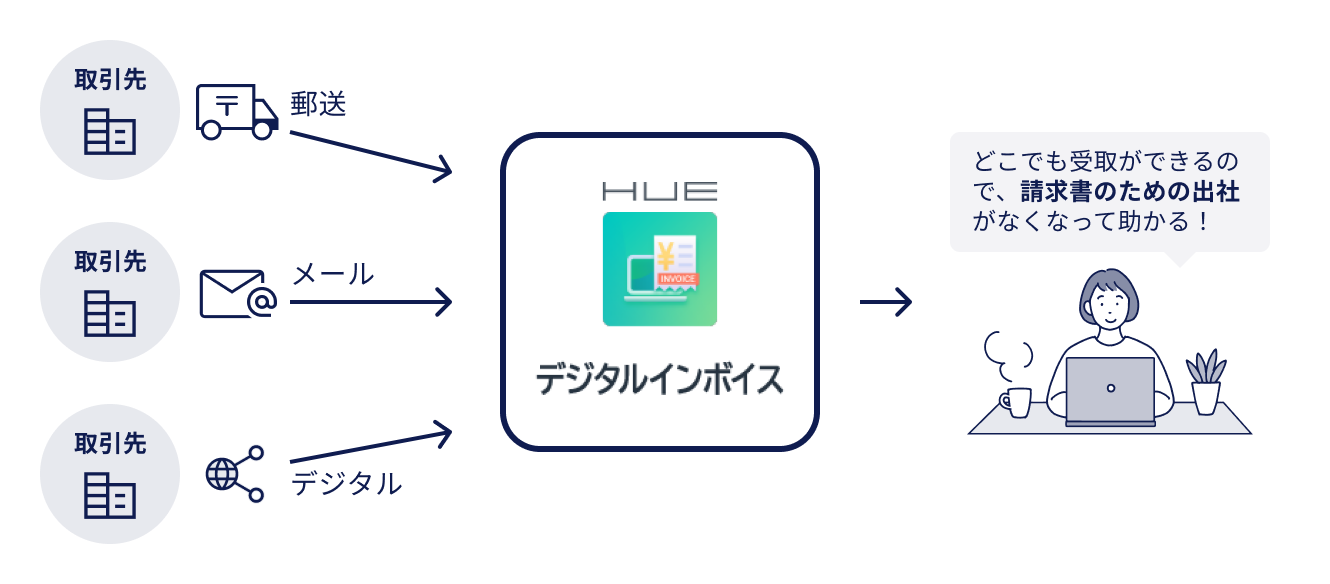
Service Overview
Invite your business partners to join HUE Digital Invoice and receive digital invoices at no cost to them. In addition, by using the invoice receiving service on behalf of your clients, you can quickly promote a paperless office environment even if paper invoices remain in your operation.
We provide a comprehensive solution that includes compliance with laws and regulations and integration with ERP systems such as the HUE series to improve the overall productivity of a company's accounting operations. In addition, since the system is Peppol (international standard) compliant, invoices can be sent and received even from different services when a business partner is using a Peppol compliant service.
Features
1. Complete paperless invoice receipt by various means
Invoices can be issued in the same way as before, such as PDF files attached to e-mails or paper invoices received by mail, allowing the invoice issuer to reduce its own burden while achieving a paperless invoice without placing a burden on its business partners. In addition, "HUE Digital Invoice" can be utilized to support the streamlining of business operations by handling everything from invoice receipt to data conversion in a single operation.
2. Support for processing invoices on behalf of the client without relying on the office
Invoices received in PDF or paper format are converted to data using our receiving agent service and AI-OCR. This enables remote and location-independent work styles and greatly reduces the need to come to the office. In addition, invoice data can be automatically posted to the workflow within HUE Digital Invoice, eliminating the need for manual posting and promoting further work style innovation.
3. Smoothly supports the Electric Ledger Law and accounting system integration
Data registered in "HUE Digital Invoice" is automatically stored in "HUE EBM," a cloud service compatible with the ledger law. HUE EBM can quickly respond to the requirements of the invoice system and the revision of the ledger law with free version upgrades. In addition, the integration function with the accounting system allows invoice data to be smoothly imported into the accounting system, reducing the time and effort required for manual input and improving the efficiency of accounting operations.
4. Company-wide operational efficiency
Smooth integration with various accounting systems, including the HUE series, enables easy digitalization of payment and billing operations.
5. Realization of gradual digitization and overall optimization in anticipation of the future
Support for all formats, from paper invoices to electronic invoices, allows for flexible transition according to the situation of the business partner. In addition, Peppol compatibility serves as a bridge to the future full digitization, creating a phased, integrated digital environment from the perspective of overall optimization. While taking an optimized approach for each individual trading partner, TOKIUM Invoicing supports the creation of a system that aims for overall optimization by promoting overall operational efficiency and digitalization.
TOKIUM Invoice
Service Overview
TOKIUM Invoice is a service that receives invoices, whether in paper or PDF format, and digitizes the information. This makes it possible to completely paperless invoice receipt and storage operations. This service complies with the Electronic Bookkeeping Law and has been certified by the Japan Institute of Document and Information Management (JIIMA) and is actually used by JIIMA.
Features
1. all forms of invoices can be managed electronically in a centralized manner. Whether in the form of paper, PDF, or receipt through a dedicated system, TOKIUM will do it for you. Paper invoices are scanned by TOKIUM operators and PDF invoices are treated as electronic data and uploaded to the TOKIUM invoice and time-stamped. This allows you to manage your invoices together in TOKIUM Invoice, regardless of the receipt format. The original paper invoices are stored by TOKIUM in a dedicated warehouse for the required period of time.
TOKIUM uses a method whereby two operators each input one voucher, and if the input matches the system, the voucher is considered to be correct. This makes data conversion highly accurate and eliminates the need for accounting staff to check for data errors. 3.
After the introduction of the invoicing system, the registration number matching error can be prevented.
Bill One
Service Overview
Bill One is a cloud-based invoice receipt service provided by Sansan Corporation. The service features the ability to receive and scan invoices received via paper or email instead. It is especially worth considering for companies that have a large number of paper invoices. This service can accept invoices in any format (paper, email, etc.) and will accurately and quickly convert the received invoices into data, making it possible to go paperless. It also allows centralized management of invoices and is compliant with the Electronic Bookkeeping Act.
Note, however, that it is not possible to receive invoices sent as password-protected zip files or to download invoices from the web on behalf of the company. In addition, documents related to IRS taxes other than invoices (e.g., quotations, delivery slips, etc.) are also not covered by this service.
Features
1. Bill One receives invoices sent by mail or email from suppliers, scans them on their behalf, and compiles the invoice data on the system.
2. using AI/OCR technology and operators, Bill One digitizes invoices with an accuracy rate of 99.9% or higher, and notifies the person in charge of the invoice from receipt to completion of digitization.
3. digitalized invoices can be centrally managed in the cloud.
BtoB Platform Billing
Service Overview
The BtoB platform is a service that enables integrated management of invoicing and receipt in the cloud. By using this platform, you can centralize and streamline invoice-related tasks. Entering invoice data into the BtoB platform facilitates the digital transformation of accounting and management. However, a request must be made to send invoices through the system to all business partners.
Features
1. Business partners that have traditionally exchanged invoices by mail or e-mail can use BtoB Platform Invoices to process both receipt and issuance of invoices electronically.
2. the revised Electronic Bookkeeping Act and the invoice system are also supported, enabling operation in compliance with laws and regulations.
The system has a proven track record of integration with many accounting systems and sales management systems, helping to improve the efficiency of accounting operations. Furthermore, the system's learning function automatically makes journal entries, reducing manual errors by accounting staff.
Baclac Invoice
Service Overview
Baclac Invoices is cloud-based software that automates everything from invoice receipt to accounting and payment procedures, utilizing AI-OCR technology to quickly digitize invoice information and record journal entry data with a unique learning function. In addition, withholding tax reports can be produced and monthly payment data can be generated.
Features
1. AI-OCR instantly digitizes documents in a wide variety of formats, and even if more than 10 documents are uploaded at the same time, they are processed quickly.
2. In compliance with the revised Electronic Bookkeeping Act, time stamping and electronic retrieval are available.
3. The system automatically learns journal entries once they are registered, reducing manual entry.
4. Linkage with other systems expands automatic entry and data linkage to achieve even greater convenience.
freee Expense Management Receiving Invoices
Service Overview
Freee provides a cloud-based invoice processing solution. It allows centralized management of invoices from receipt, journalization, integration with accounting systems, transfer processing, and storage, and implements a statement line OCR function. It also has the ability to receive invoices via a dedicated email address or website.
Features
1. Evolution of OCR technologyAI streamlines the transfer and journalizing process by utilizing OCR to automatically input and tag journal entries. Once recognized, the AI continues to learn the journal entries, so accuracy improves with each use.
2. Specialization in online collectionFocusing on online collection, the service is basically designed for online receipt.
3. Prevention of Missed ReceiptsTo prevent missed receipts, missed circulars, and missed payments, the service allows users to keep track of what stage their invoices are currently at.
* Company names, product names, and service names are trademarks or registered trademarks of their respective companies.
Digitize your invoices for efficient processing!
Many companies are digitizing their invoices. With the revision of the law, digitization will further accelerate in the future.
Digitizing invoices will streamline the cumbersome process. Let's start digitization as soon as possible to improve business efficiency.
Supervisor
Satoruaki Yasuki
As a certified public accountant, he has abundant practical experience in financial support for startup companies and streamlining accounting and accounting operations, and supports corporate growth in a wide variety of fields, including IPO support, internal control establishment, and overseas expansion support. He also writes articles on finance, accounting, and taxation directly related to practical business operations, and provides easy-to-understand advice based on his professional expertise.

Related Useful Information
White Paper
2026/03/30
Case Studies of Invoicing Receipt and Issuance Systems
White Paper
2026/03/16
Geopolitics of "Digital Invoice" that Accounting Departments Should Know
Video
February 24, 2026
Growth Engine of Accounting]
What should accounting department do to comply with the Takeover Bills Act?
Related Case Studies
Nankai Electric Railway introduces HUE DI and upgrades HUE, Building a Management Foundation that Continues to Adapt to Change
Nankai Electric Railway Co.

Peppol streamlines both sending and receiving invoices
HAMASPI Corporation
Works Applications, Inc.