Web Articles Other
2022/02/28
Points to promote DX using ERP! Explanation of viewpoints necessary to maximize effectiveness
Recently, more and more companies are considering ERP as a consistent way to promote DX by utilizing digital technology to cope with drastic changes in the business environment. Many companies are in a hurry to implement ERP, but if they do so without sufficient consideration, they may end up failing to achieve their objectives or incurring high costs. In this article, we will explain in an easy-to-understand manner what exactly DX in ERP is and the points to consider when actually implementing it.

Table of Contents

What is DX in ERP?

DX is an abbreviation for Digital Transformation, which refers to the use ofdigital technology to bring about business transformation. Although we have been discussing how to proceed with DX internally, we often hear that there is ambiguity as to what it means to promote DX with ERP. Therefore, in this chapter, we will first introduce what DX in ERP means, with an explanation of the "stages of DX," as it is commonly referred to.
1. 3 Stages of DX
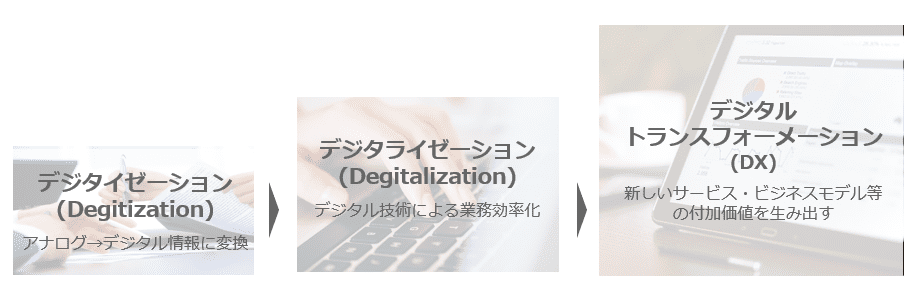
As shown in the figure, DX has stages according to the degree of achievement.
Stage 1: Digitization (converting analog to digital information)
For example, actions such as introducing a workflow system from a paper-based approval process, or digitizing a paper list, are applicable to DX.
Stage 2: Digitization (business efficiency improvement through digital technology)
After digitizing the data, for example, the application process can be streamlined through workflow, or data for forecast management can be automatically consolidated to improve efficiency.
Third step: Digital transformation (creating added value through new services, business models, etc.)
After streamlining operations, activities such as analyzing and utilizing data that has not been used until now to transform operations will fall under this category.
The ultimate goal is digital transformation to create new value, but it is difficult to achieve the third stage without having achieved the first and second stages, so it is important to proceed step by step.
Role of ERP
What is the role of ERP in this stage of DX?
ERP is a mechanism to realize business efficiency and appropriate management decisions by centrally managing information such as people, goods, and money. The role of DX is to digitize analog data, streamline operations, and accumulate data. The accumulated data will lead to operational reforms and new business challenges, so it can be said that DX plays a major role.
Many of the DX tools and services available in the world are designed to improve only individual operations, and they may not be sufficient as a data base for promoting DX, especially if they handle a huge amount of business data.
When the time comes to promote the third step, the necessary data may not be available, or it may take an enormous amount of time to collect the data.
Using an ERP that manages business data in an integrated manner prevents such situations and facilitates the utilization of data, making it easier to implement business reform and business transformation. In this way, ERP plays a major role in promoting DX, and its use is a major driver of DX promotion.
Key points of DX promotion to maximize effectiveness

In the previous chapter, we explained the definition and role of DX in ERP. Then, what points should we pay attention to when actually using ERP to promote DX? Here are some points to keep in mind.
1. Be aware of your company's level
First, let's understand what level your company is currently at. Then, by clarifying which level you are aiming for, you will be able to identify the necessary ERP elements.
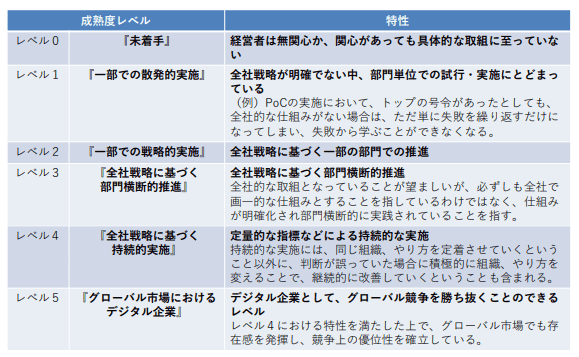
As mentioned in Chapter 1, there are various levels of achievement when it comes to DX. The following figure shows the indicators for DX promotion as defined in the "DX Promotion Indicators and Guidance" published by the Ministry of Economy, Trade and Industry.
Reference: "DX Promotion Indicators and Guidance" from Ministry of Economy, Trade and Industry, July 2028
https://www.meti.go.jp/press/2019/07/20190731003/20190731003-1.pdf
This indicator divides the degree of DX promotion into levels according to the scope of impact of the initiatives and the existence of strategies. Specific examples of situations that fall under each level are considered to be as follows, respectively.
Level 1: Sporadic implementation in a part of the company
There is no horizontal strategy, and each department has introduced
workflow systems, etc. to promote paperless operations for the time being.
Level 2: Partial strategic implementation
The accounting department is selecting systems and tools based on the policy that specific operations (expense reimbursement, invoice payment, etc.) need to be improved.
Level 3: Cross-departmental promotion based on company-wide strategy
A situation in which a grand design is made to promote management accounting and operational efficiency improvement in the field as a company-wide strategy, and various systems are introduced to ensure the
requirements to be connected to the grand design.
Level 4: Sustained implementation based on company-wide strategy
The company has not only introduced the system, but also structured it to measure its effectiveness and promote its continuous use.
The company has created a climate and culture in which the system does not become obsolete.
Regardless of which level your company is at, by utilizing these indicators, you can gain a perspective on which level to aim for next and which level you have not been able to consider. By concretizing how ERP will be utilized to reach the desired level, the necessary ERP requirements will also become clear.
In addition, the IPA (Information-technology Promotion Agency, Japan) has a "DX Promotion Indicator Self-Diagnosis Result Input Site" on its website. By entering your company's information, you can obtain analysis results such as comparisons with benchmarks, so please use this site as well.
Information-technology Promotion Agency, Japan DX Promotion Indicators Self-diagnosis Result Input Site
https://www.ipa.go.jp/ikc/info/dxpi.html
2. Clarify what to realize
Once you have clarified your company's level, next decide what exactly you want to achieve.
The DX Promotion Guidelines issued by the Ministry of Economy, Trade and Industry include the following information.
----------------------------------------------------------------------------------------------------------------------
Many executives recognize the need for DX and have established digital departments to promote DX. However, many companies are still investing to some extent, but not leading to actual business transformation, such as through repeated PoC (Proof of Concept: a process to verify a strategic hypothesis or concept before creating a new project as a whole). However, this does not lead to actual business transformation.
-----------------------------------------------------------------------------------------------------------------------
Quote: Guidelines for Promoting Digital Transformation December 2008 Ministry of Economy, Trade and Industry
https://www.meti.go.jp/press/2018/12/20181212004/20181212004-1.pdf
This is related to the aforementioned levels, but for example, to raise the level from Level 1 "sporadic implementation in some areas" to Level 2 "strategic implementation in some areas," it is necessary to consider what exactly you will do This means that we need to consider what exactly we are going to do.
To do this, for example, it would be a good idea to start by analyzing and organizing current operations to identify issues, and then to draw up a vision of what the operations should be after resolving those issues. For example, if a company-wide business analysis reveals that the accounting department's expense reimbursement operations, especially paper-based reimbursement, are costly, it will be possible to consider a mechanism to improve efficiency with a focus on the goal of going paperless.
Even though there are various cases, it is necessary to be careful that the use of digital technology does not become the goal of the project. Rather than making "implementing ERP" the objective, it is important to determine "what will be achieved" by implementing ERP.
In this way, it is important to discuss how the business will be transformed after utilizing ERP, and to have a common understanding as an organization by establishing a firm policy.
3. Develop human resources
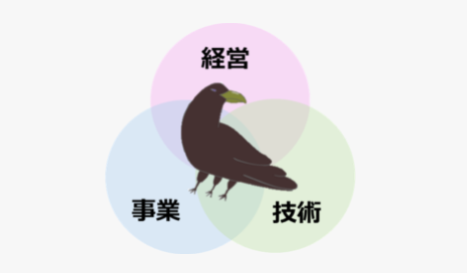
The IPA (Information-technology Promotion Agency, Japan) has compiled a "Guide to DX Achievements" which states that the following personnel are needed.
-----------------------------------------------------------------------------------------------------------------------
The "yatagarasu (raven) human resources" played a central role in driving the direction of DX, promoting development, and business application. They are able to persuade management in the language of management, involve business divisions in the language of business, and discuss feasibility with development members in the language of technology. With such personnel at the center of the project, the DX project can be smoothly planned and promoted.
-----------------------------------------------------------------------------------------------------------------------
Quote: From "DX Practice Guide: IT System Construction," a portal site for learning, knowing, and practicing DX SQUARE.
https://dx.ipa.go.jp/tools/dxpg
In order to promote DX, it is necessary to change various on-site operations. On the other hand, management tends to focus on visible results and costs. Therefore, personnel who promote DX need to be not only familiar with ERP technology, but also have an understanding of on-site operations and the ability to negotiate with related parties from a manager's point of view.
However, since such personnel are not available in every organization, it is necessary to promote their development through job rotation, promote them from outside the company, and in some cases, divide their roles within the team.
In any case, it is important to start early in the process of introducing ERP to promote DX, as it is essential to develop and secure human resources and improve the organization.
Specific examples of DX in ERP
So far, we have introduced several points for DX promotion in ERP. While it is necessary to keep these points in mind when actually promoting DX, it is also important to know about case studies that can serve as model cases in the yet unexplored area of DX.
In this chapter, we will introduce two case studies of users who are promoting DX by using our ERP.
1. Examples of streamlining and upgrading user operations
By implementing ERP, you can improve the efficiency and sophistication of the operations of the users of the system.
In cases where users are using a combination of different systems or Excel, for example, they have to enter data twice, cannot see the data they want immediately due to data inconsistencies, and need time to collect data.
ERP allows users to manage their business operations By centralizing the management of business data, these issues can be resolved and user operations can be made more efficient and sophisticated.
By centralizing business data, we can solve these issues and make user operations more efficient and sophisticated. Please refer to the following link for an example of how TDK (manufacturing industry), one of our users, solved the issues by centralizing business data in their research and development department.
2. Examples of data utilization promotion
When a system is proprietary and outdated, data in each business area can become independent, making it difficult to utilize the data. Although it varies from solution to solution, ERP is basically designed to cover all the functions necessary for business operations, preventing information from becoming scattered and isolated.
ERP enables the use of tightly integrated data and takes business operations to the next level , including data-driven analysis and business improvement. The ERP enables the use of densely integrated data to take business operations to the next level, such as data-driven analysis and business improvement, and to promote DX.
Please click the link below to see a case study of how EXSOL, a solar power generation system design and sales company, solved the aforementioned issues.
Example of EXSOL:
Introducing an ERP that can reliably achieve your objectives
So far, we have explained some examples of DX in ERP and the key points on how to proceed with DX.
When actually using ERP to promote DX, it is necessary to carefully consider whether or not the necessary functions and mechanisms are in place from the perspective of transforming your business. As mentioned in this article, it is important to implement a solution focusing on "what will be achieved".
Our ERP package "HUE" for major companies is an integrated solution with functions required by major Japanese companies. It is equipped with a wealth of functions and know-how related to business reform as standard functions of the package, and can strongly support DX promotion.
In addition, we continue to provide case studies and useful information from our users, so please take advantage of this service if you are interested.

Related page:
Related Useful Information
Video
August 3, 2026
[ERP Tech Journal]
Learning from Works Applications’ Successes and Failures: The Reality of Promoting AI Adoption

Video
July 17, 2026
[ERP Tech Journal]
Breaking Free from “AI You Can’t Trust with Business Operations.”

Web Articles
June 25, 2026
[Starting in Fiscal Year 2026] How Will the Security Measures Evaluation System Change Practical Procedures for System Procurement?

Related Case Studies
Paperless and business reform one step at a time! Effects of HUE implementation and future prospects
YANASE & CO.,LTD.

Reduced 1 million documents per year and realized a paperless office.
KAJIMA CORPORATION

Optimizing the entire ERP system with HUE's standard functions by moving away from customization
EXSOL Corporation