
Web Articles System Review Support
June 17, 2021
What are the points to compare purchasing management systems? Explanation of points that can easily make a difference!
With the recent trend toward telework and DX, more and more companies are considering purchasing management systems in order to change inefficient operations via telephone and fax.
While a variety of solutions are offered by domestic and overseas vendors, it is difficult to understand the differences among them, and an increasing number of companies are having a hard time making comparisons. In this article, we will focus on the points where companies tend to differ when comparing purchasing management systems.

Table of Contents

Difficulty in comparing purchasing management systems
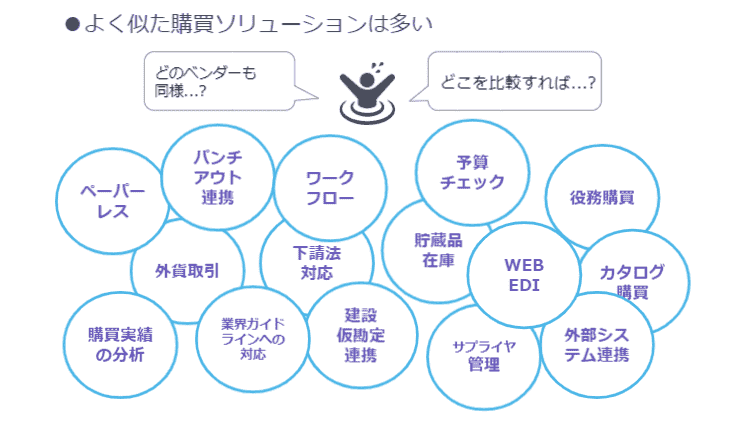
While purchasing solutions are full of various solutions such as "those from domestic vendors," "those from overseas vendors," "for large companies," "for small and medium-sized companies," etc., we often hear people say that it is difficult to understand the differences between them.
The ability to go through the flow from purchase request to order to acceptance inspection is no different for any product, and the ability to realize paperless systems and integration with e-commerce sites is a common functionality among many vendors. Therefore, it is important to understand the "points that tend to make the difference" and make accurate comparisons when selecting a system.
Related page
Four advantages of the punch-out linkage of purchasing systems
So, what are the points of difference between purchasing management systems of different vendors and what should be compared? In this section, we will focus on the points that make the difference.
(1) Can a detailed workflow from purchase request to order be realized?
Each company often defines its own particular workflow for upstream operations such as purchase requests from each department and orders placed by the purchasing department. Therefore, the key point is whether the system can be configured with the same granularity and detail as paper-based operations and the current system.
For example, large companies often require complex workflows such as "more than 10 approval flows," "a flow that requires approval from "one of these three people," "a decision flow that changes if the price exceeds 100,000 yen," or "a quote is required for each item. In many cases, complex workflows are required.
If such operations cannot be realized by the system, it may hinder the paperless system or incur expensive additional development costs, so it is important to identify the necessary requirements.
(2) Can you achieve paperless communication with suppliers?
In recent purchasing system studies, there have been many attempts to use Web EDI functions to communicate with suppliers, and to make quotations, orders, and other interactions paperless and database-oriented.
However, different solutions have different capabilities, and although they can respond to quotations and order notifications, they may not be able to handle tasks such as order acceptance, delivery date responses, and payment schedule confirmations. Therefore, it is necessary to imagine and clarify the workflow you wish to realize in your company.
(3) Can a flexible response be taken after the order is placed?
Depending on the type of item and the type of contract, delivery dates and monetary information may change after an order is placed.
For example, in the case of items with fluid unit prices, such as liquids, the unit price may not be determined at the time of order placement, but may be determined at a later time, or fixed at the time of acceptance inspection. However, some purchasing systems often have restrictions such as "if the amount is to be changed, the order must be placed again (it cannot be changed at the timing of acceptance inspection)" or "the order information cannot be changed (it must be cancelled)". It is necessary to check these conditions because they may reduce the efficiency of business operations.
(4) Does it cost more to link punch-out systems?
In recent years, many companies are considering punching out links to catalog sites such as "Cow Net" and "Amazon Business" in order to efficiently accumulate performance information in the purchasing management system.
Of course, it is necessary to check from the viewpoint of "whether it is possible to link to the sites we want to use," but there are also systems that have a pricing structure that incurs a cost for adding a linkage partner, or a cost for each linkage. It is important to check the cost structure in order to achieve cost reduction, which is the mission of the purchasing department.
For more information, click here: What is punch-out linkage in a purchasing system?
Select a purchasing management system that meets your company's requirements.
So far, we have discussed the points that tend to make a difference between different solutions when comparing purchasing management systems.
It is important to check these "points of difference" in detail and then select a solution that can solve your company's problems.
Purchasing Management System for Large Corporations HUE Purchase HUE Purchase is a product specialized for large companies and can handle all types of purchasing flows, and its wide range and depth of functions, including Web EDI and punch-out linkage, can contribute to significant efficiency improvements in purchasing operations.
A collection of examples of improved purchasing operations at major companies Purchasing Management Case Studies and other useful information related to system selection is also continuously provided. If you are interested in our products, please download and check them out.