
Web Articles Electronic Bookkeeping
2021/01/15
Electronic Bookkeeping Law Increases Fraud in Expense Reimbursement? Pitfalls of Digitization with Smartphones
Previous amendments to the Electronic Bookkeeping Act have eased requirements for scanners that read receipts, allowing the person who receives a receipt to digitize it using a smartphone, digital camera, or other device.
However, for companies considering compliance with the Electronic Bookkeeping Act, the fact that the digitization of receipts by the recipient himself/herself is now permitted not only has the merit of reducing workload, but also poses an aspect of risk of possible fraud. This article explains the "pitfalls" that may occur as a result of compliance with the Electronic Bookkeeping Act and what countermeasures can be taken against them.
The tax reform plan for fiscal 2021 has also been announced, and further relaxation is expected in the future.

Table of Contents

Reference: Past amendments to the Electronic Bookkeeping Act - from the National Tax Agency website
https://www.nta.go.jp/publication/pamph/sonota/03.pdf
Increase in Fraudulent Expense Reimbursement as a Result of Compliance with the Electronic Bookkeeping Act?
In response to the scanner preservation system of the Electronic Books and Records Preservation Act, employees are allowed to use smartphones to photograph and digitize receipts, raising expectations for improved business efficiency. On the other hand, since employees will be entrusted with the handling of receipts, including digitizing them, there is a risk of activities that could lead to unauthorized expenses.
For example, of greatest concern is the risk of "use and reuse of receipts," as shown below.
- Other people use the receipts as they are, digitize them, and apply for reimbursement.
- Other people use the same receipts and falsify the images to submit for reimbursement.
- A user mistakenly selects the same receipt image and attaches it to an application for reimbursement, resulting in a duplicate application for reimbursement.
Thus, since employees themselves handle "electronic data used as vouchers," efforts to prevent fraud are indispensable. So, how can these risks be controlled while benefiting from the Electronic Bookkeeping Act?
How to prevent "use and reuse" of receipts? Legal requirements to be complied with and creation of a system to easily detect fraud
To prevent fraud, it is important to set "limits" and create a system that makes it easy to detect fraud. Creating a system that makes it easy to detect fraud also has a psychological "deterrent" effect.
For example, three concrete examples of measures to prevent the use of receipts are as follows
(1) Detecting and preventing fraud by checking at the time of approval or by a third party
To detect whether receipts are being used and applied for twice, it is possible to check whether the application contents are exactly the same, such as date and amount. In addition, periodic inspections that check the original receipts selected at random against the electronic data to ensure consistency can also serve as a deterrent. By having a supervisor or a member of the accounting department other than the individual checking the receipt at the time of approval, and by having a third party check the receipt periodically, at least three or more eyes will be on the receipt, making it easier to detect and prevent fraud.
2) Write the recipient's name on the receipt to discourage
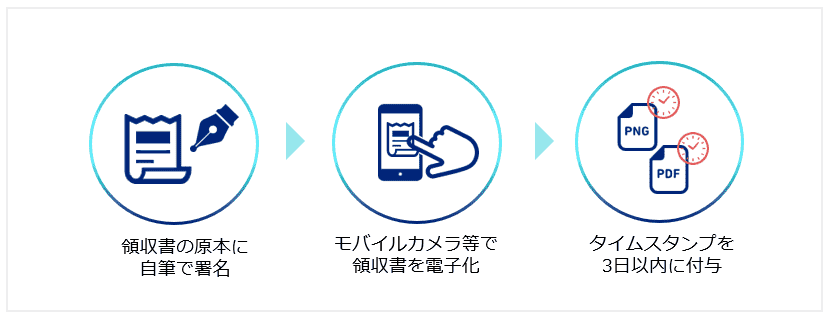
It is also effective to ensure that the name is written on the original receipt and that it is photographed. The name of the person using the expense is written on the receipt, making it easier to identify fraud in case someone else uses the receipt. Naturally, there is also a deterrent effect to the act of including signatures, since all employees, including the person whose receipt is being digitized, can recognize the risk of being easily identified in the event of fraud. Incidentally, the requirements of the Electronic Bookkeeping Act also state that the document should be "signed and read.
3) Do not give time for tampering
It is also important not to give time for tampering with the image data before the original receipt is photographed, digitized, and time-stamped. The requirements of the Electronic Bookkeeping Act also state that "time stamps should be applied particularly promptly (generally within 3 business days)." However, setting an operational time limit can prevent image data tampering.
Reference: List of Scanner Preservation Requirements - from National Tax Agency HP
https://www.nta.go.jp/publication/pamph/sonota/0018004-061_02.pdf
Reinforcement of internal control without any difficulty by using the system
As described above, measures can be taken by complying with the requirements of the Electronic Bookkeeping Law to prevent fraud and strengthen internal controls.
However, it is very time-consuming to realize these measures because it is necessary to check applications in terms of "whether receipts are signed," "whether they are digitized and time-stamped within 3 days," and "whether there are no duplicate expense applications.
The use of an expense reimbursement system is important to reduce these time-consuming and burdensome tasks.
With regard to legal compliance, for example, if the system has a function that prompts the applicant to sign the application, it can prevent the applicant from forgetting to include his/her signature. Also, if the system provides a time stamp, there is no need to check if the application was uploaded within 3 days if the system has a function to determine if the application was uploaded within 3 days. Furthermore, if the system has a function to check for duplicate applications of the same amount or date, it would save time in searching through a huge number of applications by eye inspection.
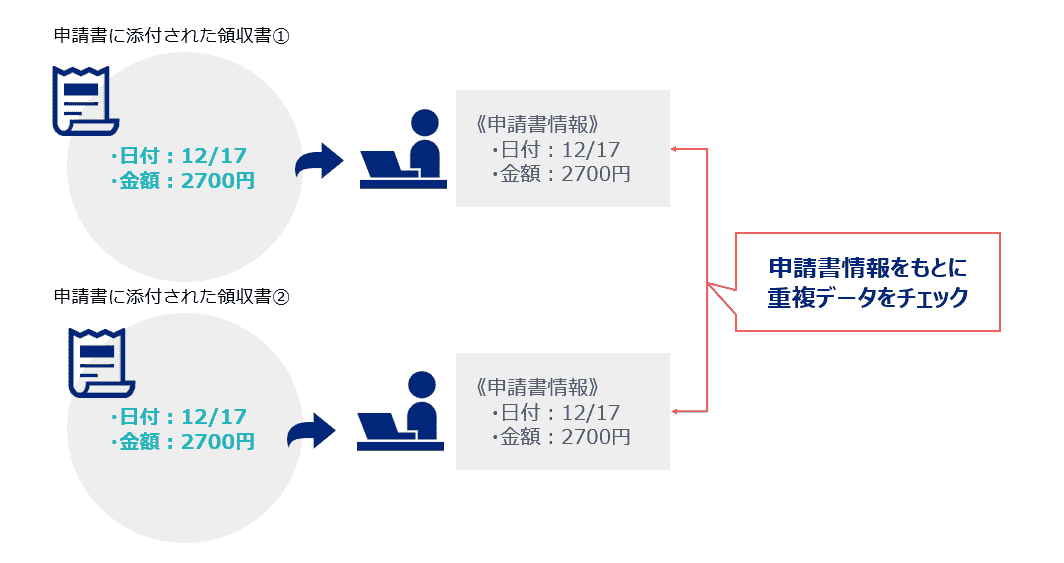
In this way, most of the complicated checks related to expense reimbursement can be automated with the system's functions.
HUE Expense" helps to comply with legal requirements and strengthen internal controls
Our expense reimbursement system, HUE Expense, provides a function that greatly streamlines the checking process related to such expense reimbursement.
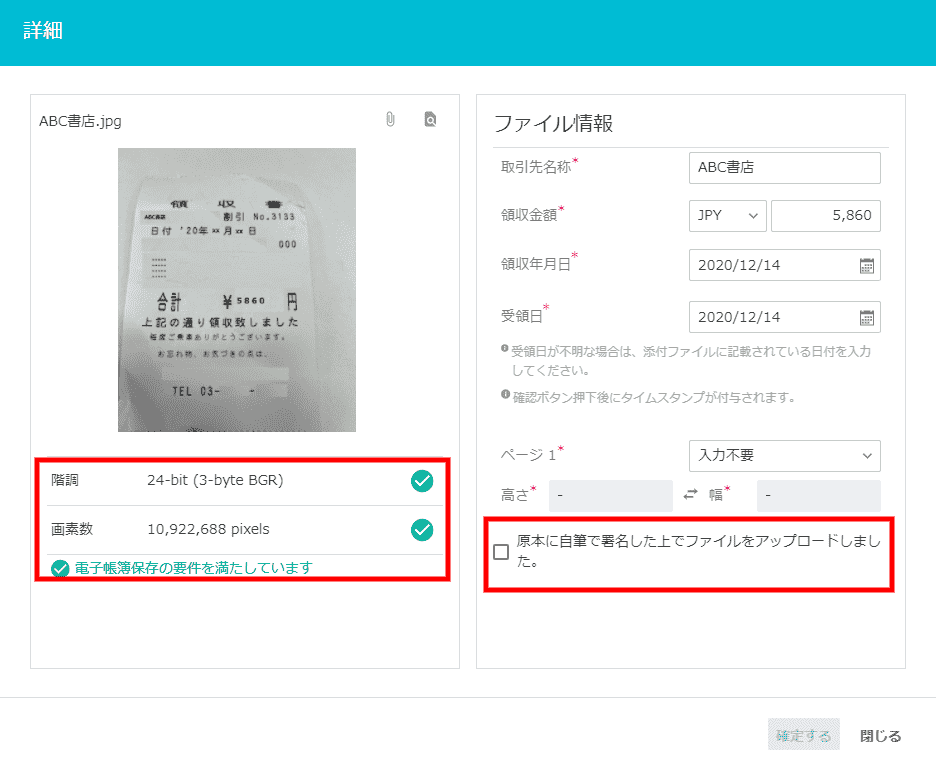
By seamlessly interfacing with Electronic Book Maintenance, a tool for electronic management of vouchers also provided by our company, it is possible to check whether the resolution and the number of days elapsed are in compliance with the requirements of the Electronic Bookkeeping Law. It also provides functions such asprompting the user to confirm whether the original receipt has been signed in one's own handwriting, and checking for duplicate dates with documents already filed.

Related Useful Information
Web Articles
2026/05/22
HUE and HULFT Square Collaboration Solution Launched|Achieving a Data Collaboration Infrastructure that is Highly Resilient to Change
Web Articles
2026/03/30
What is AI that can really be used in the accounting field? What was important in HUE's "AI Application Review

White Paper
2024/04/11
An Introduction to the Invoice System

