
Web Articles System Review Support
11/19/2021
What is a Fixed Asset Management System? Explanation of types and key points for selection!
Fixed asset management systems are necessary for all companies for purposes such as ledger management and depreciation calculations. There are a variety of solutions available in Japan and overseas, but the functions required vary greatly depending on the industry and size of the company.
In this article, we will first discuss the question, "What is a fixed asset management system? and explains the points that "tend to make the difference" when comparing and examining diversified fixed asset management systems, as well as the effects of introducing such systems.

Table of Contents

What is a fixed asset management system?
Functions included in the fixed asset management system
A fixed asset management system is a system that manages the assets owned by a company. Management and processing from the perspectives of "accounting," "tax," and "actual The system is designed to manage the assets owned by a company.
Generally, it is included in the functions, Functions to support ledger management, depreciation, tax reporting, etc. However, more functions are required depending on the type of business and the size of the company. Functions that support upstream operations such as construction in progress, leases, and actual inventory inspections, as well as grouping, signaling, and recognition measurement of assets for impairment The main peripheral areas include functions such as the following.
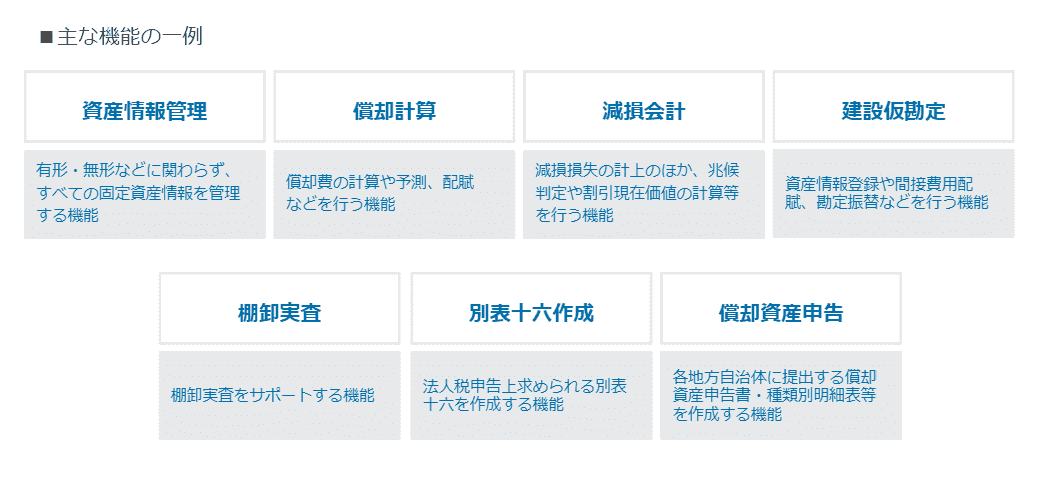
Classification of Fixed Asset Management Systems

Various types of solutions for fixed assets are available from domestic and foreign vendors. The following are some of the classifications
Fixed asset subsystems of foreign packages
This is the case where a fixed asset subsystem within an ERP package provided by a foreign company is used. While the system can be seamlessly integrated with the financial accounting and purchasing areas, it is designed for overseas use and is weakly adapted to Japanese tax laws, and may not be able to adequately respond to legal changes in the preparation of Appendix XVI and changes in depreciation methods, etc.
Dedicated fixed asset subsystems of domestic packages
This pattern is to use a system developed by a domestic vendor exclusively for fixed assets. It is characterized by its stable response to Japanese tax laws and legal amendments, etc. On the other hand, since many packages are developed mainly targeting small and medium-sized companies, individual add-ons and customization may be required for use by large companies and industries with large asset management scale (manufacturing, infrastructure, etc.).
Packages for small corporations
This is a pattern of using buy-out package software for small-scale corporations. For purposes such as systemization limited to amortization calculations, it is possible to guarantee operations with minimal investment. On the other hand, since the functions are very limited, medium-sized or larger corporations cannot perform the necessary accounting processing, and a great deal of manual and Excel management work is required.
Inventory / physical inventory management dedicated systems
There are also systems that are designed only for periodic physical inventory inspections and physical inventory management. Since they do not include functions for accounting and tax processing, they can be introduced at a very low cost. On the other hand, it should be noted that accounting, tax, and other systems need to be installed separately, and interfaces between systems need to be built.
How to choose the right fixed asset management system for your company
So, among the above types of fixed asset management systems, how should you choose the right one for your company? Here, we will explain two major points.
Point 1: Understand the necessary business areas based on the characteristics of your company.
For example, the manufacturing industry may require a more sophisticated system than other industries because of the large number of assets at its factory locations. Other distinctive operations exist, such as a multi-store retailer that needs to manage asset retirement obligations and impairment for each store. When selecting a fixed asset management system, it is important to confirm whether the system can handle the necessary operations based on the characteristics of your industry and other factors.
For more information, click here: [For the manufacturing industry] Four points to consider when comparing fixed asset management systems!
Another area that tends to be complicated is the management of construction in progress, but there are not many fixed asset management systems that support even construction in progress management, because operations and management differ greatly depending on the type of industry and business category. Especially in the retail and service industries, where a large amount of subcontract work is performed, the volume of quotation details can be enormous, and the process of assigning information such as "which details become assets or expenses" based on quotation details (i.e., construction in progress adjustment) can be complicated. Therefore, it is an important point to select a fixed asset management system that can handle construction in progress.
Click here for more information: What is a construction in progress management system? What is a construction in progress account management system?
Thus, when selecting a fixed asset management system, it is important to confirm whether the system can handle the necessary operations based on the characteristics of your company's industry and other factors.
Point 2: Confirm support for tax reporting and future changes in accounting standards.

The area of fixed assets is one that is susceptible to changes in laws and regulations, such as the preparation of depreciable asset declarations and Appendix XVI, not to mention depreciation calculations in accordance with laws and regulations. In addition, system modifications are likely to occur as a result of changes in accounting standards, such as IFRS and lease accounting standards. Therefore, it is important to ensure that system upgrades are provided promptly upon the occurrence of legal or system revisions.
Ifthe support is inadequate, there may be cases where a large amount of information is managed outside the system, such as Excel, or a large amount of money is required to upgrade the system , so it is necessary to fully check the system, focusing on its past performance.
Related articles:
Advantages that can be claimed when applying for a fixed asset management system
Especially for large companies, there are many cases where the requirements cannot be achieved with the functions of a foreign ERP or one of the functions in an accounting system, and a dedicated system must be introduced.
Since the introduction of a specialized system is highly difficult to apply for, and in many cases, a clear explanation of the benefits is required, the following is a summary of common "expected benefits from the introduction of a specialized system.
Advantage 1: Increased operational efficiency
Specialized systems for fixed assets provide detailed functions that are not available in ERP or functions within accounting systems. It is possible to automatically create Appendix XVI without individual development, and to create reports such as increase/decrease tally sheets according to the layout required by the standard functions. In addition, by setting up an electronic workflow for asset registration, etc., paperless operations can also be realized.
In addition to the "elimination of work," the reduction of the area managed by Excel, etc. reduces Excel maintenance costs, and in cases where paper documents are waiting to be sent, the lead time for approval can be reduced, so in many cases, the total reduction effect is appealed. In the case of foreign-affiliated ERP systems, for example, the total reduction in costs is often emphasized.
Advantage 2: Cost leveling in response to legal and accounting system changes
In the case of foreign ERP systems, even if the usual maintenance fee is not that high, a large amount of upgrade cost may be required when the law or system is revised. Therefore, there may be a case to use cost equalization as a reason for filing an appeal under the guise of stable response to legal revisions, rather than just a simple comparison of running costs.
Advantage (3): Elimination of human resources
For example, if Excel is used to calculate allocations, calculate impairment losses, and manage asset retirement obligations at the time of provisional liquidation, the work may be assigned to a specific person, and there may be risks of handover and calculation errors. The system can cover these areas, and there are cases in which a superior can be assembled under the guise of being able to guarantee operations by simply inputting information according to the system.
Select the best fixed asset management system for your company.
As you can see, there are a wide variety of fixed asset management systems, but it is important to select a solution that can solve your company's issues by keeping the points in mind and clarifying the axis of comparison and consideration.
In our company, Works Applications, HUE Asset, a fixed asset management system for large companies a fixed asset management system for large enterprises. HUE Asset covers the functions required by large companies in each industry and sector, and can improve operational efficiency in a wide range of areas, such as leases, construction in progress, and inventories. If you are considering replacing your accounting system with a foreign package or accounting system, please consider our system.
Related Useful Information
Web Articles
2026/01/21
Explanation of the 2026 Tax Reform Proposal for Accounting and Finance - What will change from a practical perspective? What are the changes from a practical perspective?

Web Articles
2025/11/28
Companies Subject to the New Lease Accounting Standards [Quick Reference] and What Subject Companies Need to Keep in Mind

Web Articles
2025/11/28
New Lease Accounting Standard and Lease Contracts

Related Case Studies
Nankai Electric Railway x WAP talks about the "overwhelming return generated by 'add-on zero ERP'".
Nankai Electric Railway Co.

Nankai Electric Railway introduces HUE DI and upgrades HUE, Building a Management Foundation that Continues to Adapt to Change
Nankai Electric Railway Co.
Inventory preparation man-hours drastically reduced. HUE" in a few hours
Huis Ten Bosch Corporation