
Accounting / Expense Reimbursement
Seirei Fukushi Jigyodan (Social Welfare Corporation)
Reduction of time required for expense reimbursement to one-eighth!
Aiming to realize cashless DX with HUE Expense

Seirei Fukushi Jigyodan (Seirei Welfare Foundation), a social welfare corporation, was founded in 1930 and celebrated its 90th anniversary this year. It has developed a wide range of businesses based on the pillars of "health, medical care, welfare, and long-term care services," and provides comprehensive human services, with 212 facilities and 514 businesses nationwide (as of April 2021). It contributes to society through various initiatives, such as environmental activities, support for disaster-stricken areas, and support for the success of women and employees from other countries.
In April 2020, Seirei Fukushi Jigyodan introduced "HUE" by Works Applications Inc. (hereinafter referred to as "Works") as its core system, and has realized a reduction in work man-hours in the area of financial accounting, which requires processing according to the unique accounting standards of social welfare corporations, including the area of expense reimbursement.
In this interview, we talked to the head office of Seirei Fukushi Jigyodan, which is actually using "HUE Expense" in its business operations, about the current operation status and the effects of the system after its introduction.

HUE Expense at the head office of Seirei Welfare Organization Interview participants:
Mr. Masayuki Tamanaga (Manager, Accounting Section, Finance Department, Corporate Headquarters)
Mr. Taku Yamauchi (Manager, Planning Section, General Planning Office, Corporate Headquarters)
Ms. Mika Atsumi (Accounting Section, Finance Department, Corporate Headquarters)
Aiming to "minimize inputs and maximize outputs
-First of all, please tell us about the background of your HUE implementation and what made you decide to use it.
Mr. Tamanaga:
At the time we started to consider HUE, the maintenance period of the server of the previous system was about to expire in 2020, and we were also thinking about the future of the accounting department. We wanted to shift the weight of input operations, such as bookkeeping, to the analysis of accounting data and management support, which were originally required. To achieve this, we first thought it was necessary to reduce the input work, so we reviewed the system once again. The accounting standards for social welfare corporations have unique standards, and we decided that a system that specialized in these standards would be difficult for a large corporation like ours to operate, and more importantly, would not achieve our goal of "minimizing inputs and maximizing outputs," so we selected HUE, an ERP that would enable us to achieve our goal.
In the area of expense reimbursement, we looked at expense reimbursement systems other than HUE Expense, but the key point was that HUE Expense not only had a complete set of functions, but could also be used directly connected to our accounting system. Another appealing point was that HUE Expense has a licensing structure that makes it easy to promote business improvement. Many general expense reimbursement systems are licensed based on the number of users, and if the scope of use is expanded over the long term, the cost is likely to increase. However, HUE has a licensing structure based on the size of the corporation, so we felt that we could proceed with business improvement without worry.
The introduction of HUE Expense has reduced work hours to one-eighth!
-Please tell us how you are using HUE Expense.
Mr. Tamanaga:
First, HUE Expense started its operation at the four offices that operate in the corporate headquarters building. Most of the staff at the corporate headquarters use HUE Expense for reimbursement of travel and transportation expenses incurred when visiting each facility. Outside of the corporate headquarters, employees of the Senior Citizens Public Service Department, which operates fee-based nursing homes, employees of the Home and Welfare Service Department, which promotes various welfare service businesses, and employees of the offices commissioned by Hamamatsu City to provide consultation services for living independence are using the system to apply for and be reimbursed for travel and out-of-town transportation expenses.
-Please tell us about the changes and effects after the introduction of HUE Expense.
Mr. Tamanaga:
The HUE Expense system was introduced to systemize expense reimbursement, which had previously been done entirely on paper and in cash. At the corporate headquarters, where HUE Expense has already been introduced, the time required for cash reimbursement by accounting staff has been reduced from 2 hours/day to 10 to 15 minutes/day.
Mr. Atsumi:
The introduction of HUE Expense has eliminated the need to receive and deliver cash, making the work much easier. The work of counting and reconciling cash that had been performed in the past has also been eliminated, and voucher generation has been automated, saving a great deal of work at the time of reimbursement. The frequency of risky visits to financial institutions has also been reduced, which I feel is a big advantage.
Mr. Yamauchi:
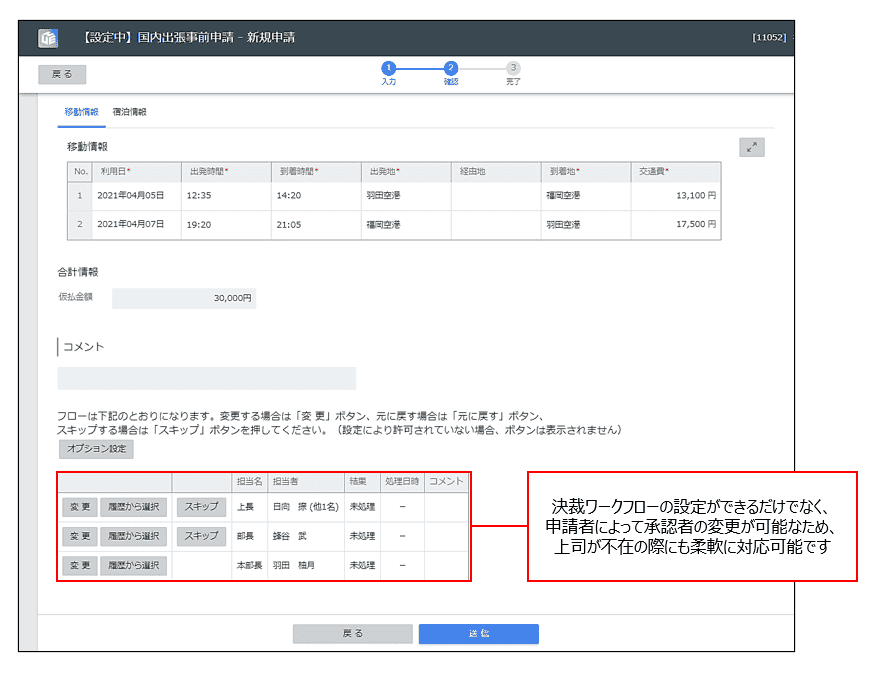
From the applicant's point of view, the system eliminated the need for stamp relays and the need to go looking for a supervisor, and HUE Expense allows the applicant to select an approver at the time of application, which is convenient because the application can be submitted anytime, by anyone, anywhere, regardless of whether that person is present or not. The approval process has also become much easier to see, as we can check the status of each submitted application to see how far it has been approved.
Reference: Change of approver at the time of application
-Please tell us about any other benefits you have experienced in addition to the improvement of business efficiency.
Mr. Tamanaga:
Another big advantage is that it has strengthened internal controls within the corporation. Before the introduction of the system, there were many cases where reimbursements were made after the fact, like an after-the-fact report after a business trip. However, with HUE Expense, it is now possible to require the submission of advance applications for business trips, so that appropriate controls can be applied and visualized, such as not allowing business trips unless the details of the trip have been confirmed in advance and the necessary approvals have been obtained. In addition, the introduction of HUE Expense has enabled us to centralize all business office transfers to the corporate headquarters, which has made it possible to eliminate cash-related travel expenses at each business office, thus contributing to a cashless business environment.
From another point of view, I appreciate the fact that even users who do not have a full-time job of handling the system can change the settings; HUE Expense has a setting screen as a function without knowledge of programming languages, and users close to the field such as myself actually set up the system. Although the burden on the user is greater, the advantages are that we can improve the functionality by changing the settings and can quickly introduce the system to each office that has various operation styles.
-How did your staff members react to the systemization of paper-based operations?
Mr. Tamanaga:
I believe that systemizing operations that were previously conducted on paper is so significant that it can be called a "cultural change. We were also prepared for the inevitable backlash against the introduction of the system, given the mix of staff with different levels of IT literacy and PC skills. However, when we started operating the system, there was surprisingly little opposition. Perhaps it was because the interface of HUE Expense was simple and easy to understand.
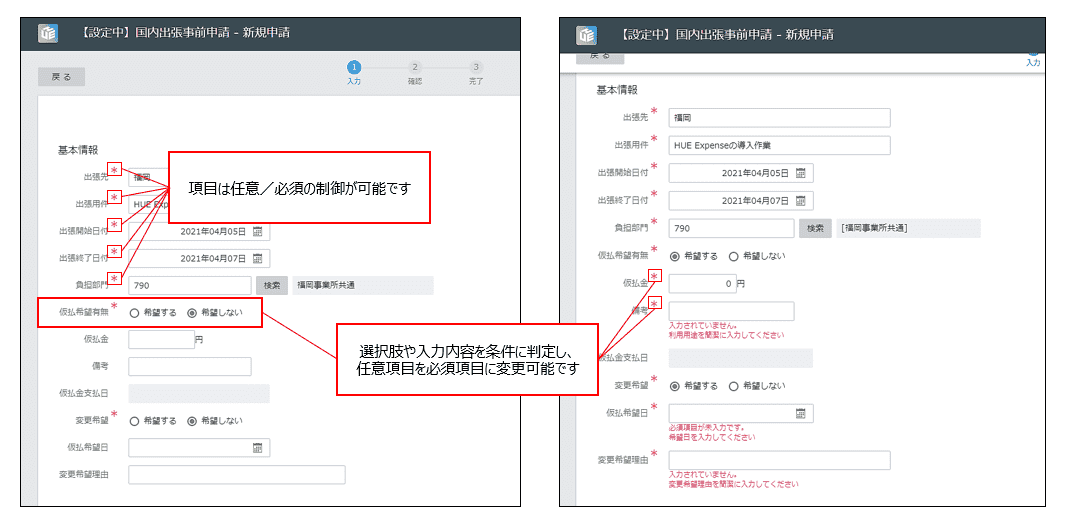
The consultant in charge at Works made careful suggestions on the layout and control of the application screen, and we devised a way to minimize the applicant's input load as much as possible, and to ensure that the application is submitted without omissions. Specifically, for example, we set the items that we wanted applicants to be sure to enter as required fields, so that the application would be completed naturally by entering them in the order from the top of the form. In fact, any staff member, regardless of length of tenure, can use the system, and even those who have some resistance to the system have found it "surprisingly easy to use," which is a big plus.
Reference: Layout setting of HUE Expense
Highly evaluated the speed with which the consultant in charge was able to resolve issues
Mr. Tamanaga:
I did not have much experience in system implementation, so when we first started implementing HUE, it was difficult for me to figure out where to touch to make HUE Expense work the way I wanted and achieve what I wanted. However, even when I had questions, the consultant in charge at Works gave me detailed instructions at regular meetings and responded very quickly to my inquiries on the @SUPPORT web forum, so I was able to quickly resolve the issues and move forward. I believe that the correspondence with the consultant that remains on that @SUPPORT is the best intellectual property of all and will be useful in future operations.
As a result, in the last few months, I am beginning to understand the configuration of the system myself and am able to set up and try out things I want to do on my own. I am extremely grateful to the consultant in charge of the works for his quick and careful guidance.
Aiming for further reduction of work man-hours and cashless operation by expanding the scope of use
-What are your plans for the future?
Mr. Tamanaga:
In February, the system began operating at our business units, mainly special nursing homes for the elderly. In March, we are planning to launch the system at hospital facilities with the largest number of beds in our group. We are planning to gradually expand the use of HUE Expense to other offices after the budget and financial closing operations are settled, and we would like to maximize the use of HUE Expense throughout the corporation.
In particular, the hospital offices make many business trips, and cash reimbursement operations at the office alone are extremely time-consuming, so we expect the introduction of HUE Expense to have a significant effect. Our goal in introducing the system is, of course, to improve operational efficiency, but we also want to promote cashless operations. Until now, our corporation has used cash for expense reimbursements and bank payments, but in the recent trend toward cashless operations, we have realized the risks associated with holding on to cash itself and the fact that the presence of cash can hinder our business efficiency. By utilizing HUE Expense, we hope to realize an efficient and speedy expense reimbursement system without having to carry cash at each office, thereby realizing cashless operations.
In addition, we hope to utilize this system to promote DX. The concept of DX is still unfamiliar to the general public, but we believe that the first step is to digitize paper operations and processing. I hope that by using HUE Expense, the general public will be able to grasp this image even a little.
-Thank you very much for your time today.
This article is current as of January 2021.
Related Case Studies
Nankai Electric Railway x WAP talks about the "overwhelming return generated by 'add-on zero ERP'".
Nankai Electric Railway Co.

Nankai Electric Railway introduces HUE DI and upgrades HUE, Building a Management Foundation that Continues to Adapt to Change
Nankai Electric Railway Co.
Paperless and business reform one step at a time! Effects of HUE implementation and future prospects
YANASE & CO.,LTD.