
Web Articles Paperless
2021/06/25
What are the points to consider for Web-EDI in purchasing systems? Advantages of Web-EDI and points to be noted when selecting a system.
Web-EDI is a function that realizes various benefits by enabling communication with suppliers directly on the system, such as quotation, order placement, acceptance inspection, and payment. While systemization is expected to produce easily understandable benefits such as paperless and reduced input, the detailed benefits and points to be considered when examining the system are not well known.
This article explains the benefits of considering Web-EDI in conjunction with a purchasing system and points to note when considering the system, based on the characteristics of the business.

Table of Contents

What is Web-EDI in purchasing systems?
Web-EDI is a system for conducting business-to-business transactions such as quotation, order placement, order acceptance, acceptance inspection, billing, and payment via a Web browser. Web-EDI is often regarded as an indispensable requirement for purchasing management systems these days, as it enables transactions with suppliers to be conducted in a paperless manner, greatly improving operational efficiency andpreventing fraud and strengthening controls in purchasing operations.
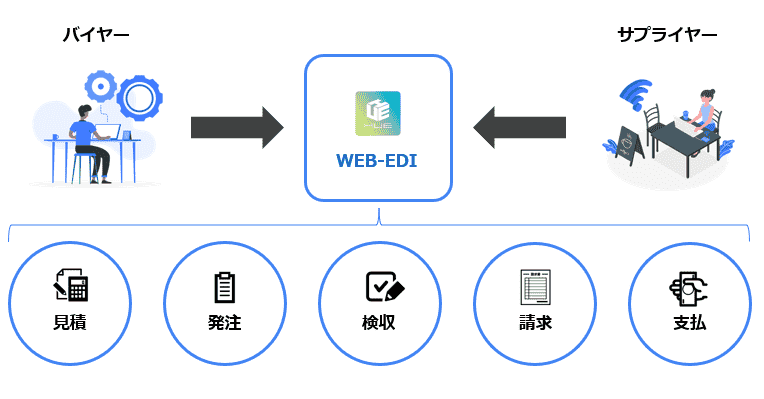
Four advantages of choosing a purchasing system that supports Web-EDI
So what are the advantages of having Web-EDI in a purchasing system? Here are four typical benefits for each operation from quotation to payment.
(1) Accumulate detailed quotation information without inputting data
It is not easy to manage quotations individually presented by e-mail or fax, even if you want to refer to past quotations and use them to judge the validity of the current quotation or to adjust prices.
However, with Web-EDI, quotation information entered by suppliers is automatically stored, so a database of quotation information can be created and easily accessed without any hassle.
(2) Complete the exchange of orders and purchase orders at the touch of a button
In many cases, ordering operations are complicated, with order forms sent by e-mail or fax, order acceptance and delivery date responses received individually, and input into the system.
Web-EDI makes it possible to place and accept orders at the touch of a button. After the order is completed, when the supplier places the order and receives the delivery date reply via Web-EDI, the details of the order are reflected in the purchasing system.
The supplier can confirm the order acceptance and delivery date response via e-mail notification and the system, reducing the need to re-enter the information into the system or to confirm each order individually by phone or e-mail.
(3) Reduction of work omissions by listing tasks and reminding of pending deliveries
When receiving quotation requests and orders from various clients via e-mail or fax, individual e-mails and faxes may go missing or the response may be forgotten, leading to omissions in quotation responses and delays in delivery.
With Web-EDI, the latest information on transactions that need to be handled in-house This enables less leakage than with e-mail or fax.
Furthermore, if a delivery date has passed but has not been registered as accepted, the system can send a reminder e-mail to the supplier to ensure that there are no further omissions.
This eliminates the need for the requesting department to log in multiple times, providing benefits to both administrators and users.
(4) Paperless communication of payment schedule
When receiving invoices from multiple companies and making payments, it takes an enormous amount of time to input the invoice details into the system; if Web-EDI allows suppliers to input the invoice details, there is no need to input the billing information.
In addition, large companies, especially those in the manufacturing industry, collect monthly payment schedules for each supplier and send them to their suppliers. Even companies that use EDI for quotation and order exchange often do this work on paper, requiring a great deal of time and effort to enclose and send the paperwork each month.
However, if monthly payment schedule information registered in a purchasing management system is disclosed and exchanged via Web-EDI,
it is possible to greatly improve efficiency.
Click here for a cutting-edge case study of "paperless purchasing".
Key Points for Selecting a Purchasing System Compatible with Web-EDI
Although Web-EDI appears to be convenient at first glance, it is important to select the system carefully because what it can do and the effects of its introduction vary depending on the system you choose. The following points require special attention.
(1) Do you have the functions to achieve the expected introduction effect?
Even if Web-EDI is referred to all at once, what it can do differs greatly depending on the system. For example, some systems can only provide quotations and orders, but not detailed processing such as payment. It is important to take stock of your company's operations, prioritize them, and select a system that can deliver the desired results.
(2) Security measures
Since Web-EDI involves exchanging information over the Internet, it is important to ensure that the system meets security requirements, from basic measures such as preventing SQL injection (*1) to the use of robots to perform detailed processing. It is necessary to confirm that the security requirements meet your company's policies, including basic measures to prevent SQL injection (*1) and security measures to withstand brute force attacks by robots.
HUE Purchase, a purchasing management system for large companies, implements Web-EDI as a standard feature.
It enables paperless processing of all interactions from quotation to payment, while meeting the high security requirements for large companies. In addition, HUE Purchase is equipped with abundant functions such asinventory management of stored goods andpunch-out linkage, and can contribute to a significant improvement in the efficiency of purchasing operations.
We will continue to provide useful information related to system selection, such as a case study of a major company that has achieved paperless purchasing operations. If you are interested, please download and review the report.
For product inquiries, please contact us at
HERE
Related Useful Information
Web Articles
February 24, 2026
What has changed from the Act against Delay in Payment of Subcontract Proceeds, Etc. to Subcontractors (Act against Delay in Payment of Subcontract Proceeds, Etc. to Subcontractors)? What has changed from the Act against Delay in Payment of Subcontract Proceeds, Etc. to Subcontractors?

Web Articles
2026/01/21
Explanation of the 2026 Tax Reform Proposal for Accounting and Finance - What will change from a practical perspective? What are the changes from a practical perspective?

White Paper
2025/09/18
Case Studies of Purchasing and Procurement Systems in the Manufacturing Industry

Related Case Studies
Nankai Electric Railway x WAP talks about the "overwhelming return generated by 'add-on zero ERP'".
Nankai Electric Railway Co.

Nankai Electric Railway introduces HUE DI and upgrades HUE, Building a Management Foundation that Continues to Adapt to Change
Nankai Electric Railway Co.
HUE Purchase supports 180,000 sheets paperless & invoice system
Kyokuyo Industries Corporation