Web Articles System Review Support
2022/03/08
How to Integrate Core Systems and POS Cash Registers? A thorough explanation of options and benefits!
Many companies that are using or considering the introduction of POS cash registers are probably thinking about linking their core systems with POS cash registers.
In particular, for retailers and other companies with nationwide stores, there are many benefits to be gained by linking the two, such as eliminating the tedious work of typing data into the core system for accounting processes while viewing the data from each store's POS cash register.
This article provides a thorough explanation of how to link mission-critical systems and POS cash registers, as well as points to keep in mind in order to maximize the benefits of the linkage.
Table of Contents

How to link the core system and POS cash register?
There are many ways to integrate a mission-critical system with a POS cash register, and there are many different patterns and advantages and disadvantages. Here we introduce some of the most common methods.
1 Develop an interface
If the POS system and the core system currently in use are to be used as they are, it is possible to realize this by developing a separate linkage program.
For example, it is possible to realize the linkage to the core system by developing a nightly batch linkage program that stores sales data from each store from the POS register to the store's server and sends the data to the server at the head office.
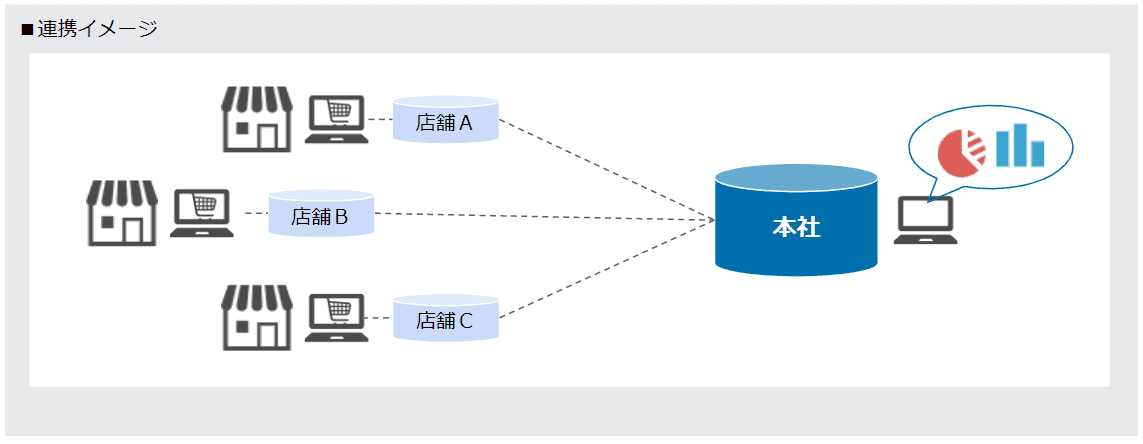
Although man-hours and costs are required to develop the interface , the linkage between POS cash registers and the core system can be realized without changing the system in use or its operation.
2 Introduce a POS system with API functions that can be linked to the core system
With the spread of tablet terminals, the types of POS cash registers have been increasing in recent years, with tablet-type POS cash registers appearing following conventional PC-type and terminal-type POS cash registers, and cloud-type products being developed.
Many of these products are equipped with an API-based data linkage function, making it easy to link data with a company's core system by introducing a POS cash register that can be linked with the company's own core system.
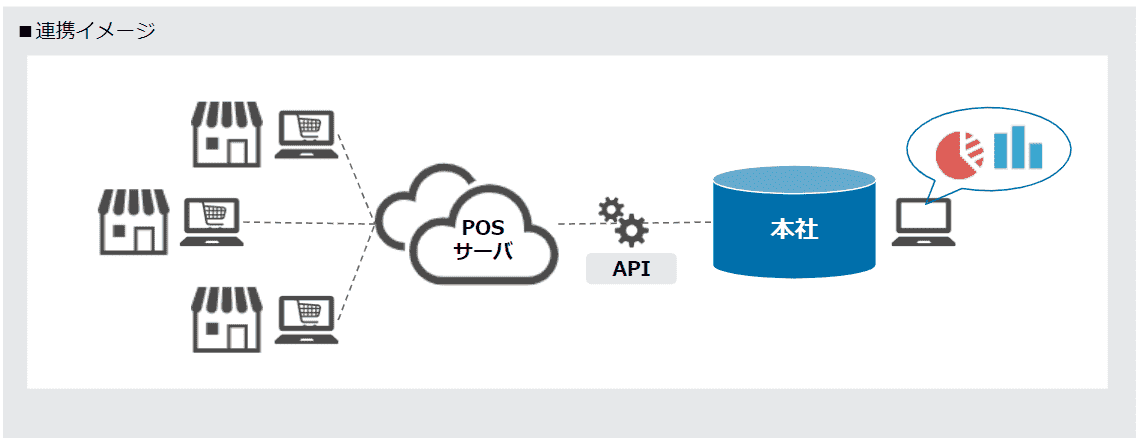
If you can automatically link POS cash register data to your core system in real time, you can quickly grasp the sales status of each store. Another benefit is that data can be reflected in the system without being exported, reducing the risk of information leakage.
Since the method of linking differs depending on each company's product, it is necessary to confirm whether the system can be linked to your company's core system or not before introducing it.
3 Introduce a mission-critical system that covers front-office operations
Some mission-critical systems cover front-line operations, such as a POS system included in a sales management system.
Although there may be various reasons for considering this, such as the aging of the existing core system, data linkage between POS cash registers and the core system can be realized even by renewing the core system.
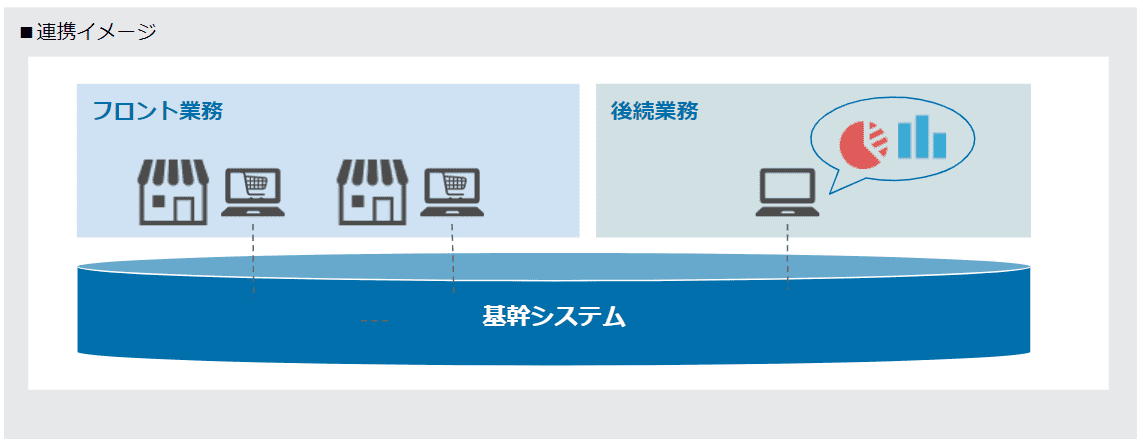
Since the system is renewed not only for front-line operations but also for the scope of subsequent operations, the burden on users due to operational changes and system changes will be high. However, if you can choose the right system for your company from a wide range of products, such as those specialized for the retail industry, you can gain significant benefits in terms of overall operational efficiency.
Advantages of Linking Core Systems and POS Cash Registers
So what are the actual benefits of integrating a POS cash register with a core system? Here are two of the most commonly cited benefits.
1 Reduce costs by streamlining operations
When POS cash registers and mission-critical systems are linked, the time and effort required for data entry is reduced, and input errors can be prevented.
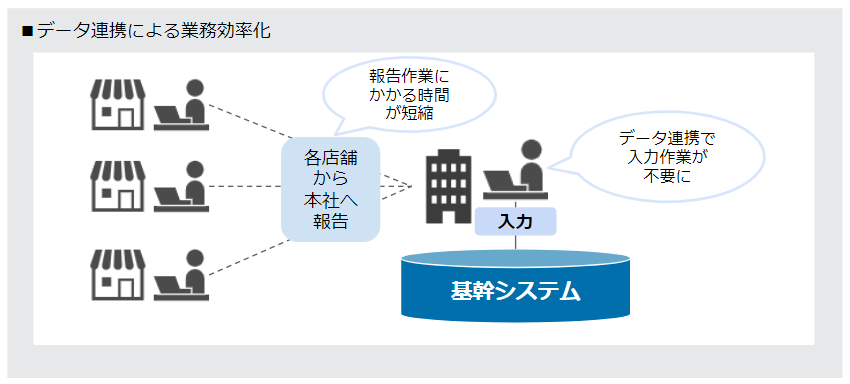
Data entered at the POS cash register is directly linked to the mission-critical system, so there is no need for double entry. The system is also able to provide a more efficient and efficient sales process. Store employees spend much less time reporting sales, and even if they spend 15 minutes a day on reporting, they can achieve significant annual labor cost savings.
2 Link data from the core system and use it for business improvement and marketing
POS cash registers are equipped with data collection features that allow them to record a variety of information, including sales, customer, and inventory information.
By combining data from these POS cash registers with data held in the core system without any hassle, it is possible to improve operations throughout the entire process from the front desk to the back office , and by utilizing the data gathered for marketing and other purposes, it can be used for business growth.
For example, by linking POS cash register data to the sales management area of the core system, you can accurately grasp inventory information at each location in real time, effectively replenish products, and realize appropriate inventory management.
In addition, it is also possible to link POS cash register data to data in the accounting area of the core system to strengthen the company's management accounting. This enables analysis from various angles, such as by business, store, or department, and allows for a more detailed understanding of sales trends, costs, etc., and the ability to take action.
Pitfalls of Linking POS Cash Register and Core System
Now that we have introduced the method and benefits of linking POS cash registers and mission-critical systems, it is not enough to simply link them.
It is important to thoroughly check the linkage in advance to avoid the following results: the information you wanted to use for analysis could not be linked even though the linkage was established, or the core system was renewed together with the POS cash register, but there were operations that could not be handled by the new system.
In this section, we will introduce some of the pitfalls that can occur when linking a POS cash register to a core system.
Case 1: The core system cannot receive all the data linked from the POS cash register.
A POS cash register can collect not only sales information such as "when," "which products," "how many," "which payment method," and "how much," but also various other information such as product, customer, and reservation information.
By linking this information to the core system, it may be possible to analyze it together with the accounting information in the core system and use it for business strategy.
However, depending on the core system to be linked, there may be cases in which the items that can be retained and the axis of information inquiry may be limited.
For example, if you want to view sales and SG&A expenses by product category, you need to receive both "sales data" and "information on products sold" from the linked core system. Without the ability to query data by product category, you would have to output the data and process it according to the axis of analysis in order to perform the desired analysis.
In order to avoid the situation where data cannot be utilized even though it has been linked, it is important to confirm in advance whetherthe core system can receive the data necessary for analysis according to the company's business and the products it handles, and whether the information can be queried according to the axis of analysis.
Case 2: Data reflection to the core system is slow during periods of rapid increase in data volume.
During busy periods such as the year-end and New Year holidays, the amount of data linked from the POS cash register to the core system increases rapidly.
In particular, if you develop your own nighttime batch linkage program to link the data, the accumulated data will be processed during the night, so when the maximum data processing volume increases rapidly, it may take some time for the data to be reflected in the core system.
In order to ensure that the necessary data can be queried at the desired time, it is necessary to confirm whether the system can handle the timing of linkage and the maximum amount of data to be processed, as well as the linkage method.
Case 3: The company's own operations that cannot be handled by the new core system remain.
When implementing a mission-critical system that covers front-line operations, there are cases where data linkage was achieved, but a part of the company's operations could not be secured by the new mission-critical system.
In the front-office operations, there are various business patterns such as "cross transactions are required" or "processing is required according to the power relationship with business partners," depending on the type of industry or business category.
When selecting a core system, it is necessary to organize the company's business operations and check whether they can be summarized and secured as requirements as shown below.
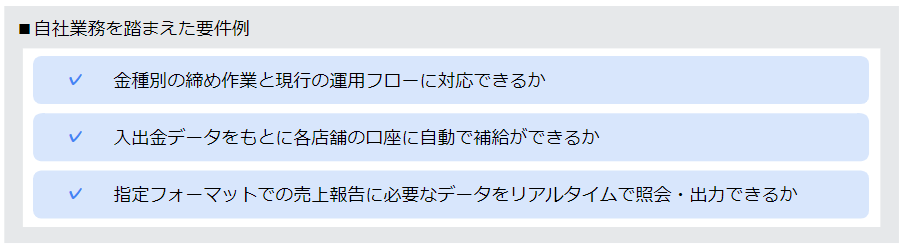
Therefore, it is important to focus not only on whether or not they can be linked, but also on whether or not they can be adapted to your company's business and operations.
Click here to download "Key Points for Preparation of Accounting System RFP without Failure
The core system should be suitable for your company's front desk operations!
As described above, there are various advantages to be gained by linking POS cash registers and mission-critical systems, but in some cases, depending on the linking method, disadvantages may arise without fully considering the company's business operations. When renewing your core system, it is important to organize your requirements based on your entire business, including the front office, so that you can select a system that is suitable for your company.
The ERP package system provided by Works Applications, Inc. ERP package system "HUE" for major companies HUE, an ERP package system for major companies, is a solution for retailers with multiple stores, and is equipped with functions that can handle tenant management, sales and payment data reconciliation, and has a proven track record of operational improvement through linkage with POS cash registers.
For more information on our solutions for retailers, please visit
. If you are interested in our products, please contact us from the product introduction page.

Related Useful Information
Video
August 3, 2026
[ERP Tech Journal]
Learning from Works Applications’ Successes and Failures: The Reality of Promoting AI Adoption

Video
July 17, 2026
[ERP Tech Journal]
Breaking Free from “AI You Can’t Trust with Business Operations.”

Web Articles
June 25, 2026
[Starting in Fiscal Year 2026] How Will the Security Measures Evaluation System Change Practical Procedures for System Procurement?

Related Case Studies
Paperless and business reform one step at a time! Effects of HUE implementation and future prospects
YANASE & CO.,LTD.

Reduced 1 million documents per year and realized a paperless office.
KAJIMA CORPORATION

Optimizing the entire ERP system with HUE's standard functions by moving away from customization
EXSOL Corporation