Accounting / Fixed Assets
Imabari Shipbuilding Co., Ltd.
Revamping the Group’s Accounting Infrastructure with “Fit to Standard” as the Core
Simultaneous Go-Live as Planned Through a Group-Wide Implementation Project Across Nine Companies

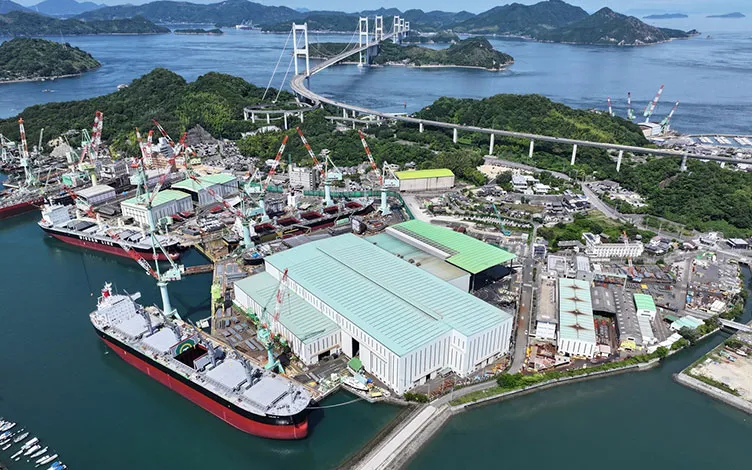
Imabari Shipbuilding Co., Ltd. is Japan’s leading specialized shipbuilder, supporting the Japanese shipbuilding industry, which is gaining increasing importance as a national strategic sector. Operating 13 shipyards across Japan, the company handles the construction and repair of a wide variety of vessels. Building on over a century of experience and achievements since its founding, the company is committed to building environmentally friendly and safer ships.
■ The Three Products Deployed in This Implementation
Financial and Management Accounting System “HUE Financials & Strategy”
Accounts Receivable and Payable Management System “HUE Accounts Payable/Receivable”
Fixed Asset Management System “HUE Asset”
To modernize the management infrastructure supporting these operations and eliminate the complexity and reliance on specific individuals caused by custom-developed systems, the company adopted Works Applications’ (hereinafter “WAP”) cloud ERP “HUE.” This enabled the early realization of simultaneous go-live across nine group companies.In this article, we will cover everything from the background leading to the adoption of “HUE” to the key factors that ensured the project’s steady progress, as well as the current status of its utilization and future prospects.
Interview Participants:
Imabari Shipbuilding Co., Ltd. Executive Officer, Head of Marugame Accounting: Mr. Shiro Kamino
Accounting & Finance Division, Head of Accounting Group: Mr. Kyosuke Kishizoe
[Challenges and Background] Moving Away from the Old System, Which Had Become Overly Dependent on Individual Expertise and Increasingly Complex
Please tell us about your respective roles.
Mr. Kamino:
I served as the project manager for the implementation project. At the time of implementation, I was based at the Accounting and Finance Division at the Imabari headquarters, but I have since been transferred to the Marugame Business Division. As an Executive Officer, I am responsible for overall decision-making regarding the Group’s accounting and finance, while primarily overseeing the accounting for the Marugame and Saijo plants, as well as our overseas subsidiaries.
Mr. Kishizoe:
I served as the project leader under Mr. Kanno. At the time, I was in charge of accounting at the Hiroshima Plant, but I was transferred to Imabari in a sort of swap with Mr. Kanno, and I am currently based at the Accounting and Finance Division at headquarters as the Accounting Group Manager.
Please tell us about the background and challenges at the time HUE was implemented.
Mr. Kamino:
The end of support for our legacy accounting system prompted us to begin considering whether to upgrade to a newer version or replace it with an entirely new system. The old system had become structurally complex due to layers of custom development, which increased the maintenance burden on our IT staff and made the system’s operations a “black box”—a major challenge.
Furthermore, every time there was a legal amendment—such as the introduction of the invoice system—we had to apply correction patches, which required additional development costs and time. Given this situation, there was a growing internal demand to introduce a system that did not require version upgrades, and we took the step of selecting a new system to optimize our operational workload.
Please tell us how you first learned about HUE and why it was selected.
Mr. Kishizoe:
I first learned about HUE at a trade show that the system administrator and I attended to gather information. First of all, I was impressed by the comprehensiveness of its features.We conducted extensive research on products from other companies as well, and ultimately invited six companies to give presentations; we selected HUE from among them. Although the initial setup does require a certain amount of effort, we were greatly attracted to the “no customization” concept, which allows for flexible handling of virtually anything within the scope of standard features.
[Key to Successful Implementation] A Group-Wide Modernization Project
This time, the system was implemented and launched simultaneously across nine group companies—was this part of the strategy from the product selection phase?
Mr. Kanno:
Yes.We had decided as early as the product selection stage that the nine companies in the Imabari Shipbuilding Group, including our own, would use the same system. While we had already standardized our bookkeeping and accounting processes using our previous system, there were inconsistencies across systems for fixed asset management, accounts receivable, and accounts payable. Therefore, we decided to consolidate these functions into HUE as part of this system replacement to improve efficiency.
How was the implementation project team structured?
Mr. Kanno:
We formed a team of 12 members, including staff from our company’s Finance and Accounting Division, accounting personnel from group companies, and information systems staff. While we appointed the leader for the initial launch phase, we opened up certain roles to open recruitment to ensure that members with a strong sense of the challenges at hand would participate.
With nine companies involved, wasn’t it difficult to align expectations among all stakeholders during the implementation?
Mr. Kishizoe:
While there are some differences in how internal operations are conducted from company to company, there was already existing communication among accounting staff across the group. I feel that, even with this implementation, we were able to reach consensus smoothly by ensuring thorough communication.
Were there any specific strategies you employed regarding the division of roles and collaboration among team members?
Mr. Kishizoe:
First, we divided responsibilities by area and assigned a leader to each. We held regular sessions with each leader, along with Mr. Kamino and myself—who were in charge of driving the overall project—and WAP, proceeding while periodically confirming the overall direction. We made a point of sharing the details of these sessions with the other members each time to ensure everyone was on the same page.In addition, we held quarterly meetings to report project progress to senior management and seek their input on decisions as needed; key members attended these sessions.
Given that we had assembled a team of elite members with a deep understanding of their respective business operations, balancing the project with their regular duties proved challenging. Consequently, colleagues from each department gradually began to support the project members, and ultimately, nearly everyone from the departments involved in HUE participated, allowing us to advance the project as a cross-group initiative.
After the preparation phase, were there any specific measures you took during pre-launch briefings at each group company?
Mr. Kanno: From the early stages of the
implementation project, we had accounting staff from our group companies participate in sessions as members of the team. Although we also went to each company to provide support during data migration and pre-launch operational training, I believe it was crucial that the staff members themselves were able to proceed with a shared understanding.
Mr. Kishizoe:
Since the accounting staff at each company has limited personnel, we had them focus primarily on rolling out the system to their respective companies once the implementation details had been finalized, in order to minimize disruption to their regular operations as much as possible. I imagine the workload was still heavy, but it was only thanks to the cooperation of each company that we were able to proceed smoothly all the way to go-live.
What factors contributed to your ability to achieve simultaneous go-live on schedule?
Mr. Kishizoe:
WAP initially proposed a go-live date of April 2026, but we wanted to go live earlier and were aiming to move the go-live date up by two months. Since preparations for the fixed assets module took longer than anticipated, the final go-live date was set for March 2026; however, as a result, we were able to achieve stable operation earlier than originally proposed.
Since HUE allows us to expand the scope by configuring settings ourselves even after go-live, I believe it was crucial that we did not try to cram everything into the pre-launch phase but instead assessed the priority of issues and proceeded flexibly.In our case, we decided to address compliance with the new lease accounting standards and the migration of historical transaction data after go-live. I believe that our ability to manage the project appropriately led to the successful implementation of a simultaneous go-live.
[Benefits of Implementation] Immediate Benefits and Stable Operation of HUE
What was the volume of internal inquiries like after the HUE implementation?
Mr. Kishizoe:
While there weren’t many inquiries from the accounting staff after go-live, we received a lot of internal inquiries regarding AR (accounts receivable management) during the initial implementation period, as this module is used by staff outside the accounting department as well. Since we had anticipated this, we held several briefing sessions at each location.In addition, by providing intensive training to key users—who often shared best practices with other users—we’ve been able to use the system without major issues to this day.
Please tell us about usage patterns and the results achieved after implementing HUE.
Mr. Kishizoe:
We had to force the old system to fit our business operations by implementing extensive add-on customizations, but HUE—despite being a “no-customization” solution that requires no additional development—has delivered comparable performance right from the start. This alone makes us feel the benefits of the implementation. HUE is fast, and I’m impressed by the wide range of features—I’m constantly discovering new things it can do.
How well did the system address industry-specific requirements?
Mr. Kishizoe:
In the shipbuilding industry, consistency in output formats and input fields is essential to integrate the data required for cost accounting and management accounting with other systems, such as materials management.HUE offers a high degree of configuration flexibility and a wide range of columns, allowing us to flexibly accommodate these requirements specific to the shipbuilding industry. Even after going live, we have experienced no major issues with data integration, and the system has been operating very stably.
[Future Outlook] Expectations for Future Operational Improvements Revealed by “Fit to Standard”
If you have any future plans regarding the use of HUE, please share them.
Mr. Kanno:
Through our regular maintenance support meetings with WAP, I’ve come to appreciate how well AI and HUE complement each other and the potential they hold. Drawing on case studies from other companies, we hope to actively pursue the use of AI within our own organization as well.
Mr. Kishizoe:
Since we’ve come this far, we’d like to aim for a completely paperless environment. In the future, we hope to achieve this by leveraging HUE AR’s automatic integration with electronic invoicing services and HUE EBM, which automatically stores documents in storage compliant with the Electronic Accounting Records Act. We’d also welcome additional convenient services and feature enhancements that contribute to going paperless.
Do you have any advice or messages you’d like to share with companies considering a system overhaul, based on your experience with this project?
Mr. Kamino:
From the very beginning of the selection process, our company clearly established the policy of “adapting our business operations to the system.” We trusted HUE’s capabilities and proceeded based on HUE’s “Fit to Standard” concept—I believe the project succeeded because we stuck to that policy.
Mr. Kishizoe:
Although things went smoothly overall, there were a few setbacks during the implementation project.It is indeed important to clearly define what you want to achieve and to move forward while maintaining thorough communication with the WAP consultants involved in the implementation. Omissions in communication or misalignments in expectations can lead to rework, so I recommend proceeding carefully, step by step, while ensuring that information is distributed evenly throughout the entire project.
*This article reflects information as of September 2026.
Related Case Studies
Revamping the Accounting Infrastructure of Nine Group Companies with “Fit to Standard” as the Core
Imabari Shipbuilding Co., Ltd.

MIRARTH Holdings’ “Zero Add-On” Case Study: Laying the Foundation for AI × ERP
MIRARTH Holdings Co., Ltd.

Nankai Electric Railway and WAP Discuss the “Overwhelming Returns Generated by ‘Zero-Add-On ERP’”
Nankai Electric Railway Co., Ltd.