
Web Articles System Review Support
2022/02/28
Points to consider when calculating ROI in ERP studies! Explanation of how to clarify return on investment
With the recent momentum for DX promotion, large-scale investments in ERP and other systems are increasing.
In such a situation, there may be many cases where ROI (return on investment) calculations are required in order to make proposals and recommendations in the actual system study process.
In this article, we will explain the key points of ROI calculation in ERP studies, including specific calculation examples.

Table of Contents

What is ROI?

Before explaining the points of ROI calculation in ERP studies, let us briefly explain the premise of ROI.
ROI (Return on Investment ) is a term that refers to "return oninvestment " or "return on investment ratio," and is an indicator that measures how much profit was generated for the amount of money invested.
The higher this indicator is, the higher the ratio of profit to the amount invested. It is sometimes used to measure whether a company has a rate of return, or to determine the return on investment for each specific measure.
Difficulties in calculating ROI when considering ERP
Many people may know the meaning of the term as described above, but many may not know how to proceed when it comes to actually performing the calculations.
In many cases, especially when considering a large-scale system such as ERP, they have difficulty in obtaining a budget and making an offer on the selected product.
When investing in an ERP system, it is common to first consider the issues you want to solve as a starting point.
The issues can be seen by organizing the operations in the current system, and it is easy to intuitively see that the current system is not good enough.
However, when it comes time to make the investment, it tends to be difficult to clearly explain the amount of money that will be saved and the return on investment if the
issues are resolved, because ERP is designed to reduce costs, not improve revenue.
In any case, since a large investment is required to make a system investment in ERP, it is necessary to be able to clearly show the return on investment or ROI in figures and logic.
Three points of ROI calculation in ERP
As mentioned above, the calculation of ROI is an unavoidable step in the ERP study.
Therefore, this chapter introduces three points for calculating ROI from the management's perspective, which is the subject of budgets and proposals.
1. Clarify the reduction of labor costs by improving operational efficiency
The first point is to calculate the effect of reduced labor costs due to more efficient operations.
The following is an image of the calculation.
Calculation example of labor cost reduction by improving operational efficiency]
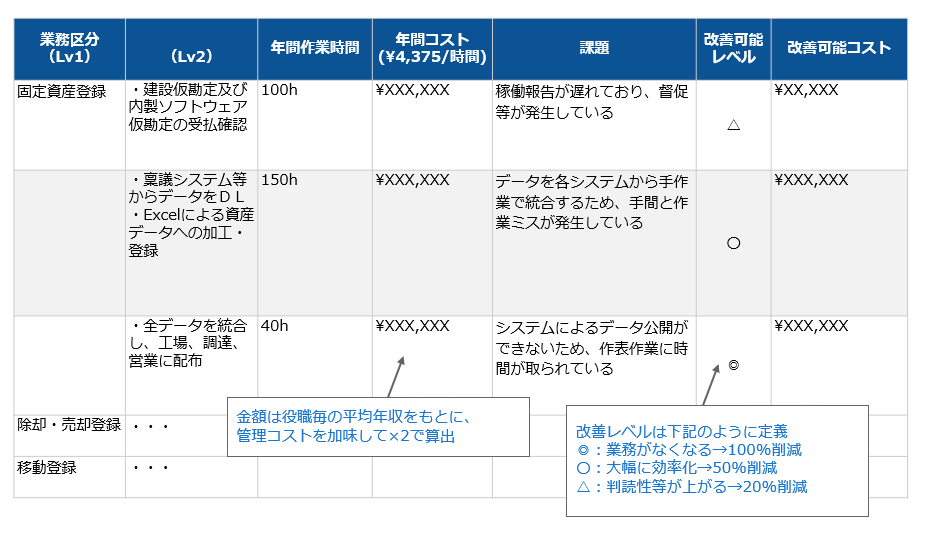
For each operation under consideration for ERP, calculate the annual amount of work hours currently incurred and the amount spent. The amount is calculated as an average for each position, and then doubled based on management costs.
Then, divide the degree of improvement that can be achieved for each job into levels, and set the percentage of reduction effect for each level.
By organizing in this way, the qualitative term "operational efficiency improvement" can be reduced to a specific amount for each operation that is expected to be improved.
2. Clarify cost reductions over the medium to long term
Once you have calculated the annual savings for each operation, the second point is to calculate the cost savings from a medium- to long-term perspective.
With large-scale system investments such as ERP, the initial cost tends to be inflated, giving the impression that the investment amount is large.
However, by incorporating a medium- to long-term perspective, it is possible to contrast the costs incurred over the system's lifecycle and clearly explain the cost reduction benefits.
Without such a perspective, the decision maker's request to keep initial costs down may lead to a situation in which only minimal investment is made and the truly necessary functions and systems are not introduced.
The following is an image of a calculation that incorporates a medium- to long-term perspective.
Example of mid- to long-term cost reduction calculation]
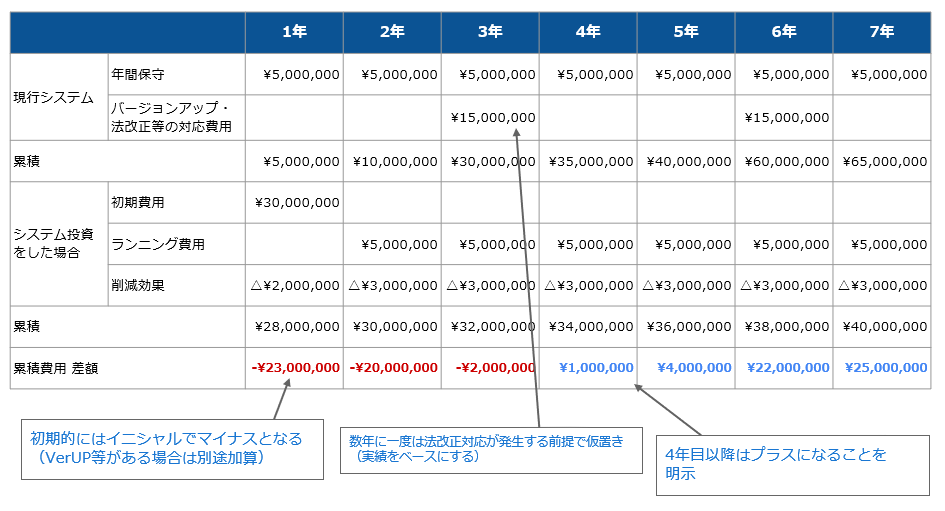
When making calculations, lay out the cumulative amount of annual system investment costs for the current system and the system investment.
For the costs of version upgrades and legal revisions, incorporate the figures by taking actual results into account.
This arrangement will help explain how the initial costs will result in a negative figure for the first few years, but will turn into a positive figure after a few years.
Achieve an ERP implementation that maximizes the effect! For points on ERP selection, see
3.Clarify the effect of governance enhancement and risk reduction
Once the medium- and long-term costs have been calculated, identify the risks that could occur if the investment were not made, for example, input errors due to manual work or omissions in tax returns, against these figures.
After sorting out the risks and impacts, calculate the approximate cost in terms of manpower and time spent to deal with problems such as undeclared tax returns that have occurred in the past, and add it to the annual amount of medium- to long-term costs.
By organizing in this way, the ROI can also include the risk reduction effect that can be obtained by investing in ERP.
ERP Selection Points to Increase ROI

So far, we have introduced a method for calculating ROI in ERP studies.
By converting all the expected benefits to be gained from ERP investment into concrete numbers, you will be able to explain ROI. So, what specific ERP should you choose to increase your ROI?
This chapter introduces the key points required for ERP from the viewpoint of increasing ROI.
1. Is the cost of add-ons and customizations likely to grow?
Since ERP systems are used over the medium to long term in units of several years, various legal and institutional changes will occur during that time.
At such times, the key point is how much the cost of add-ons to the system can be kept to a minimum.
If this point is not carefully considered, for example, the initial cost may be low, but over time, the cost may increase due to various add-ons, and the expected return on investment may not be achieved.
2. Is the system scalable and can it handle the growth of the company?
It is also necessary to assume that the company will grow as it uses the ERP system over time. For example, as a company grows and a number of group companies are added to the ERP system, it may be necessary to consider how the company will grow.
For example, a company may grow to include a number of group companies, or the number of employees may increase, and the number of areas to be systematized may increase.
In such cases, it is important to confirm in advance whether the ERP system will be able to handle such a situation and how much the cost is expected to be. If the system cannot handle the growth of your company, you may end up having to replace the system before you get a return on investment.
To increase ROI, the ERP should be able to be used over the long term as your company grows.
3. Does the system itself have the know-how to improve business efficiency?
It is also important that the ERP itself has the know-how to improve operational efficiency. It is also important that the ERP itself has the know-how to improve operational efficiency.
A recent trend is to fully utilize the efficiency-enhancing know-how in the system by putting the business in the system rather than putting the system in the business, in line with the "Fit to Standard" concept.
By utilizing such a method, it is possible to streamline operations in a novel way, without merely rehashing the current operations.
In order to accelerate business efficiency and increase ROI, it is important that the know-how is accumulated in the system itself.
4. "HUE" ERP system that maximizes ROI
So far, we have introduced the points of ERP consideration necessary to increase ROI.
Select an ERP system that can streamline your business operations while keeping in mind the perspective of legal changes and corporate growth.
Our ERP package system for major companies, HUE, is an integrated solution with functions required by major Japanese companies.
Based on the concept of no customization, we can respond to legal systems and changes without additional development or add-ons for a fixed maintenance fee. In addition, the package is equipped with a wealth of functions and know-how related to improving operational efficiency and strengthening controls as standard features of the package.
This makes it possible to reducelabor costs, realize mid- to long-term cost advantages, and reduce risk by strengthening governance. For more details, please click on the link for product information.
In addition, we will continue to provide case studies and other useful information from our users, so if you are interested in our products, please take advantage of them.

Related Useful Information
Web Articles
2026/01/21
Explanation of the 2026 Tax Reform Proposal for Accounting and Finance - What will change from a practical perspective? What are the changes from a practical perspective?

Web Articles
2025/08/01
Behind-the-scenes of the implementation of generative AI functionality in ERP "HUE" for major companies

White Paper
2025/07/24
Introduction to the "Entire Base Establishment Accompaniment Service

Related Case Studies
Paperless and business reform one step at a time! Effects of HUE implementation and future prospects
Yanase Corporation

Reduced 1 million documents per year and realized a paperless office.
Kajima Corporation
Optimizing the entire ERP system with HUE's standard functions by moving away from customization
EXSOL Corporation