
Web Articles System Review Support
2022/03/15
ERP Implementation to Maximize Effectiveness! Explanation of ERP Selection Points
With the recent momentum for DX promotion, more and more companies are considering the introduction of ERP or the replacement of existing systems. Many companies are in a hurry to implement ERP, but if they do so without sufficient consideration, they may fail to achieve their objectives and their operations may not be able to run smoothly. This article explains what points to keep in mind when selecting an ERP system.

Table of Contents

What is ERP?
Before explaining the key points of ERP selection, let me briefly explain about ERP.
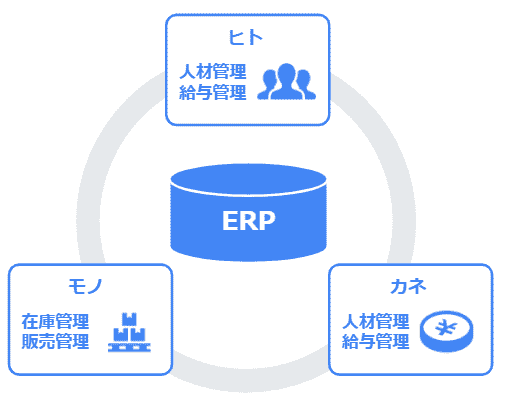
ERP stands for "Enterprise Resource Planning" and is a system for centrally managing information such as people, goods, and money related to a company's business.
By centrally managing business data, it is possible to streamline administrative tasks and utilize data to make management decisions.
ERP is expected to prevent complicated administrative tasks caused by individual management and the inability to correctly grasp the business situation due to scattered data.
Classification of ERP
ERP is a single word, but there are many different types of solutions, depending on the vendor and the form of provision.
The following is a description of some of the most common types.
1. Foreign packages
Packaged software provided by overseas vendors. For large companies that have a global presence, it is possible to manage overseas offices and other sites to improve operational efficiency and centralize data.
On the other hand, it tends to be very expensive due to its large scale, and it is not suited to Japanese business practices, so add-ons and individualized support may be required. Typical vendors include SAP, Oracle, and Microsoft.
2.Japanese packages
Many of the packaged software products offered by Japanese vendors are equipped with systems and functions that are suited to Japanese business practices, such as multiply-and-close transactions and closing operations. Compared to foreign products, these products are inexpensive, making it possible to keep costs down.
However, there are many cases in which the software lacks functionality, such as being designed for small and medium-sized companies or not supporting management of overseas offices as well. In such cases, add-ons and customization may increase costs.
Typical products include NEC's Explanner, Fujitsu's GLOVIA, and OBIC's OBIC7.
Saas ERP
Saas is an abbreviation for Software as a Service, which refers to software as a service available over the Internet.
The aforementioned packaged software products, whether on-premise or in the cloud, require a reasonable infrastructure cost.
However, in the case of SaaS ERP, the system is optimized so that you only need to pay for what you use, especially when using it on a small scale. The advantage of this is that it can be used easily with low installation and maintenance costs.
On the other hand, since all user companies basically use the same mechanism, add-ons and customization are not possible, and the degree of freedom is low, which is a demerit.
In addition, many of the SaaS-type ERP products available today are aimed at small corporations, so we often hear that even if the product is good at first, it becomes difficult to use as the company grows.
Typical vendors include Freee and Money Forward.
ERP Selection Points

So, how should you select an ERP from the various types mentioned above? Here are some points for selecting the best ERP for your company.
Clarify your objectives
First, clarify the core objectives for implementing ERP. For example, it is necessary to determine what you especially want to do when selecting an ERP, such as securing current operations, reducing management costs, improving convenience in the field, or promoting DX.
This is because the scope of work covered by an ERP is broad and many people are involved in the selection process, so what you initially intended to do tends to become blurred as the selection process proceeds.
There are a number of obstacles that are encountered during the selection process, such as difficulty in summarizing the opinions from the various parties involved and in explaining the budget to the management.
As a result, there are many cases in which a compromise is made with a low-cost solution, and nothing is achieved even though an investment has been made. To avoid such a situation, let's proceed with the study from the viewpoint of solidifying the objectives that will serve as the axis of the selection process and realize them.
2. Consider the construction pattern to meet the objectives
Once the objectives of implementation have been established, the next step is to consider the construction pattern to meet those objectives.
This is related to the aforementioned discussion of ERP classifications, but it is necessary to select the appropriate type of ERP for your objectives.
Below are some examples of objectives and construction patterns.
①Implementation of a foreign package on a global basis
(Example of purpose: Visualization of manufacturing costs including overseas bases)
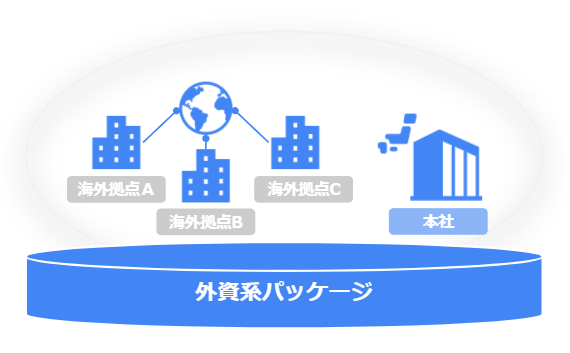
The first is a pattern in which foreign packages are used to centrally manage the entire company, including overseas locations.
For example, there are many cases where the same product is manufactured at different sites in a large manufacturing company. In such cases, if each site uses a different system, the data will be scattered and it will be difficult to view the data using a unified index.
On the other hand, by integrating a foreign package that can be used overseas, it is possible to visualize the data of all sites, including those overseas.
As a result, it becomes easier to grasp the cost of products, such as which materials are used for which products and how much they are used, and it is possible to link this to improvement activities.
However, it is necessary to take into account that the cost of the product may be high in the first place, or that a large number of add-ons may be generated due to incompatibility with Japanese business practices, which may lead to inflated costs.
②Implementation of a domestic package + products for overseas sites
(Objective: To optimize operations at each site by implementing an ERP suitable for each site)
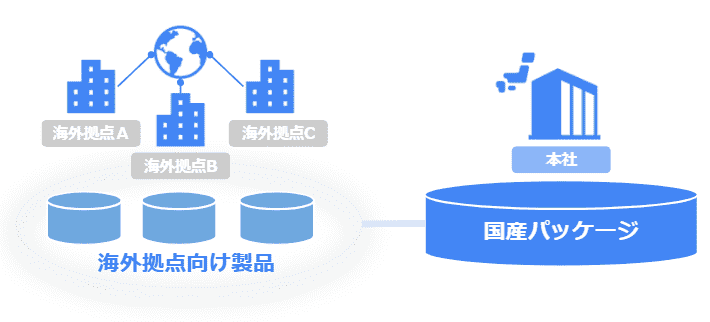
This is a pattern in which ERP is used in combination with the level of business required at each site and the country's system.
For example, let us assume that a company has its main base in Japan and its overseas bases are small in scale.
In this case, a construction pattern can be considered in which a domestic ERP with rich functions is used in Japan to some extent, while a small-scale system for the local market is used in the overseas offices.
In this way, it is possible to optimize operations at each site. However, when adopting this pattern, it is necessary to assume that, for example, it is sufficient to check the business performance of all bases together to some extent at the time of coordinated closing of accounts, since the system differs among bases.
(3) Combination of ERP packages and individually optimized solutions for each operation
(Example of purpose: To optimize individual operations and respond flexibly to changes while streamlining ERP)
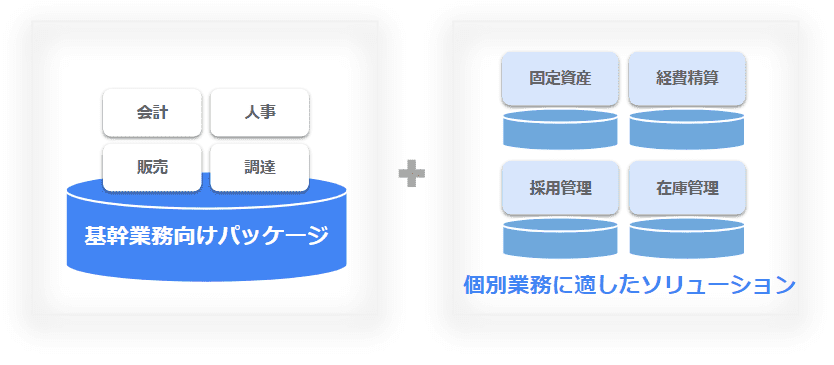
In this pattern, business areas that can be handled by the ERP package used are handled by that package, and individual solutions are added for areas where functions are lacking or where the package product does not excel. This is also called postmodern ERP and is a recent trend.
For example, depending on the ERP package to be introduced, there may be cases where "HR, accounting, and sales procurement can be used, but fixed assets are difficult to use because they are not compatible with the Japanese system.
In such cases, it is possible to secure convenience in each business area by combining the solution with a stand-alone fixed asset solution that can realize the business.
In this way, the areas that can be realized with the package can be streamlined with a simple system configuration, while the areas that are lacking can be flexibly realized with individual solutions.
This allows you to realize what you want to do in an individualized and optimal manner, while also preventing the system from becoming a black box due to customization, making it possible to create a system configuration that is flexible and easy to follow changes.
However, there is a possibility that the cost of linking ERPs that have been put in for each business area will be incurred, and that the management cost will increase by using several products. It is also necessary to carefully consider whether you can afford these costs.
The important thing is to select a system that can realize your company's objectives. Using the patterns described above as a reference, consider what kind of construction pattern is best for your company in light of your company's objectives.
3. Decide the implementation policy according to the purpose
Once you have considered the construction pattern, you should also decide on an implementation policy that matches your objectives. Typical examples are as follows.
1) Customize and adapt to your company's business
2) Minimize customization and realize your business by leaning toward the package
3) Standardize your business by adapting your business to the package product
For example, if the purpose of implementation is to secure the current business, you can use the policy in 1) to realize your business at some cost.
If the purpose is not to do so, but to reduce costs by aligning the business with the package, even if it means reforming the business process, then policy (2) would be used.
Or, if you want to select the most suitable system according to the intensity of your commitment to each business area, you need to proceed with policy (3).
By clarifying the implementation policy, it will be possible to consider whether the product is suitable for the policy when making the selection.
4. Consider even the usability in the field
Once the implementation policy has been decided, the last step is to consider the usability of the product in the field.
For example, suppose a company is using an ERP product with a wide range of management items. When management requests to view data from various angles, the system's functions can accommodate their needs.
However, when it comes time to start operations, the input load on the field increases, and cases occur where data is not input on the field, or correct values are not inputted.
Therefore, it is also very important to take into account the load on the field where the data is actually input.
For example, a function that has an initial value for each client and does not require basic information to be entered is an example of an effective function.
Another example would be a function that suggests possible input suggestions to minimize the workload on the field.
In this way, choose an ERP that goes beyond what is feasible as an ERP and goes one step further, taking into account the workload on the field. By doing so, it is possible to implement ERP with an eye on the feasibility of the business.
Introducing an ERP that can reliably achieve your objectives
So far, we have explained the key points of ERP selection, including construction patterns and implementation policies.
In fact, when selecting an ERP, it is necessary to clarify the objectives and carefully consider whether it has the necessary functions and mechanisms.
Our ERP solution for major companies, HUE, is an integrated solution with functions required by major Japanese companies.
It is a package that has accumulated a wealth of business know-how, including business practices unique to Japanese companies, making it possible to promote business standardization.
In addition, we will continue to provide case studies of our users and other useful information, so if you are interested in our services, please take advantage of them.

Related Useful Information
Web Articles
2026/01/21
Explanation of the 2026 Tax Reform Proposal for Accounting and Finance - What will change from a practical perspective? What are the changes from a practical perspective?

Web Articles
2025/08/01
Behind-the-scenes of the implementation of generative AI functionality in ERP "HUE" for major companies

White Paper
2025/07/24
Introduction to the "Entire Base Establishment Accompaniment Service
Related Case Studies
Paperless and business reform one step at a time! Effects of HUE implementation and future prospects
Yanase Corporation

Reduced 1 million documents per year and realized a paperless office.
Kajima Corporation
Optimizing the entire ERP system with HUE's standard functions by moving away from customization
EXSOL Corporation