
Web Articles System Review Support
2025/11/17
Practical Guide to Avoid Failure in Notes Transition|Causes and Steps to Avoid
The number of companies considering migration from Notes is rapidly increasing against the backdrop of Notes maintenance termination, increasing operation costs, and delays in DX support. However, proceeding without sufficient preparation and design will lead directly to failures such as business disruption and cost increase. This article provides practical explanations of the causes of common mistakes and steps to avoid them.
Table of Contents
Please read the following useful documents for further details of this article.

Why is Notes migration necessary now?
The background to the current demand for Notes migration is the expansion of technical, human, and managerial risks. Here, we summarize the major factors behind this trend.
Increased risk due to end of support and depletion of human resources
Notes has been used as a business infrastructure by many companies over the years to support their business activities. On the other hand, the system to continue to support and repair problems is collapsing due to the disappearance of know-how caused by the retirement or transfer of personnel familiar with Notes and the decrease in the number of Notes engineers in the world. In addition, the extended support for v9/v10 will end in June 2026, which will inevitably increase security risks and maintenance costs. The limitations of the maintenance infrastructure are increasing the operational risk for the entire enterprise.
Necessity of system restructuring due to DX and cloud computing
At the same time, the world trend is to respond quickly to changes in the business environment, such as DX promotion, remote work support, and strengthening of internal controls. It is difficult to respond flexibly and efficiently to these demands in the traditional Notes environment, and migration to a new cloud-based business platform has become a realistic option. Migrating to Notes is not just a system update, but an opportunity to review business processes and the state of the organization.
2. Common Failure Patterns in Notes Migration
There are three common pitfalls behind the failure of the Notes migration. These are: "Misjudgment of technical requirements," "Poor operational design," and "Insufficient organizational preparation. All of these problems can be prevented with proper preparation, but they are areas that are often neglected.
Pattern 1) Misjudgment of functional design and technical requirements
This is a case where an application flow or branching logic that has been optimized in Notes for many years fails when a "simple tool" such as a no-code tool is used to replace it. The highly flexible structure unique to Notes cannot be reproduced, resulting in simplified approval routes and broken integration with other systems. As a result, some tasks revert back to paper or Excel, and the field staff leaves, saying "Notes was easier to use. The success or failure of a migration depends not on technical compatibility, but on the ability to accurately redesign business requirements.
Pattern 2: Insufficient design for internal deployment and operation design
If the migration is rushed into without sufficient design of operability and operation rules, different departments will use the system in different ways, and unified operation will collapse. Inquiries are concentrated on the IT department because education and guide maintenance cannot keep up. As a result, complaints from the field, such as "it is difficult to use" and "I don't know where to ask," erupt. At the time of migration, it is essential to design the operational aspects such as authorization settings, training plans, and inquiry flow, and to inform everyone about them at the same time.
Pattern 3: Poor project management and organizational readiness
This is a case of attempting a simultaneous company-wide deployment without conducting a PoC or staged implementation and failing. The scope of coverage and requirement definitions remain unclear, resulting in a bloated migration target and cost overruns. Since Notes is deeply embedded in the entire business, careful scope design and phased verification are essential. The key to a successful Notes migration is to understand the challenges and the opportunities for success.
3. Steps and points to prevent failure.
In order to successfully migrate to Notes, it is essential to review the business and establish a system for retention, rather than simply replacing the tools. Here, we organize a practical way to proceed in four steps.
Step 1: Clarify objectives and KPIs from a business perspective
The first step is to design the migration not as a goal but as a means to improve business operations. Clarify "Why are we migrating now?" and "What issues do we want to solve?" and set quantitative KPIs, such as reducing approval lead time and eliminating the need to assign staff to specific tasks. By sharing the same goals among management, information systems, and the field, we can prevent a blurring of direction.
Step 2: Inventory and prioritize DB and operations
A huge amount of DB and applications have been accumulated in Notes over many years of operation. If you try to migrate all of them, the cost will expand and cause rework. Therefore, we scored them based on indicators such as frequency of operations, departments using them, and improvement effects, and categorized them into "priority migration," "phased migration," and "elimination/integration. This inventory becomes the decision axis for PoC design and phased introduction.
Step 3: Verify feasibility and retention through PoC and phased transition
PoC (Proof of Concept) is not a "rite of passage," but rather a verification process to visualize issues. Clear evaluation criteria are set, such as user satisfaction, the rate at which requests for modifications are reflected, and the identification of operational issues. Instead of a sudden company-wide implementation, we will minimize risk and increase the retention rate by going through phases such as small-scale PoC, limited departmental implementation, and company-wide deployment.
Step 4: Establish operational phase structure and improvement rules
Post-release operations will determine the success or failure of the migration project, so we will establish a "system that will continue to be used" by designing FAQs, establishing a primary contact point, and establishing rules for modification applications in advance. Furthermore, if a cycle is established to collect and reflect requests for improvement through periodic review meetings, etc., the system will continue to evolve even after the migration to
and become firmly established as the foundation for business reform.
4. Learning from Successful Cases: Notes Migration with ArielAirOne
Many companies considering the migration to Notes have concerns about whether it will really work for their company. Here, we present two case studies of two companies that have achieved migration from Notes by utilizing ArielAirOne. Both are successful examples of how gradual migration and field-based operational design minimized disruption.
GUNZE Corporation: Consolidate 1,300 DBs to 466 to avoid phased migration
GUNZE Corporation organized and integrated approximately 1,300 Notes DBs that had been used for many years, eventually reducing the number of DBs to 466. 4-year phased migration plan was developed and implemented in phases with repeated coordination with the site. By decluttering unnecessary applications and duplicated data in advance, we were able to prevent confusion associated with the migration while significantly improving maintainability and operational efficiency. Involving the user departments and verifying ease of use from the field perspective helped to ensure that the system would take root.
For a detailed case study, please visit
Strengthening core technologies, improving operational efficiency and information utilization - Case study of migration from Notes to ArielAirOne
K.M.C.: Achieved a quick transition with clear goal definition and training system
K.M.K. decided to discontinue Notes for the entire group. The company clearly defined what to keep and what to change, and completed the migration in a short period of time. Training sessions were held more than 10 times for the entire company, and a "key person" was assigned to each department. We built a system that allows users to run on their own by sharing questions from the field via FAQs. In addition, the operational burden was greatly reduced by restructuring the system to a simpler design, such as consolidating the number of bulletin board applications from 100 to 2.
For a detailed case study, please visit
The Secret to Success in Notes Migration ArielAirOne Standardizes and Streamlines Operations
5. Three changes that the Notes migration will create
Migration from Notes is not just a simple system replacement, but a process of unraveling the complexity and gentrification caused by years of operation, and evolving to a "business infrastructure that can be continuously improved. Here we introduce three typical changes that can be achieved through migration.
Liberated from dependence on Notes technicians and large operational burden
The number of engineers who can handle Notes is decreasing year by year, leaving many cases of "applications that no one can modify" and "DBs whose structure is not understood. In addition, daily maintenance and operation also require specialized knowledge of Notes and many man-hours. The reality is that every time there is a failure or a change in specifications, the company is dependent on a specific person in charge, which tends to cause delays in response and risks related to the individual.
The ability to reduce these burdens in terms of both people and systems is the major significance of the Notes migration.
Eliminated "human resource operation" and shifted from "maintenance" to "growth
The major turning point of the migration to Notes is the transformation of the business system from "an object to be maintained" to "a mechanism to be evolved. By taking the opportunity of the migration to standardize business processes based on the assumption of low code, the system will be changed to a system that allows on-site staff and information systems staff to review and improve the business by themselves without hiring new technical personnel.
This allows the system to evolve into a "growing system" that can quickly implement improvements, moving away from the conventional "operation just to maintain.
Next work style" that can utilize data and AI
What system will be used after the transition is a very important issue, but in general, it will be a system that satisfies the requirements for convenience and external linkage. This will enable automation and data-driven business improvements through AI and RPA. The system can be accessed from smartphones and tablets, and approval and sharing can be completed from any location. The utilization of centrally managed data will not only improve efficiency, but also bring about the "next stage" of evolution that will change the way companies work itself.
6. What is ArielAirOne, a business development platform that has been migrated from Notes more than 50% of the time?
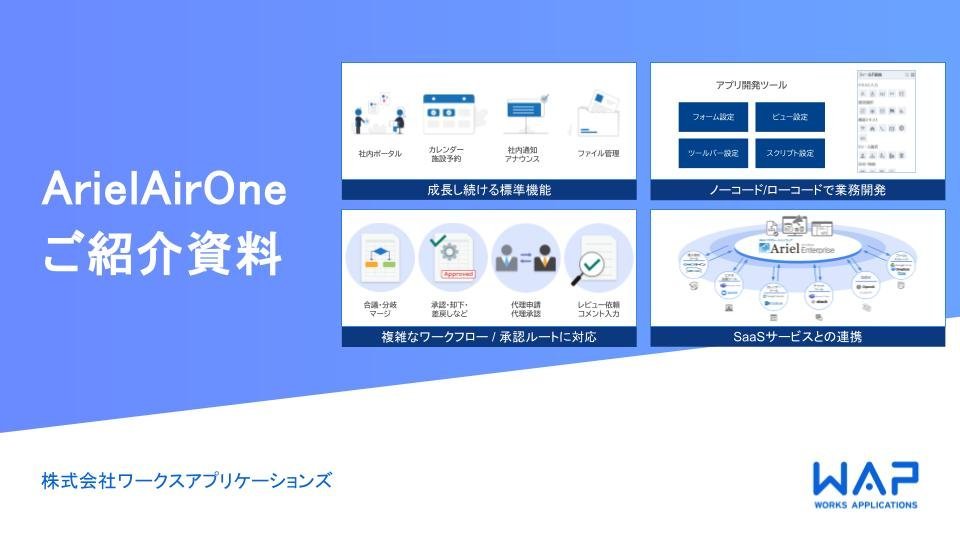
ArielAirOne is an integrated business platform with a proven track record of migration from Notes. It provides workflow, portal, bulletin board, file management, and other functions in a single package. The dedicated migration tool enables safe and efficient migration of design and data, and after implementation, we support the establishment of the new system by providing support and improvement cycles. As a system that is "used" by the field, it provides both standardization of operations and flexible scalability.
7. Conclusion
Success or failure of the migration to Notes depends not only on the selection of tools, but also on the design and operation. It is important to set objectives from a business perspective, and establish a system for step-by-step verification and establishment. Migration is not a goal, but a starting point for better business evolution.
If you want to know more about Notes migration, please read this useful document.
Related Useful Information
Video
2026/02/16
ArielAirOne Product Introduction Seminar

Video
Jan 30, 2026
The First Steps of University DX: Learning from Oberlin College

Video
2025/12/19
How to create a system that enables information to reach the entire company.

Related Case Studies
Paper applications have been reduced to almost zero, and an information sharing infrastructure has been built with Ariel at its core.
Art Nature Co.
Increased business speed with ArielAirOne for more than 10 years
Exing Corporation

ArielAirOne's Flexibility Improves Operational Efficiency after Migration to Notes
Water Supply Company A