Web Articles Invoice System
Jul. 27, 2022
How Will Receipts Change with the Introduction of the Invoice System?
From October 1, 2023, the qualified invoice storage method (so-called invoice system) will be introduced. Accordingly, receipts will also be allowed to be used as simple qualified invoices, and tax credits for purchases will be available based on receipts. However, there are several requirements to be met in order to be recognized as a qualified invoice, so it is necessary to sort out the requirements in advance.
Therefore, this article explains the use of receipts after the introduction of the invoice system, as well as the changes in operations and points to note for both the issuing and receiving sides.
Table of Contents

Under the invoice system, receipts can be treated as invoices?
The invoice system to be introduced on October 1, 2023 will also cover receipts.
1. What is the invoice system in the first place?
The invoice system is a legal revision introduced to correctly calculate the amount of consumption tax credit for purchases after the introduction of the reduced tax rate. In order for the buyer to correctly grasp the applicable tax rate, consumption tax amount, etc., the seller is required to issue an "invoice (qualified invoice) ".
For more information, please click here: [Easy-to-understand explanation] What is the invoice system? What will happen to accounting work?
2. Receipts are also subject to the system as "simplified invoices
Under the invoice system, receipts and receipts can also be treated as simple invoices (qualified simple invoices).
Until now, a separate invoice was required to apply for the credit for taxable purchases, but it will now be possible to apply only with receipts.
So, how will the introduction of the invoice system actually change business operations?
In the next section, we will explain the changes on the issuing and receiving sides.
Changes on the issuing and receiving sides after the introduction of the invoice system
1. Changes from the issuer's point of view
(1) Changes in invoice form items
Invoices must include the items specified in the Consumption Tax Law.
First, it is necessary to change the format of invoices, receipts, and other forms (formats) that you are currently using to comply with the invoice system.
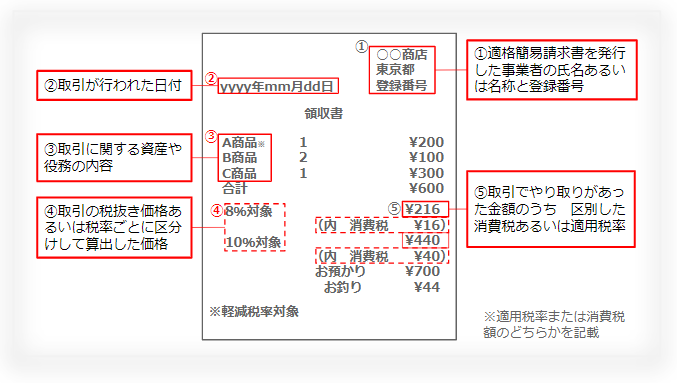
The following items must be correctly listed on the Qualified Simplified Invoice as shown in the figure below.
(2) Issuance is required no matter what the transaction price is.
Under the previous system, if the transaction price was less than 30,000 yen, the tax credit for purchases was applied without issuing receipts or invoices. However, after the introduction of the new system, no matter what the transaction price is, the credit for taxable purchases will not be applied without a receipt or receipt that would be applied as a qualified simplified invoice. This point should be noted.
2. Changes from the Receiver's Perspective
(1) Requires preservation in compliance with the Electronic Bookkeeping Law.
If an expense is to be deducted as a purchase tax credit, the invoice must be preserved.
When preserving the invoices, it is necessary to preserve them in accordance with the Electronic Bookkeeping Act.
(2) Substantial increase in checks
However, if you submit invoices, receipts, and receipts from various suppliers for expense applications, you need to check each invoice, receipt, and receipt in detail.
For example, if the issuing business is a " Whether or not the issuing business is a "Qualified Invoice Issuing Business For example, it is necessary to check whether the issuing business is a "Qualified Invoice Issuing Business" and to confirm that the invoice contains all the necessary information.
In particular, unlike the conventional invoice system, the receiver cannot add any additional information to the invoice even if there is a deficiency in the required items, and must ask for a reissuance. Since " even a handwritten receipt must be reissued if it is incomplete," it is expected that the number of points to be noted will increase greatly.
(3) Change in accounting rules
Receipts and receipts submitted for expense applications are not in a uniform format, and it is possible that invoices and non-invoices may be confused.
This places a heavy burden on the accountant who is responsible for checking them. It may be a good idea to review the rules, such as checking items that need to be applied for at the time of application instead of at the time of approval, or preparing a checklist and applying with the checklist attached.
Points to note for using receipts as qualified simplified invoices
1. Qualified simple invoices cannot be used unless the conditions for use are met.
In order to deduct tax on purchases using a qualified simple invoice, several conditions must be met.
The issuing entity must of course be a "qualified invoicing business," and only the following seven types of businesses are allowed to use the simplified invoice.
(1) Retail
(2) Restaurant
(3) Photography
(4) Travel
(5) Taxi
(6) Parking
(7) Businesses that transfer assets to many unspecified persons in addition to (1) through (6)
Please note that if your business does not fall under these categories, you cannot issue a qualified simple invoice. If your business does not fall under any of these categories, you are not eligible to receive a qualified simplified invoice.
2. In case of electronic data, both parties' agreement is required.
In recent years, in response to changes in work styles, such as telecommuting, companies have been promoting a paperless business environment. There is a growing need for receipts to be delivered or requested in electronic form. When a company wants to switch from the conventional paper-based exchange of receipts to electronic data exchange, there will be changes in the business operations of the recipient company. To avoid confusion, it is advisable to consult with the counterparty in advance and obtain their agreement.
What is a system that can handle changes in the operation of receipts?
After the introduction of the invoice system, receipts and receipts must be issued accurately in order to be eligible for the deduction of taxes on purchases. Receipts and receipts can be treated as qualified simple invoices, which are simplified versions of qualified invoices. In order to implement compliance with the invoice system, it is important to understand the changes and the correct issuance method.
We have explained the changes to receipts and invoices in the introduction of the invoice system. Some of you may be considering a new system in conjunction with the introduction of the invoice system. If you do so, be sure to choose a product that is compatible with the invoice system.
Our company, Works Applications, provides ERP "HUE" for major companies that supports the invoice system based on the concept of no customization.
Related Useful Information
Video
August 3, 2026
[ERP Tech Journal]
Learning from Works Applications’ Successes and Failures: The Reality of Promoting AI Adoption

Video
July 17, 2026
[ERP Tech Journal]
Breaking Free from “AI You Can’t Trust with Business Operations.”

Web Articles
June 25, 2026
[Starting in Fiscal Year 2026] How Will the Security Measures Evaluation System Change Practical Procedures for System Procurement?

Related Case Studies
Paperless and business reform one step at a time! Effects of HUE implementation and future prospects
YANASE & CO.,LTD.

Reduced 1 million documents per year and realized a paperless office.
KAJIMA CORPORATION
Optimizing the entire ERP system with HUE's standard functions by moving away from customization
EXSOL Corporation