Web Articles Invoice System
2022/04/08
Measures against the invoice system! How to avoid losing money when dealing with tax-exempt businesses?
From October 1, 2023, the qualified invoice storage method (so-called invoice system) will start. Large companies, including sole proprietors and freelancers, are also doing business with many tax-exempt businesses. Many businesses may be troubled by the fact that some transactions with some business partners may not be eligible for tax credits on purchases. In this article, we will explain in an easy-to-understand manner how transactions with tax-exempt businesses should be handled in light of the law.

Table of Contents

Is the invoice system making transactions with tax-exempt businesses a challenge?
The invoice system is a legal revision introduced to correctly calculate the amount of consumption tax credit for purchases after the introduction of the reduced tax rate. In order for the buyer to correctly grasp the applicable tax rate, consumption tax amount, etc., the seller is required to issue an "invoice (qualified invoice) ".
For more information, please click here: [Easy-to-understand explanation] What is the invoice system? What will happen to accounting work?
Under the invoice system, it is expected that reviewing transactions with tax-exempt businesses will become an issue. Under the invoice system, only taxable businesses are allowed to issue invoices (qualified invoices) for the deduction of purchase taxes, and transactions with tax-exempt businesses will result in an increase in tax payments because the amount of purchase taxes cannot be deducted.
For more details, please refer to: Deduction of purchase tax and changes in consumption tax calculations explained in an easy-to-understand manner at
. Therefore, as we move forward with the invoice system, businesses that have many transactions with tax-exempt businesses, including sole proprietors and freelancers, need to consider their future transaction policies.
How to avoid losses in transactions with tax-exempt businesses?
So, how should they deal with transactions with tax-exempt businesses when they actually occur? From the perspective of avoiding even the slightest loss, here are two policies for handling the situation.
Method 1: Request for tax conversion
First, there is the method of asking the tax-exempt business to convert to a taxable business and become a taxable business.
If the business partner becomes a taxable business, it will be able to issue "invoices (qualified invoices)," which will allow it to deduct taxes on purchases and continue business as usual.
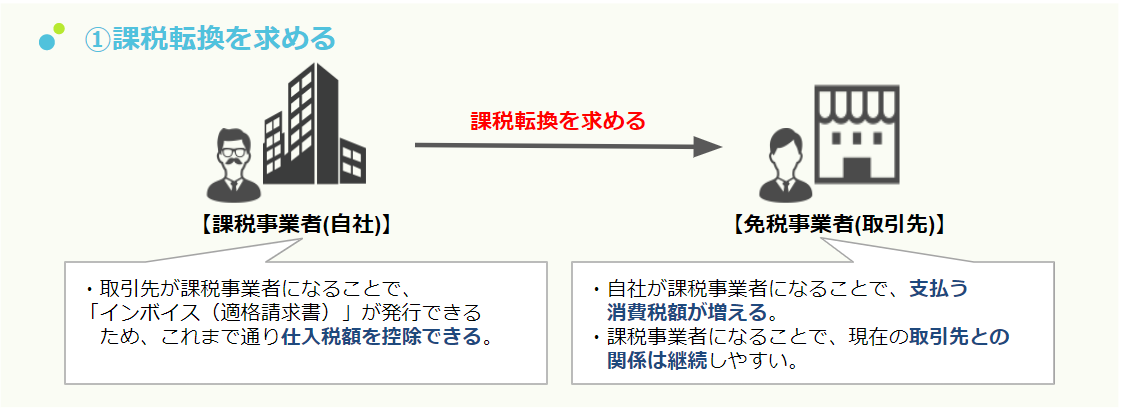
One concern is that the tax-exempt business partner will pay consumption tax that it did not pay before by becoming a taxable business, and may negotiate with the tax-exempt business partner to raise the price of the transaction.
Since unilateral refusal of a price negotiation from a tax-exempt business may violate the law, the two companies should discuss the price before deciding on a price. In addition, since negotiations with each business operator are often conducted by on-site personnel, company-wide announcements are necessary, such as by informing the public of the revision and holding study sessions.
Method 2: Ask for a reduction in the transaction price
Although we introduced the method of requesting taxable conversion in Method 1, we believe that some tax-exempt businesses may not accept taxable conversion.
In that case, there is a way to negotiate a reduction in the transaction price. Since the amount of consumption tax to be paid is higher than the current amount, asking the tax-exempt business to reduce the transaction price by that amount can prevent a small amount of expenditure.
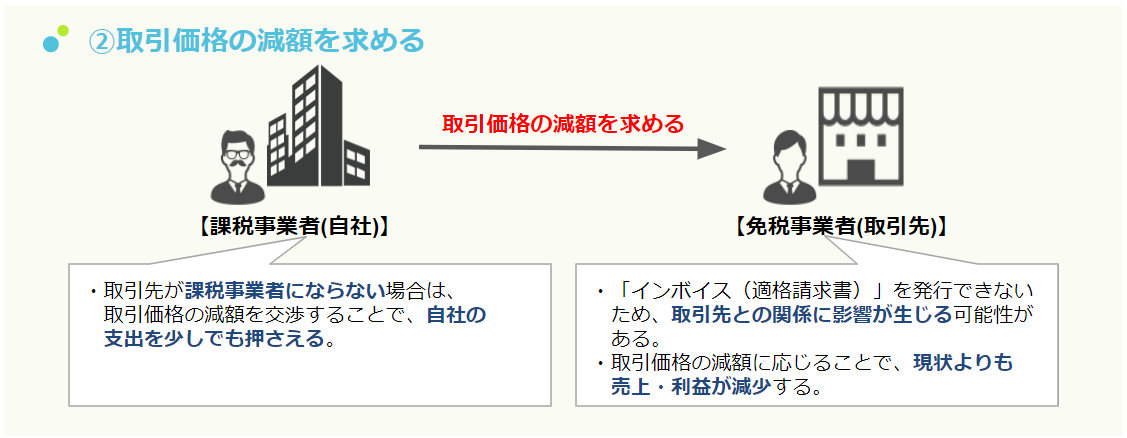
One concern is that the tax-exempt business may not agree to negotiate the transaction price because the reduction in the transaction price will also result in increased expenditures on their part.
In this case, too, unilaterally suspending transactions because of non-negotiation may violate the law. It is necessary for both companies to consider and negotiate to implement the transaction at an appropriate price after estimating how much impact the system revision will have.
Points to keep in mind when negotiating with tax-exempt businesses
However, when actually considering transactions with tax-exempt businesses, careful negotiation is necessary to avoid violating laws such as the Act against Delay in Payment of Subcontract Proceeds, Etc. to Subcontractors and the Antimonopoly Act.
As an example, unilaterally suspending transactions with a tax-exempt business if it does not become a taxable business, or leaving prices unchanged without any consideration even though it has become a taxable business, may be in violation of the law.
Specifically, the National Tax Agency's Q&A states that the following acts may be problematic.
Types of acts】
1 Reducing the transaction consideration
2 Refusing to accept or returning goods or service deliverables
3 Requesting sponsorship fees, etc.
4 Compelling purchase or use
5 Stopping transactions
6 Encouraging a person to become a registered business
Quote: National Tax Agency dedicated website "Q&A for tax-exempt businesses and their business partners regarding compliance with the invoice system"
Therefore, it is important to Therefore, when considering transactions with tax-exempt businesses, it is necessary to consult with the business partner to ensure that there is no conflict with the law before deciding on future transaction policies.
Click here to download "[5-minute explanation] Introduction to the invoice system - 8 points explained in an easy-to-understand manner
Check the system taking into account transactions with tax-exempt businesses.
For transactions with tax-exempt businesses, it is necessary to check not only the business but also the current system.
Specifically, the core system or accounting system used by the company needs to manage whether the client is a tax-exempt business or not, and to handle consumption tax calculations during the transitional measures period. Since this is an area where cross-departmental checks will be necessary, we recommend that you start checking as early as possible to see if your systems are ready to handle this.
HUE, an ERP package for major companies, supports legal and system revisions within a fixed maintenance fee. A wide range of support is available for qualified invoices as well as requirements related to transactions with tax-exempt businesses.
Related article:
The information in this article is based on laws and regulations as of April 1, 2022. The information is subject to change in accordance with laws and regulations to be promulgated in the future, and will be updated accordingly.
Related Useful Information
Web Articles
2026/01/21
Explanation of the 2026 Tax Reform Proposal for Accounting and Finance - What will change from a practical perspective? What are the changes from a practical perspective?

Web Articles
2025/08/01
Behind-the-scenes of the implementation of generative AI functionality in ERP "HUE" for major companies

White Paper
2025/07/24
Introduction to the "Entire Base Establishment Accompaniment Service
Related Case Studies
Paperless and business reform one step at a time! Effects of HUE implementation and future prospects
Yanase Corporation

Reduced 1 million documents per year and realized a paperless office.
Kajima Corporation
Optimizing the entire ERP system with HUE's standard functions by moving away from customization
EXSOL Corporation