
Web Articles System Review Support
2022/05/20
When is it time to replace the core system, and how to proceed without failure?
Many companies may consider replacing or restructuring their core systems due to obsolescence or maintenance expiration.
In replacing a mission-critical system, there are various steps from selection, implementation, and maintenance, and many costs are involved. In addition, there is tremendous pressure to obtain a budget and proceed with the project, which means that the project cannot be delayed or fail.
So, how can you proceed with core system replacement without making mistakes?
This article will explain in detail how to proceed with core system replacement and the key points to consider for success.

Table of Contents

Core Systems Need to be Replaced and Restructured Regularly
A company's mission-critical system needs to be replaced or restructured periodically over a period of several years.
There are various triggers, and the following are some of the most common cases.
An example of a common trigger
- Maintenance of a system that was originally built by the company is now performed by a person in charge, and the retirement of the person in charge will make it difficult to continue using the system.
- To achieve the goal of IT cost reduction set in the mid-term management plan, the management gives an order to eliminate the host system.
- Server and application maintenance deadlines are approaching.
- A company-wide DX promotion project is launched and IT investment is decided.
- On-site personnel in charge of business operations are often dissatisfied with the current system.
Of course, such issues do not necessarily require replacement of the system, and there are means to address them by extending the current system or reviewing operations.
However, in many cases, the core system needs to be replaced because changes in business operations alone cannot solve the problem, or because the cost of developing additional functions to the current system would be too high.
Once the decision to replace the core system has been made, how should the process proceed?
How to proceed with core system replacement
1. Clarify the purpose of introduction

The first thing to clarify is the "purpose" of introducing a new core system.
The purpose of implementation is also the axis to determine the success of the core system replacement project.
For example, if the problem is that "the system was originally developed and built, and there are few people who can maintain it due to the retirement of the person in charge at that time," the objectives of the system should be "to enable anyone to maintain it without special knowledge" and "to create a system that does not require original add-ons or customization development. In this case, the purpose of the introduction of the system is to "make it possible for anyone to maintain the system without special knowledge" and "make it a system that does not require original add-ons or customized development.
In this way, based on the study background mentioned in the previous section , what you want to achieve is concretized and the purpose of implementation is clarified.
2. Prepare a system for consideration
If the objective is to resolve issues within an individual department, the department in charge, such as the accounting or systems department, will take the lead in the study. On the other hand, if the objective is to solve company-wide issues that cross multiple departments, a "project" organization may be established with personnel from multiple departments taking the lead.
The important thing here is to secure the necessary and sufficient personnel.
Replacing a mission-critical system requires many man-hours to communicate with multiple vendors and to organize operations.
It is necessary to establish a system so that the replacement of the mission-critical system does not proceed unintentionally without sufficient work organization due to a lack of personnel, or the system does not start operating by the scheduled time because the coordination with vendors is not completed in time.
3. Organize issues to achieve the purpose of introduction
Once the purpose of the introduction and the subject of the study are determined, the requirements that must be fulfilled in order to achieve the purpose of the introduction are identified.
To this end, it is necessary toclarify issues through on-site interviews and business organization.
For example, if the goal is to "reduce the workload of accounting staff by 20%," we will investigate where a large burden is placed on the current operations. When we organize the work, we find, for example, that "the front office system and the core system are separated, which causes double data registration".
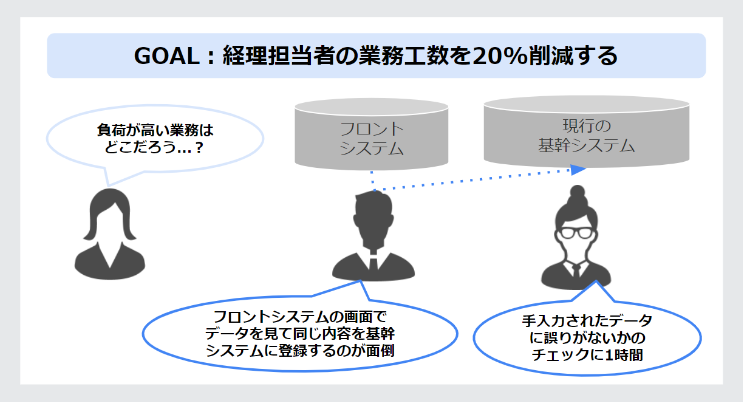
By visualizing the tasks with high workloads that can be significantly reduced, it is possible to identify the requirements for the new core system. In the above example, requirements such as "data integration between the front-end system and the core system without any hassle" can be identified.
After identifying the requirements, decide which product will be adopted as the new core system.
4. Contact vendors
Vendors will be approached to gather product information.
The following are some examples of how we find vendors to approach.
- A vendor who is already in and out of the company is approached.
- Find a vendor by relying on the contacts of employees who used to work in the systems department of another company
- Search the Internet using product names or words such as "0000 system" and request information from the vendor or contact the vendor
After approaching vendors, we will check to see if they can realize the requirements we have identified.
5. Confirm whether the proposed product can be implemented based on the requirements
To confirm products that can realize the requirements, we generally put the requirements into a document such as a Request For Information (RFI) or Request For Proposal (RFP) and ask the vendor to respond whether or not they can handle the requirements and how to realize them.
If you are in a situation where you want to select a product from a broader perspective than the requirements you have identified, you can create an "RFI" for the purpose of gathering information.
If the requirements have already been established, an "RFP" is prepared, and the vendor is asked to provide a specific proposal for each requirement and an accurate estimate of the cost. This is how the selection of a core system proceeds.
Now that we have explained how to proceed with the selection process, what are the key points that need to be considered in order to successfully replace the core system?
In the next section, we will explain the points to consider for a successful replacement of the core system.
Points to consider to avoid failure
POINT 1: Leave it to the consultants? Do we leave it to the consultants or proceed on our own?

For example, if you have a goal, such as "upgrading management," that is difficult to achieve by simply replacing the system, you can bring in a consultant to help you flesh out your ideas.
Also, in cases where the company does not have the manpower to adequately organize its own operations and requirements, consulting services can be used to make up for the man-hours that are lacking.
When using consulting services, it is important to decide in advance what and to what extent you will request consulting services, such as "product selection" or "implementation and maintenance," while taking into consideration the man-hours and budget you can secure for your own company.
You should also carefully consider which consulting firm to request.
Some consulting firmsmay have a partner agreement with a particular vendor and strongly recommend the implementation of that vendor's products. If you want to gather information in a flat manner, look for a consulting company that offers proposals that meet your company's objectives, for example, by requesting a company that does not strongly promote a particular product on its website.
POINT 2: What is the scope of the new core system?
When replacing a core system, it is also necessary to consider how to separate the scope of system use.
For example, there are configurations such as "integrating the entire company's mission-critical operations with a single ERP," or "adopting individual systems for each country's business customs at overseas sites," or "combining SaaS services for front-line operations that emphasize ease of use. In particular, the concept of "narrowing and streamlining the scope of ERP use and optimizing it by combining SaaS services, etc." is called "postmodern ERP " and has been gaining popularity in recent years.
It is advisable to separate the scope of use based on the company's business operations and adopt the optimal configuration for the company.
For an example of a construction pattern, click here:ERP implementation that maximizes effectiveness!
POINT 3: How to communicate what you want to achieve to the vendor
When dealing directly with vendors, it is important to communicate what you want to achieve to the vendor in a form that can be understood by anyone who sees it.
As explained earlier, "what you want to achieve" is summarized as a requirement in an RFI or RFP and sent to the vendor. However, there is a limit to what can be conveyed to the vendor with only one sentence, "what can be done".
In such cases, for example, sending a "business flow diagram" along with a list of functional requirements to the vendor will enable more information to be accurately conveyed to the vendor. Based on the current operation, the vendor will be able to make a wider range of proposals because they will have a common image of what they want to achieve.
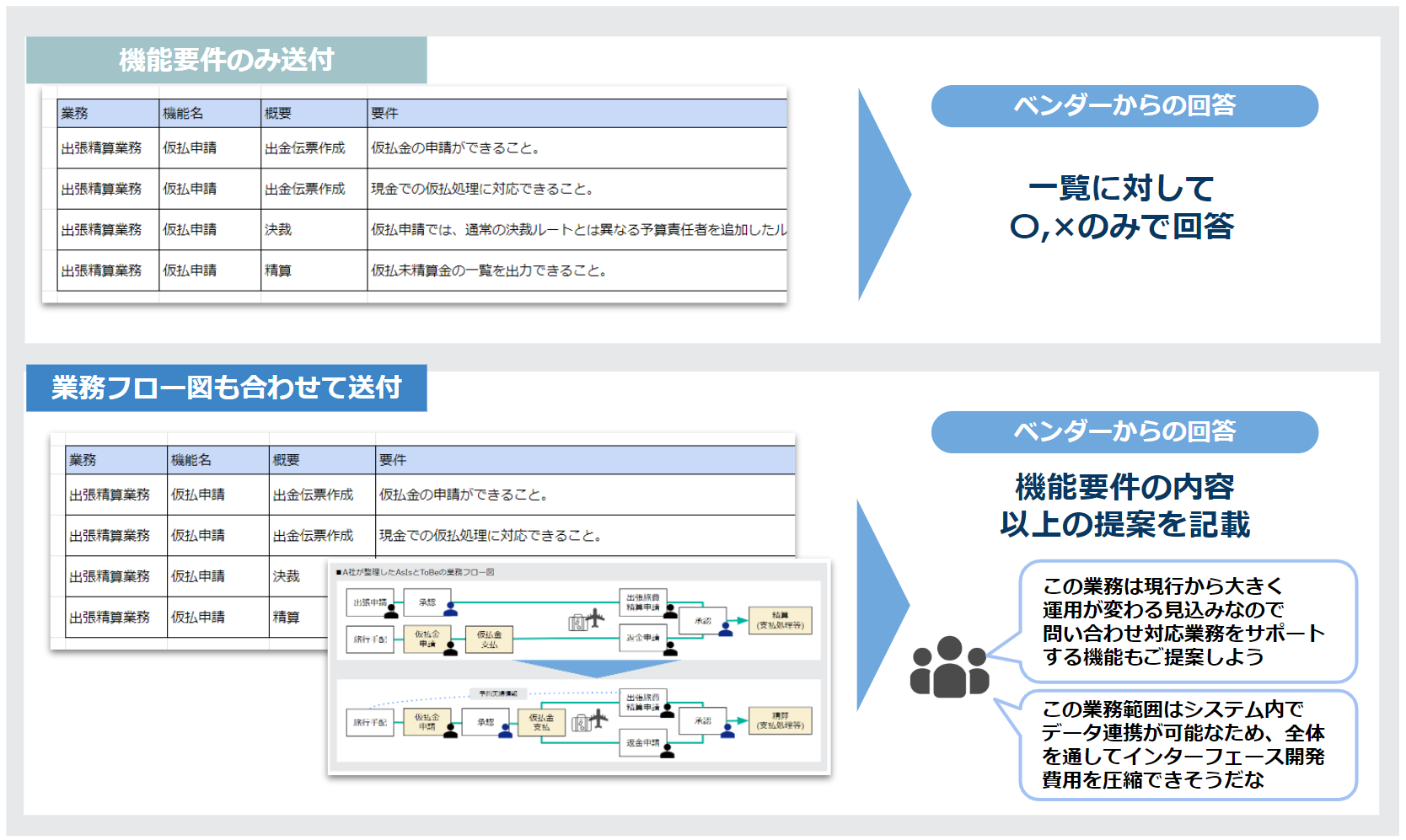
In this way, the proposals and responses you receive will vary depending on how you communicate what you want to achieve to the vendor.
When communicating directly with the vendor, consider how to share information with the vendor.
A system that can solve problems and achieve the objectives of the introduction of the system
The most important thing is to solve the issues that triggered the project and to achieve the objectives of the project.
To achieve this, it is necessary to select a mission-critical system that can meet your requirements and demands and cover the scope of your company's business.
Our company will provide you with ERP package "HUE" for major companies HUE, an ERP package for major companies, was developed based on the concept of "no customization," reflecting the requirements of a wide variety of industries in its "standard functions" to achieve a high rate of business compatibility. If you are interested in this product, please refer to the product introduction page below for details.

Related Useful Information
Web Articles
2026/01/21
Explanation of the 2026 Tax Reform Proposal for Accounting and Finance - What will change from a practical perspective? What are the changes from a practical perspective?

Web Articles
2025/08/01
Behind-the-scenes of the implementation of generative AI functionality in ERP "HUE" for major companies

White Paper
2025/07/24
Introduction to the "Entire Base Establishment Accompaniment Service

Related Case Studies
Paperless and business reform one step at a time! Effects of HUE implementation and future prospects
Yanase Corporation

Reduced 1 million documents per year and realized a paperless office.
Kajima Corporation
Optimizing the entire ERP system with HUE's standard functions by moving away from customization
EXSOL Corporation