
Web Articles System Review Support
2018/06/29
The "Cloud" Series in a Minute - Part 1: Which will your company choose?
Cloud services continue to attract attention as an entity that supports the latest technologies such as IoT, Big Data, and Artificial Intelligence. Recently, more companies are adopting cloud services from the perspective of protecting their IT environment in light of the risk of physical server damage in the event of a disaster, in addition to cost reduction and ease of use. On the other hand, there are probably still some people who "have a vague idea of what it is like, but don't know exactly what it is," or "have an image that security is a bit insecure. In this issue, we would like to discuss the basics of cloud services and compare them with on-premise services.

Table of Contents
Cloud computing is a bank deposit, while on-premise is a savings account?
The decisive difference between cloud and on-premise is that "the system environment can be located anywhere. As shown in the figure, cloud computing uses servers on the Internet via a network, whereas on-premise uses servers, network equipment, and other facilities installed in the company. In other words, it is like whether you deposit money (= company data) in a bank (=cloud) or keep it on hand (=on-premise) like a savings account. 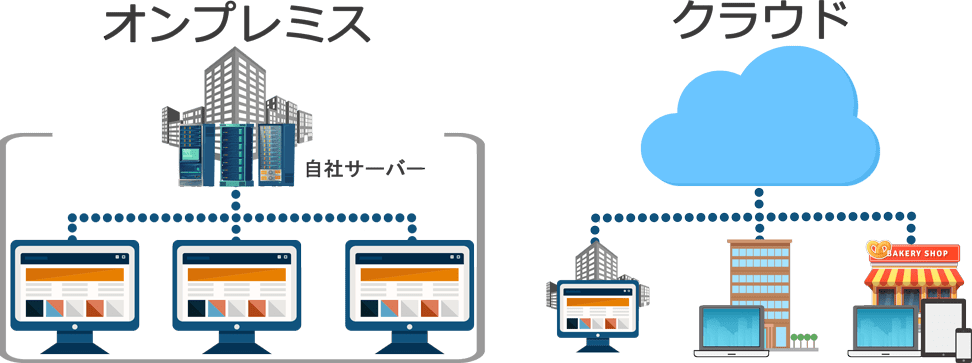
Let's compare the two and look at the features that companies should keep in mind when using both.
A Simple Comparison of Cloud vs. On-premise
Cloud:
Basically, a fee structure where you pay only for the use of servers provided by a business. There is no need to pay for building and managing your own servers.
On-premise:
Requires initial costs for purchasing servers and system construction, as well as operation and management costs such as personnel and facility management costs for maintenance. Higher than cloud computing.
Easy Comparison: Speed】Cloud VS On-premise
Cloud computing:
The service provider already owns the infrastructure, so the system environment can be used immediately. Also, if expansion becomes necessary due to usage conditions, the environment can be used simply by making an additional contract and payment.
On-premise:
It can take several months to estimate, procure, and build the necessary equipment to support the system in-house.
Easy Comparison: Customization] Cloud VS On-Premise
Cloud:
Because the system environment provided by the service provider is used, the degree of freedom is lower than with on-premise.
On-premise:
Because the company manages its own system environment, it is possible to build an environment tailored to its own operations.
Easy Comparison: Security: Cloud vs.
Cloud:
Basically, the service provider takes necessary security measures. In addition, the service provider also handles the recovery response in the event of a failure. The advantage is that the service provider can be entrusted with the operation, but it can also be said that the company is dependent on the service provider, as it is not able to take care of its own operations.
On-premise:
The risk of intrusion from outside is low because the system is operated in a system environment limited to the company's premises, but the company must take the necessary security measures in-house. Similarly, in the event of a failure, it is necessary to investigate the cause of the failure and perform restoration work in-house. Also, in the event of a disaster, there is a risk of physical damage to the server.
Which is right for your company?
What do you think? If ease of management and cost reduction are your priorities, you should choose cloud computing. If your system environment requires detailed customization, you should choose on-premise. In the past, the cloud was often said to be "insecure," but in recent years, an increasing number of companies are shifting to the cloud from the perspective of service providers' high security measures and disaster risks. In the next issue, we will introduce some examples of the expanding use of cloud computing.
Related Useful Information
Video
August 3, 2026
[ERP Tech Journal]
Learning from Works Applications’ Successes and Failures: The Reality of Promoting AI Adoption

Video
July 17, 2026
[ERP Tech Journal]
Breaking Free from “AI You Can’t Trust with Business Operations.”

Web Articles
June 25, 2026
[Starting in Fiscal Year 2026] How Will the Security Measures Evaluation System Change Practical Procedures for System Procurement?

Related Case Studies
Paperless and business reform one step at a time! Effects of HUE implementation and future prospects
YANASE & CO.,LTD.

Reduced 1 million documents per year and realized a paperless office.
KAJIMA CORPORATION

Optimizing the entire ERP system with HUE's standard functions by moving away from customization
EXSOL Corporation