Web Articles Other
2022/04/08
Half a century has passed since the birth of the world's first ERP - What does the history tell us about the future of ERP?
ERP (Enterprise Resource Planning), which has been introduced to companies around the world to support management and various core business operations, was born in Germany in 1973.
How did ERP, which was born overseas, spread to Japan?
Even now, almost half a century after its birth, ERP continues to evolve and incorporate new technologies and trends.
What is the future of ERP?
This article details the history of ERP from its birth to its spread in Japan, as well as recent trends.

Table of Contents

Birth of the World's First ERP

1964: The first commercial mainframe "IBM System/360" appeared.
What were the systems that supported corporate operations before ERP was born?
Computers have been used in corporate operations since the 1960s, but at that time, it was the large computers known as "commercial mainframes " that supported corporate mission-critical operations.
The origin of the commercial mainframe can be traced back to 1964, when the base "IBM System/360" was released.
Prior to that, computer systems were custom-built for specific purposes.
After the appearance of the "IBM System/360," the method of building software based on the"IBM System/360" later became widespread, and in Japan, the method of building software based on this foundation later became widespread with the proprietary technology of each vendor such as NEC Corporation and Fujitsu Limited. In Japan, the method of building software based on the IBM System/360 became widespread, and the systems built on this foundation supported the core business operations of companies.
The AS/400 mid-size computer system is introduced
As a successor to the IBM System/360, IBM developed the IBM AS/400, a small to medium-sized computer system. The "AS/400" incorporated "DB2," a relational database management system for mainframes, and DB2 is said to have been the first to adopt SQL. With a full range of useful tools for installation and operation, the system was suitable for medium-scale system operation.
Compared to large computer systems, the "AS/400" was easier to operate and manage and less costly, and it became widely used by small, medium, and mid-sized companies that did not necessarily have the resources to build a strong systems department system.
In Japan, it is called "off-computer (office computer)," and although the name has changed to "AS/400," "eServer i Series," "System i," and "Power Systems" to date, the series is familiarly referred to as "AS/400.
However, in many cases, companies that introduced computer systems proceeded to introduce them from operations with high workloads, and they were built with unique designs that differed by department and business content.
As a result , data linkage and data consistency among systems became difficult, resulting in problems such as inconsistent master data for common use in each business, time required for the data of each business to be aligned, and difficulty in seeing the earnings of the entire company. ERP solved these problems.
1973: World's first ERP "SAP R/1" released in Germany
The world's first ERP was born in Germany.
The world's first ERP was "R/1" released by SAP in 1973, which ran on a mainframe.
ERP was developed from MRP (Material Resource Planning), a method of planning production through materials management that was popular in the manufacturing industry. ERP was developed from MRP (Material Resource Planning), a method of planning production by managing materials that was popular in the manufacturing industry, with the concept of systemizing the entire core business of a company, including accounting, inventory, asset management, etc. ERP was born in Germany.
When did ERP become popular in Japan?
About 20 years after the birth of R/1, SAP Japan is established.
ERP was born in Germany, but how did it spread in Japan?
In Japan, the spread of ERP accelerated in a kind of boom, and SAP Japan, a Japanese subsidiary of SAP, was established in 1992.
ERP became popular in Japan from the 1980s to the late 1990s
One of the reasons for the accelerated spread of ERP in Japan is that the management concept of "BPR (Business Process Re-engineering) ERP has attracted attention as a system to realize BPR, and its introduction has progressed.
BPR is a method to improve business efficiency and productivity by fundamentally reforming and reengineering existing work content, workflow, organizational structure, business rules, etc. ERP has become the focus of attention as a system to realize BPR, and its introduction has progressed, The introduction of ERP has progressed.
At the time, Japanese companies were dominating the global market, and while they had excess funds, they were also short of manpower, and IT was required to improve operational efficiency to compensate for the shortage of manpower, with little emphasis on how much the system would cost. Many companies thought, "I can afford to invest in IT, so let's invest in IT.
Furthermore, in the late 1990s, the wave of globalization led to the so-called "Accounting Big Bang, " a reform to introduce new accounting standards in order to bring the Japanese accounting system closer to international standards.
The impact of this series of revisions had a significant impact on companies. ERP attracted attention as a mechanism to integrate and reform core business operations, and many Japanese companies introduced ERP with accounting and performance reporting functions to comply with International Financial Reporting Standards (IFRS).
Thus, ERP attracted attention and was introduced in Japan, but the number of companies that successfully implemented ERP was limited at that time.
Related article: [For Major Companies] Thorough Comparison of ERP! Types and Features Explained in an Easy-to-Understand Way
Why was domestically produced ERP created?
Reasons for the demand for domestically produced ERP
Then, why didn't many Japanese companies succeed in implementing ERP?
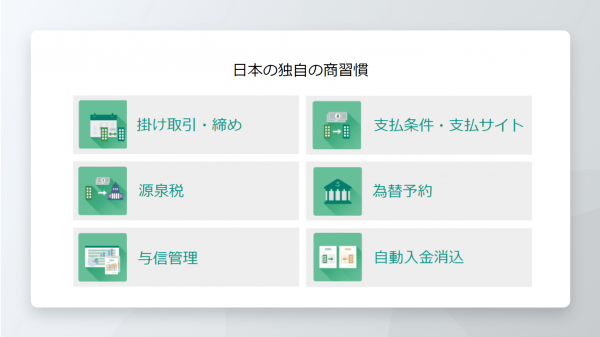
The reason is that there is a mismatch between the "unique business practices" of Japanese companies and those of foreign-made ERPs.
In Japan, for example, there are unique business practices such as multiplier transactions and payment terms based on power relationships with suppliers. In order to adapt foreign-made ERP to the business practices of Japanese companies, it had to be customized through add-on development, and the cost was enormous.
2000s: Increase of domestically produced ERP
In the 2000s, a number of products, including domestically produced ERPs, were released to accommodate Japan's unique business practices.
For example, " GRANDIT," which was developed by a consortium of 13 companies with experience in implementing mission-critical business systems and ERP, and " Biz∫," which was developed based on "intra-mart," a workflow system, were The emergence of domestically produced ERPs has led to the introduction of new ERPs.
The emergence of domestically produced ERPs eliminated the problem of cost increases due to add-ons and customization to adapt to Japan's unique business practices, and not only large companies but also small and medium-sized companies that had not been able to adopt foreign packages began to adopt domestically produced ERPs.
However, even after the introduction of domestically produced ERPs that were compatible with Japanese business practices, it was difficult to implement all of the more complex requirements of large Japanese companies and requirements specific to different industries and business categories as standard functions, and the reality is that a complete breakaway from add-ons and customization has not been realized. In fact, it was not possible to completely break away from add-ons and customization.
Works Applications' attempt to use only "standard functions
The challenge to break away from add-ons and customization, which had not been realized, was taken up by Works Applications, Inc.
Works Applications was the first company in Japan to develop an ERP package system for major Japanese companies, and its concept was to absorb the requirements of all industries and sectors into "standard functions" for development.
The situation at the time of major Japanese companies, which spent a great deal of money trying to adapt foreign packaged products to the unique culture and business practices of Japanese companies through add-ons and customization, was at odds with the information investment efficiency that packaged products were originally intended to achieve. The business concept of Works Applications was born out of a strong desire to develop an ERP package that could be used by major Japanese companies without additional development in order to improve the efficiency of information investment in Japan.
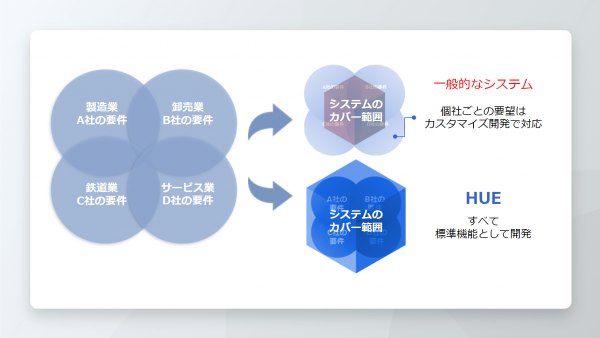
Developed based on the concept of "no customization," ERP is developed by covering changes in business practices and trends in companies in various industries and business categories, and then absorbing them into standard functions, resulting in a high business fit rate.
The business started in the human resource domain, but now it has also developed products in the accounting and supply chain domains, which are adopted by many Japanese companies, increasing the effectiveness of their system investments.
For more information about HUE , click here.
What is the future of ERP?

Evolution of Technology
In recent years, cloud computing technology has become widespread, making it easy to use vendor-supplied systems and applications over the network .
Compared to conventional on-premise ERP, which requires in-house provision and operation of servers and middleware, cloud ERP is easy to use and can reduce the total cost of ownership.
To learn more about the merits of cloud ERP, click here: Should ERP really be in the cloud? A thorough examination of the most commonly asked benefits!
We can also expect ERP to evolve through AI and IoT technologies.
For example, there are many use cases where AI can analyze handwritten text to create application data, and chatbots incorporating artificial intelligence technology can provide primary response to inquiries that used to be handled by engineers, operators, and other people.
In this way, the range of what ERP can achieve is greatly expanding with new technologies.
The Next Generation of ERP: "Postmodern ERP
In recent years, with many cloud-based so-called SaaS services being offered, the nature of ERP is also being reevaluated.
Gartner Inc. has defined "postmodern ERP" as the next generation of ERP that breaks down the wide range of operations covered by traditional ERP, and integrates multiple business applications, including ERP and SaaS services, while maintaining their independence.
Conventional ERP has focused on covering and integrating all core business operations. The concept of streamlining ERP by narrowing its scope of use and optimizing it through a combination of SaaS services and other solutions that are best suited to individual operations is gaining ground.
SAP 2025 Cliff
In addition, it has been announced that in a few years' time, the maintenance support for SAP's products, which are used by many Japanese companies, will expire.
The extended maintenance period has been referred to as the "SAP 2025 problem" or "SAP 2027 problem," and many companies are at a crossroads of choice, such as whether to migrate to SAP/HANA or to build a postmodern ERP as mentioned earlier.
In addition to product choices, there is also a wider range of options for maintenance services.
Traditionally, maintenance for SAP products has been handled by the vendor that built the product. However, the concept of "third-party maintenance," in which customers switch to maintenance support provided by a third party and continue using the product after the maintenance support period has expired, is becoming a major trend. For example, Rimini Street and Spinnaker Support offer third-party maintenance services.
Thus, it is time to rethink the traditional structure of products and maintenance in response to the "SAP 2025 cliff.
ERP can follow the changing trends with the times at a low cost.
As described above, we expect to see many changes in technology and trends that will continue to affect companies in the future.
Under such circumstances, it is important to implement an ERP that can keep up with changes at a low cost and continue to support your company's operations.
Our product, ERP package "HUE" for major companies is an ERP package for large companies that offers a wide range of standard functions that can be used by large companies without the need for individual development.
Related Useful Information
Web Articles
2026/01/21
Explanation of the 2026 Tax Reform Proposal for Accounting and Finance - What will change from a practical perspective? What are the changes from a practical perspective?

Web Articles
2025/08/01
Behind-the-scenes of the implementation of generative AI functionality in ERP "HUE" for major companies
White Paper
2025/07/24
Introduction to the "Entire Base Establishment Accompaniment Service
Related Case Studies
Paperless and business reform one step at a time! Effects of HUE implementation and future prospects
Yanase Corporation

Reduced 1 million documents per year and realized a paperless office.
Kajima Corporation
Optimizing the entire ERP system with HUE's standard functions by moving away from customization
EXSOL Corporation