Web Articles System Review Support
2022/05/20
What is ERP? Thorough explanation of ERP from its history to the key points of selection!
Many of you may have heard of ERP when considering or implementing a system. In this article, we will explain what ERP specifically refers to, covering everything from its definition to its purpose and points to note when actually selecting a system.

Table of Contents

What is ERP?
Before explaining the purpose and types of ERP, we will explain what ERP is in the first place, touching on its history.
Definition of ERP
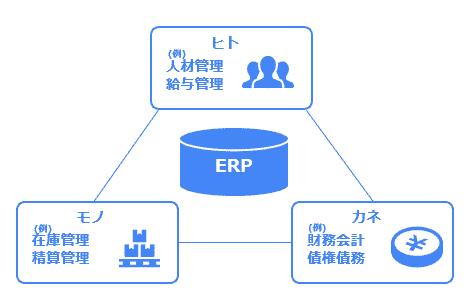
ERP stands for "Enterprise Resource Planning," and it is a system for centrally managing information related to a company's operations, including people, goods, and money.
By managing business data in a centralized manner, it is possible to streamline administrative tasks and utilize data to make management decisions.
By utilizing ERP, it is expected to prevent complicated management tasks caused by individual management and the inability to correctly grasp the business situation due to scattered data.
2. History of ERP
ERP is expected to improve the business operations of companies, but when did it first come into use in Japan? The following is a brief history of ERP in Japan.
ERP first appeared in the world in 1973. SAP, headquartered in Germany, released "R/1" running on mainframes.
Later, from the 1980s to the late 1990s, foreign-made ERPs became popular in Japan. Foreign ERP products that were becoming popular at the time did not fit Japanese business practices, and customization was a prerequisite.
In the 2000s, however, domestically produced ERP products that incorporated Japanese business practices became widespread, not only among large companies, but also among small and medium-sized enterprises that had not been able to use foreign products.
In recent years, cloud-based products and new technologies such as AI and IoT have been utilized, and many more convenient products have become available.
For a brief introduction to the history of ERP, but if you would like to know more about it, please see the following article.
Purpose of using ERP

ERP can improve business efficiency and utilize data, but what exactly is ERP used for?
1. Business Efficiency through Integrated Management
The first objective is to improve operational efficiency through integrated data management.
If you are using individual solutions or Excel to manage data without ERP, you will have problems such as double entry in each solution , inconsistencies in data, and time-consuming checks. This can cause problems such as double entry in individual solutions and time-consuming data checking.
By using ERP to manage business operations on a single platform, it is possible to use consistent data while minimizing the time and effort required for input, thereby enabling efficient execution of business operations.
2. Visualization through data aggregation
The second purpose is that it enables visualization of data.
When managing without ERP, data used for business operations is scattered among individual solutions and files, making it difficult to quickly view the data one wants to see and making it very time-consuming to collect the data.
By using ERP, business data is consolidated into a single platform, so that the data you want to see can be viewed immediately. This makes it possible to utilize and analyze data and make appropriate management decisions.
For more information on the key points of DX promotion using ERP, please refer to the following article.
Types of ERP
As mentioned above, ERP is expected to improve business efficiency and data visualization, but what kinds of products are available? There are a variety of solutions for each of the core business operations required by a company. Below are some typical products.
Products in the accounting area: "financial accounting," "management accounting," "receivables and payables," "purchasing management," "cash management," etc.
Products in the supply chain area: "production management," "inventory management," "sales management," "cost management," etc.
Products in the human resource area: "Payroll Management," "Attendance Management," "Labor Management," "Recruitment Management," etc.
Since some vendors deal only with specific business domains, when looking at products, it is necessary to first check whether the vendor's product lineup matches the scope of your company.
In addition, an increasing number of companies are using a combination of SaaS products that handle specific business areas. For example, if an ERP package can handle a particular area of business, that area can be handled by the SaaS product, and if the package lacks functionality or does not excel in that area, an individual solution can be added to the mix.
By using the ERP package as much as possible to realize operations, the system can be streamlined, while individual operations can be realized flexibly.
This approach to system configuration is called "postmodern ERP," and it is also a recent trend.
Points to keep in mind when selecting ERP

So, what points should we pay attention to when actually selecting an ERP system, given the various options available? The following is an explanation of the points to pay attention to when selecting an ERP.
Clarify your objectives
First, clarify the purpose that is the axis of ERP implementation. For example, it is necessary to clarify what you want to do, such as improving operational efficiency, reducing costs, or promoting DX.
In the selection of an ERP, there are many departments and people involved, so what you originally intended to do will often be divergent.
There are many factors, such as disagreements between organizations and budgetary issues. As a result, there are many cases where nothing was realized after compromising on the investment with something less expensive.
To avoid this, let's clearly identify the core objectives and then proceed with the study from the perspective of realizing them.
2. Calculate costs correctly
ERP involves not only the cost of the product itself, but also various other costs such as implementation support, support, add-on development, and infrastructure to build the system.
In addition, costs will be incurred over a long period of time for maintenance support to operate the system and for additional development to respond to system revisions.
Thus, since costs consist of various elements and occur over the medium to long term, care must be taken when making estimates.
For example, there are cases where the product itself is inexpensive, but the total cost is high because the product is based on add-ons, or where huge costs are incurred to respond to legal or institutional revisions.
To avoid such cases, when calculating costs, it is important to take care to ensure that necessary elements are not omitted and that medium- to long-term costs are taken into account.
For more information on how to calculate mid- to long-term costs, please refer to the following article.
Related article: Points for calculating ROI in ERP! Explaining how to clarify return on investment
3. Selecting the right product for the right purpose
Select a product that meets the purpose of implementation. For example, if you intend to optimize company-wide operations including global bases, you need to select a product that is designed to manage overseas bases as well.
If you want to optimize operations in a specific area, for example, "purchasing management" or "asset management," you need to select a product that specializes in that area.
So far, we have introduced some of the key points for selection, but if you would like to know more details, please refer to the following articles.
Related article: Achieve ERP Implementation that Maximizes Effectiveness!
Gather ERP information efficiently
The following article provides basic information on ERP and the key points to consider when selecting a product.
While there are a variety of SaaS products and other solutions available in the market these days, it is important to accurately assess your company's objectives and costs before making a selection.
At Works Applications, we have developed an ERP system for major companies with a wealth of standard functions based on the concept of no customization. ERP for major companies HUE ERP "HUE" for major companies with a wealth of standard functions based on the concept of no customization.
In addition, we are continuously sending out case studies and useful information from our users, so please take advantage of this service if you are interested.

Related Useful Information
Video
August 3, 2026
[ERP Tech Journal]
Learning from Works Applications’ Successes and Failures: The Reality of Promoting AI Adoption

Video
July 17, 2026
[ERP Tech Journal]
Breaking Free from “AI You Can’t Trust with Business Operations.”

Web Articles
June 25, 2026
[Starting in Fiscal Year 2026] How Will the Security Measures Evaluation System Change Practical Procedures for System Procurement?

Related Case Studies
Paperless and business reform one step at a time! Effects of HUE implementation and future prospects
YANASE & CO.,LTD.

Reduced 1 million documents per year and realized a paperless office.
KAJIMA CORPORATION

Optimizing the entire ERP system with HUE's standard functions by moving away from customization
EXSOL Corporation