
Web Articles Other
2021/08/24
Should ERP really be in the cloud? A thorough examination of the benefits we often hear about!
In general, the advantages of using cloud-based ERP are often cited as "the ability to work from anywhere, without being restricted to the computer you use" and "the ability to easily use the latest version of the system at any time.
But are these advantages really unique to cloud-based ERP?
This article examines three commonly cited advantages and explains common misconceptions. In addition, we will present the advantages of using cloud-based ERP, including a comparison with on-premise ERP.

Table of Contents

What is cloud ERP? How does it differ from on-premise ERP?
Cloud ERP is one of the cloud services provided through cloud computing. In today's world of high-speed Internet, data can be stored on servers on the network, and ERP and applications prepared by vendors can be used over the network.
There are also different types of cloud services , such as "IaaS," "PaaS," and "SaaS," depending on the scope of management by the vendor or cloud service provider. SaaS products such as Gmail, which is a cloud-based web service (software), are generally familiar to the general public. Like Gmail, cloud ERP can be used without preparing and managing your own servers, middleware, and applications.
On-premise ERP, on the other hand, requires the company to prepare servers, communication lines, and software in its own facilities or data centers, and to build and operate the system on its own.
Should ERP be in the cloud? A thorough examination of common misconceptions!
Cloud ERP is often talked about for its various merits due to its advanced impression, but it is not uncommon for the image of cloud ERP to precede its merits, and for the merits to be communicated in a way that is not essential. In this chapter, we will examine the advantages of using cloud ERP that are generally mentioned one by one.
1. If it is in the cloud, can I do my business regardless of time and place?
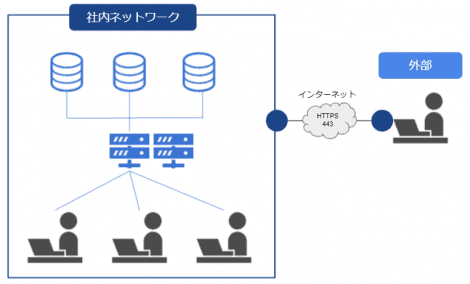
It is true that cloud-based ERP is easy and attractive because it can be used at any time and any place via the Internet. However, even on-premise ERP can be accessed from outside the company by configuring the Internet, so the location of use is not limited to within the company.
To begin with, cloud computing can be divided into "public cloud," which uses IT resources provided by vendors, and "private cloud," which creates a cloud environment exclusively for the company. Private cloud includes on-premise type. As mentioned above, there are no time or location restrictions between public cloud and private cloud. However, it is important to select the most suitable ERP offering format by correctly understanding the advantages and disadvantages in terms of security, cost, and whether it is possible to build a system that fits your company's operations.
Even on-premise systems can be accessed from outside the company.
2. If it is in the cloud, can I always use the latest version easily?
It is true that some cloud-based ERP systems allow users to always use the latest version without worrying about the version, as the vendor that provides the system performs version upgrades from time to time.
However, "always having the latest version available" has some disadvantages. For example, when a major function is added or a specification change occurs, users need to go through the process of getting used to the new version. If such version upgrades occur during busy periods, such as during the closing of accounts, it will have an impact on maintaining operational efficiency.
Some vendors that provide cloud ERP offer a service in which each company builds its own environment, and each user is charged a fee to upgrade to the latest version. In this way, the ability to always use the latest version depends on the type of provision and the vendor's response policy.
It is important tounderstand the advantages and disadvantages of cloud computing and determine which type of provision is best suited for your company.
3. Does the cloud make it easy to link data and analyze information in real time?
Generally speaking, SaaS-type products are often solutions that are designed to work together with other products, so they provide a wealth of Web APIs, etc., and it is said to be easy to build linkages. Indeed, a system in which data can be obtained simply by executing a publicly available API may seem simple at first glance.
However, it is necessary to adapt to the specifications of the provided Web APIs, and this requires time and effort.
Since the API is created based on the specifications of the connection destination, it may be necessary to prepare certificates and other documents in accordance with the authentication of the connection destination service, and it may also be necessary to periodically respond to functional modifications, including specification changes.
In addition, the availability of Web APIs and other linkages does not depend on the type of system provided, but on the specifications of the product and interface. For example, there is an example of using Web API to send contract information that needs to be re-signed or cancelled to a chat tool such as Slack based on contract information with a client maintained in ERP, and to remind the person in charge of the contract. However, there are also on-premise solutions that can link data to chat tools in the same way. In addition, there are many solutions that enable data integration between on-premise and cloud-based products, so it is difficult to say that there is a clear difference between the two.
Advantages of Using Cloud ERP
So what are the advantages of using cloud-based ERP?
One specific benefit is the reduction of "hidden costs" such as environment construction and operation.
The total cost of ownership varies between an on-premise model, in which you provide your own servers and middleware, and a cloud service managed by a vendor.
It depends on whether the vendor providing the ERP uses IaaS, which provides the infrastructure such as OS and servers, or PaaS, which provides the platform. However, in either case, the total cost of ownership for the user is the same, since the user is using a SaaS product that provides the application as well.
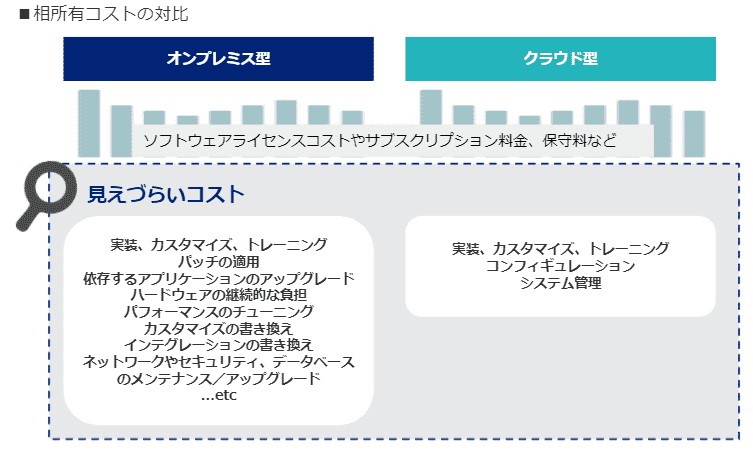
So what exactly are the "hard-to-see costs"?
Assuming continuous use, on-premise ERPs incur costs for continued operation in addition to applying patches and performing upgrade work.
For example, network maintenance and upgrades may need to be performed to maintain performance, and security and database maintenance and upgrades may need to be performed due to customization and system integration. Some costs, such as changes in laws and accounting standards, have a somewhat clear timing and can be planned for, while other costs arise unexpectedly due to various internal and external factors, and it is difficult to see a clear timing or volume of such costs.
On the other hand, when using a cloud-based ERP, the costs are clear as a fee for using cloud services, since the vendor manages and provides everything from applications to networks in SaaS Products / Services. In addition, when considering the overall costs, costs can be focused on the products used, such as the fees for using Products / Services and the costs for customization and other modifications to meet the company's requirements.
Thus, if you consider continuous long-term use, a cloud-based ERP will reduce your total cost of ownership more than an on-premise ERP, and the costs involved will be more clearly defined.
Click here to download the "Key Points for Failure-Proof Accounting System RFP Preparation.
Consider the optimal environment configuration according to your company's business and system requirements.
As described above, generalizations and interpretations about the merits of cloud computing include misunderstandings. It is necessary to compare the advantages and disadvantages of cloud computing and on-premise computing, and consider the optimal configuration for your company's business and system requirements.
Our product, HUE, an ERP package for major companies, is available in both on-premise and cloud computing types to suit your needs. We offer a wide variety of functions that can be used by large companies without individual development, so please take a look at the details if you are interested.
Related Useful Information
Web Articles
2026/01/21
Explanation of the 2026 Tax Reform Proposal for Accounting and Finance - What will change from a practical perspective? What are the changes from a practical perspective?

Web Articles
2025/08/01
Behind-the-scenes of the implementation of generative AI functionality in ERP "HUE" for major companies

White Paper
2025/07/24
Introduction to the "Entire Base Establishment Accompaniment Service

Related Case Studies
Paperless and business reform one step at a time! Effects of HUE implementation and future prospects
Yanase Corporation

Reduced 1 million documents per year and realized a paperless office.
Kajima Corporation
Optimizing the entire ERP system with HUE's standard functions by moving away from customization
EXSOL Corporation