
Web Articles System Review Support
2022/04/08
Is Web API Integration Necessary for ERP? Explanation of advantages and points to note
As the number of SaaS-type systems increases year by year, more and more services are providing Web APIs for external collaboration. In this trend, many people may be thinking of using Web API in ERP as well.
In this article, we will explain what the use of Web API in ERP is and what you should pay attention to when using it.

Table of Contents

What is Web API?
Before explaining Web API in ERP, let me explain what WebAPI is.
API stands for Application Programming Interface, and is an abbreviation of "window" that is provided to use the functions of a specific service/system from an external application. It is a "window" provided to use the functions of a specific service or system from an external application.
One of the advantages of using an API is that you can develop applications with a variety of functions at a low cost by utilizing the functions and data of external systems.
In addition, Web API enables such external program use and data acquisition from the Web.
The API can be easily executed by accessing a URL that conforms to published specifications. For example, a site that embeds Google Map on a web page is created using Web API published by Google.
Implementation methods can be broadly classified into REST (RESTful API), SOAP, etc. REST, which has fewer restrictions on the provider side, has become more common due to its popularity, and is used in many cases to combine functions and data from multiple applications.
In this way, Web API makes it easy to combine functions and data from multiple applications.
Usage Patterns of Web API in ERP
So, how are Web APIs used in ERP? Compared to consumer products and business tools, Web API tends to be used less frequently in ERP, but let's take a look at some examples.
In ERP, the use of Web API can be broadly divided into the following cases, Patterns of using functions of external applications and patterns of linking business data There are two main types of cases in which Web APIs are used in ERP. Here are some examples for each pattern.
1.Supplement functions lacking in ERP with external applications
Case 1: Contract renewal due date notification
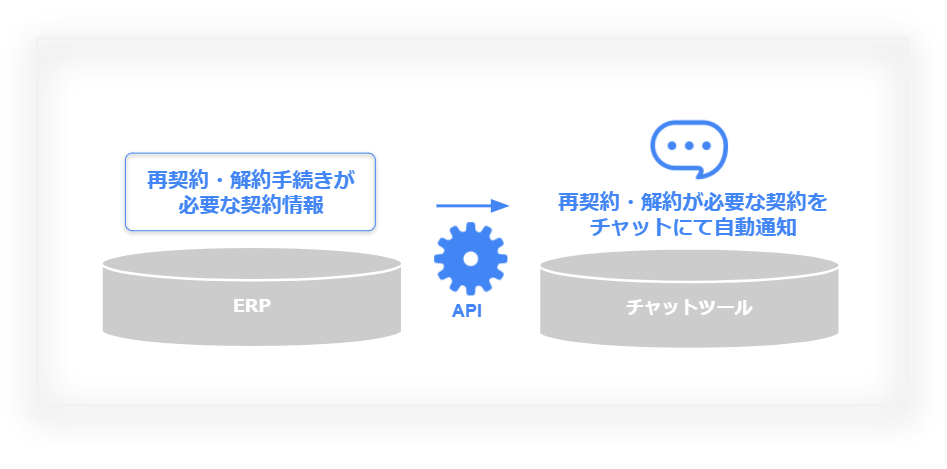
This is an example of using Web API to notify the person in charge based on the business data stored in ERP.
For example, a company manages contract information with its clients in ERP. In this case, by using ERP's Web API from an external chat tool, it is possible to retrieve data on clients who need to re-sign or cancel contracts.
Since the acquired data can be used to send notifications via chat, it is possible to automate the work of reminding the person in charge, which would normally require manual work.
In addition to contracts, there are many other matters that require periodic confirmation based on information managed by ERP, for example, "a matter for which an order form has not been received" or "a client who has not paid after the payment due date.
Reminders based on such information can also be developed at low cost by using Web API.
Case 2: Management of construction completion schedule
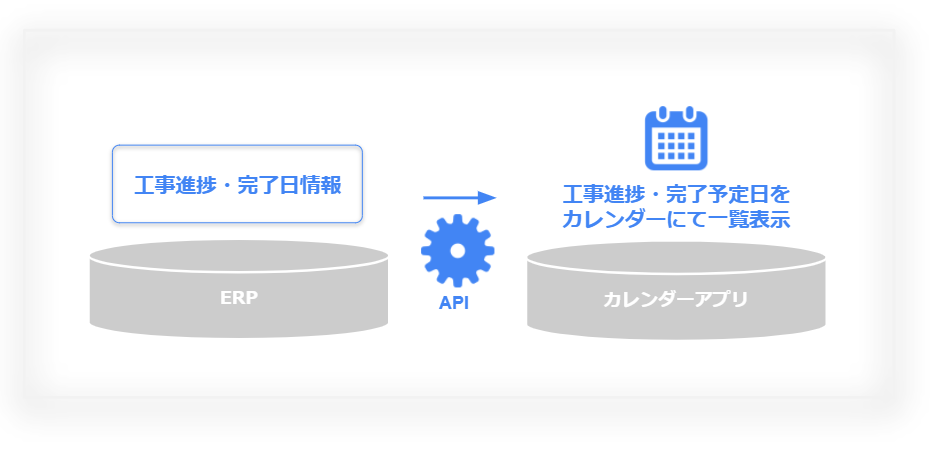
For example, a company that is engaged in construction work may use a calendar application to manage construction completion schedules. The construction progress data managed by ERP is acquired via Web API and displayed in a calendar application. The application can then be used to display a list of all the completed projects.
2. Linking business data using Web API
In addition to the use of external applications as described above, there are other ways of using WebAPI to link business data. The following is an example of such use.
Case 3: Linkage of acceptance inspection data
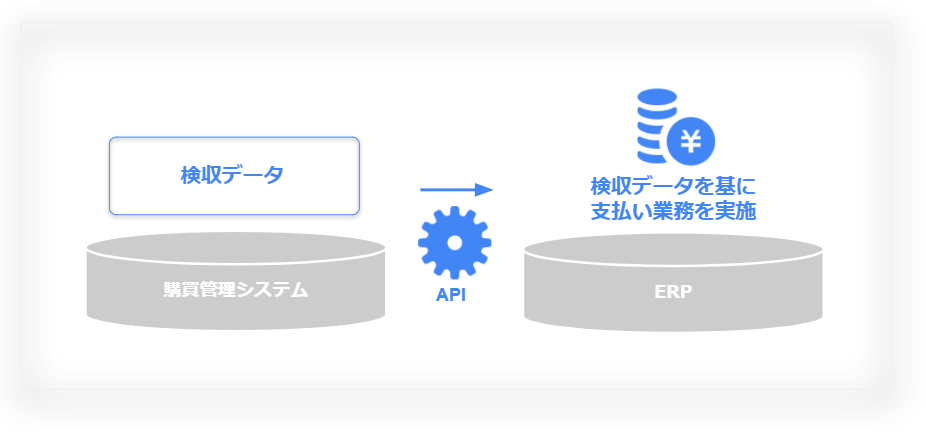
For example, if the main ERP does not manage the purchasing area and a different solution is used, the pattern is to link the acceptance inspection data generated in the purchasing area to the ERP obligation area. By linking the acceptance inspection data with Web API, it is possible to connect it to the payment operations performed in ERP.
The above is an example of business data integration using Web API, but currently ERP tends to use file integration, which has been used for a long time.
For file linkage, it is necessary to define linkage items and set up a server to transfer files. However, Web APIs are currently rarely used for business data integration, and file integration is still the most common method. This point is also explained in the notes in the next chapter.
Points to keep in mind when using Web API in ERP

As mentioned above, Web API has many uses and benefits, but what points should we pay attention to when using it in ERP? Here are some points to keep in mind.
1.Will the use of Web API bring benefits?
When using Web API for the aforementioned business data integration, it is necessary to pay attention to the question of whether the integration using Web API will bring benefits in the first place.
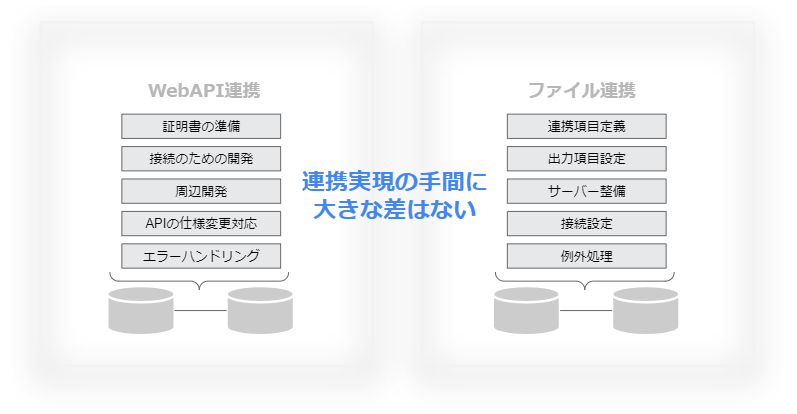
Even if Web API can be used easily, there will be time and effort required, for example, in preparing certificates to connect to the other service, developing programs to connect to Web API, and developing peripherals.
Especially when handling a large amount of business data, such as ERP, the linkage process tends to be complex. Accuracy and consistency of data are also required, so error handling and cancellation processes must also be considered.
In addition, there are few services that provide Web APIs for ERP, and file linkage, which has been used for a long time, is still the mainstream linkage method.
Therefore, system vendors have little experience in building systems using Web API, and have more experience and know-how in building systems using file integration.
From this perspective, it is necessary to consider whether Web API should be used in the first place, and file integration should be considered as a realistic option.
Be careful not to make "using Web API" a means to an end, and choose the most appropriate collaboration method.
2.Is the number of solutions to be used increasing too much?
Be careful not to use too many solutions by using Web API.
Aiming for individual optimization and using a combination of many solutions may result in a situation where the cost of setting up and maintaining the linked parts is higher than expected.
To avoid such a situation, first, use the ERP package that can handle the business areas that can be handled by the ERP package to be used.
Then, for areas that lack functionality or in which the package product does not excel, it is recommended that individual solutions be added.
This construction method is also called postmodern ERP and is a recent trend.
While streamlining the system by using the ERP package as much as possible to realize operations , individual operations can be realized flexibly by using Web API. The number of solutions used can also be reduced.
Since the number of solutions used can be kept to a minimum, it is possible to operate with minimal development and maintenance costs for the linked parts.
3.Are you able to consider the management system of the applications and Web API to be used?
Be careful not to manage the Web APIs and applications to be used only on site.
If management is left to the field, individual solutions may become disorganized and uncontrolled, and this can become a breeding ground for inefficient operations.
In addition, the individual solutions may become too personalized, making it difficult to hand over responsibility, or they may become a stumbling block when using a new system.
Therefore, it is necessary to have a system in which the system department manages all the applications to be used, or, in the case of on-site use, manages the application and approval process.
4. Will the benefits of ERP be compromised?
It is also important to take into account the viewpoint of whether or not the benefits of ERP will be compromised.
ERP package products are often designed to optimize the whole, including the visualization and efficiency of information as a company.
Therefore, care must be taken when adding individual solutions to a system that is designed for overall optimization.
Adding individual solutions to a system that is designed for overall optimization requires caution when adding individual solutions to a system that is designed for overall optimization.
Carefully consider whether or not to use individual solutions after taking a bird's-eye view of the entire system.
Appropriate use of Web API
So far, we have explained the points to keep in mind when using Web API with examples of its use in ERP.
As introduced in the usage patterns, Web API can expand the scope of your business, so proceed with its use while taking into account the cautions mentioned in this article.
Our ERP package "HUE" for major companies has started providing Web API that can be linked with a wide range of services. HUE" aims to realize an ecosystem that enables optimal business operations bycombining it with a variety of solutions.
In addition, based on the concept of no customization, the package itself has a wealth of standard functions, making it a product that can be used as the core of a postmodern ERP without the need to combine a number of services.
In addition, we will continue to provide case studies and other useful information from our users, so if you are interested in our products, please take advantage of them.

Related Useful Information
Video
August 3, 2026
[ERP Tech Journal]
Learning from Works Applications’ Successes and Failures: The Reality of Promoting AI Adoption

Video
July 17, 2026
[ERP Tech Journal]
Breaking Free from “AI You Can’t Trust with Business Operations.”

Web Articles
June 25, 2026
[Starting in Fiscal Year 2026] How Will the Security Measures Evaluation System Change Practical Procedures for System Procurement?

Related Case Studies
Paperless and business reform one step at a time! Effects of HUE implementation and future prospects
YANASE & CO.,LTD.

Reduced 1 million documents per year and realized a paperless office.
KAJIMA CORPORATION

Optimizing the entire ERP system with HUE's standard functions by moving away from customization
EXSOL Corporation