
Web Articles Business Efficiency
2025/01/20
Trend Words from an Accounting and Finance Perspective - Part 4: "Accounting and Finance x Automation
The areas that accounting and finance departments are required to deal with are expanding year by year, and in addition to traditional daily operations, they are now required to have multifaceted perspectives and information-gathering skills. In this special article, we will focus on a trend word that is attracting attention as the times change and delve into it through an interview with Mr. Sakurada, a senior research committee member of the Japan CFO Association, who is well versed in the accounting and finance area. We hope that this article will provide an opportunity for those in charge of accounting and finance to gain new perspectives and ideas in their daily work. The fourth issue's trending word is "automation.

Table of Contents

Guest: Mr. Shuichi Sakurada
Chief Research Committee Member, Japan CFO Association
Accounting Advisory Inc.
Managing Director/CPA
The time of accounting and finance department personnel becomes valuable to the company.
The theme of the fourth issue is "Accounting and Finance ✖ 'Automation'".
In the past, efficiency has been sought in the accounting and finance departments, but now, with the evolution of technology, the trend is toward automation. Could you first give us your view on the background to this?
There are two main reasons why we should aim for automation rather than efficiency. The first and most direct reason is that applications are evolving. The reality is that we can automate processes simply by utilizing the various functions of applications. With D2D (Data to Data), if data comes in digitally rather than on paper, it can be received directly by the application and connected to automated processing, This eliminates or minimizes the need for input.
An indirect or intrinsic reason could be the increased management expectations of the accounting and finance departments. This is due to the fact that they are now expected not only to close monthly, quarterly, and annual accounts as actual results, but also to support the business and drive the business forward by utilizing constants. In this era of rapid social, economic, and environmental changes, it is necessary to have a broad perspective, and the number of variables that must be considered in decision-making is increasing and changing. For this reason, the idea of quantifying what can be quantified as base information and managing based on indicators is becoming more prevalent. This is so-called data-driven management. The accounting and finance departments are the ones in charge of quantified management performance data. Even so, it is not easy to increase the number of personnel in the accounting and finance departments, given the social issues of cost, a shrinking workforce, and a shortage of IT personnel. The key to success is to find ways to make more time for the accounting and finance staff to focus on the business, such as by using technology to automate the monthly and annual closing process. The time of the people in the accounting and finance departments is becoming more valuable to the company.
However, the reality is that automation is not necessarily going to happen. I believe that there is a great deal of resistance to change, which is a fundamental problem in Japanese organizations, as they do not want to change from the status quo and do not want to change. Also, from the perspective of reskilling, which is necessary in human capital management, there is probably not enough understanding of digital and IT. On the other hand, ERP and accounting systems are evolving rapidly. For example, the ERP package "HUE" by Works Applications allows users to select and build necessary functions by themselves by setting or combining nearly 7,000 functions with no code. Recently, the "Composable ERP*" model, in which multiple solutions are combined to build a system, is becoming mainstream against the backdrop of the problems of systems becoming heavy and aging, and "HUE" is the very embodiment of this concept. And now we are also seeing the addition of integration with generative AI, aren't we? This is why it is called JTC (Japanese Traditional Company).
Composable ERP: An ERP structure that combines multiple functional components or elements and allows flexible reconfiguration of functional components in response to changes.
Opportunities for learning to understand the basics of accounting systems and decipher data are necessary
Are some companies concerned about the negative effects of automation?
From the perspective of the accounting and finance departments, the downside of automation is the black boxing of operations, and many companies are wondering how to improve the skills and understanding of the accounting and finance departments in promoting automation in order to achieve D2D. Certainly, if all processes are accurately automated, we will not have to look at each and every process. This makes it difficult to learn how to process transactions, generate journal entries, and post them for accounting purposes. Since the bookkeeping system taught in Level 3 is the basis of the accounting system, it is necessary to build on that knowledge and intentionally provide learning opportunities to view accounting data through the system and decipher automated data in reality. It is also essential to involve the accounting and finance department staff in IT projects such as system implementation and updating, so that they can understand the business design of all automated processes as if they were their own.
As IT and automation progresses, the majority of accounting operations, such as information required for closing and disclosure of accounts and payments to suppliers, will naturally depend on the system. Therefore, especially with automation, it is important to have a solid data structure in the system, strict master registration, and standardization of transactions.
For example, the "Customer Credit Check" application, which is linked to HUE ERP and Microsoft Copilot, allows you to easily refer to the performance data registered in the customer master in the system. Even for first-time suppliers, the system provides manual suggestions on how to proceed with the credit check.
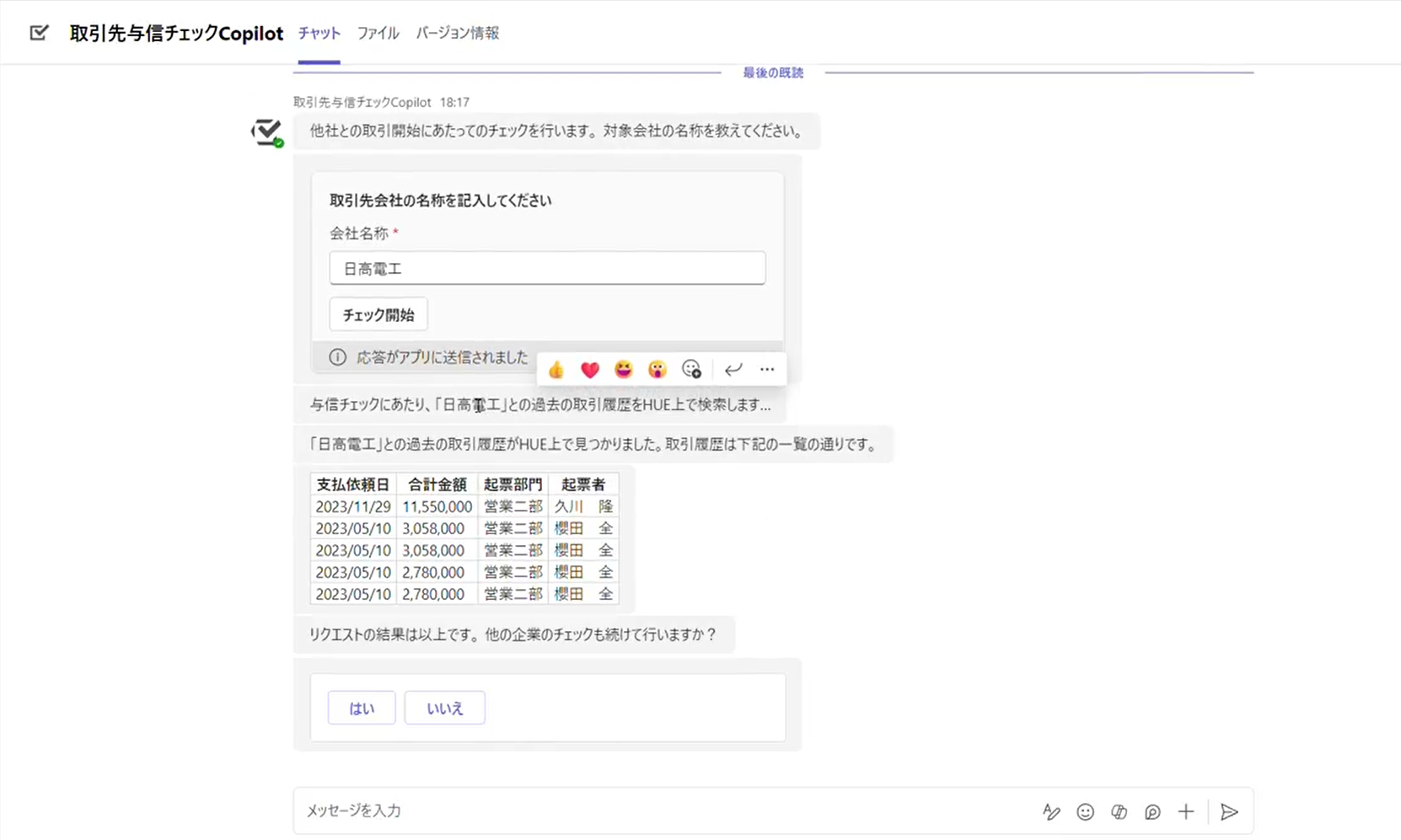
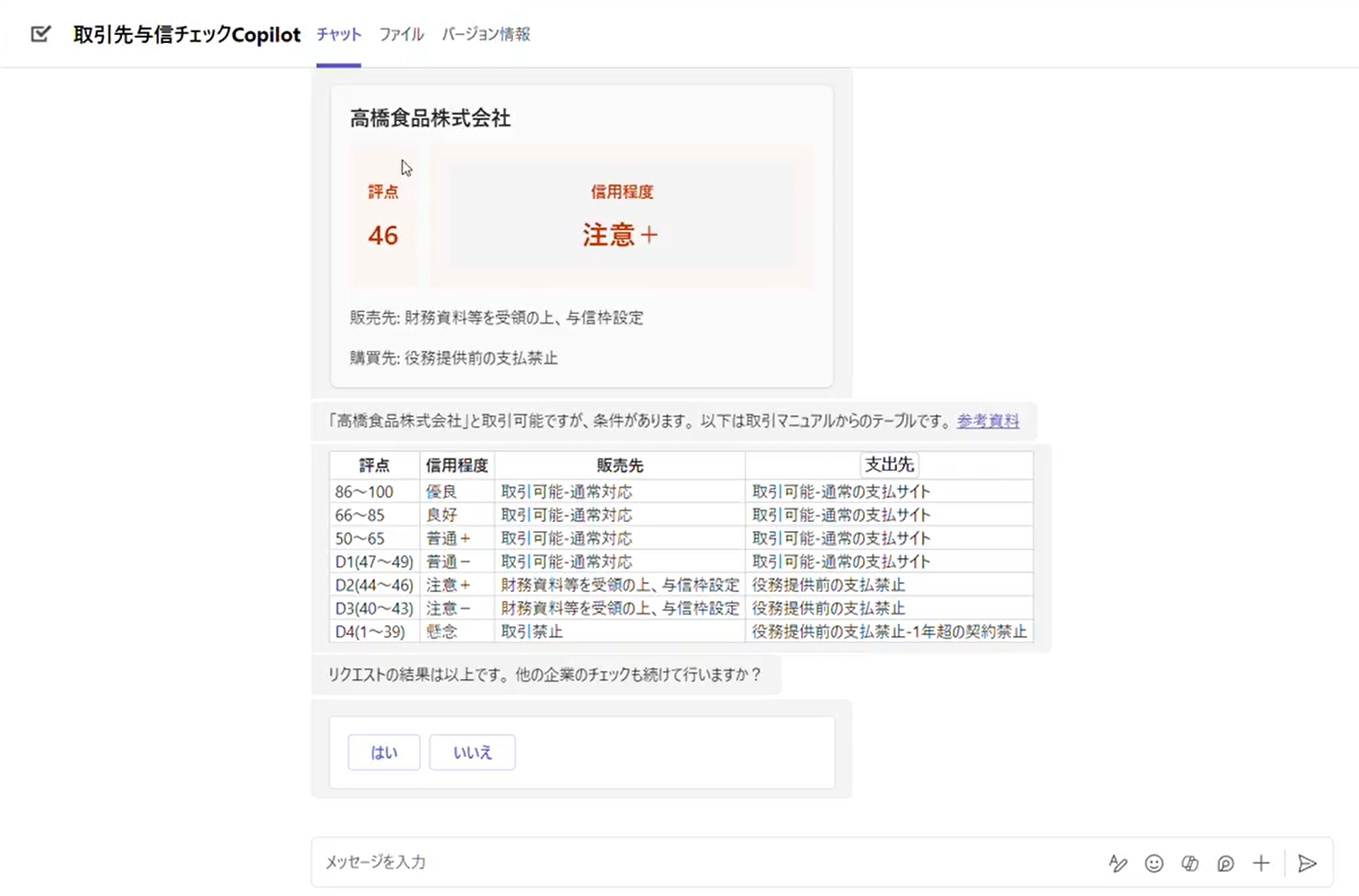
A credit check application for suppliers created with HUE x Copilot Copilot Studio
By linking ERP and Copilot, credit checks can be completed in a chat format. In addition to credit judgment based on transaction performance, Copilot can also be adjusted in accordance with corporate rules, such as limiting the files to be referenced.
Since automation is a process based on predetermined rules, one of its major advantages is to strengthen compliance measures. In addition, the ideal timing for promoting automation is to consider it all together at the time of updating the accounting system or core business system, rather than only partially addressing the issue. However, opportunities for such large-scale system renewal usually occur only once every 5 to 10 years.
Therefore, one option is to take an efficient approach to automation by adopting a method that allows flexible addition and modification of necessary parts while taking advantage of existing systems. For example, by introducing SaaS (Software as a Service) for specific business functions, such as expense reimbursement, electronic invoice issuance and receipt services, or even more efficient data entry using AI-OCR, and by linking these systems together, the automation of transaction processes can be advanced in stages By introducing SaaS (Software as a Service) for specific business functions and linking systems together, the automation of transaction processes can be promoted in stages.
After automation, accounting and finance will be responsible for "future-oriented operations
What do you think about the changes in the outlook and state of accounting and finance departments due to the evolution of accounting systems?
In implementing systems such as ERP and business applications, the need for individual development, known as add-on development or modification, is becoming less and less necessary. HUE is a good example of this. The UI/UX that allows users to configure themselves, rather than having to ask a specialized consultant to do so each time, is a real advance for application vendors. I think this is close to a system where users can get the joy of creating, or rather the satisfaction of doing so. That is why, in the near future, in conjunction with generative AI, it will be possible to get ideas through conversation, combine a number of functions, and set them up without more workload than now.
It goes back to the question of what the accounting and finance departments will end up doing after applications and AI take over the tasks that used to take man-hours. What is the purpose of creating time for? The idea is to derive market prospects based on data extracted from the past and to take preemptive measures.
Skills required of accounting and finance departments as data controllers in the future
What skills will be required of accounting and finance departments in the future amid such changes?
The base is still accounting and accounting standards, but there are several directions. One is the business skill of using diverse data and working with business departments to create scenarios, including future projections, to think about how decisions will be made and realized, and to promote these scenarios. The second is to stay close to the system. You need to understand how the system works and how it needs to be changed, and think about this together with the IT department from the perspective of accounting and finance. Third, data skills. In order to fulfill the demands of the business side, they will need to know what kind of data to collect from where, both inside and outside the company, and how to analyze it, and they will also need to make full use of statistical analysis and machine learning.
Finally, as a person in charge of data directly related to business performance, i.e., financial and accounting information, you will be working with people from various departments across the company, so communication and leadership skills such as discussion, explanation, opinion, and summarizing will be important. I think that human skills such as communication and leadership skills will become important.
The next "Accounting and Finance ✖ 00 Trend Words from an Accounting and Finance Perspective" is scheduled to be distributed around March 2025.
This article is current as of January 2025.

Related Useful Information
Web Articles
2026/01/21
Explanation of the 2026 Tax Reform Proposal for Accounting and Finance - What will change from a practical perspective? What are the changes from a practical perspective?

Web Articles
2025/08/01
Behind-the-scenes of the implementation of generative AI functionality in ERP "HUE" for major companies
White Paper
2025/07/24
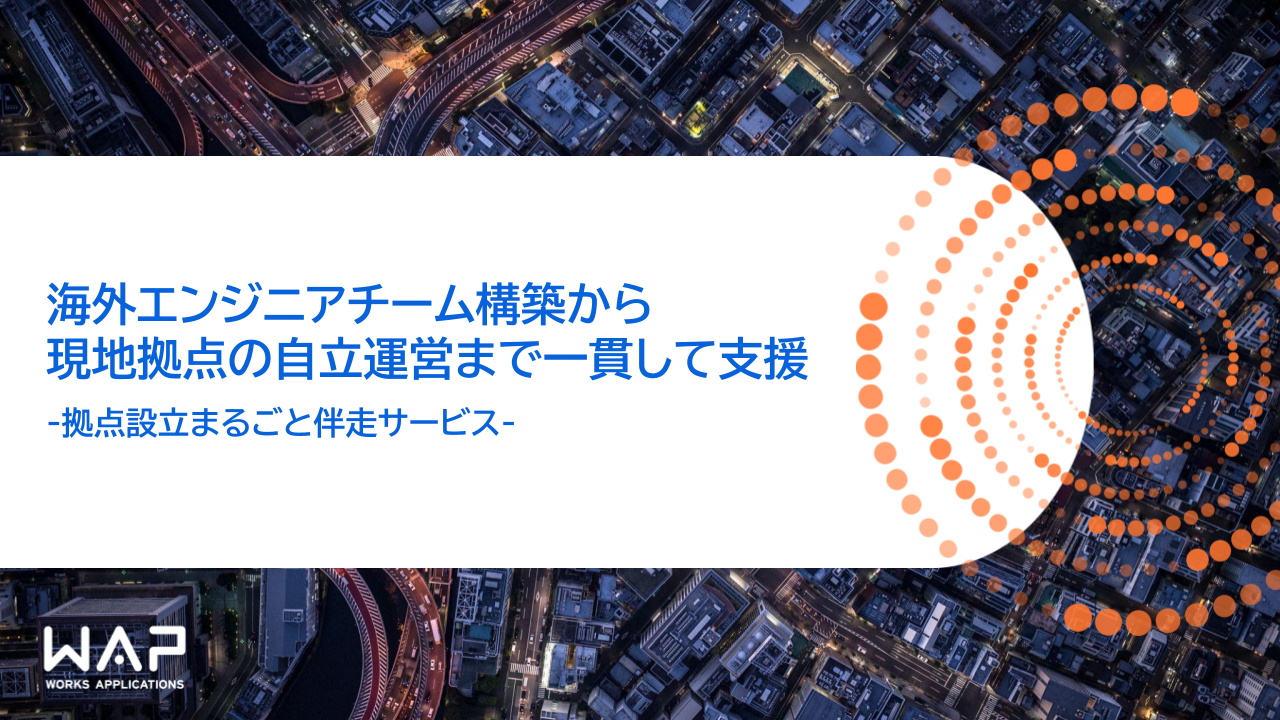
Introduction to the "Entire Base Establishment Accompaniment Service
Related Case Studies
Paperless and business reform one step at a time! Effects of HUE implementation and future prospects
Yanase Corporation

Reduced 1 million documents per year and realized a paperless office.
Kajima Corporation

Optimizing the entire ERP system with HUE's standard functions by moving away from customization
EXSOL Corporation