
Web Articles System Review Support
2021/02/08
For stores and company housing] 4 points to systemize the management of real estate contracts!
The management of real estate contracts in a company involves both the management of the "lessor" and the "lessee" of the property.
Among these, the management of real estate on the "renting side," which is owned by most companies, tends to require a very heavy workload, including management of contracts and cancellations, monthly payments, allocation of expenses, and preparation of payment records, although many companies use Excel to handle this task.
In this article, we will focus on four key points to introduce a system to manage "borrower's side" real estate contracts and improve efficiency.

Table of Contents
What is real estate contract management?
The management of real estate contracts in a company involves both the management of the "lessor" and the "lessee" of the property.
Among these, the "renting side" includes a variety of properties such as offices, stores, offices, rented dormitories and company housing, parking lots, and so on.Most companies manage some type of real estate contract, as it includes a variety of properties such as offices, shops, offices, rented dormitories, company housing, parking lots, etc. The purpose of the management is to manage the monthly rent of the property.
Click here for a real estate management system for "lenders": HUE Real Estate
The purpose of management is not only to pay the monthly rent for the property, but also to prepare journal entries by prorating expenses for each department using the property and to prepare various outputs such as payment records, which are legally required tax returns.
In order to carry out these tasks, a wide range of items must be managed, including contract details, payment terms, lessor, security deposit, property location and area... To perform these tasks, it is necessary to manage a wide range of items such as contract details, payment terms, lessor, security deposit, property location and area...etc.
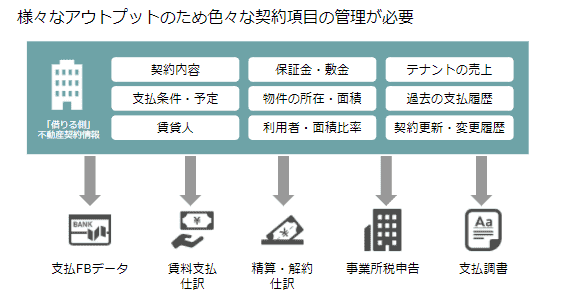
Although these tasks are generally performed in Excel, the need for various outputs such as payments, journal entries, and declarations often leads to the consideration of systemization when the number of contracts to be managed is large.
In particular, companies in the retail industry with a chain of stores and a large number of branches, and companies in the construction industry with a large number of company housing and business offices are increasingly systemizing to improve management efficiency.
Four points to consider when systemizing real estate contracts
So, what are the requirements and key points required when actually implementing the systemization of real estate contracts? Today, we will introduce four key points, including perspectives from the General Affairs Department to the Accounting Department.
Point (1) Management costs can be reduced by centralizing data.
The first point is the ability to centralize all real estate contract information.
In managing real estate contracts, it is necessary to manage various items with a view to payment, journalization, and tax reporting. In addition, it is not uncommon to find that when systemizing, "each office manages information in separate Excel files, and the management items are scattered among the offices.
By selecting a system that has a wide variety of management items and can centralize payments, journal entries, and tax reporting, it is possible to eliminate the use of spreadsheets and improve efficiency.
Point (2) Payment and journalizing can be automated
The ability to automatically make monthly rent and security deposit payments and prepare journal entries for those payments is another key point.
For payments, the ability to create FB data, as well as to collate names by payment date and counterparty, greatly reduces monthly work.
In addition, journal entries can be made not only by simple journal entries, but also by prorating expenses according to the ratio of the departments using the system and creating journal entries using the prorated results, thereby reducing the workload of not only the general affairs and rental departments but also the accounting department.
Point (3) Payment reports and business office tax returns can be automated.
Another key point is the ability to streamline tax reporting operations using information from real estate contracts. In addition to the preparation of payment records (payment records for real estate rental fees, etc., or payment records for brokerage commissions for the sale, purchase, or lease of real estate, etc.), the automation of business office tax calculations based on area information will reduce the burden of annual event work, leading to reduced overtime work.
Point (4) Accounting treatment in accordance with IFRS 16 (New Lease Accounting Standards) can be handled.
The final point is whether the system is capable of complying with IFRS 16 (new lease accounting standard).
IFRS (International Financial Reporting Standards) has adopted a lease accounting standard that requires complex on-balance sheet accounting, including real estate contracts that previously did not have to be treated as leases The standard is expected to be adopted by the Japanese government in the coming years.
Since this standard is expected to be adopted in Japanese accounting standards in a few years, it is important to select a system that anticipates the need for compliance now.
Related articles:
What systems are recommended for use by large companies?
Even though the above requirements are required in the management of real estate contracts, it is not impossible to deal with them in a one-sided operation if the number of contracts is small. However, for large companies that manage more than 100 offices and contracts, in addition to the above functions, security functions for internal control are also required, and the system must be able to handle these functions.
HUE Asset, asset management software for large companies, maintains a subsystem specialized for rental contract management. In addition to providing one-stop support from contract management to payment, journalization, and taxation, HUE Asset can also support IFRS 16 (new lease accounting standards) with standard functions by linking with the lease asset management subsystem.
Many examples of how HUE Asset has improved asset management operations can be found in our collection of asset management case studies. If you are interested, please download and check them out.

To request HUE Asset information, please visit
Related Useful Information
White Paper
2021/07/15
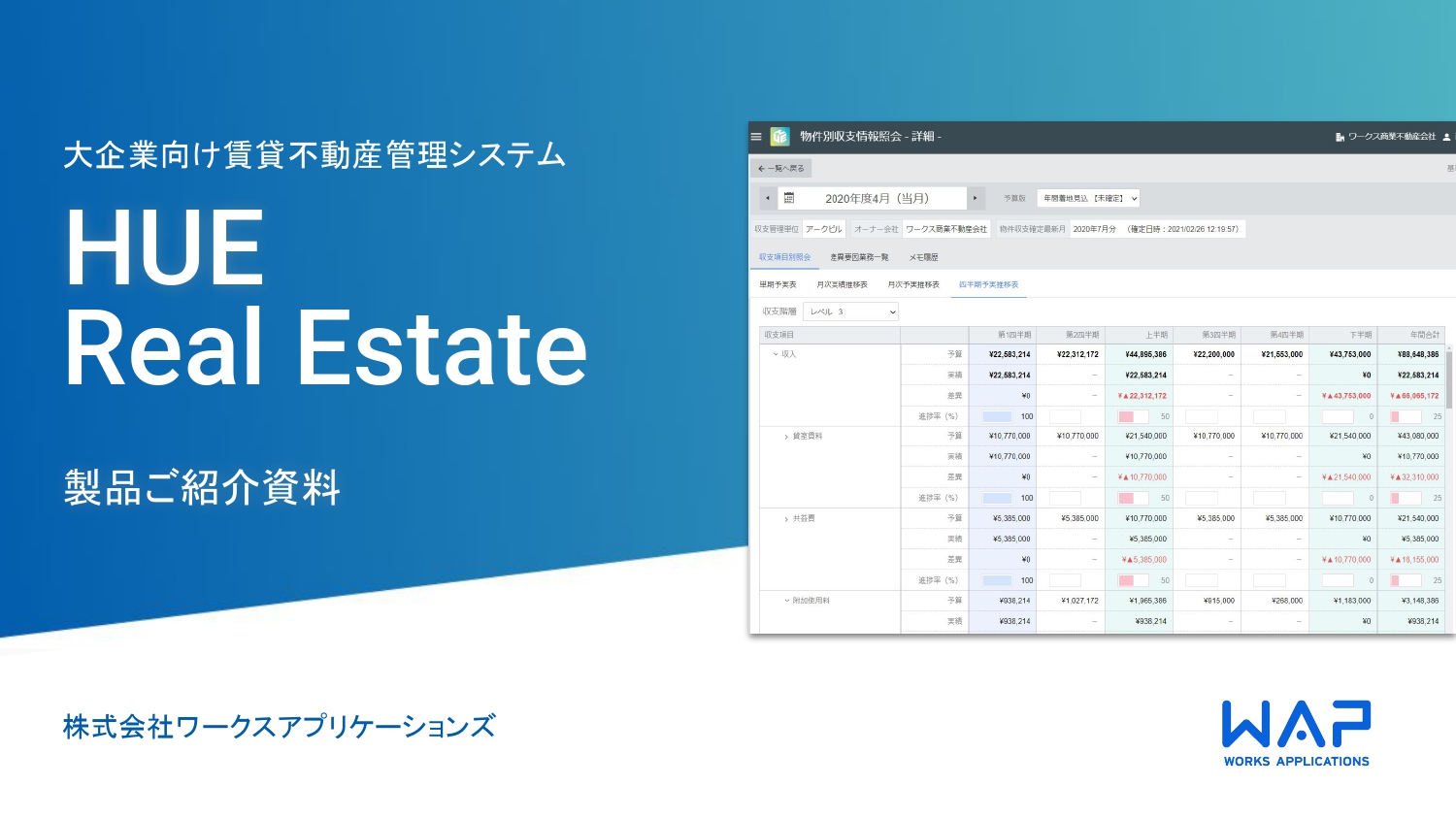
HUE Real Estate
White Paper
2020/12/25
Digitalization of Rental Real Estate Management Case Studies

Related Case Studies
Systematized real estate contracts for stores, freeing them from "stacks of contracts
Toyota Mobility Service Corporation

Adopting HUE as the core system for strategic management of airport commercial facilities
Japan Airport Building Co.