
Web Articles System Review Support
2021/08/13
For large companies】4 points of comparison for accounting systems!
When comparing the best accounting system for your company, there are many points that you should pay attention to based on the characteristics of major companies. For example, if you look at it from the perspective of a company that is expanding its business widely, the accounting work tends to be complex, such as processing a huge amount of data due to the large volume of daily transactions.
In this article, we will explain the points of comparison that you should be concerned about in order to choose the best accounting system for your company, based on the characteristics of major companies.

Table of Contents

What are the characteristics of accounting operations of major companies?
Accounting systems should be selected according to the accounting operations of the company, but what are the differences in operations at large companies compared to small and medium-sized companies? Here we will look at two major characteristics.
Feature 1: Accounting for all group companies is required.
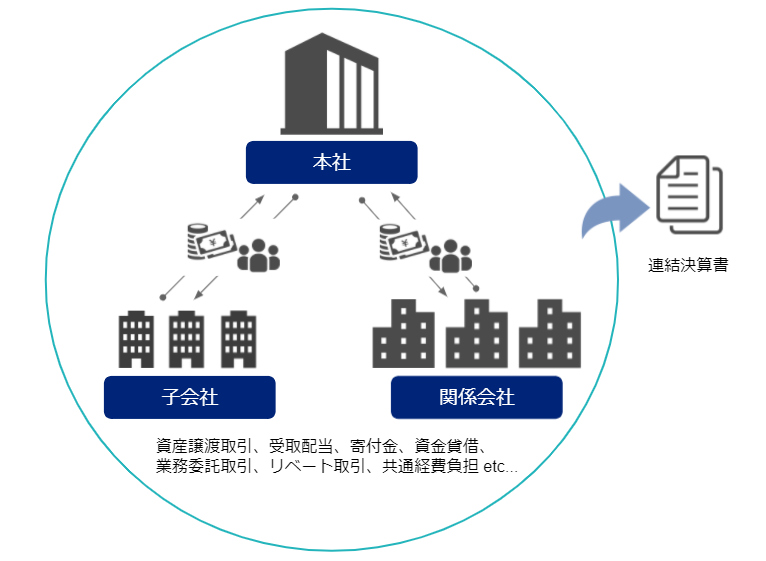
Companies that have grown in size through repeated business diversification and M&A have many subsidiaries and affiliates. Such companies need to perform accounting operations that include subsidiaries and affiliates.
For example,"consolidated settlement of accounts," which is the settlement of accounts for the entire group, is included in the accounting work. In addition, they may also process transactions among group companies. Furthermore, some companies standardize and consolidate accounting operations for the entire group through shared services. In such cases, there are cases where the business flow is operated through the entire group, such as approving vouchers and applications across companies.
Feature 2: The volume of transactions is large and operations can easily become complex.
Large companies are constantly engaged in a large number of transactions.
As a result, the amount of accounting work that occurs for each transaction increases, and the work becomes more complex.
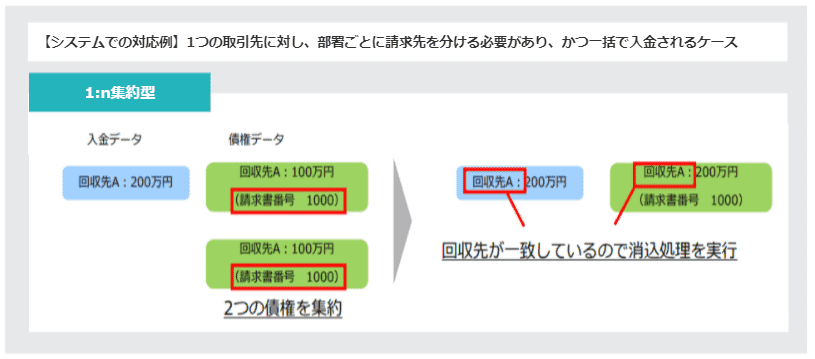
For example, in the case of accounts receivable transactions, it isnecessary to erase the corresponding items from a huge volume of receivables after receiving payment from the client. However, the ratio of receipts to receivables is not necessarily 1:1, but there are various patterns such as 1:1, 1:n, N:m, etc. If these patterns cannot be handled, the work must be automated. If these cannot be handled, the automatic erasure rate will be low, leaving scope for visual checks and manual work.
In other cases, when there are many suppliers, payment conditions also vary according to various contracts and transaction terms. Even for a single payment data, there are multiple payment terms depending on commission deductions, posted amounts, payment methods after installments, etc. The more clients there are, the more payment conditions there are, and the more complicated it becomes to correctly determine the payment method and process the payment according to the conditions. Thus, in the accounting operations of major companies, there are complex tasks such as accounting procedures including subsidiaries and affiliates such as consolidated accounting, and management of receivables and payables arising from a vast number of transactions.
Four points of comparison of accounting systems for major companies!
So, what factors should we pay attention to in order to choose an accounting system that can handle the accounting operations of a large company? Based on the characteristics discussed in the previous chapter, we offer four points.
1. Can the system handle group-wide operations such as consolidated accounting and processing of intercompany transactions?
As mentioned in the previous chapter, large companies with many subsidiaries and affiliated companies need accounting procedures that include group companies, so naturally the accounting system must also be able to handle this. For example, if the system does not have a function for consolidated accounting, it will be necessary to purchase a separate software for consolidated accounting, or the company will still have to work with Excel.
In addition, there are many other "requirements" for an accounting system that includes group companies, such as the ability tohandleintercompany transactions, the flexibility of the system's workflow to handle approval flows for shared services, and the ability to control users from viewing confidential/unnecessary data. By thoroughly identifying and comparing these "requirements," it is possible to select an accounting system that meets the needs of a company with many subsidiaries and affiliated companies.
2. Can the system handle patterns of payment and payment terms that occur in the company's own transactions?
Accounting operations tend to be complex in large companies, such as the complicated management of receivables and payables due to the large volume of transactions as mentioned in the previous chapter. Whether or not the accounting system can flexibly handle such complex operations and the cost of additional development are also points to consider when comparing accounting systems.
Using the example of payment cancellation mentioned in the previous section, if a system is capable of finding and automatically canceling credits based on pre-defined conditions for various patterns such as 1:n or n:n, the workload can be reduced even if a huge amount of credit data is registered.
3. Is the system designed so that anyone can use it easily?
In areas frequently used by employees, such as voucher entry and invoice-based payment applications, the number of people using the accounting system will also increase. For large companies with many employees, the number of people using the system will be even larger.
Naturally, employees have varying levels of IT literacy and PC skills. In order to enable employees to work with the accounting system without reducing business efficiency, a system that does not require time and skills to learn to operate, such as a user interface that is easy to understand at a glance, is necessary. Whether or not a system is easy for everyone to use will also determine whether or not there will be any backlash when the system is introduced.
When comparing accounting systems, you should carefully check the actual screens in product demonstrations and videos to identify a user-friendly system.
4. Is the system capable of handling large amounts of data?
For large companies that move a lot of money and people on a daily basis, the amount of data to be registered in an accounting system is also enormous. Since accounting systems support the core business of a company and are not replaced in a short period of time, one important point of comparison is whether the system can continue to be used without problems over the long term.
These are just a few examples, but considering the size of your company, the number of users, and the complexity of your business, there are a number of other points to consider when making comparisons.
The best accounting system for your company through a comparison of points to keep in mind
So far, we have explained the points to consider when comparing accounting systems based on the characteristics of major companies.
Because accounting systems support a company's core business, it is important to select the best accounting system for your company while also considering the characteristics of your company. To this end, it is necessary to identify requirements based on the characteristics of your company. The requirements are compiled as an RFP or RFI and distributed to the vendor. However, if the requirements are not accurately reflected in the documents, they may not be well communicated to the vendor, resulting in a large gap in satisfaction after the new system goes live.
At Works Applications, we have prepared content that explains specific points for creating an RFP in order to correctly communicate your company's requirements to the vendor.
Click here to download: How to create an RFP that will be communicated to the vendor
We also offer an accounting system, HUE AC.
The accounting system "HUE AC" has been adopted by a number of major companies because of its high level of business coverage and its ability to continuously reflect the requests and requirements of companies in various industries and business categories in its standard functions.
Related Useful Information
Web Articles
2026/01/21
Explanation of the 2026 Tax Reform Proposal for Accounting and Finance - What will change from a practical perspective? What are the changes from a practical perspective?

Web Articles
2025/08/01
Behind-the-scenes of the implementation of generative AI functionality in ERP "HUE" for major companies

White Paper
2025/07/24
Introduction to the "Entire Base Establishment Accompaniment Service
Related Case Studies
Paperless and business reform one step at a time! Effects of HUE implementation and future prospects
Yanase Corporation

Reduced 1 million documents per year and realized a paperless office.
Kajima Corporation
Optimizing the entire ERP system with HUE's standard functions by moving away from customization
EXSOL Corporation