
Web Articles Electronic Bookkeeping
2021/06/20
Paper storage of electronic transactions will be "abolished! Is it necessary to review the operation after the revision?
More and more companies are preparing for the revision of the Electronic Bookkeeping Act, which has been announced for a two-year grace period.
The revision includes a review of the requirements for "electronic transactions," and many of them may be particularly concerned about the fact that the method of storing output documents, which was previously considered "possible," has been "abolished.
This article focuses on "electronic transactions," an area of growing interest, and explains how to respond after the revision.
Table of Contents

Tax reform in 2022 will abolish the preservation of electronic transactions in written form?
Electronic transactions" refers to transactions in which transaction information on order forms, receipts, etc. is exchanged by electromagnetic means.
For example, a PDF file of an invoice or receipt can be received via e-mail or downloaded from a web page such as a reservation site.
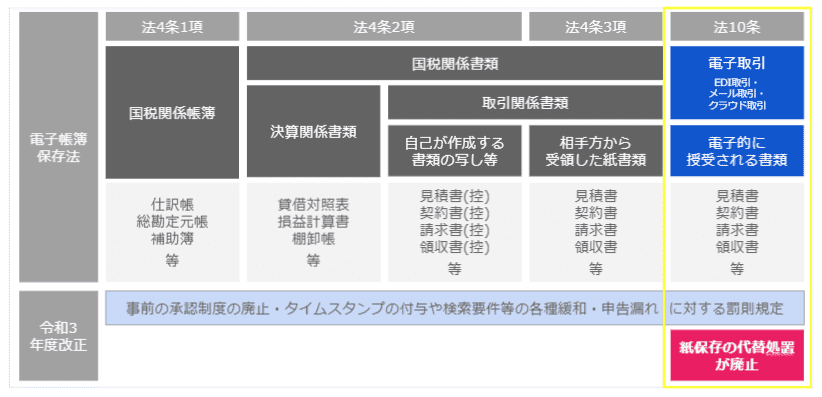
Until now, such transaction information had to be stored in either (1) electromagnetic records or (2) COM (*1) or (3) documents. However, the upcoming revision will "abolish" the alternative treatment of (3) in writing, and paper output and storage will no longer be permitted after 2024.
From "2021 Tax Reform Proposal," p. 98:
- Measures that allow a person who is obliged to preserve electromagnetic records of transaction information of electronic transactions for income tax return and corporate tax purposes to replace such electromagnetic records by preserving the output document of such electromagnetic records, etc., will be abolished.
(*1) Computer output microfilm. (*1) Computer output microfilm refers to a method of storing materials on photographic film.
Click here to learn about trends at other companies: The latest version of the 2022 Survey Report on the Actual State of Compliance with the Electronic Books and Records Preservation Act
Email attachments are not acceptable?
So, in what specific cases do we need to review the current operation?
Let us take the receipt of invoices as an example.
Receiving invoices by paper
First of all, if you receive invoices on paper, they are not subject to electronic transactions, so there is no problem with keeping them on paper.
If you receive invoices in paper form, they are not subject to electronic transactions, so they can be kept in paper form.
Receiving invoices via e-mail
What you need to be careful of is when you receive a PDF of the invoice attached to an e-mail.
According to the document published by the IRS, "if transaction information is included in the body of the e-mail, the e-mail is to be preserved, and if transaction information is exchanged through an e-mail attachment, the attachment is to be preserved ".
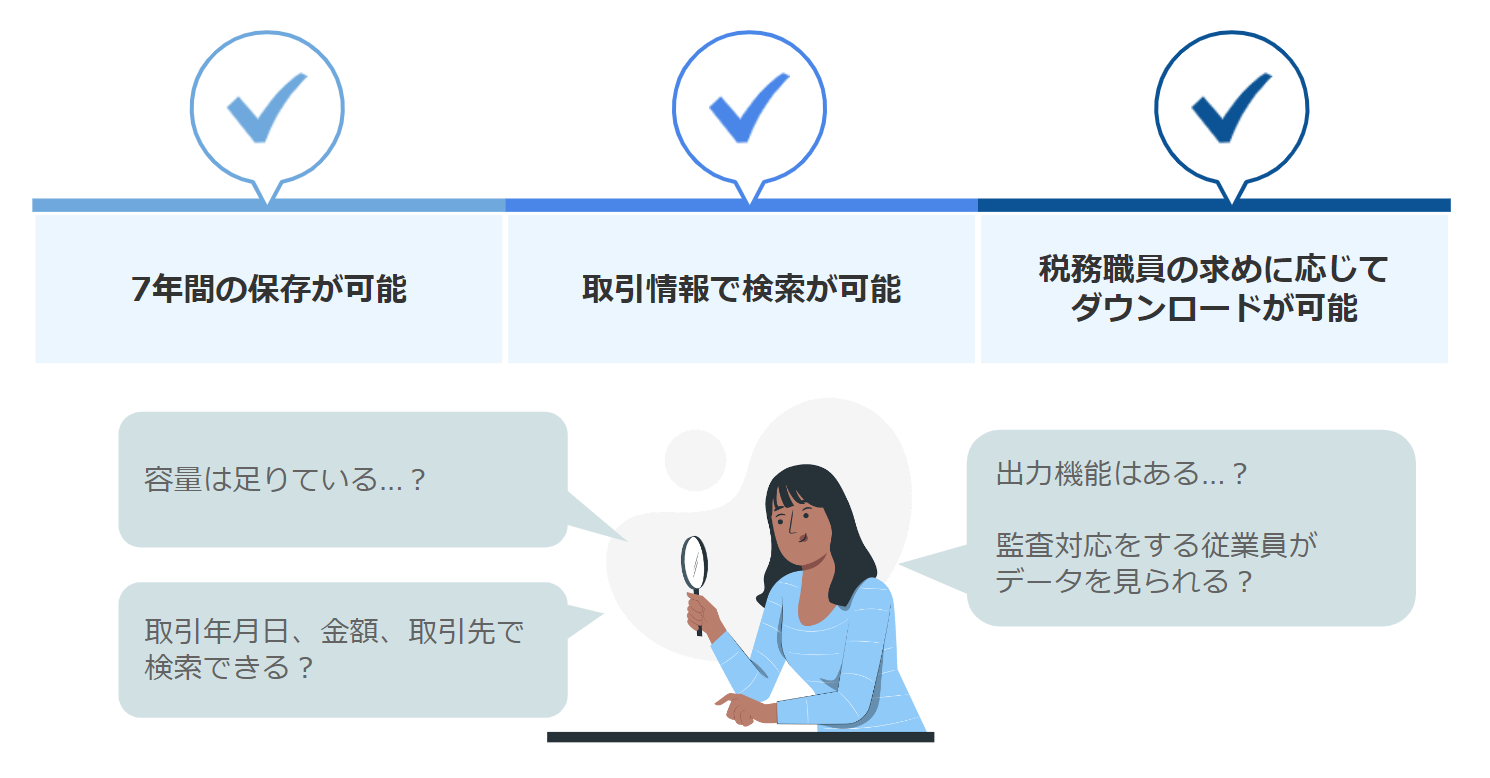
It is necessary to confirm whether thee-mail software, in-house server, storage service, etc. to which the information is to be savedcan be saved in compliance with the legal requirements.
Similarly, when transaction information is included in the body of an e-mail, such as in cases where a part of the date or amount is corrected or the contents of an order are conveyed without attachments, the information must be stored in accordance with the legal requirements.
Receiving invoices electronically via Web Billing Service
If you use a cloud service that allows you to send and receive invoices to and from business partners, you must also store them in compliance with the legal requirements for electronic transactions.
In April 2021, a new category was created in the JIIMA Certification, an official legal certification system, and a certification system for electronic transactions was also created, so that legal requirements are met. This can be used as one indicator when selecting a system or service.
Billing Management Robot Begins Integration with "HUE" Provided by Works Applications
Make sure you are ready for the revision and can respond within the grace period!
As mentioned above, it is now mandatory to check "whether the current operation meets the requirements," including when using e-mail or invoice transaction services, etc.
Our company, Works Applications, provides systems with functions to comply with the Electronic Bookkeeping Act, and we have also acquired the JIIMA certification, which is an official certification. Please feel free to contact us if you are considering compliance.


