
Consultant
HUE Evangelist talks about the concept and appeal of HUE
HUE", the only system with a unique concept
Profile
He is also a member of the Customer Success Div.
H.S. Joined the company in 2005 as a new graduate
Release Date : 2025/07/15
New graduate / Male

HUE Evangelist talks about the concept and appeal of HUE
In this issue, we talked to an employee who received the HUE Evangelist "Silver Certification" about the concept of HUE, our main product. (What do you know about the HUE Evangelist System? HERE )
Profile
Customer Success
H.S. Joined the company in 2005 as a new graduate
When I was in college, I majored in IT utilization research at the Faculty of Economics. He participated in an internship program that was being held at the time, and decided to join the company after empathizing with the company's philosophy. At the time of joining the company, he was in charge of implementation/operation of a newly released accounting system. Currently, he is engaged in business consulting for our clients' accounting operations, making the most of his experience in implementing accounting systems.

H.S., what kind of products does HUE usually handle?
I am mainly responsible for the "HUE AC" series, which handles accounting work for large companies within the "HUE" series. The "HUE AC" series is a system that handles the "accounting" area, which is the equivalent of a household account book or pocketbook for individuals, to manage money in more detail.
Many people may first think of "journalizing" when they think of accounting work. Journalizing is the process of recording a company's daily money movements. For example, when sales of goods are made or expenses are incurred for the purchase of equipment, each transaction is recorded in the accounting books.
This journalizing process is an important part of the accounting work, but in reality there are many other tasks involved before and after the journalizing process. When people and goods move, money moves along with them. This movement is then reflected in the accounting journal entries.
Therefore, accounting operations are not limited to simply entering journal entries; it is also important to manage and grasp the information before and after the movement of money.
The "HUE AC" series products support the efficient management of such money movement.
Systems that centrally manage a company's management resources (people, goods, and money) are collectively called "ERP (Enterprise Resource Planning)," and "HUE" is one of these ERP systems.
Back-office administrative tasks, such as accounting and human resource management, do not directly generate revenue. Therefore, even if a large amount of money is spent on system development, the effect is limited to cost reductions through improved operational efficiency. That is why it is important to obtain the maximum effect at the lowest possible cost.

What are HUE's strengths?
The product concept of "no customization" and "free version upgrades" achieves "unparalleled functionality coverage.
General ERP is sold as a packaged system with the "minimum functions required by each company" as standard features. What the package lacks in functionality can be supplemented with "add-ons" and "customizations.
Add-ons" and "customizations" require additional development costs in addition to the package system usage fees (monthly and annual system maintenance fees).
HUE, on the other hand, is based on the concept of "no customization," with a wide range of functions provided as standard equipment from the beginning, eliminating the need for "add-ons" and "customization.
In the 20 years since the release of the AC series, we have taken the function requests we have received from many customers and reflected them in the standard features at no additional cost. This is the "no-cost version-up" concept.
As a result, HUE has grown into an ERP product with overwhelming functionality coverage that can flexibly respond to the needs of large companies that require complex operations.
*For details of the "HUE" concept, click here.
You sometimes pay for additional functions.
At first, I too wondered, "Why would they do that?" I thought.
The HUE concept of "free version upgrades" and "no customization" is a mechanism that allows for functionality to be expanded at no additional cost.
Smartphone applications are also updated as needed, and new functions are added, right? However, it is difficult to think of "paying an additional fee to have a desired function added" just because "it is difficult to use" or "the function is not enough.
However, the situation is different for companies. While a little inconvenience can be tolerated if the application is used by an individual, in the case of corporate activities, if employees have to do more work, it will lead directly to an increase in labor costs.
Therefore, if a system lacks a necessary function, a company may pay an additional fee to a system company to request "add-ons" (additional functions) or "customizations" (functional changes) to create a system that is optimal for their company.
Does that mean that you can create a system that suits your company's business?
At the point of implementation, the system is optimized for the company's operations. Although customization costs will be incurred, the system will often be completed to the satisfaction of the on-site department.
However, business operations are constantly changing. In addition, there will be situations where it will be necessary to respond to legal revisions or changes in the company's situation. The underlying package system will also undergo version upgrades.
What will happen to the customized functions at that time? Customized functions optimized and developed for the business at the time of implementation may not be able to adapt to future changes as is.
If they cannot adapt to changes, they will need to be re-developed, incurring additional costs. This unpredictable cost is the difficulty with package systems based on customization.
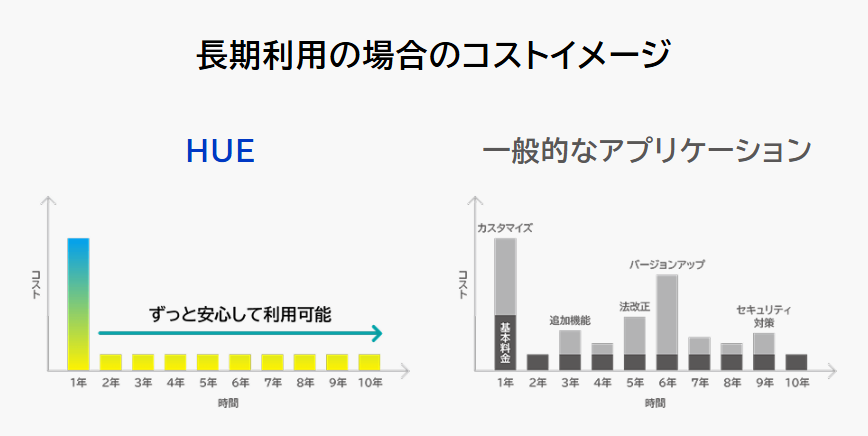
Do you mean that "HUE," which claims "no customization" and "free version upgrade," has no such disadvantages?
Yes, that is true. Another advantage of "HUE" is that it can be commercialized in the form of incorporating new operations into an existing system.
We can upgrade HUE in response to customer requests, and the new functions will be made available to all customers. In other words, the business know-how of other companies may be useful for improving their own operations.
For example, trading companies handle a wide variety of commercial products and have to process payments with many suppliers. Therefore, we have introduced a system that receives payment schedule data from suppliers in advance and checks at the end of each month to see if the payment schedule matches that of the suppliers.
This type of functionality can be applied to other industries as well, as it allows the accounting department to move up its workload during the busy season. In this way, HUE's strength is its ability to share business know-how across industries and business categories, and to find know-how on improving business efficiency that cannot be thought of by the company itself.
Furthermore, when HUE reveals that there are operations that cannot be covered by standard functions, this in itself can be an opportunity to review the operations.
There are two major reasons why the standard functions cannot cover a certain task. One is "efficient operations that have not yet been implemented by other companies. In this case, we will consider whether or not to add that work to the standard functions of HUE.
The other is "operations that are actually inefficient. Since there is a high possibility that it is an inefficient operation that has not been adopted by other companies, it is necessary to review the business process itself.
Since we have been incorporating the business process with functions that we have judged "this is an efficient business process" from among our clients' function requests, there is a high possibility that "business process not covered by HUE = inefficient business process not implemented by other companies".
In other words, HUE can serve as a "mirror" to compare your company's operations with the de facto standards of your business.
Finally, do you consider HUE, which has been evolving for 20 years, to be complete?
We would like to say so, but in fact we feel that recent changes in society are pushing the completion of HUE further into the future.
Until now, it was common practice to receive paper documents such as receipts and invoices and have the person in charge manually input them into a system, which required the system to be "easy to input and easy to use.
However, with the advent of AI technology, the situation has changed dramatically. Paper documents are now scanned, and AI reads the necessary information and converts it into data. As these technologies evolve further, the input process itself may become unnecessary in the future.
HUE must continue to grow and evolve to keep up with these changes.
It will also become increasingly important to identify what to use and how to make use of the myriad of technologies emerging in society.
Therefore, HUE will continue to adhere to the concept of "free version-up" and "no customization," and will always provide products that are "half a step ahead" in the sense of staying close to customers and anticipating their requests.
Related Articles
Consultant
Three organization heads in their 30s who will create the future gather together. What is the appeal of Works Applications from the viewpoint of a department manager?
S.I. / H.A. / Y.F. / 2010 new graduate
Development / Sales / Consultant
Consultant / New graduate

Consultant
I feel rewarded by the "Thank you" from our customers.
M.M. / Joined mid-career in 2020
Account Management Div.
Consultant / Mid-career / Female

Consultant
Proposing the best way to use the system. Working with customers as a consultant.
K.N. / Mid-career 2022
ERP Consulting Div.
Consultant / Mid-career / Male