
Sales / Consultant / Engineer
Three organization heads in their 30s who will create the future gather together. What is the appeal of Works Applications from the viewpoint of a department manager?
Profile
Development / Sales / Consultant
S.I. / H.A. / Y.F. Joined the company in 2010
Release Date : 2025/02/18
New Graduate
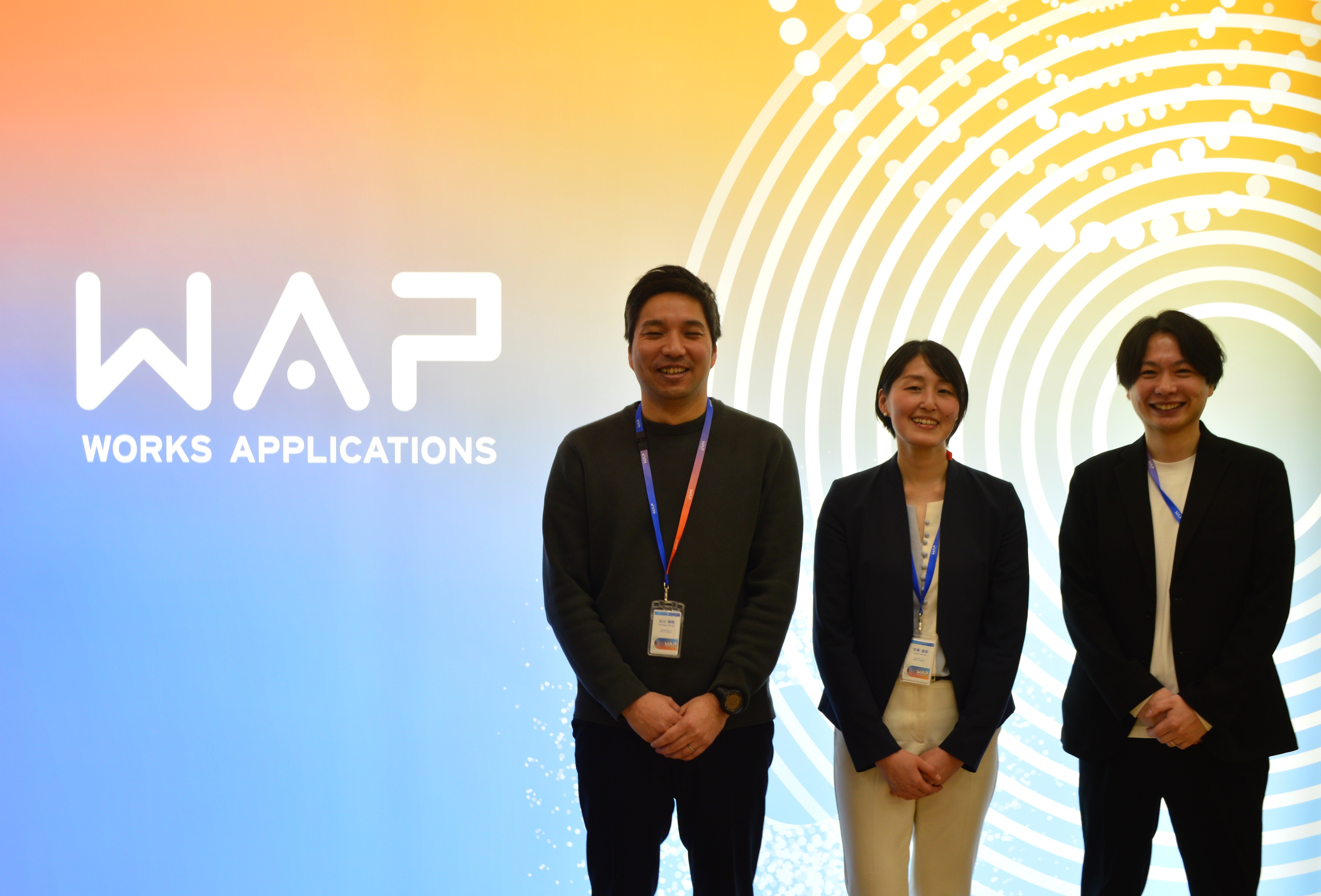
For this interview, we spoke with three department heads on the theme of "The Appeal of Works Applications from the Perspective of the Department Managers.
What makes Works Applications so appealing to me
What were your reasons for joining Works Applications?

I participated in our internship program during the summer vacation of my senior year of college. I decided to join the company because I could get an image of growth from a young age from the content of the program that made me think thoroughly and the employees who showed excellence in conversation with me.
I had received job offers from several major companies during my job search, but I felt that if I joined a major company, I would probably be in my 40s or later before I could take the initiative in carrying out challenging tasks. However, I was strongly attracted to the fact that at our company, there is a flat relationship regardless of position, and we have an environment in which we can be entrusted with tasks of great responsibility from a young age. In particular, the fact that I felt there were abundant opportunities for growth while I was in my 20s was a deciding factor in my decision to join the company.

When I was a graduate student, I was conducting research in a certain field, and there was a time when I considered pursuing a career as a researcher. While attending academic conferences where researchers gathered, I met many excellent researchers, but at the same time I learned about the reality of shrinking R&D spending by Japanese companies and declining salaries for researchers. I became acutely aware that my career path as a researcher was limited, which made me uneasy, and I began to consider career options other than being a researcher.
I attended a job hunting seminar hosted by our company and strongly empathized with what the then president had to say about the decline in Japan's national power and what Japanese companies need to do and the role they should play in the future. This seminar sparked my interest in the Company, and I was able to successfully pass the employment screening process. Although it is a different path from a research position, after receiving the job offer and talking with various employees, I became convinced that I could visualize my own personal growth and that H.A.S. is a company that can contribute to society, and I decided to join the company.

Like H.A., I also became interested in the company after participating in an internship at the company. To be honest, when I was a student, I did not have a specific goal of "wanting to work in this industry" or "wanting to do this kind of work. However, I had a vague and strong desire to "grow," and I focused my job search on "companies where I can grow.
It was during this time that I participated in our internship program, which focused on "growth," and I was extremely stimulated. What impressed me the most was that I received accurate and sharp reviews from employees during my internship. I was not held back because I was a student, but received feedback on a serious and equal footing. The students who participated in the same internship were also very enthusiastic, which naturally gave me the image that I could absorb a lot of things and grow if I worked in such an environment.
I heard that the three of you are in the same company. What is your impression of the employees who joined the company at the same time?
There were a total of 300 employees who joined the company at the same time, and I got the impression that many of them were extremely talented and upwardly mobile, partly because they had passed our rigorous selection process. Immediately after joining the company, I felt a strong sense of urgency and pressure to not be left behind by those around me. While I was a student, I did not feel much competitiveness toward my classmates around me, but after joining our company, I naturally developed a competitive mindset and felt that I had to work very hard to grow.
Although I did not have many opportunities to work on the same projects as S.I. and H.A., I often heard about their successes. Each time I heard about their activities, I was strongly inspired by them and thought, "I can't lose to them either.
Similar to Y.F., I think that many of my peers were extremely motivated to grow and were excellent. The members assigned to the consulting team, including Y.F., were very impressive in their willingness to actively communicate with a wide range of people, without being limited by gender or age.
I am from the countryside and have lived peacefully as a student, so I was overwhelmed at first by the energetic and confident people (laugh). Working in such a vibrant work environment was a great stimulus for me, and now I feel that I was blessed with a place where I could grow.
There were about 30 of us in the sales organization, all of whom had a strong desire to grow, and we were always thinking about how we could improve our performance at work. Whenever we failed in our work, we would ask ourselves, "Why didn't we succeed? How can we do it better the next time?" He had a positive attitude toward his work.
On the other hand, many of them were able to switch on and off the job very well. During the daytime, they were serious about their work, and after work, they sometimes went out for drinks with their classmates and seniors. I myself spent time on hobbies and lessons on my days off, and because I was able to create many opportunities for input outside of work, every day was extremely fulfilling, even from the time I was a new employee.
How did you feel about the work environment when you actually joined our company?
I had many opportunities to be entrusted with challenging tasks from a young age. At first, I was worried about whether I, as an inexperienced employee, would be able to complete the difficult tasks to the end, but senior employees supported me well, and I was able to proceed with my work with confidence. Sometimes I received harsh feedback on my deliverables, but I think I was able to work in a warmer environment than that.
Through this experience, I strongly felt the importance of finishing the job by myself. By overcoming difficult challenges, you not only achieve results, but you also feel that you have completed the task. This gives them confidence and fosters a desire to take on more difficult challenges, which I believe leads to further growth. I feel that our company's working environment, where young people can take the initiative in carrying out difficult tasks while their seniors watch over them, is a very fortunate place for growth.
I feel that our company places great importance on having a "sense of ownership" in our work, and that our employees have an attitude of taking responsibility for the results of their work, rather than simply performing the tasks that are assigned to them. They also consider the work of others as their own, and always think about how to propose the best solution to solve the customer's problem.
I also have abundant opportunities to get involved in large projects and play an important role from a young age. I believe that this is an environment in which you can become more aware of the responsibility for your own words and actions, and thus think more deeply about each job and solve difficult problems.
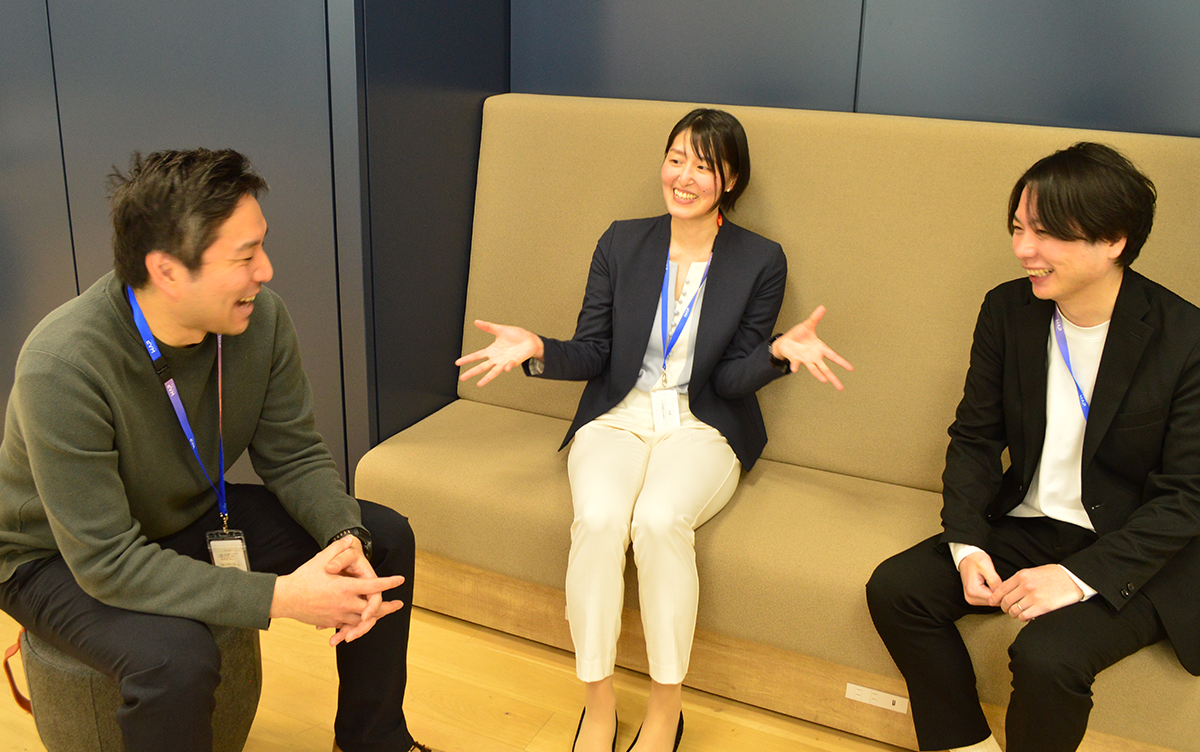
Is there a point in time when you realized significant growth after joining our company?
I myself have had many opportunities to work with clients with large transaction amounts since my first year with the company, but I have experienced several lost orders. Since our sales activities involve a long proposal period and many stakeholders, the causes of lost orders are complex, and there is rarely a single cause or area for improvement. In addition, each project is different, and it is impossible to apply a uniform pattern of success to each customer. In this environment, I carefully analyzed the factors that led to my failure to receive new orders, and reflected on what actions led to the loss of orders. At the same time, I clarified the content of proposals and approaches necessary to win new orders, and made a conscious effort to systematically incorporate them into my own work.
Then, in my seventh year with the company, I was able to win a large order, something I had never done before, and for the first time I had a great sense of my own growth. At the beginning, our competitors were ahead of us in building relationships with customers, and customers were sorting out their requirements for our products based on the proposals of other companies, so I felt that the possibility of adopting our products was low. On the other hand, I thought that the other company's proposal was not the best for the customer. Usually, in the early stages of a relationship with a customer, we make a proposal that meets the customer's requirements and gradually insert another proposal. However, due to the approaching deadline for product selection and the competition situation, it was difficult for us to win the order by following a theory-based approach. Therefore, at a customer proposal meeting where other companies were also present, I told the customer, "There is a possibility that what you are requesting may not fully fulfill your original objective," and clearly indicated the points where we could make a more appropriate proposal. By verbalizing the issues that needed to be resolved, the client became aware of its own potential problems, and its trust in our company grew dramatically. After that, we were able to take the lead in discussions with the client, and eventually we were able to win the order. We risked being disliked by the client because our approach was out of the norm, but I think our decision paid off and we were able to gain their trust.
Sorry to interrupt (laughs).
I have an image that salespeople have a manual like a talk script or sales procedure manual and basically approach customers according to it, but is that not the case?
I had the strong impression that our sales team is organized, and I didn't have much of an image of individuals thinking of strategies individually.
In sales activities, there is a framework for basic sales flow and sales strategy. However, it is practically difficult to approach customers in the same way in actual business meetings, and it is necessary to change the content of proposals according to the issues each customer has and the background of the industry. There are many times when I have to make split-second decisions about what to say and how to change course, based on what I understand the customer's needs.
I still feel I am growing every day (laughs). The time when I felt the most growth was when I first got involved in non-development work. There was a time to start a new customer support team within the company, and I volunteered to join the project. Since I had been working as a developer until then, at first I was worried and perplexed as to whether I could handle work outside my area of responsibility, but with the support of my seniors, I managed to complete the project. After experiencing such work, I began to understand the role and meaning of my work in the company as a whole when I started working in development. It was also a moment when I came to understand the difficulties faced by those who are in charge of positions other than development, and I was able to approach my work from a multifaceted perspective. Through this experience, I think my approach to work changed dramatically. I think this was my first major turning point.
Bringing team members together
You are in a position to manage team members, but is there anything you are conscious of?
I believe that sales managers in general companies are expected to manage the sales of their team members and achieve numerical targets. On the other hand, we believe that it is important not only to achieve sales results, but also to learn and realize things in the process, which leads to personal growth, which in turn improves the performance of the team as a whole. For this reason, I am conscious of providing an environment in which each member has a great deal of discretion and is able to carry out his or her work independently, without excessive management of sales activities in general, including numerical figures. Of course, we set sales targets and sales policies to a certain extent, but we leave specific approaches to customers to the ideas and ingenuity of each member so that they can develop the ability to generate results on their own. If I decide on a specific sales policy, the members will have fewer opportunities to think, so ideally, I would like them to take the initiative in their sales activities and produce results that exceed my expectations.
As a premise, the company's organizational chart shows the members under the manager, but I believe that positions and titles are simply different roles, and I do not consider the boss to be in a position of greatness. I believe it is important to respect each other and work together regardless of position or title.
What I keep in mind when managing team members is to support them in their work by considering "how to help them grow further. If I take the initiative or give detailed work instructions, it will lead to my own growth, but it will not lead to the growth of the team members. Therefore, I think my role is to let the members take the initiative in carrying out their work, and to give them advice based on my knowledge and experience when they get stuck. When giving advice, I try not to give them answers or force my ideas on them, but rather to give them hints and simple advice that they need to carry out their work. In order to grow, it is important to "think for oneself," and one does not grow just by being taught by others. I believe that growth is achieved when members learn, think, and act on their own to carry out their work.
Like S.I., I believe that my role is to have respect for team members, respect their individuality, delegate as much responsibility and authority as possible, and create opportunities for them to take on difficult tasks. Of course, I do not simply delegate tasks, but I am conscious of giving feedback to team members on the work they have done at an appropriate frequency to encourage their growth. However, there is a risk that too much support may undermine the autonomy of the members. We do not want to create a situation in which managers give hand-holding instruction so that employees can achieve results without having to think about it. We do not want a work environment that is overprotective and nurturing, but rather one that provides appropriate support so that employees can think and act on their own. We believe that a good balance between an environment that allows employees to take on challenges and a system that supports them will ultimately lead to the growth of the company as a whole.
There is an environment where you can take on difficult challenges and "grow.
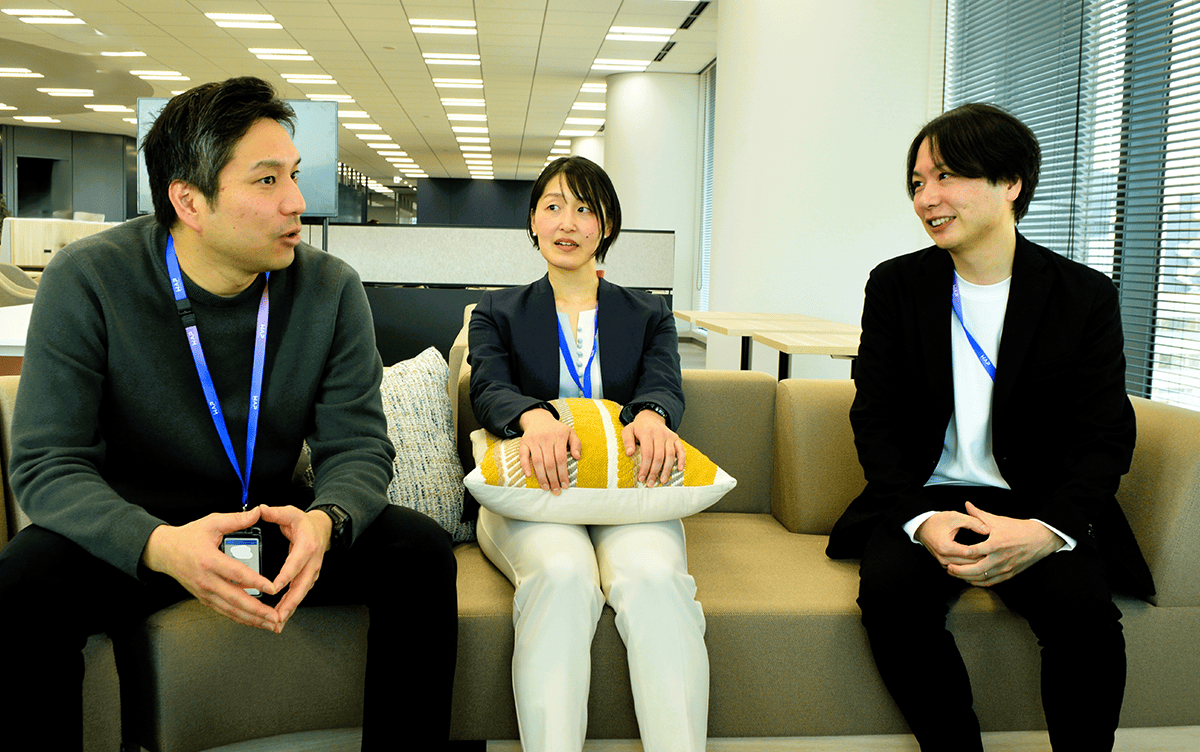
What are the characteristics of each organization? Please tell us more about the characteristics of each organization.
The sales team has a flat organizational structure, with managers and members very close, and the entire team works together with a sense of unity while exchanging opinions on business operations on a daily basis. Basically, we work in teams of several people, and we try to communicate frequently with each other.
We also value relationships and communication not only within the team but also with various departments within the company. The cooperation of many employees, including those in the development and consulting departments, as well as the legal and financial departments, is essential for salespeople to obtain orders. Sales members are aware of this, so many of them always have respect for other departments and work with a humble attitude.
It may be obvious, but many members of the development staff like to develop systems and enjoy their work. Underlying the members' work philosophy is a strong desire to solve customers' problems through system development. If a situation requires new technology or skills to solve a problem, they will actively catch up and update their own knowledge. One of the strengths of our development team is that we have the positive attitude to see any technical challenge we face as an opportunity to grow. Ultimately, our goal is not only to create excellent products, but also to grow ourselves.
I believe that many of our members are passionate and motivated to build trusting relationships with customers and lead implementation projects. Of course, moving forward with a project is not all fun and games. Especially in projects that last one to two years, we often face more difficulties than smooth progress. System issues may arise, there may be differences in perception between the client and the consultant, and many other problems may arise in the course of the project. To ensure the success of a project, all members are constantly thinking about "what are the real issues the customer wants to solve" and "how to build trust with the customer to ensure the smooth progress of the project.
What do you look for in a new employee to be successful in your company?
What we look for in new employees is "the ability to work through things" and "a desire to grow. In any job, you may encounter difficulties along the way, but it is important to have the attitude of not giving up at such times and persevering to the end. I hope that you will proactively pursue your own personal growth and actively work to improve your skills when you join the company. The company offers a variety of support systems and working environments that encourage growth. There are many opportunities to take on difficult tasks, so I want them to take the initiative in their work and always be aware of their own growth, rather than simply waiting for instructions.
What I look for in new employees is a "sense of ownership" in addition to a "desire to grow. The current business environment is rapidly changing, and the skills and knowledge required are constantly shifting. If you have a desire to grow, you will catch up with new knowledge on your own, allowing you to respond flexibly to changes in the world. In addition, I believe that having a sense of being a party to the company will give you a sense of responsibility for your work and enable you to work proactively. I want new employees to always think about how their work will affect the company and the team, and to act on their own initiative to produce results.
We are waiting for colleagues who can expand our business together with us.
Do you have a message for job seekers reading this interview?
We are interested in and value individual growth. Our work environment offers discretion from a young age and numerous opportunities for growth. We don't just look for results in our work, but we place importance on challenging ourselves with difficult tasks and learning new things in the process of performing our duties. We are also a highly team-oriented company, as members with different backgrounds and experiences cooperate with each other and incorporate diverse ideas and perspectives into their work. If you have a strong desire to grow and want to work independently from a young age, we encourage you to apply!
We have an environment that offers a variety of growth opportunities depending on your motivation. There are plenty of opportunities to learn new skills and challenge yourself in different areas, making this the perfect environment for those seeking growth. Also, when you want to take on a challenge, your supervisor will provide support and feedback, and you will not be discriminated against because you are a young person.
We are looking forward to hearing from anyone who is willing to take on difficult tasks and grow.
I hope that you will not underestimate your abilities, believe in your potential, and challenge yourself in a variety of ways. More than a decade after I joined our company, I had the opportunity to be invited to an international conference as part of my work, and I had the valuable experience of demonstrating our products to members of the Diet. If you are willing to grow and take on challenges, you will be able to do the work you think you cannot do now if you work hard, and you will also be given opportunities to be entrusted with work you never expected to do. At our company, there are many opportunities to expand your potential. We believe in the potential of each and every employee and do our best to support their growth. If you have the desire to grow, you will have the chance to be involved in difficult but rewarding work. If you are willing to challenge your limits without fear of failure and enjoy change, we are sure that you will be able to achieve great results. If you have a strong desire to grow, we would love to work with you.

Profile
Development
S.I. Joined the company in 2010
I have experience in developing multiple ERP products and setting up customer support departments. In his 30s, he became the youngest executive officer of the development department and manages a development team of 200 people.

Profile
Sales
H.A. Joined the company in 2010
He has been involved in new sales of our enterprise software since he joined the company, and has experience in setting up a new department in the technical sales division.
He was selected as a manager in his 20s and is currently responsible for sales of several billion yen as the head of the sales department for the eastern Japan region.
Profile
Consultant
Y.F. Joined the company in 2010
He has experience in quality control of the company's products and as an implementation consultant.
In his 30s, he became in charge of the entire consulting division, managing a team of about 100 consultants and managing multiple projects.
Interviewer: R.K., Human Resources