Consultant
Maximizing team performance through various innovations! What is the management challenge for young managers?
Real Stories of Next Generation Leaders Developed in a Flat Organization
Profile
Consultant / Customer Support
K.T. / K.A.
Release Date : 2023/02/13
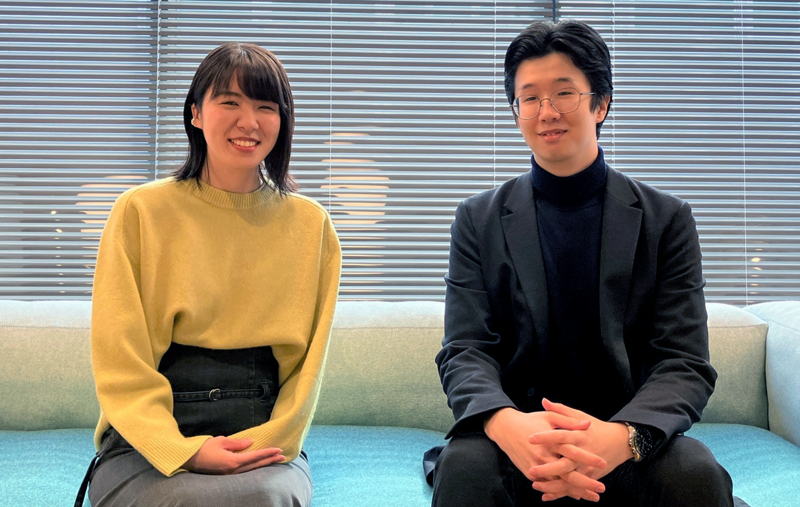
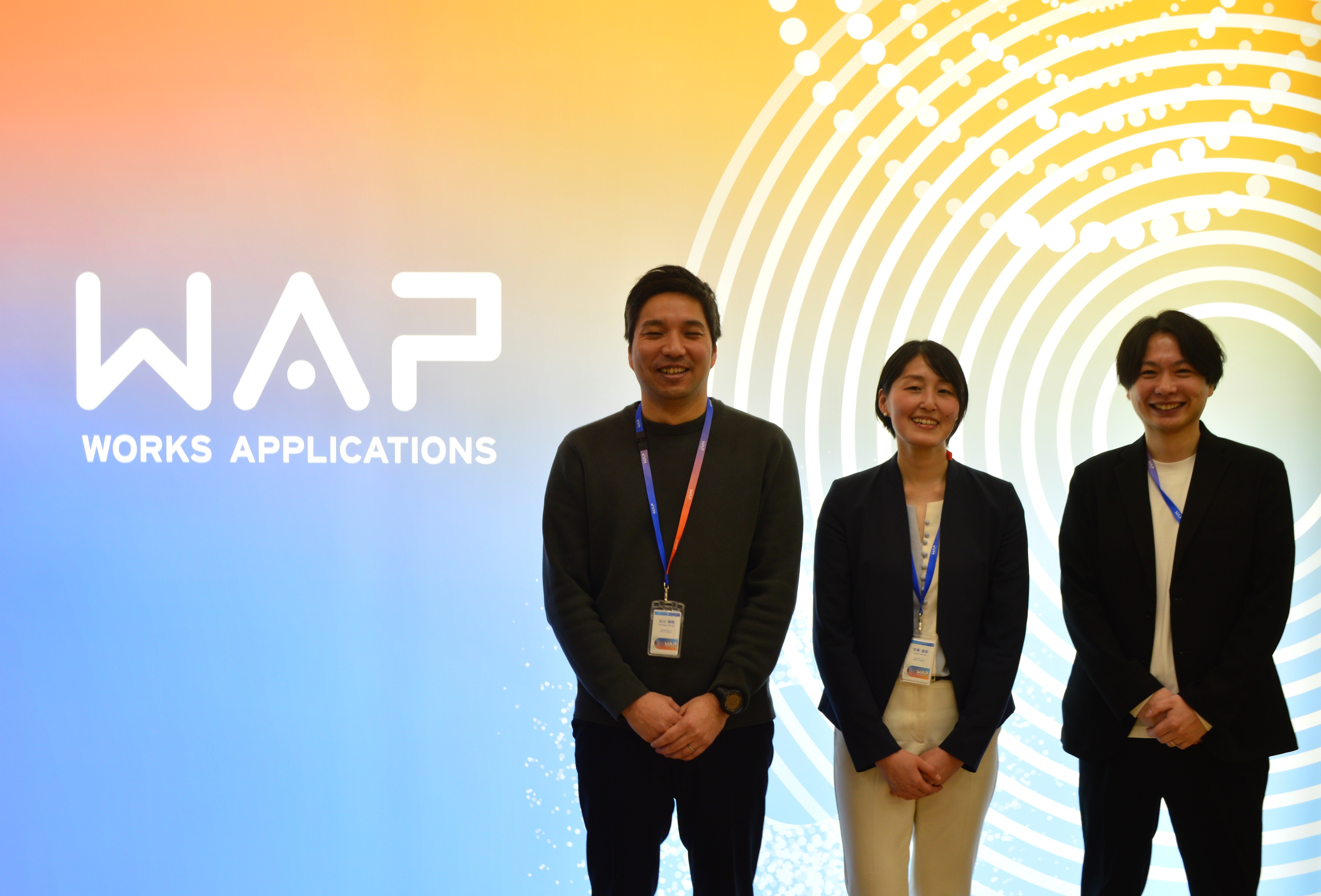
In this interview, we spoke with two young managers who are active in the Works Applications Group.
Manage according to the work of your team and the characteristics of your team members.
K.T. and K.A. Please tell us about the department (hereafter referred to as "team") in which you each serve as manager, and give us an idea of your roles and duties.

The team I manage belongs to the customer support department, and my role is to find and solve problems in the entire customer support department.
The "customer support" department here includes the departments that deal with customers on a daily basis, such as installation consultants who support customers after they have purchased the product until the product is actually up and running, maintenance consultants who perform maintenance after the product is up and running, and customer support who responds to inquiries from customers. This includes the departments that deal with customers on a day-to-day basis.
My team is in charge of identifying issues, prioritizing them, and considering and implementing measures to resolve them, based on a bird's-eye view of the overall status of the division in order to achieve our business plan, rather than viewing issues in the customer support division within the narrow scope of each department.
To give an example of my responsibilities, I design training programs and support the growth of human resources so that employees in the customer support department can work in the right place at the right time, and I think about and implement operations to visualize and improve the level of support in order to continue providing higher value to our customers.

The team that I manage is responsible for providing optional services beyond the standard scope of support to clients who are considering implementing or have already implemented our products, in order to provide a higher value experience.
Specifically, the team consults with the client's systems department to determine "what kind of support is needed to integrate our products with the systems already in use," provides interface program development and maintenance services, performs data migration when a client switches from a competitor's product to our product, and provides other services. We also provide data migration services when a customer switches from a competitor's product to ours. We also provide support for our customers' server replacements, and so on.
What is the size of the team? Please also describe the characteristics of the team members.
Our team is relatively small, with four members in addition to myself. All four are female employees who have completed maternity or childcare leave.
The team's responsibilities are "to solve issues and implement measures on our own schedule," and since it is an environment where it is relatively easy to balance work and private life, all team members are active while working shorter hours and balancing work and childcare.
In addition to myself, there are about twelve other members in my team. What is unique about our team is that three are our employees and nine are outsourced workers from outside companies. The optional services that we offer include a high percentage of system development, which requires a variety of programming knowledge and skills for each project. For this reason, we have a relatively large percentage of outsourced staff so that we can assign appropriate members with the right skills for each project at the right time.
What are the specific roles and duties of the two of you as managers?
In response to the team's role of "resolving issues for the entire customer support department," my responsibilities include organizing issues, making decisions when setting priorities, and managing progress toward resolving issues.
In addition, when a measure involves the entire department, I am also responsible for coordinating operations, including those of other departments.
On the other hand, among the team members, there are several senior employees who have been with the company longer than I have and have experience and knowledge that I do not have. They also have different experiences within the company. Each of them has knowledge of different products and experience in different business areas, and each has his or her own areas of expertise. Therefore, I do not devote all of my time to management tasks, but rather, I am involved in the day-to-day operations of the project myself.
In my case, my role as a manager is to check the progress of the projects my team is executing, coordinate with the client when irregularities arise, and liaise with other departments within the company.
Since the team's work also includes proposing optional services associated with product development (sales work), I am also responsible for checking quotations prepared by the team members. Because the team's work is so diverse, we are currently working on standardizing the work to improve the productivity of the entire team.
Two team members are senior employees who have been with the company longer than myself, one is a fellow employee, and the others are outsourced workers, so each member is able to work independently.
Therefore, we basically leave the work to the discretion of each individual. As each person proceeds with his or her work, I step in and make decisions when necessary as a manager, and I take responsibility for those decisions and the results.
Since everyone works on their own initiative, I, like K.T., do not devote all my time to management work, but sometimes I have a project that I am in charge of and work with my hands.
Incidentally, we both happen to be talking from the perspective of so-called "playing managers," who are both engaged in management tasks while also doing their own hands-on work. I think the ratio of "management work" to "hands-on work" varies depending on the nature of each team's work.
In fact, when I was first promoted to manager, I was in charge of a team with a relatively young workforce, so all of my management duties were divided into management tasks.
To maximize the team's performance.
Now that you have talked about the roles and characteristics of your teams, what are some of the key points that you are working on in the management of each team?
My team often worked teleworking from home, and our daily meetings were basically conducted via web meetings. Because it is difficult to have a small conversation in a web meeting when necessary, I have been trying to make some efforts in communication.
For example, if there is a little extra time at the end of a web meeting, I take the time to talk with the members, and if they come to the office, I also come to the office to see them and communicate with them face to face.
I also try to find common topics in our conversations. More than half of the team members, including outsourced workers, are older than myself, but I try to build a relationship with them that allows us to exchange opinions easily by finding common ground, not only on work-related topics but also on hobbies and other small talk.
All members of my team also telework from home, and for the purpose of communication, we have a 30-minute web meeting every morning for chatting. Participation is free, and we have casual rules such as "it is OK if your child participates with you" and "it is OK to eat snacks" so that we can have a flat conversation.
All team members work shortened hours after maternity or childcare leave, so their working hours vary, and it is difficult for them to come to the office to pick up their children, etc. We created this chat time so that team members can communicate with each other even under such circumstances.
In addition, due to the nature of the team's work to "solve issues for the entire customer support department," rather than thinking things through on one's own, conversations often lead to triggers that lead to solutions, so we value this time for chatting to generate inspiration.
*There are some positions that do not allow telework due to the nature of the work.
*There are some positions that do not allow telework due to the nature of the work.
I see that both of you are devising communication methods that match the characteristics of your teams.
What are some of the points that you are devising in terms of operations?
Since each member has a child, there is a possibility that a sudden leave of absence may occur, such as when a member has to take time off for a child's reasons. For this reason, we have a system in which several people are assigned to each task.
However, in my team, we have clearly defined who is responsible for each task, and at the weekly team meeting, we always have a place for the responsible person to report on the progress of the task. After clarifying responsibilities in this way, we ensure that information is shared not only among those in charge but also with other team members, so that operations can run smoothly even when someone is absent.
I mentioned earlier that more than half of the members of my team are older than myself, but to be honest, they are at a higher level than I am, not only in terms of age, but also in terms of programming knowledge and skills.
That is why I value the awareness of "trusting and entrusting each member. Rather than intervening in everything, I leave things to the members without forcing them to intervene, except when a member raises an alert or when I objectively feel that there is a possibility that the situation may develop into a problem.
I think the key point is to identify "the stage of trusting and entrusting" and "the stage where the manager takes steps for recovery.
That is right. Because we trust them, I think it is important to take prompt action when alerts are raised by members and to objectively detect potential problems, so I always try to keep track of the status of all projects.
For example, at the beginning of a project, we have a kick-off meeting with the client, and I always attend the kick-off meeting for all projects to understand the purpose and goals of the project and to ensure that the project members are on the same page.
Also, I think communication is important here, so I try to communicate carefully. When I feel that I am not conveying the intent of the project in writing alone, I supplement the communication by holding a web meeting, and when I receive opinions from members that it would be easier to communicate in this way, I put them into practice. I have also received opinions from other members that it would be easier to convey the message in this way, and I try to put them into practice.
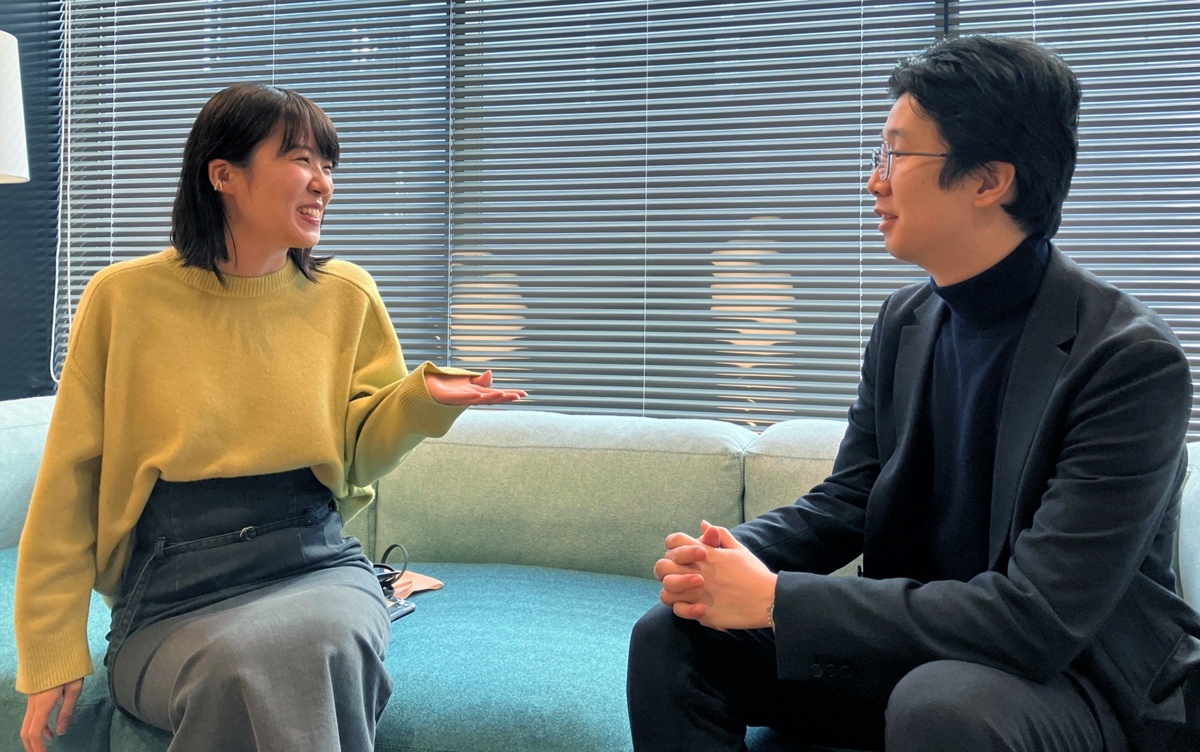
Manage in your own way in a flat environment.
What were your impressions when you first took on the challenge of management?
I had always wanted to do this, so I was looking forward to the managerial position.
In my case, I had already told my then-supervisor that I wanted to try it before I was promoted to a managerial position, and as a preliminary step, I was entrusted with the role of project leader to organize team members. It was not a case of suddenly being given the manager's job and then saying, "Take care of the rest! (laugh). Instead, I was given a certain amount of preparation time to gradually become accustomed to the role.
I think this was an experience that allowed me to experience firsthand the culture at K.A.M.T. Group, in which employees who raise their hands and say, "I want to do this," are entrusted with challenging and responsible work, regardless of their age.
Like K.A., before I became a manager, I was a project leader, which is a position with "no scope of responsibility, but the duties are similar to those of a manager," so I did not have any major concerns.
At the time, the only thing that I thought would change significantly once I became a manager was that I would have more areas to make decisions and that I would be required to make decisions more quickly.
I am the type of person who likes to organize and deliberate everything slowly, so I wondered if I would be able to keep up with that sense of speed. I was a little concerned about whether I would be able to keep up with the speed.
However, once I actually started, I found that I could consult with senior managers without hesitation, so I did not encounter any major obstacles and was able to approach my management duties with a sense of ease.
I was very grateful that I was allowed to take on new challenges with the support of my seniors in a flat environment that was not influenced by my year or position.
What, if anything, are you aware of because you are both "young managers"?
In my case, due to the nature of my team's work, which is to "determine issues to be addressed as a client support department and propose solutions to management," I need to have a bird's-eye view of the entire organization and its goals.
In order to have a bird's eye view of the organization, it is necessary to always have a high perspective, including a sense of sales, costs, and other figures, as well as a medium- to long-term perspective on what the organization should achieve.
In order to raise one's perspective, it is of course important to input knowledge and information, but to be honest, I think there is a "part where experience comes into play" that cannot be compensated for by reading books alone. It is only natural that I have less experience compared to veteran managers who have accumulated a lot of experience, so I try to let that go and make an effort to make it my own by giving feedback to my superiors who have more experience.
In common with K.T.'s story, I also have a lack of experience compared to senior employees, so I try to be honest in my interactions with veteran managers, saying, "There are things I don't understand, so please tell me about them.
There are many employees in our group who are unique in a good way (laugh), but if I honestly ask them to teach me, they are very polite in their communication with me, so I have not had many difficulties because I am "younger" or "younger.
I think that many of the people in managerial positions in our group have their own firm ideas of "this is how it should be. That said, there may be times when it is necessary to reconcile these ideas with each other when making adjustments between departments. But even in such cases, managers talk with each other, or depending on the content, managers one position above them may need to discuss it with each other, and the company communicates with each other to make sure they are on the same page! You can rest assured (laughs).
Our "Will
What are your future goals as a manager in the Works Applications Group?
When I was a manager for the first time in the past, my team was a team of implementation consultants who handled our expense reimbursement system called "HUE Expense. Most of the team members were younger than myself, so it was more of a team structure where the manager led the team.
On the other hand, my current team is in charge of tasks that can lead to deeper solutions if the issues are viewed from multiple perspectives from multiple angles rather than from a single person's perspective, and each member has a wealth of experience. I would like to challenge myself to create such a team, which is a little different from what I have experienced in the past, with this current team!
Some of my team's work is like consulting work, where we analyze and make proposals in response to customer requests, and some of our work is to develop features based on that analysis. In some cases, the team takes on a sales role to propose optional services to customers, and in other cases, the team is able to gain a wide range of experience without being limited to a specific job title. Therefore, there is potential for growth in various directions, depending on the individual's desire to grow in this or that way.
As a manager, I would like to create an environment where all team members can gain many experiences so that they can shine as specialists!
To work with people who show a "sense of ownership" and a "fighting pose".
What kind of people would you like to work with as a manager?
I think the most important thing in a job is to have a sense of ownership, so I would like to work with people who have a sense of ownership and responsibility.
For example, in my team, when we propose a solution to a problem, we ask ourselves questions such as "Are there any elements that would convince people in this position? and "Is it a measure that the people who will implement the solution can continue to do so? I believe it is important to view the entire process from the implementation of the solution to its results as one's own personal matter. I believe that by viewing the solution in this way, the precision of the solution itself will increase, and as a result, the effects obtained from the implementation will be of a higher level.
I believe that careful communication is important when working as a team, and I would like to work with people who can communicate with others in a respectful manner.
My team covers a wide range of work, so I would like to work with people who show a "fighting pose" (motivation) for various tasks and who have the will to "solve the problem at hand, no matter what it takes".
*There are some positions that do not allow telework due to the nature of the work.
*There are some positions that do not allow telework due to the nature of the work.
Pick up! ★
The openness of the Works Applications Group
What is unique about Works Applications Group?
I think the atmosphere is overwhelmingly open!
Before and after becoming a manager, there are absolutely no restrictions that say, "You can't do this because you are young! You can express your opinions to anyone as much as you want, and as long as they are reasonable, they will say, "Yes, that's right. That's right. If you have a reasonable opinion, they will listen to you.
I think it is a unique and blessed environment at the Group where we are treated as equals, purely as human beings, without prejudice to our positions.
In addition to K.T.'s story, our group has "Wappo! (Wappo!)" and "Wappo! and "Wappo!
Wappo!" is a combination of "WAP (Works Applications)" and "monthly status check = monthly report." In addition to its role as a so-called engagement survey that measures changes in scores for the values that employees consider important, it is a system that allows employees' voices to be delivered directly to department heads and management. The system also allows employees' voices to be delivered directly to department heads and management.
The "Wappo! Return" is a system that allows employees' voices to be delivered directly to department heads and management, in response to employee feedback received through the "Wappo! is a live broadcast in which Works Applications CEO Hata responds to employee comments delivered via the "Wappo!
This system, which allows employees to directly communicate their opinions to management and receive feedback, is very gratifying to me as an employee, and I think it shows the openness of the Work Applications Group!
Information in this article is current as of the date of publication.

Profile
Consultant
(Works Applications Enterprise Co., Ltd.)
K.T. New graduate joined the company in 2017
I was initially assigned to the development department and experienced development work. Later became a consultant for the implementation of ERP package software and was promoted to a manager position in 2020. Currently, he is a manager in the organization responsible for the overall planning of the client support department.

Profile
Customer Support
(Works Applications Enterprise, Inc.)
K.A. New graduate joined the company in 2017
He gained experience in supporting the implementation of ERP package software. He then moved to the department that handles optional services for clients. In 2020, he was promoted to the position of manager in the same department.
Interviewer: M.S., Human Resources
Related Articles
Consultant
HUE Evangelist talks about the concept and appeal of HUE
H.S. / New graduate joined in 2005
Customer Success Div.
Consultant / New graduate / Male
Consultant
Three organization heads in their 30s who will create the future gather together. What is the appeal of Works Applications from the viewpoint of a department manager?
S.I. / H.A. / Y.F. / 2010 new graduate
Development / Sales / Consultant
Consultant / New graduate
Consultant
I feel rewarded by the "Thank you" from our customers.
M.M. / Joined mid-career in 2020
Account Management Div.
Consultant / Mid-career / Female