
Web Articles System Review Support
11/26/2021
Points to consider when implementing a purchasing management system! What are the necessary perspectives for system replacement?
In recent years, an increasing number of companies have been renovating their purchasing management systems in the midst of the current trend toward paperless systems and DX. Many companies are rushing to introduce a new system due to the aging of their current system, but in many cases, rushing to introduce a new system may cause problems such as not being able to ensure the current operation or not being able to achieve the original purpose of the system. In this article, we will explain the issues and points to note when introducing a purchasing management system, touching on the classification of solutions offered by various companies and their merits.

Table of Contents

What is a purchasing management system?

Before explaining the points to pay attention to when introducing the system, let us reiterate the premise of a purchasing management system.
A purchasing management system is a system to electronically manage operations related to the purchase of goods necessary for a company's activities. They can be classified into several types according to their characteristics and what they can achieve. Four representative types are introduced below.
1. Foreign-affiliated purchasing systems
Purchasing management solutions provided by foreign companies that offer ERP and other solutions. Because of their extensive experience overseas, they can cover many types of purchasing, and their unique services, such as marketplace functions, are one of the most attractive features. However, they are often very expensive, and because they are not tailored to Japanese business practices, some say that their specifications are unique and difficult to operate.
2.Domestic purchasing management system/Saas
This solution is provided by a domestic system vendor. They are easy to use because they fit Japanese business practices and are often less expensive than those provided by foreign vendors. However, many solutions are mainly targeted at small and medium-sized enterprises, so large enterprises often require individual add-on development due to lack of functionality. If individual development is required, the price may be significantly higher when purchasing or upgrading.
Web-EDI system
This solution specializes in conducting electronic transactions over the Web. Compared to systems that cover the entire purchasing process, these systems can be introduced at a lower cost and promote digitization and paperless transactions. However, of course, it does not cover operations other than those with suppliers (e.g., internal purchase request application/approval and detailed processes for acceptance inspection), so the effect may be partial and you may not realize a sufficient return on investment.
Related article: What are the key points of Web-EDI consideration in purchasing systems?
4. EC site
This is a case where an e-commerce site provides services to corporate customers. Basically, it is possible to start using this service with almost no initial cost, and some services within the EC site can even manage processes such as application and approval. However, since they naturally do not include menus such as quotation and acceptance/inspection, and provide only basic application and approval functions, they cannot guarantee operation in large companies, and the expected effect will be partial.
Thus, there are differences in what different types of purchasing management systems can do, and it is important to select a solution that fits your company's needs.
Pitfalls in Introducing a Purchasing Management System

Although purchasing management systems are expected to have the above-mentioned effects, if you do not choose the right solution for your company, you may not be able to achieve the expected effects. The following are some of the "pitfalls" that tend to occur.
Case 1: As a result of using an EC site for the time being, the results were scattered.
This is a case in which, although the company has proceeded to utilize various EC sites at its own discretion, as a result, the purchase results have been dispersed to each site, making it difficult to analyze and improve them.
In such a case, it is important to promote the use of e-commerce sites while building a system to accumulate information in anticipation of analysis and improvement.
Case 2: Introduced Web-EDI for the time being, aiming for "de-faxing
This is a case in which a company started to consider Web-EDI with the goal of eliminating faxes, but during the implementation process came to the conclusion that Web-EDI was not necessary and cancelled the project because it would be sufficient to exchange order forms and other documents via e-mail if only faxes were to be eliminated.
In such cases, it is necessary to clarify the objectives and then carefully examine whether the means to achieve them are appropriate.
Case 3: Aiming for "DX" system, business efficiency declined.
This is a case in which operations become inefficient as a result of a project that aims to break away from the existing built-up system and aim for DX. For example, for a material whose price is not determined until it is received, the new system requires the re-creation of purchase orders, whereas in the past price changes were made at the time of receipt, resulting in more man-hours than before.
Such cases may occur due to rushing to implement a system without having the current system specifications and business operations organized. It is necessary to organize the specifications and operations of the system currently in use before conducting a review.
Key Points in Introducing a Purchasing Management System

Point (1) Clarify the goal of system implementation
First, clarify the purpose of implementing the system. If the purpose of the introduction is unclear, the project may start with a vague sense of the issues to be addressed, or the project may move in a different direction from the original purpose as it progresses, the intended effect may not be achieved. While each company's goals may differ, the following is a list of typical benefits that can be obtained by introducing a purchasing management system. Please consider the direction your company is aiming for while referring to the contents of this page.
1. Improve efficiency of purchasing operations
By introducing a purchasing management system, you can digitize all the vouchers generated in the process from purchase request to payment, thereby reducing the time required for their creation. By digitizing vouchers and going paperless, the work of storing and organizing vouchers becomes unnecessary, and past vouchers can be referred to efficiently on the system. Web-EDI enables transactions with suppliers to be completed on the system, so there is little need for individual communication or coordination, and business can be conducted more efficiently. Other features such as punch-out linkage to place orders in conjunction with shopping sites and the ability to read barcodes printed on delivery slips to accept goods can also be used to further streamline operations.
Related article: What is punch-out linkage in a purchasing system?
2. Reduce costs related to purchasing
By streamlining purchasing operations as described above, you will be able to engage in activities such as purchasing cost reduction and price negotiation, which you should be focusing on. Since the purchasing management system accumulates past purchase records, it can be used to analyze items for which there is room for cost reduction and as material for price negotiation. Companies with multiple business sites may purchase the same items separately, but the introduction of a purchasing management system allows them to manage their purchase histories together and identify items that can be purchased centrally. In addition, electronic transactions through Web-EDI are expected to reduce the cost of faxing and mailing.
3. Fraud prevention and internal control enhancement
The purchasing department is a customer of the suppliers with whom they do business, and they sometimes receive sales calls. It is also a department that is closely involved in the flow of money for purchasing. Because of this position, the purchasing department is an environment where fraud is highly likely to occur. By introducing a purchasing management system, it is possible to prevent fraud and strengthen control by visualizing purchasing operations, strengthening the approval system through workflow, and controlling the operations that can be performed by each user.
Point (2) Clarify the scope of system implementation
Once you have clarified the goals and objectives, the next step is to clarify the scope of the implementation. The following two points should be considered as the scope.
1. Target items
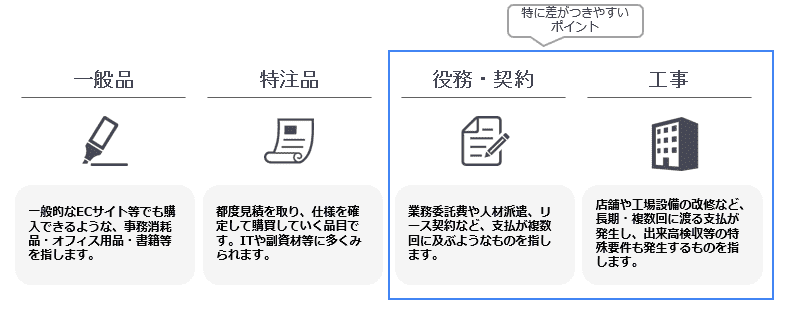
First, organize the items handled in your company's purchasing operations. Since there are different items that can be handled by different systems and items that cannot be handled by different systems, let's first clarify what you will handle. The following figure shows a typical list of items.
The fact is that many systems can handle general items and special-order items, so it is difficult to distinguish between them. On the other hand, services, contracts, and construction work are often not handled by some systems, so it is important to pay attention to the differences between them.
2. Targeted operations
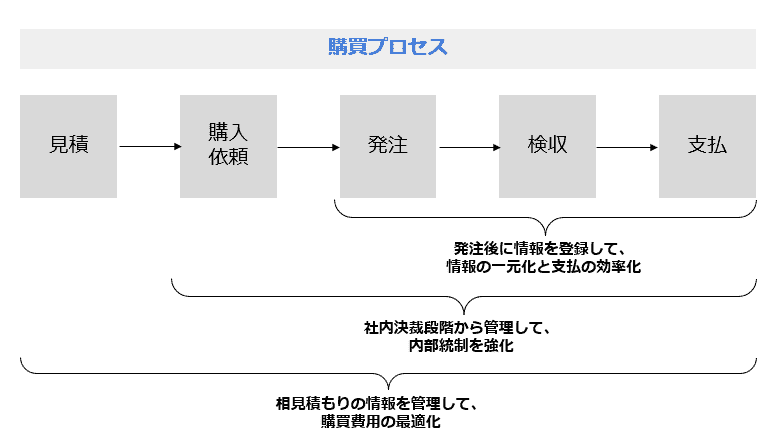
Once the items have been sorted out, the next step is to sort out which areas of purchasing will be handled by the new system. The following figure shows a list of typical processes that occur in purchasing operations.
It is necessary to define the target operations depending on the purpose of the system implementation. For example, if the objective is to improve efficiency by centrally managing information from order placement to payment, areas such as quotations and purchase requests will be unnecessary.
On the other hand, if the purpose is to optimize purchasing costs by managing information including quotations, or to strengthen internal control by managing internal approvals, it is necessary to introduce the quotation and purchase request areas as well. Since the necessary functions differ depending on the business, it is important to organize the areas to be handled by the new system after clarifying the objectives.
Point 3) Decide on a policy for introducing a new system
Once the goal and scope have been clarified, the implementation policy should be decided based on them. Budgetary considerations and timing of implementation should also be taken into account. For example, if you decide to implement a simple, inexpensive system, will you adapt your company's operations to that system?
See also: What are the points to consider when comparing purchasing management systems?
Introducing a purchasing management system that can reliably achieve your objectives.
So far, we have introduced some points to keep in mind when introducing a purchasing management system, including the benefits that can be obtained by introducing the system. Keep the aforementioned points in mind and introduce a purchasing management system that can achieve your company's objectives.
HUE Purchase, a purely domestic purchasing management system for large companies, covers purchasing items and operations as well as foreign-affiliated systems, not to mention the practices and business customs of large Japanese companies. In addition, Web-EDI, punch-out linkage, inventory management of stored goods, and barcode acceptance functions, which would require additional development for Saas products, are implemented as standard functions, eliminating the need for add-ons and customization.
We also continuously provide useful information related to system implementation, such as a practical guide to selecting a purchasing system, which introduces the points that "make the difference" among purchasing systems from different companies. If you are interested, please download the guide and check it out.
