
Web Articles System Review Support
2023/03/09
How to migrate to Notes? Introducing migration procedures, precautions, and recommended migration destinations, learning from successful cases.
Although Notes has supported many companies for many years, many companies are considering migration due to the end of support and lack of technical staff. This article details the key points of Notes migration and failure patterns to watch out for. In addition, it introduces successful case studies of Gunze Corporation, which achieved a phased migration over a period of four years, and Keimyu Corporation, which was renewed in a short period of seven months. The book is packed with hints on how to select the most suitable migration destination for your company and lead the project to success.

Table of Contents

For more information about ArielAirOne and Notes migration support, please see the following special page :
" ArielAirOne" (Japanese only) ArielAirOne is a business development platform that makes the most of Notes assets filled with "persistence".
History and current status of Notes
History of Notes
Notes is groupware developed and marketed by HCL Technologies, Inc. Prior to December 2018, Lotus was developed and marketed by IBM as one of its own software under the Lotus brand.
Lotus is an abbreviation for Lotus Development Corporation, which developed the original Notes. Notes is sometimes referred to as Lotus Notes, which may be more familiar to companies and engineers who have been using the software for a long time.
The first version of Notes was released in 1989, and its brand value rapidly increased after IBM acquired Lotus Development in 1995.
Current Status of Notes - End of Support and Lack of Technical Staff
However, HCL, the current distributor of Notes, announced that the versions with the most users (v9.0.x and v10.0.x) will no longer be supported on June 1, 2024 (the company has now postponed paid support). In addition, it has become difficult to maintain a system to continue troubleshooting and modification due to the disappearance of know-how caused by the retirement and transfer of personnel familiar with Notes and the decrease in the number of Notes engineers worldwide.
Against this backdrop, many companies are considering migration from Notes when support ends.
End of Sales / End of Support Product Versions
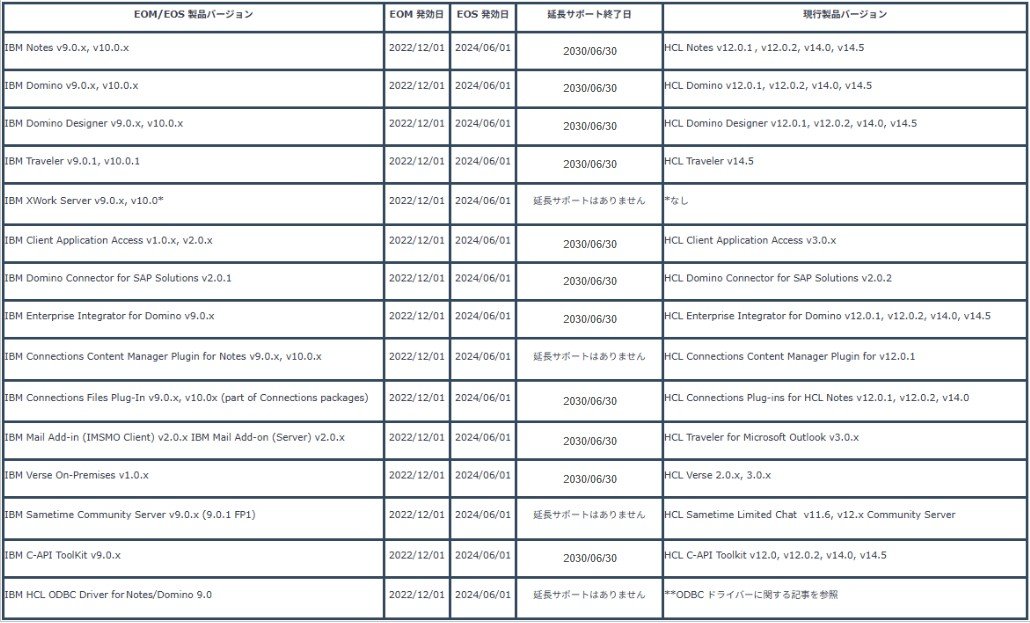
Source: HCL Notes/Domino v9.0.x and v10.0.x end of sales (December 1, 2022), end of support (June 1, 2024), and extended support (until June 30, 2030) (table processed based on source)
2. Key Points and Cautions for Notes Migration
Key Points of Notes Migration
When considering the migration to Notes, it is necessary to first take inventory of your information assets and understand and organize what assets you have in your company.
It is important to carefully select what should be migrated and what should not be migrated, and to make an appropriate migration plan after investigating in advance whether the migration is feasible or not.
However, in addition to planning, there are many other hurdles to Notes migration, such as selecting a migration destination, executing the migration project, and educating users.
Failure Patterns and Cautions for Notes Migration
There are three common reasons why Notes migrations fail: misjudgment of technical requirements, poor operational design, and organizational unpreparedness.
For example, easily replacing the complex business logic unique to Notes with a no-code tool may not reproduce the business requirements and may cause a backlash from the field.
In addition, if the system is introduced without sufficient post-transition operating rules and training systems, operations will vary from department to department and the support burden will increase.
Furthermore, unplanned company-wide deployment may lead to a bloated scope and cost overruns, and there is a risk of a breakdown in consensus building.
The key to a successful migration to Notes is not simply a system renewal, but a systematic promotion with a view to the transformation of the entire organization.
In the next chapter, we will introduce case studies of companies that overcame various hurdles and successfully migrated to Notes.

3. Successful Cases of Notes Migration
In this chapter, we will introduce the case studies of Gunze Limited and Keimu Corporation, which realized the migration from Notes to Works Applications' ArielAirOne groupware, as successful examples of Notes migration.
GUNZE Corporation, which proceeded with the migration in stages over a long period of time, and KMU Corporation, which achieved the migration in a short period of time. We will explore the secrets of successful migration to Notes from each company's efforts.
This chapter is a reorganized version of WorksWay 2021 "Secrets of Successful Notes Migration Learned from Case Studies! which was distributed on May 25, 2021.
Case study of Gunze Limited
Reasons for considering Notes migration
Founded in 1896, GUNZE Co., Ltd. has developed its business with a focus on apparel, functional solutions, and life creation businesses.
For 20 years, the company has used Notes for email, workflow, and document management. However, in addition to concerns about the future of Notes due to its declining market share, the company was unable to fully respond to the strong demand for "work style innovation" that was identified through internal interviews. Against this backdrop, the company began to consider the migration to Notes.
Challenges in Notes operation
The following three issues were considered to be particularly problematic in the operation of Notes.
1. When Notes is used from outside the company, it is necessary to connect to the company network via a remote tool, which requires a lot of communication and is slow and unusable from overseas, etc.
2. It cannot be used from smartphones and tablets
3. It is impossible to exchange large data with business partners and send files over 7 MB in size. Cannot send files over 7MB
Based on these current issues and the results of interviews with users, we organized "what should be improved by migrating to Notes" and started a study project.
Selection of products to be migrated
In considering the groupware products to be migrated to Notes, we focused on "strengthening core technologies," "improving operational efficiency," and "improving information utilization," and conducted a study from both functional and cost perspectives.
In the area of Notes usage, such as e-mail, workflow, and document management, the core product group of Works Applications' ArielAirOne was selected based on the conditions that it could be used in a cloud environment and that it had functions that ensured security.
After deciding on the product, we examined configurations that would provide both convenience and security, and designed how the system would be used on PCs and smart devices.
Key points of project management
After product selection and internal approval, the implementation project began. GUNZE planned a phased migration over a four-year period, taking into consideration the volume of Notes usage and internal resources.
First, the things to be realized and requirements were identified on post-its and priorities were organized. A master schedule was created based on the policy of migrating high-priority items in the first year and phasing in the rest thereafter.
The major point of the four-year plan was to use both the old system (Notes) and the new system (ArielAirOne). To ensure that user convenience would not be compromised, we proceeded with the plan by considering in advance how data from both systems could be successfully linked.
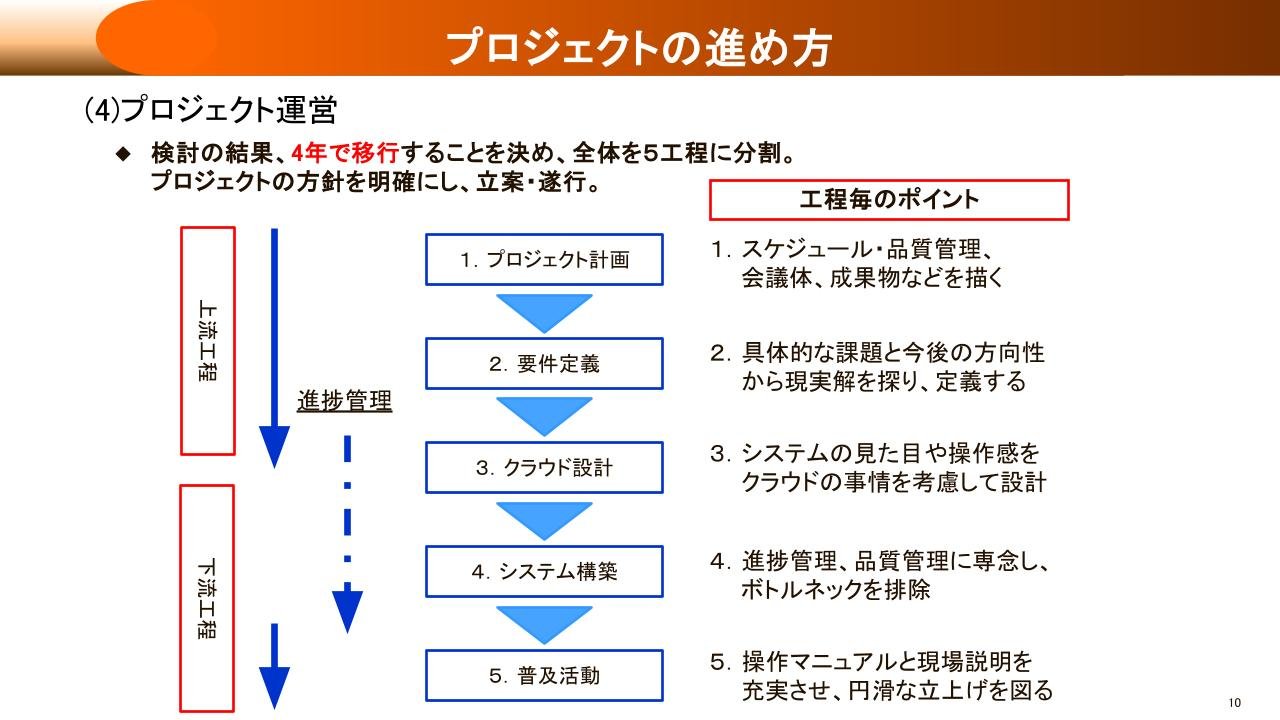
Requirements definition
In the requirements definition process, we examined each business scenario in depth and considered the priorities and methods of response, and solidified the requirements for each scope of business, such as ID management and e-mail.
In the cloud design, we took security into consideration for each use of PCs and smartphones, and designed the system so that there would be no inconsistencies. Although there were some glitches during the development process, we clarified the issues, priorities, responsibilities, and deadlines, and managed quality and delivery.
Key points of new system implementation
In order to ensure that the system would take root among a large number of users in a short period of time, we positioned the maintenance of manuals as the most important measure. We developed a creation plan, and in addition to detailed manuals for each scene, we created digest versions for PCs and smartphones, totaling nearly 500 pages.
We held briefing sessions for about two hours each time across Japan, and explained the new system based on the manual, so that the new system could be used without any confusion.
What was achieved by migrating to ArielAirOne
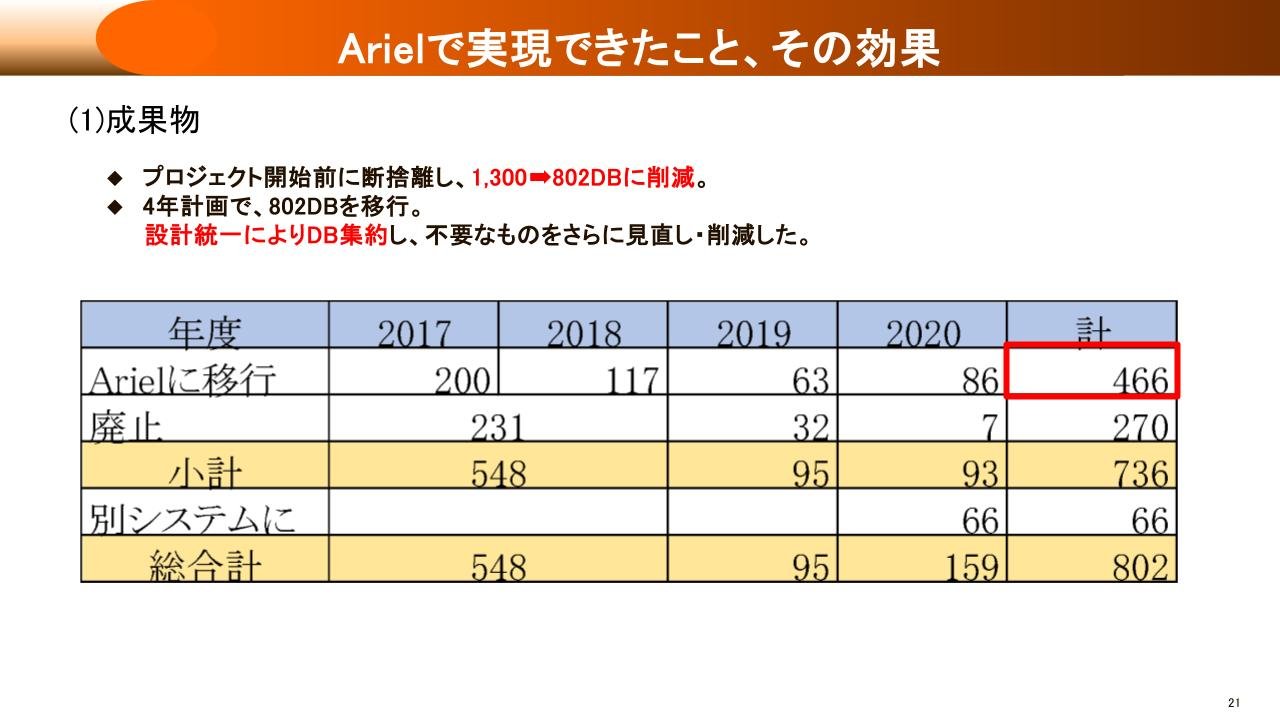
The first is the improvement of maintainability and convenience through the consolidation of unnecessary databases (DBs).
The number of DBs was about 1,300 when Notes was used, but was reduced to about 800 before the migration began. The second point is the resolution of issues that arise when using Notes.
For example, the use of tablets and smartphones has led to a reduction in the number of users of the Notes system. For example, the use of tablets and smartphones has enabled a change in work style, and the searchability and sharing of information has increased, which has led to better utilization of information. Another major advantage was the use of Works Applications' cloud services, which freed the company from operational hassles. As a result, the company was able to respond quickly to the rapid changes in the environment of the Corona disaster.
Case study of K.M.K.
Reasons for considering Notes migration
Keimyu Corporation was established in December 2003 through the merger of the housing exterior divisions of Kubota Corporation and Matsushita Electric Works (now Panasonic Corporation), and is Japan's only manufacturer of exterior building materials, offering a total range of roofing materials, exterior wall materials, and rain gutters.
The company had introduced Notes as the Panasonic Group's system and was using it mainly for e-mail, portal (bulletin board), and workflow. However, when the entire group decided to discontinue using Notes, the company began considering a Notes migration.
In addition, there were some dissatisfactions with Notes, such as the poor portal functionality at the time and the difficulty of creating and editing workflow and bulletin boards, so a Notes migration project was started as a restructuring of the groupware, including the internal portal.
Consideration and key points of migration to Notes
KPMG compared and examined five groupware products and finally selected "ArielAirOne" for the migration. The following five main points were considered:
1. The availability of a Notes migration tool and the ability to migrate in a "short period of time"
2 . Cost
3. The ability to build and maintain the portal, workflow, and group management in-house
4 . The ability to link organizational and human information from the HR system
5 . The ability to utilize smart phones 5. Ability to use smart phones
Devices of the implementation project
The implementation project was promoted by a project manager (PM) and three non-executive members. Focusing on a short-term implementation, the actual construction period was approximately 7 months. The key to the project was time management. The four main points were as follows: 1.
1. schedule setting and deadline management that worked backward from the goal. Also, to avoid spending time on management itself, "cutover checks" were simply described on a monthly basis.
2 . The PM has full authority and makes decisions quickly.
3. Rules were established to thoroughly discuss in the review phase and proceed without backtracking in the construction phase .
4. Fitting ArielAirOne instead of Notes Fitting the business
We placed particular emphasis on the fourth item. We received many requests from users saying "Notes could do this and that," but we proceeded with the common understanding of the members that we were aiming for 100 points in the new system.
For example, we simplified the rules by reducing the number of bulletin boards from 100 to two formats and by setting permissions on a per-board basis. We also sorted out the vast amount of past data to be migrated and those not to be migrated, and thoroughly decided not to take any past data other than bulletin board data, and to leave bulletin board data for viewing only on Ariel.
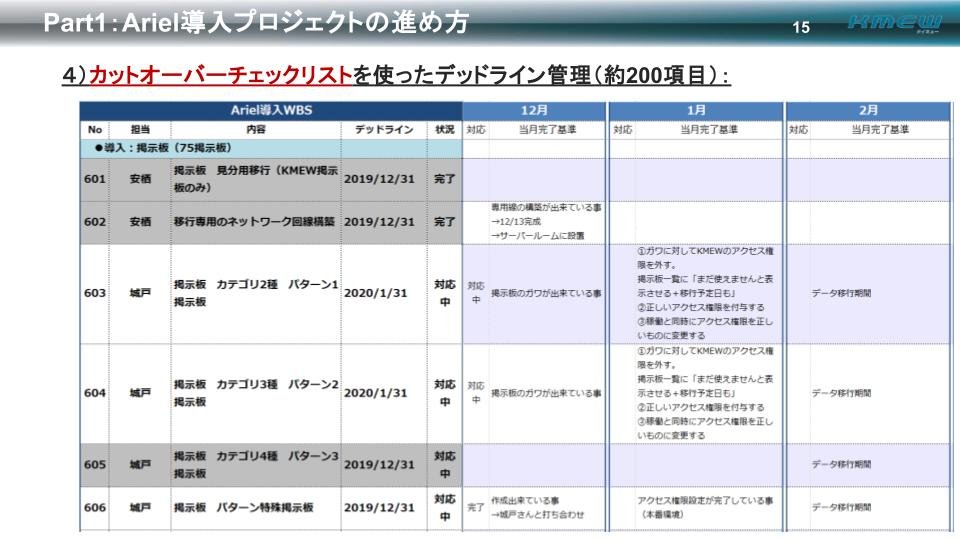
Step-by-step migration and retention measures
The migration was done in phases by system and scope of work. The first was "scheduling and facility reservations," followed by "e-mail. The migration of e-mail, in particular, required time to respond to inquiries during the migration, so each department was carefully migrated over a period of two months. The "Bulletin Board" was migrated in two weeks for each bulletin board, and finally, the "Workflow" was migrated after a period of parallel operation of the old and new systems. As a result, the migration went smoothly with no loss of user convenience, such as the completion of projects that had already been applied for in Notes.
In terms of user familiarization, training was conducted for all users via videoconference, and an "Ariel key person" was assigned to each department to coordinate questions. We also prepared a QA collection based on questions raised during the initial introduction in the IT department. Although users themselves had limited access to the QA book, the QA book played an extremely important role in ensuring that the support side was able to provide uniform answers in a timely manner.
What was realized by the migration from Notes to ArielAirOne
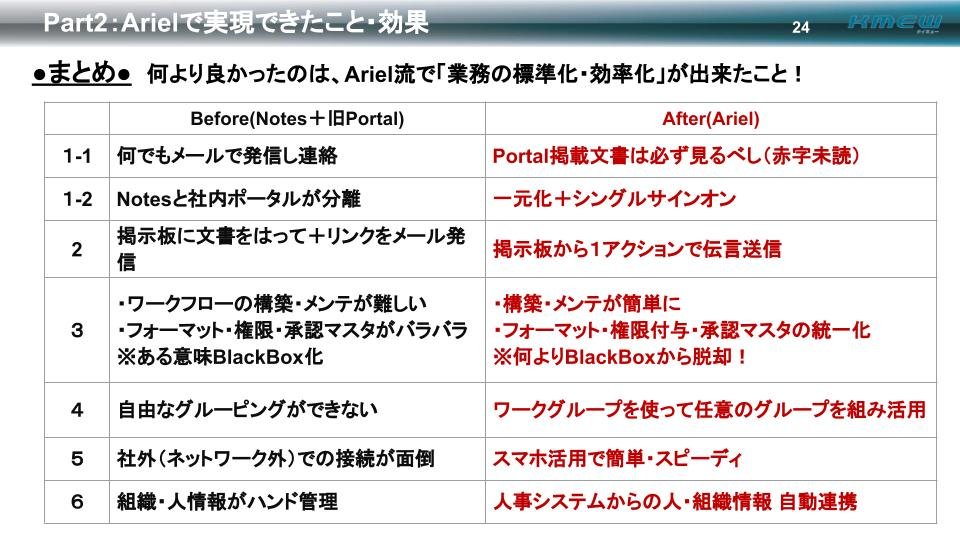
The greatest achievement was the realization of "standardization and streamlining of operations. First, the portal was designed so that "anyone can access the necessary information." In the Notes era, the culture was to e-mail everything, but in the new system, we devised ways to improve the speed of information acquisition, such as "visualizing unread items" and "making it easy to see at a glance where the information is located. We have also made some innovations to improve the speed of information acquisition.
The new system has improved convenience by, for example, using a "message notification function" that sends a notification when a registered message board is updated.
In addition, the workflow system has greatly streamlined the system administration workflow. This has dramatically reduced the maintenance workload.
4. Where to migrate to Notes? Introduction of a system that covers all necessary functions
Points to consider when selecting a Notes migration destination
①Flexibility and scalability to reproduce business requirements
The most important thing is to be able to accurately reproduce the complex approval flows and branching logic that have been developed over many years in Notes. Choose a tool with design capabilities that can flexibly reproduce and expand on business-specific requirements and linkages with other systems.
Ease of data migration and system integration
Confirm that the vast amount of data and workflows accumulated in Notes can be migrated safely and reliably. Check the availability of functions that integrate with existing systems and migration tools, as well as the clarity of data migration procedures, to plan for a smooth migration.
(3) Future operation, maintenance and cost
Determine whether the system can be operated stably over the long term, including AI utilization, richness of standard functions, licensing and operation costs. The key to success is to select a system that avoids gentrification and allows for continuous improvement.
(4) Usability and operational design development
An easy-to-use UI, unified rules, and education system are essential to avoid confusion in the field after the transition. The ability to design a system that allows the user department to operate independently in terms of operability, authorization settings, and support system will make the difference between success and failure.
ArielAirOne", the best choice for Notes migration
For more information about ArielAirOne and Notes migration support, please see the following special page :
" ArielAirOne" (Japanese only) ArielAirOne is a business development platform that makes the most of Notes assets filled with "persistence".
Lastly, we would like to introduce ArielAirOne, a system that is highly compatible with Notes as a migration destination. 50% of ArielAirOne users have migrated from Notes, and Works Applications has experienced many Notes migration projects and retains the know-how.
ArielAirOne is largely composed of "ArielAirOne Portal" for groupware and "ArielAirOne Framework" for workflow and development tools, which can be used by selecting a license according to the scope of use. ArielAirOne also has its own Notes migration tool, "ArielAirOne Transfer for Notes," which greatly reduces the burden of Notes migration for administrators and users.
ArielAirOne Portal groupware
ArielAirOne Portal" is preloaded with general functions necessary for business, such as schedules, bulletin boards, file management, and portal functions that display applications in a portlet format (small window), which are required for information sharing, and can be used by companies, organizations, and individuals. The groupware functions used in Notes can be migrated to ArielAirOne Portal.
Feature 1.Various settings can be configured for major functions such as scheduler and information sharing portal, facilitating information sharing according to corporate culture.
Feature 2. Flexible access authority settings prevent information leaks and contribute to strengthening internal controls.
Feature 3. Expandability to simple business applications and workflows to further promote information and know-how sharing and business efficiency
For more details Groupware ArielAirOne Enterprise product page for more information on AI chatbots.
Workflow development tool "ArielAirOne Framework
A particular hurdle in migrating to Notes is the migration of the company's proprietary application and approval workflows. ArielAirOne Framework" can replace standard design elements such as forms and views in workflows and databases (custom apps) built in Notes.
ArielAirOne Framework is a GUI-based low-code development system that can quickly build complex corporate workflows without the need for programming knowledge, making it suitable for agile development that speeds up continuous improvement and enables flexible construction of workflows that incorporate on-site requirements. It is also possible to construct workflows that flexibly incorporate on-site requirements.
Feature 1: Application development is possible using screen development tools that require no programming knowledge.
Feature 2: Flexible support for complex workflows unique to Japanese companies.
Feature 3: Efficient Notes migration using migration tools.
For details, see the " ArielAirOne Enterprise Groupware" product page. Enterprise " product page for details.
Notes migration tool "ArielAirOne Transfer for Notes
ArielAirOne Transfer for Notes, a tool for efficient Notes migration, enables migration of Notes applications that are difficult to migrate using other companies' products by rewriting LotusScript code unique to Notes into JavaScript code.
It has an automatic conversion function for forms, views, etc., which can greatly reduce the man-hours required for design migration. It also includes a data migration tool, which enables migration of tables, images, attachments, and even document links in rich text data.
For details, please see the special page "ArielAirOne, a business development platform that makes the most of Notes assets filled with "special care".

Related Useful Information
Web Articles
2025/11/17
Practical Guide to Avoid Failure in Notes Transition|Causes and Steps to Avoid

White Paper
2025/10/22
With Failure and Success Cases Why do major companies' migration to Notes fail?
White Paper
2024/06/28
What are the common mistakes and options for avoiding them in the digitization of large companies' operations?

Related Case Studies
Paper applications have been reduced to almost zero, and an information sharing infrastructure has been built with Ariel at its core.
Art Nature Co.

Increased business speed with ArielAirOne for more than 10 years
Exing Corporation