
Web Articles Other
2020/11/05
About 90% of large companies have implemented telework. What are the issues that have come to light while teleworking is essential as a BCP measure?
In the spring of 2020, teleworking is rapidly spreading. Although telework has long been considered as a response to diverse work styles and as part of a BCP, the unprecedented spread of a new virus has forced many companies to introduce it semi-mandatorily. However, many companies started operation with inadequate advance preparation, and various issues have come to light. This article summarizes the issues and explores avenues for solutions.

Table of Contents
Approximately 90% of large companies are teleworking, partly due to the impact of the new coronavirus
In recent years, an increasing number of companies have implemented telework for the purpose of reforming the way their employees work. Under such circumstances, the new coronavirus suddenly emerged as a threat to mankind. The timing of the spread of the infection in Japan and the declaration of a state of emergency has triggered more companies than ever to start teleworking.
At Works Applications, we conducted a questionnaire survey of users, mainly major companies using accounting systems, workflow and groupware systems, to investigate the status of telework implementation. According to the results of the survey, 38% of the companies implemented telework, and 86% if partial implementation is included, indicating that many customers implemented telework in a hurry due to the impact of the new coronavirus, except for those companies in industries and business categories that require employees to come to work.
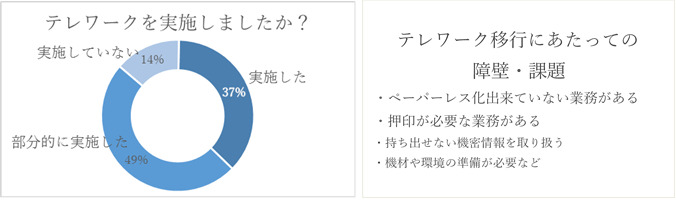
Increasing need for telework as a BCP measure
Companies that had been reluctant to introduce teleworking are now beginning to rethink their approach after actually starting to operate teleworking. In particular, there are many companies that recognize the effectiveness of telework from the perspective of business continuity planning (BCP). Many companies are expected to continue teleworking even after Corona has subsided.
With the threat of new infectious diseases and an increase in the number of natural disasters, teleworking is undoubtedly becoming more important as a BCP measure.
Telework as the New Normal Way of Working
Even before the Corona epidemic, telework had remained a system only for a select few as the government called for increased productivity and diversification of work styles. However, now that the Corona disaster is said to have ushered in the new normal, many companies are realizing the convenience and effectiveness of telework, and it is expected that many will continue to operate telework in the future.
On the other hand, various problems have become apparent in the course of continuing actual operation of telework.
Issues highlighted by the implementation of telework
The following two issues have been identified as challenges faced by companies that have implemented telework over the past several months.
Issue 1: Productivity is declining due to difficulty in communication in addition to the complexity of conventional work.
The first challenge is the decline in labor productivity. While workflow tends to become more complex in companies with larger operations, teleworking has added new functions and tools, and some employees have had to become more proficient with these tools, resulting in a decrease in productivity if they have not reached a certain level of IT literacy. Problems that could be solved by asking someone nearby when working in the office must be looked up on their own in a telework environment. As a result, this is causing a decrease in productivity compared to when they were working in the office.
Issue 2: Employees are forced to come to the office to sign and submit documents.
Second, employees have to come to the office for the purpose of approving documents, such as approval requests and other applications, in order to have their seals affixed. If the workflow includes the tasks of "stamping" and "submitting paper documents," the work cannot be absent for the sake of internal control and preservation of trails. In order to solve this issue, it may be necessary to review the workflow itself.
So how can these challenges be overcome?
What to prepare for when implementing telework
There are two things that are necessary to solve the challenges faced with telework and to implement and sustain the initiative.
(1) Centralized management of information necessary for business operations
When telework is introduced, employees will be working in multiple locations scattered throughout the company. What is important, therefore, is to centrally manage information necessary for work, such as work manuals and how to use tools, and to create an environment in which it is easy to obtain necessary information when needed. To this end, it is important to create an environment in which employees can solve business-related problems on their own to some extent by going paperless and centralizing information within the company as much as possible.
(2) Introduction of a workflow system
When a workflow system is introduced to digitize documents, it is possible to digitize the seals used for applications and approvals as well. As a result, the processing of in-house applications can proceed without the need to have a physical seal, reducing inefficiencies such as having to come to the office every Monday and at the end of the month to affix a seal.
Introduction of groupware with workflow functionality that enables telework
ArielAirOne, a groupware that promotes information and know-how sharing and operational efficiency, is an application that allows the digitization of applications and manual documents necessary for the promotion of telework and efficient workflow. It can create an environment in which each employee can easily access necessary information, while maintaining internal controls with flexible access authority settings.
In addition, a cross-functional integrated full-text search function is included as standard. In addition to keyword searches for information entered in each application, file searches for Excel, Word, PowerPoint, PDF, etc. are also possible, making it easy to reach necessary information. Furthermore, information can be easily shared between office workers and teleworking employees by using information sharing applications such as Portal.
If your company is facing challenges in adapting to the new normal working style, please consider this solution.

Related Useful Information
Web Articles
2025/11/17
Practical Guide to Avoid Failure in Notes Transition|Causes and Steps to Avoid

White Paper
2025/10/22
With Failure and Success Cases Why do major companies' migration to Notes fail?
Web Articles
2025/03/05
The latest in 2025] 12 recommended groupware products! Thorough comparison of functions and prices

Related Case Studies
Paper applications have been reduced to almost zero, and an information sharing infrastructure has been built with Ariel at its core.
Art Nature Co.

Increased business speed with ArielAirOne for more than 10 years
Exing Corporation
ArielAirOne's Flexibility Improves Operational Efficiency after Migration to Notes
Water Supply Company A