
Web Articles Electronic Bookkeeping
2021/08/24
3 patterns of how to operate invoices for stores and offices
Many companies are now in the phase of gathering information and examining operations in preparation for the revision of the Electronic Bookkeeping Act that will take effect on January 1, 2022. We are receiving an increasing number of inquiries from companies that would like to consider "scanner requirements" in the future, while making "electronic transactions" a mandatory requirement under this revision.
On the other hand, many customers in the retail and restaurant industries who receive invoices at their stores may be having operational difficulties, even though they are aware of the legal requirements.
This article explains how to comply with the Electronic Bookkeeping Act, including electronic transactions, when the person in charge of receiving invoices on site and the person in charge of accounting and finance who submits invoice information are different, as well as how to operate with our web services.

Table of Contents

Is the actual status unknown at the head office? Problems with invoices received at stores and offices
In the case of a business type with stores and offices, stores often make a decision on whether or not to pay an invoice when they receive it and mail the invoice to the head office.
If that invoice is received by e-mail or other means, it is printed out and then mailed together with the paper invoice that was received.
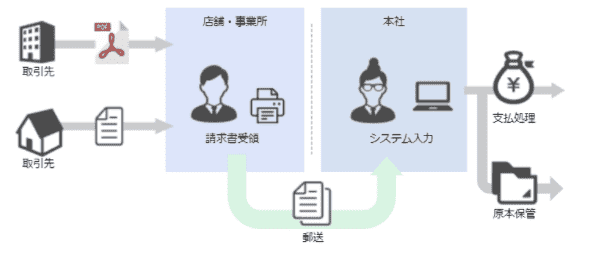
If this is the case, be careful with the revision of the Electronic Bookkeeping Law. If the invoice arrives by e-mail or other means, it is an electronic transaction, and even if the printed paper invoice is kept at the head office, it does not mean that the original is kept there.
Click here to learn about electronic transaction requirements
Also, since the head office receives the invoice on paper, it is impossible to know whether the original is electronic or paper. In one company, the head office thought that 99.5% of the documents were on paper, but in reality, they could not tell without asking the stores. In such an operational flow, an approach to the originals on the store/office side is required.
Three patterns of compliance with the Electronic Bookkeeping Act at stores and offices
So what kind of operational flow review will occur exactly? The question-and-answer session of the Electronic Bookkeeping Law published on July 16, 2021, describes the policy for various cases.
① Create a list of electronic transactions using Excel
The operation is to write the counterparty, amount, date, etc. in Excel and save it with the file. The example of devising the file name itself was also described, but it can be said that it is easier to manage when the number of files is large if the file name is written in a list, etc.
(2) Manage invoices by source
There are cases where the requirements for electronic transactions are met even on Web invoicing and receipt services. It is necessary to check whether each service or system meets the storage and retrieval requirements. Be aware that industry-specific WebEDI and other services may require periodic data rewrites. In addition, if invoices are received via e-mail, the operational flow at the store side may become more complicated, since the requirements may vary depending on the contents of the e-mail. By adding the
③ Implement a centralized management system
system, the operational flow can be unified while also covering the electronic transaction requirements. Although it will be necessary for stores to use the system, if it can be operated successfully, it will lead to a paperless system and promote operational efficiency.

In this way, it is necessary to consider the extent to which the stores should operate the system and the extent to which the head office should operate the system, while balancing the increase or decrease in workload, the simplicity of the operational flow, and the possibility of work errors.
Introduce a system with an eye on the future
Even if you want to organize the system infrastructure with a view to scanner requirements in the future, in addition to the mandatory electronic transactions, rather than alternative operations such as Excel or e-mail forwarding, it is not realistic to introduce an accounting system at the store side due to the high degree of difficulty.
In such cases, our EBM, a web service specializing in the Electronic Bookkeeping Act, can help you comply with the revision of the Electronic Bookkeeping Act, go paperless, and improve operational efficiency with a minimum of operational flow changes.
For more information about EBM, click here.
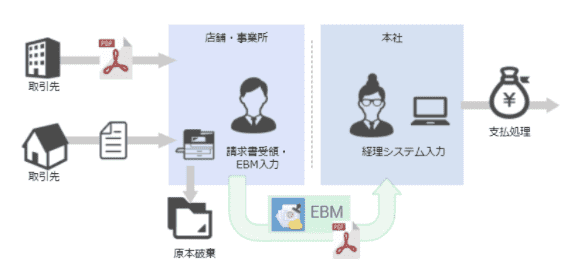

For consultation and proposal requests on how to operate using EBM, a web service specialized in the Electronic Bookkeeping Act, please visit
here
Related Useful Information
Web Articles
2026/01/21
Explanation of the 2026 Tax Reform Proposal for Accounting and Finance - What will change from a practical perspective? What are the changes from a practical perspective?

White Paper
2025/01/28
Key Points of ISO 20022 Transition

White Paper
09/30/2024
Case Studies of Debt and Credit Systems

Related Case Studies
Nankai Electric Railway x WAP talks about the "overwhelming return generated by 'add-on zero ERP'".
Nankai Electric Railway Co.

Nankai Electric Railway introduces HUE DI and upgrades HUE, Building a Management Foundation that Continues to Adapt to Change
Nankai Electric Railway Co.