
Web Articles Business Efficiency
2025/12/01
Trend Words from an Accounting and Finance Perspective Part 5 (Final)
Accounting and Finance x Dare Now AI "AI Utilization Leads to the Future of Accounting and Finance"
The areas that accounting and finance departments are required to deal with are expanding every year, and in addition to traditional day-to-day operations, they are now required to have multifaceted perspectives and information-gathering skills. In this issue, we have discussed four times with Mr. Sakurada, a senior research committee member of the Japan CFO Association, who is well versed in the accounting and finance fields, the trend words that are attracting attention as the times change, in order to give those in charge of accounting and finance a chance to obtain new perspectives and ideas in their daily work. Mr. Sakurada, a senior research committee member of the Japan CFO Association and an expert in the accounting and finance field, has been covering these trending words. The fifth and final issue of this series will focus on the trend word "Dare to use AI now. We will discuss the topic in depth with an AI developer from Works Applications, Inc.

Table of Contents
Interlocutor

Mr. Shuichi Sakurada
Chief Research Committee Member, Japan CFO Association
Managing Director/CPA, Accounting Advisory, Inc.
Mr. Tatsuya Yamamoto
ERP Business Division, Works Applications Co.
It's not too late to get started with Generation AI
The fifth and final trending word in this column is "Dare Now AI. We will delve into the topic with an AI development staff member from Works Applications. In addition to Mr. Sakurada, Mr. Tatsuya Yamamoto of the Development Division, who is involved in the functional design and implementation of core business systems utilizing AI technology at Works Applications, also participated in this issue.
We will hear about the reality and possibilities of AI utilization in the accounting and finance fields from the viewpoint of those who are actually integrating AI into their business systems.
Sakurada: I've been seeing a lot of news about generated AI since around 2024, and while some people are starting to use it as soon as possible, there were also many who were sitting on the sidelines thinking, "I think this is a great tool, but I'm not sure I want to use it at work. Since the beginning of 2025, many people have actually started using generative AI in their work, making this the first year of generative AI application. In the Japanese corporate world, I feel that there is an atmosphere of both a desire to use AI in business as a matter of course and an atmosphere of uncertainty as to how to tackle AI in their own companies. As for the latter, if they are going to work on it in the coming year, they are not necessarily behind the curve in terms of the speed of change in Japanese society. However, if we look at the global situation, we are still behind, but that is not a new phenomenon.
We have heard that companies, especially in accounting and finance and other core business divisions, have been slow to make progress in the use of generative AI.
Sakurada: As I commented earlier, the situation is exactly the same as the lack of progress in DX, systemization, and streamlining: there is resistance to the evolution of IT, and people say they cannot afford to work on it due to the "lost 30 years," but they still need to start working on it, I am sure that everyone is already aware of this.
Even so, there are many people who still do not trust figures that include AI processing and wonder if they can be verified. In light of technological advances and the way companies perceive the AI generated, a final check by humans is necessary, but the accounting data output from business processes that incorporate AI functions, based on the maintenance and standardization of payment terms and various codes in the client master, is not so much a question of "whether it is viable" as it is "whether it can be used as a matter of course. It can be said to be at the level of "use it as a matter of course" rather than "whether it is viable or not. The essence of accounting is nothing other than the conversion of business transactions into data for balance sheets on a rule basis and recording them. This is just one example, but it is not a simple matter for a human being to think, "What is that account?" and look it up. The AI will immediately suggest the subject and the code of the counterparty, so that the accounting data can be generated with the push of a button. Furthermore, since the AI will follow a variety of information and patterns, it will provide suggestions and support to the accounting and finance staff without becoming too rule-based. I think that is the direction of its existence.
What would be the most effective approach to utilize generative AI in accounting operations?
WAPYamamoto: I think the following approach is effective.
One is to start using Copilot and ChatGPT at the individual business level.
The second is to use AI-enabled functions in the business systems used in accounting on a daily basis.
The third is to develop your own system on your own.
In reality, this is difficult to achieve unless the company has the resources to develop the system and a sufficient budget. Before completing a single function, a person in charge with a deep understanding of the business will start by organizing the business content and processes. Even after the functionalization is completed, it is necessary to go through a number of trial-and-error processes to improve the accuracy.
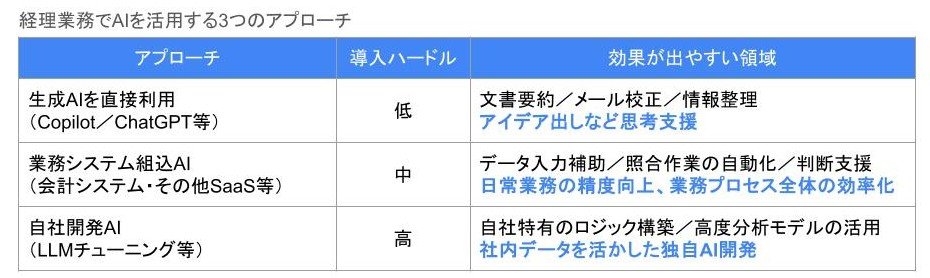
Vendors such as ours go through such a trial-and-error process before implementing a function, so it is naturally easier to start using a function implemented in a second business system.
The function I was in charge of developing is one example. In the asset management module "HUE Asset," I developed a new function that uses AI to suggest values that should be entered or changed next according to the values entered in the fixed asset registration. By incorporating AI into the system, all users of the fixed asset registration can use the system in accordance with their own company's usage situation because AI makes suggestions based on the registered information.
Mr. Sakurada: This is so-called agent-type AI. Instead of a human being having to go to the screen and input all the details, you can give the AI information and ask it to do things this way, and it will do it for you. Do you have any other examples or future prospects?
WAP Yamamoto: Talking about future prospects, there is a move to support agent-type AI as well. To talk about what is currently being done with "HUE AC," multidimensional balance inquiry using analytical AI can visualize accounting data analyzing balance information simply by giving instructions in natural language. In addition, the function of deposit erasure using decision-making AI enables highly accurate erasure by providing AI with information similar to human "judgment," such as allowing for subtle fluctuations in the amount of money in advance. In the functionality that links HUE and Copilot for Microsoft 365, which utilizes proposal AI, it is possible to combine information in HUE with Microsoft 365 products such as Excel and Outlook to propose and verify a wide range of business processes in real time. For example, simply telling Copilot on Teams, "Show me this month's payment information," will pull it from HUE's accounting data.
Sakurada: Many companies prepare their institutional accounting ledgers via applications provided by vendors, but if the system is SaaS-type, it will continue to evolve with version upgrades behind the scenes, so the embedded AI can be utilized simply via the system. When utilizing applications with individual functions, such as AI-OCR, electronic invoice conversion tools, replacement cost functions, etc., by connecting them to an existing accounting system, there are various methods such as file linkage and API linkage, etc., but it should be noted that there may be a small number of connection problems between existing applications. However, it would be good to keep in mind that there may be a few problems in connecting existing applications.
Suitable and Unsuitable for Accounting AI
What do you think about the suitability and unsuitability of using AI in accounting and finance department operations?
Sakurada: Another good example is the use of AI in gap analysis and position paper preparation when introducing new accounting standards. We tried it with Copilot's AI agent, which we have already implemented, and it was really fast and accurate. The even better part is that it is accompanied by the source of the information. It is good enough, at least as a tapping. Works Applications. s accounting department is already using a generative AI in their position paper preparation practice.
WAP Yamamoto: AI is not suited for tasks that require 100% accuracy. For example, it is more effective to delegate to a system that can achieve 100% accuracy in areas such as checking for budget overruns and journal entry consistency.
AI is suited for tasks that require human judgment, such as proposals and analysis. There may be many tasks for which AI is suited, assuming that the final decision is made by a human being, as long as it is the preliminary stage of the work.
The first step in utilizing AI in the accounting and finance department is to "have a point of contact
What do you think is a realistic first step for management and the accounting and finance department?
Sakurada: I would say that the realistic first step is to start using AI for individual-level tasks. It can be just a part of accounting work, and the first step is to use it, even if it takes time. There may be some who think it is unnecessary to do so, but I think we have to change our mindset.
Even if you use it at the personal level, since you are a company, it is essential to introduce a paid version (enterprise version) of generative AI with the involvement of the information system department to ensure security.
WAP Yamamoto: To the extent that this can be done on an individual level, it could be used, for example, to create an application form based on the contents of a delivery note. If we use the "file uploading" mechanism as a method of importing into the system, we can customize ChatGPT a little and have it automatically perform the task of "converting PDF delivery receipts into CSV format (a format that can be handled by spreadsheet software)".
Sakurada: I would not go so far as to call it a custom use, but even as a beginner, I have started using it to review and verify lecture content, translate English contracts, proofread various texts, and create simple Excel management documents that I used to ask my staff to do for me. I think it is important to have contact with AI as a first step, even in terms of familiarizing yourself with AI. In terms of accounting and finance operations, I think there is a need to easily create reports from accounting data downloaded to Excel using generative AI. But many people don't know what they need to learn to do that.
WAP Yamamoto: You might want to take advantage of Copilot for Microsoft 365 for Excel. Copilot is already built into Excel, and it does a decent job of learning.
Generative AI cannot be used unless time is spent on it.
Sakurada:
In fact, many people of my generation have a bit of a hard time learning how to set up functions and macros in Excel. Of course, it is easier to ask someone who is good at Excel to create something like this, but it would still be better to spend some time to get used to the generative AI. I think we have to dare to use time now in order to be able to use generative AI, taking into account the future.
WAP Yamamoto: The same is true for use in the development field; it is still difficult to master the use of ChatGPT without some prior study of how to make it more accurate.
Sakurada: I think it is important for individuals to first try it and share their experiences of how they use it with everyone around them. Unless we spend time on it, I think we will not be able to move on to the next step of using AI as a partner in our work.
Especially for Excel work, I try to give instructions to the generated AI as if it were an employee who has just joined the company. I have to explain what I want it to do logically to make it understand. What is different from the past is that Copilot does not need to know the programming language, but only a human being can explain it logically in natural language and it will do the work. Copilot is in trouble if you say, "That's how it's done, so keep it nice and neat. Unfortunately, there is no such thing as an AI agent that is as good as in the movies, or as a magic tool.
WAP Yamamoto: Unlike people, generative AI cannot understand the intention behind the text. The method to get better answers and deliverables from a generative AI with such instructions (prompts) is called prompt engineering. To improve accuracy, I am conscious of trying various methods to improve accuracy after organizing my own thinking.
In terms of accuracy, there are still many aspects that cannot be said to be 100%, so as a way of thinking, it may be just as well to view AI as "one of the employees who just joined the company," as Mr. Sakurada mentioned earlier Rather than entrusting AI with work, our stance is to follow up on AI work by humans. If the amount of data to be loaded is too large, the AI may not know which one to use; as a way of thinking about AI agentization, it is better to separate each task into separate instructions, so that each one is more accurate.
Sakurada: Once a series of tasks are solidified as a prompt, it becomes easier to give instructions the next time, and it's interesting because it's like creating a processing agent for yourself.
AI utilization will lead to the future of accounting and finance
What do you think about the corporate culture and human resources required to incorporate AI?
Sakurada: As I have said many times before, the important point in utilizing AI is to use it first, and I feel that the entry hurdle is much lower and easier than with DX. Unlike programming, even people with a liberal arts background can use it easily. If there is no such atmosphere in your workplace, you can ask the information system department or management for advice. It is important to share and accumulate experiences of what has been done and what has been done well, so I think it is beneficial to start by looking in the same direction as a department.
The younger generation, or the "alpha generation," as we call them, have already started to use AI generation from elementary school students, and it is only natural that university students who are about to start their careers are also familiar with AI generation. The same can be said for those who are changing jobs. Whether or not a company is using AI may also become a condition for a new job.
Finally, Mr. Sakurada, please give us a few words to conclude the column.
Sakurada: We have talked about different themes over the past five sessions, but I think the fundamental question is how to make the various changes work for us. It is not easy to change corporate culture and customs, but I think middle management and above must be aware of what should be protected, what does not need to be protected, and what should be changed rapidly. Conversely, what are the things that a company really needs to protect? Other than that, I think it is okay to change things.
In the case of accounting and finance, as long as the accounting books are correctly and properly recorded and the processing is in accordance with accounting standards and tax laws, it does not matter whether the process is done by a person or an AI. Accounting standards and various laws and regulations are also changing in response to the social and economic environment. As the common sense of the world is changing, companies and their employees must change their thinking and awareness and take on new challenges in order to survive.
Proactive use of AI now will lead to the future for everyone in accounting and finance.
*This article is current as of November 9, 2025.
Related Useful Information
Web Articles
2026/01/21
Explanation of the 2026 Tax Reform Proposal for Accounting and Finance - What will change from a practical perspective? What are the changes from a practical perspective?

White Paper
2025/11/17
2025 Report on the Status of AI Application in Accounting/Finance Departments
Web Articles
2024/09/30
Trend Words from an Accounting and Finance Perspective Vol. 3 "Accounting and Finance x "Fit to Standard

Related Case Studies
Nankai Electric Railway x WAP talks about the "overwhelming return generated by 'add-on zero ERP'".
Nankai Electric Railway Co.

Nankai Electric Railway introduces HUE DI and upgrades HUE, Building a Management Foundation that Continues to Adapt to Change
Nankai Electric Railway Co.
Continuously Evolving "HUE" Reduces the Cost of Closing Accounts
Utoku Corporation