
Accounting / Fixed Assets
TOKAI RIKA CO., LTD.
Transformation into a Shape - Case Study of Business Improvement Toward the Next Stage of Accounting

TOKAI RIKA CO., LTD. manufactures and sells automotive switches, shift levers, seat belts, and other products mainly for major Japanese automobile manufacturers under the themes of "Achieve Comfort," "Support with Security," and "Protect Safety. Recently, we have been focusing on entering new business areas, such as the digital key business, which utilizes existing security technology to lock and unlock various locks with smartphones, and the planning and development of products and services that utilize magnesium processing technology and magnetic sensor technology used in automotive parts. We also have many domestic and overseas bases, and are engaged in global manufacturing on a daily basis.
TOKAI RIKA CO., LTD. started the implementation project in October 2015 and has been working with Works Applications Enterprise (hereinafter referred to as Works) to implement HUE Classic Financial Management (hereinafter referred to as CFM) and HUE Classic Business Management ("CBM"), and HUE Classic Assets Management ("CAM") from Works Applications Enterprise, Inc. From the introduction to the present, we have been working on continuous improvement using HUE Classic.
In this issue, we spoke with the person in charge of the project, who has been involved with HUE Classic in various ways from its introduction to its current use, about the introduction project, its effects, and future prospects.
This article has been re-edited based on the session "Transforming Change into Shape: Business Improvement Case Studies for the Next Accounting Era" at "Works Way 2021 - Cornerstone x Transformation: Accelerating DX in the Next Normal Era" (hosted by Works Applications Group).
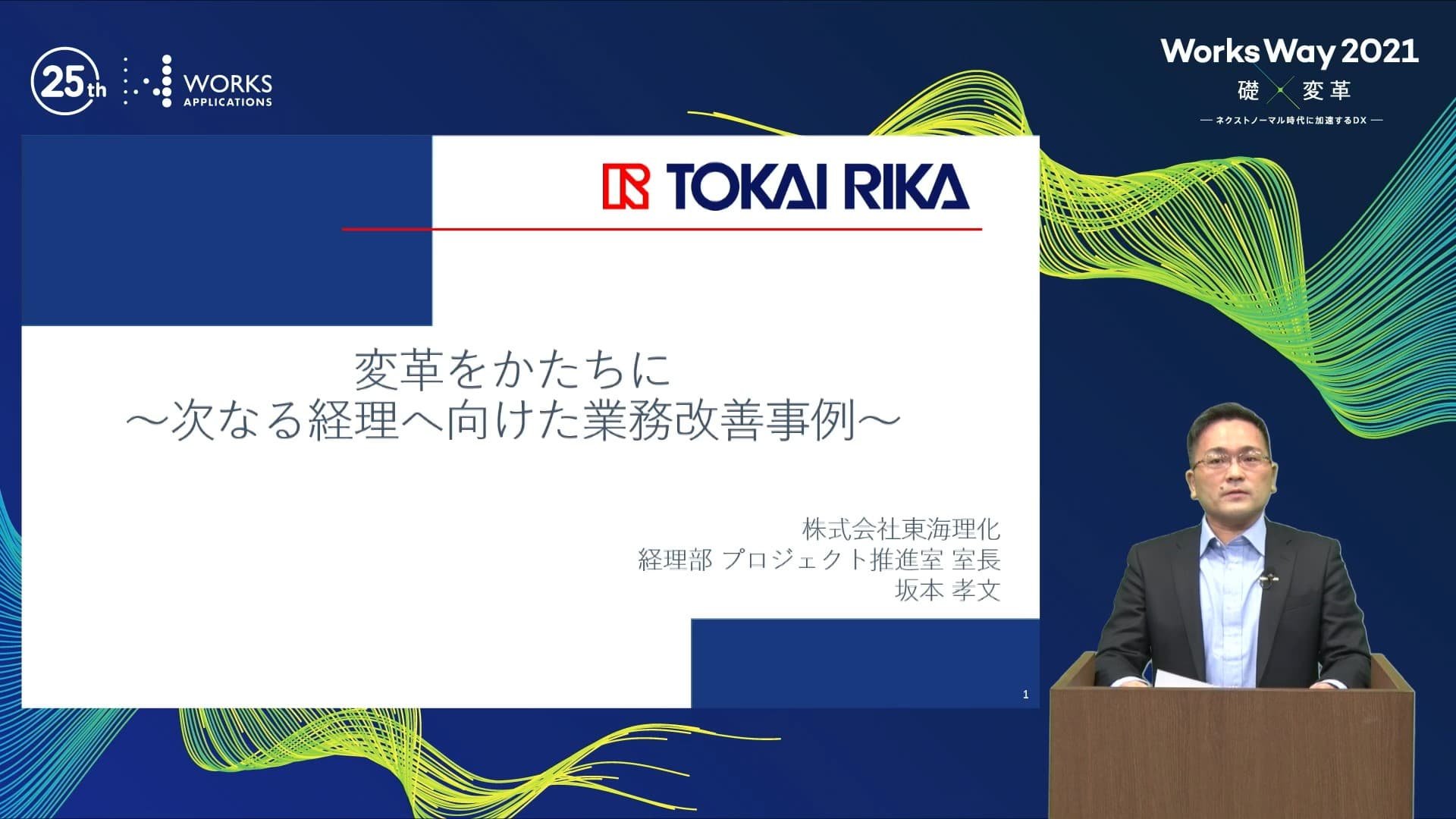
Interview participant:
Mr. Takafumi Sakamoto (Manager, Project Promotion Office, Accounting Department)
Background of HUE Classic
We had been facing a serious problem in our accounting operations for some time: low productivity in accounting operations due to the aging and legacy of our accounting system. The system was developed in the early 1990s, and we were the only company in Japan that was using it. We were unable to do things that we took for granted, such as exporting CSV files, drilling down into detailed statements, and responding to changes in accounting standards.
Fortunately, our company has a culture of improvement, and we continued to cover system weaknesses with individual improvements and hard work, but these efforts were limited by the dramatic changes in Japan's accounting system and business environment over the past several years. In addition to external changes, the role of the accounting department within the company has also changed. In other words, the role of the accounting department is no longer to simply prepare financial statements by the due date, but to serve as the pocketbook of management and to provide information for management decision making. For these reasons, we came to the conclusion that a system renewal was essential.
Reasons for selecting HUE Classic
We first clarified the objectives of the accounting system renewal, and then selected a system from the viewpoint of whether it matched those four objectives.
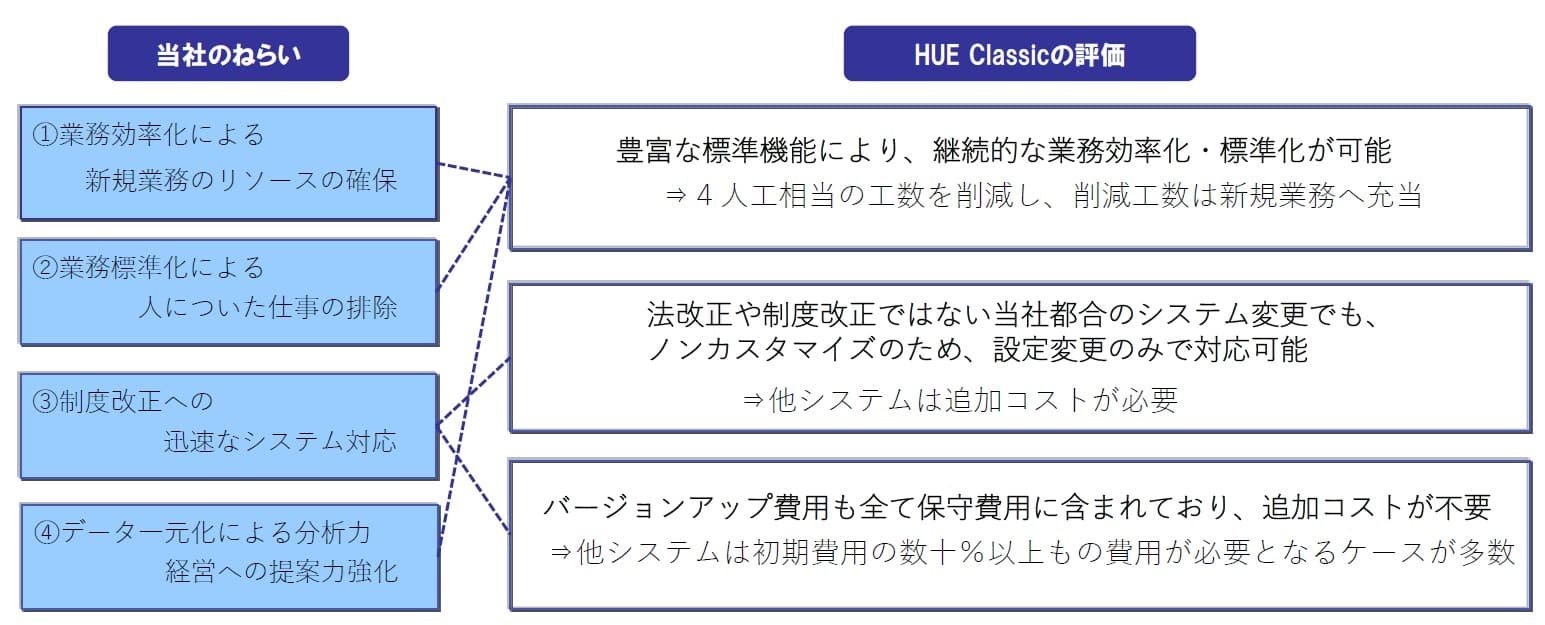
As a result, we concluded that HUE Classic was the best fit, as described above.
How to proceed with the introduction project
The HUE Classic implementation project kicked off in October 2015. Based on the request from the director in charge to "look at our work and work on improving it" and to "think from the ground up about what is needed rather than cutting anything from our current work," we proceeded with the project with the basic policy of adhering to the implementation schedule and achieving the intended results.
All of these are very important, but the most important thing we emphasized was "thinking from the ground up. When replacing a system, we tend to think in terms of the current workflow, but once the old way of doing things is carried over to the new system, the inefficient way of doing things will be carried over for several years to come. It is not easy to think of a new way of doing things or a new workflow, but considering that the effects of such a change will be felt for a long time to come, we believe that a "zero-based" approach should be pursued even if it takes a little time at the time of implementation. Also, since HUE Classic has a wealth of standard functions, it was somewhat easier to think about how to fit our business into the standard functions of HUE Classic rather than to "think from scratch.
It had been more than 20 years since we had undertaken a large-scale accounting system renewal project, but we worked closely together, utilizing the WBS, bulletin board, and issue management chart provided by Works, and proceeded on a tripod. By using these tools to visualize progress and current issues, the implementation project proceeded smoothly, and we were able to migrate to the new system in one and a half years as originally planned.
Effects of the introduction of Ariel
Although we were able to implement the system on schedule, we felt it was important to look back and verify whether we had achieved our initial goals, and not just "implement and be done with it. As mentioned above, we initially set the following four goals: "operational efficiency (reduction of 4 man-hours)," "standardization of operations," "timely response to system revisions," and "enhancement of analytical capabilities.
Business Efficiency
We had set a goal of reducing man-hours equivalent to 4 man-hours in the accounting department, and as a result, the number of man-hours was reduced by 2. However, we are able to handle various projects after the introduction of HUE Classic with our existing staff, and we are able to handle the increased workload of new projects without increasing the number of staff, so we believe that we were able to achieve the four man-hour reduction. We believe that the most significant factor in our success was not only the introduction of Hue Classic, but also the effect of reviewing our work itself in response to the introduction of Hue Classic. To this end, we have taken the following actions.
Items to be addressed to achieve the goals
1. changed the way of doing business to match the system, rather than migrating the existing business as it is
2. "Stopped" the business itself
3. reviewed the forms along with the business change, and reduced unnecessary forms
The most effective and easiest of these was to "stop" the business. The easiest and most effective way is to "stop the business" when the system is introduced. For example, when we had a task to "compile data, create a document, and submit it to our supervisor," our first priority was not to "reproduce the report in HUE Classic," but to "stop creating the document itself if it can be viewed in HUE Classic at any time. This way, we can work on the layout of the documents. By doing this, we can reduce the man-hours involved in setting up the layout of the documents, and we can also free up the entire process of creating and submitting documents afterwards. Through the introduction of HUE Classic, we realized how effective it is to "eliminate unnecessary work.
Standardization of operations
In introducing HUE Classic, we were also able to achieve this by incorporating procedures that were not written down in individual manuals or procedure manuals into standardized work and making them into manuals. In doing so, we tried to make the manuals visually easy to understand by using many screen captures, rather than using only textual explanations. Works also provides standard manuals, which are also very useful. However, there is a risk that the manuals will become old newspapers before long due to system upgrades, etc., so how to maintain and manage them remains an issue.
Adapting to regulatory changes
In October 2019, we had to deal with several system revisions after the introduction of the system, such as the revision of the consumption tax rate and support for electronic tax returns, and in each case, the version upgrades went smoothly. We received assistance from Works as part of our regular support without additional cost, and were able to respond to the system revisions without stopping our operations.
Enhancement of analytical and proposal capabilities
The fourth goal, to strengthen analytical and proposal capabilities, is currently halfway through the process. The two main reasons are that if accounting information is summarized from the original information, it cannot be analyzed in the first place, and data is only a means to an end. The drill-down function, which was not available in the past, has made analysis relatively less time-consuming, but we have reaffirmed the importance of data that can be obtained from outside the accounting system for advanced analysis and proposals that create added value. We are currently considering the use of BI tools to strengthen our analytical and proposal capabilities.
Side Effects of HUE Classic
Finally, as a side effect that we did not initially anticipate, we have received a number of questions, such as, "Can we use HUE Classic to perform this task? "Can we make use of this HUE Classic functionality? What if we could stop this work altogether?"
I personally believe that HUE Classic's abundance of standard features makes it easier to foster such a mindset .
Examples of actual improvements
We would like to introduce one example of the use of HUE Classic. Each factory had its own petty cash management operations such as disbursement and replenishment, which used to be an analog process of Excel ledger management, printing, stamping, and hand entry of journal entries. This was managed using the standard functions of HUE Classic, and then the question was asked, "Is it really necessary to have petty cash at the factory in the first place?" and finally eliminated the use of petty cash at the factory itself. We believe this was also a result of the introduction of HUE Classic.
Finally
We believe that a new system is not the end-all solution, but an improvement mindset is important. It is fine to say, "If we have gone to the trouble of introducing a new system, let's use it to the fullest," or "I want to make things easier," but what is important is not to accept the status quo, but to develop a culture and human resources that are willing to change. Based on this culture of willingness to change, we will continue to work on a variety of initiatives.
*This article is current as of June 2021.
Related Case Studies
Nankai Electric Railway x WAP talks about the "overwhelming return generated by 'add-on zero ERP'".
Nankai Electric Railway Co.

Nankai Electric Railway introduces HUE DI and upgrades HUE, Building a Management Foundation that Continues to Adapt to Change
Nankai Electric Railway Co.
HUE" reduces the man-hours required to prepare for inventory significantly. HUE" reduces it to a few hours.
Huis Ten Bosch Corporation