Fixed Assets / Accounting
Tokai Rika Corporation
Use the system to the fullest! Realizing efficiency in fixed asset operations through system consolidation

Tokai Rika manufactures and sells automotive switches, shift levers, seat belts, and other products mainly for major Japanese automobile manufacturers under the themes of "Achieve Comfort," "Support with Security," and "Protect Safety. Recently, we have been focusing on entering new business areas, such as the digital key business, which utilizes existing security technology to lock and unlock various locks with smartphones, and the planning and development of products and services that utilize magnesium processing technology and magnetic sensor technology used in automotive parts. We also have many domestic and overseas offices, and are engaged in global manufacturing on a daily basis. In this interview, we asked members of the accounting department about the fixed asset operations performed by HUE Classic Assets Management.
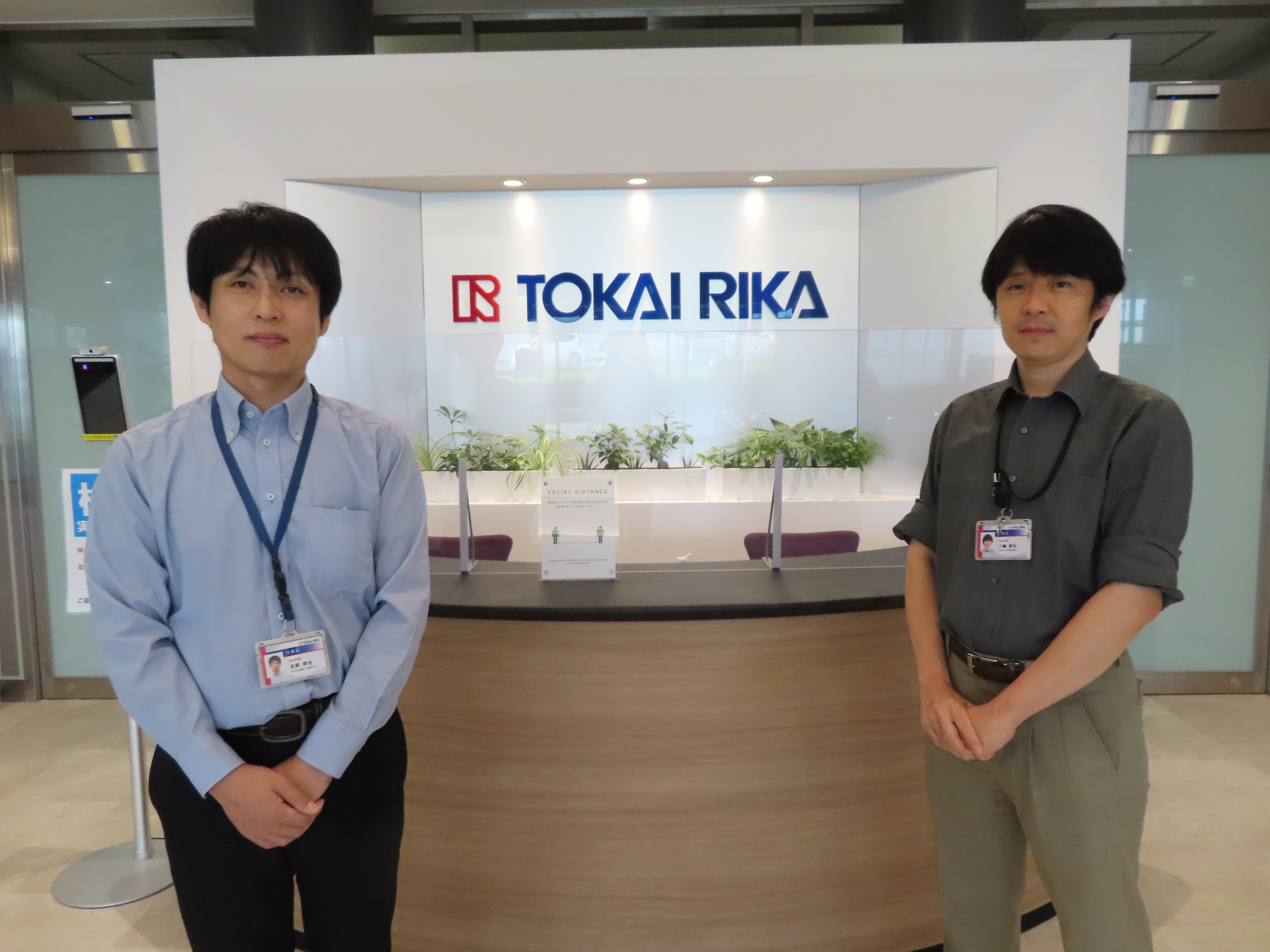
Interview participants:
Mr. Mikiya Kitahara, Senior Manager, Project Promotion Office, Accounting Department
Mr. Norihiro Miwa, Senior Manager, Finance Office, Accounting Department
Advanced Fixed Assets Management in the Manufacturing Industry with HUE Classic
-First of all, please tell us about the functions you use in the asset management area.
Mr. Kitahara:
We use the functions of fixed assets, construction in progress, and asset retirement obligations. I mainly use fixed assets and construction in progress.
For the construction in progress account, we import and record the data inspected from the front-end capital investment management system, and transfer the items that have started to be used to fixed assets.
For fixed assets, in addition to normal depreciation, the system also uses ledger management for retirement and transfers, simulation calculations, and tax functions such as depreciable asset tax and corporate tax.
-First of all, please tell us about the functions you are using in the asset management area.
Mr. Kitahara:
We manage about 100,000 fixed assets, including intangible assets. Construction in progress is about 200 to 300 items per month that are purchased externally.
We are often told that the number of fixed assets is large compared to other companies.
Mr. Miwa:
Most of the assets we manage are machinery and dies used in our factories. The main locations are the head office and four factories in Japan, but there are 50 to 60 departments that manage fixed assets, making it a business with a large number of people involved.
HUE Classic has greatly improved fixed asset management operations by moving away from an in-house developed system!
-What are some of the particular advantages of using HUE Classic?
Mr. Kitahara:
We feel the benefits are in terms of streamlining our operations and being able to smoothly respond to changes in the law.
Before we introduced HUE Classic, we were using an in-house developed system, which required manual work to calculate depreciation simulations for profit planning, for example, and it took an enormous amount of time due to errors that occurred. With HUE Classic, we can import the necessary information and the system automatically performs the calculations.
Mr. Miwa:
We also had issues with legal revisions because we were using an in-house developed system.
When there were major legal revisions in the past, we manually maintained all the calculation formulas in our self-developed system. With HUE Classic, this was made much more efficient because all legal revisions are provided as a free version upgrade. Recently, we have been able to smoothly complete the fixed-amount method compliance for building fixtures because of the prompt provision of the upgraded program.
The implementation was achieved smoothly with the support of experienced consultants!
Mr. Miwa:
The implementation of HUE Classic was a very difficult project, not only because we had to "replace the system," but also because we had to centralize information on assets that were scattered across various systems and files. The Works consultants provided not only a lecture on how to use the system, but also proactive advice on how to migrate from the existing ledgers, which helped the project proceed smoothly. We are very grateful for their accurate advice based on their wealth of experience.
Aiming for further man-hour reduction through continuous improvement activities
-How do you continue to make improvements after migrating to our system?
Mr. Kitahara:
We had a goal of reducing the equivalent of four man-hours of accounting department staff when we implemented HUE Classic, so we are constantly working to improve efficiency.
For example, in the area of construction in progress, we still have an in-house developed system for registering the timing of the start of asset use (fixed asset transfer), but when I spoke with the developer of Works at the Development Assessment Service (*), he told me that we could cover this area with a function we had not used before.
Knowing that construction in progress operations can be realized so deeply with standard functions, we realized once again that the system can be used without the need for customization.
Currently, we have already completed the setup for using the functions and testing seems to have no problems, so we are planning to deploy the functions to our users in the future.
* Development Assessment Service: A service in which HUE/HUE Classic developers ask customers how they are using the product and provide free advice on how to make more effective use of the functions.
-Are there any other areas of improvement besides the construction in progress area that you are working on?
Mr. Kitahara:
We would like to make improvements in the output area. We would like to devise a way to use the data used for quarterly closing and for audits, etc., in the same state as the output as much as possible. In the past, when we asked @SUPPORT(*) about how to output a tally sheet of increase/decrease for each function such as fixed assets and construction in progress, we were immediately informed of the available functions, and we are now considering whether we can use them in the future. I think this is a part of our business that we are not usually aware of, and although it is a small amount of work each quarter, we would like to further improve our business by continuously reducing the load.
*@SUPPORT: A bulletin board service provided by Works Applications Enterprise.
Enables efficient communication with development and consulting from introduction to maintenance.
HUE Classic is a "go-to" solution for further business improvement.
-What are your prospects for future improvement efforts using HUE Classic?
Mr. Kitahara:
The introduction of HUE Classic has strengthened our mindset of continuous improvement centered on "using HUE Classic to the fullest." HUE Classic has so many functions that we can simply ask questions on @SUPPORT such as "Can we realize this kind of work? HUE Classic has so many functions that we can simply ask @SUPPORT "Can this kind of work be realized?
In addition, by discussing with developers at the "Development Assessment Service," you can dig deeper into your company's issues and formulate a policy for improvement based on an understanding of HUE Classic's functionality. With the feeling that "it would be a waste not to use a good system that we have introduced," we hope to continue to learn more about HUE Classic and improve our business operations to a higher level.
-Thank you very much for your time today.
*This article is current as of November 2021.
Related Case Studies
Nankai Electric Railway x WAP talks about the "overwhelming return generated by 'add-on zero ERP'".
Nankai Electric Railway Co.

Nankai Electric Railway introduces HUE DI and upgrades HUE, Building a Management Foundation that Continues to Adapt to Change
Nankai Electric Railway Co.
Inventory preparation man-hours drastically reduced. HUE" in a few hours
Huis Ten Bosch Corporation