
Project Progress Management Tools
TDK Corporation
Centralized management of R&D themes with "HUE Classic Project Management" Aiming to expand the scope of visualization by using together with the WBS tool "HUE Project Board

TDK Corporation ("TDK") is a leading electronic components company founded in 1935. TDK has continued to create many original and high-value products through manufacturing that makes full use of its five core technologies: materials technology, process technology that maximizes the characteristics of materials, evaluation and simulation technology, production technology, and product design technology. Currently, TDK has more than 250 factories, R&D and sales bases in more than 30 countries and regions around the world, and employs approximately 130,000 people. (As of March 31, 2021)
In March 2021, TDK introduced HUE Classic Project Management ("HUE CPJ"), a project management system from Works Applications Corporation ("Works"), at its headquarters functional R&D organization. To further expand the scope of visualization, Works added HUE Project Board, a task progress management service that was expanded in July of the same year as part of the new lineup of the HUE Works Suite.
In this interview, we talked about the introduction project progress at Corona Disaster, the current operation status, and future expectations.
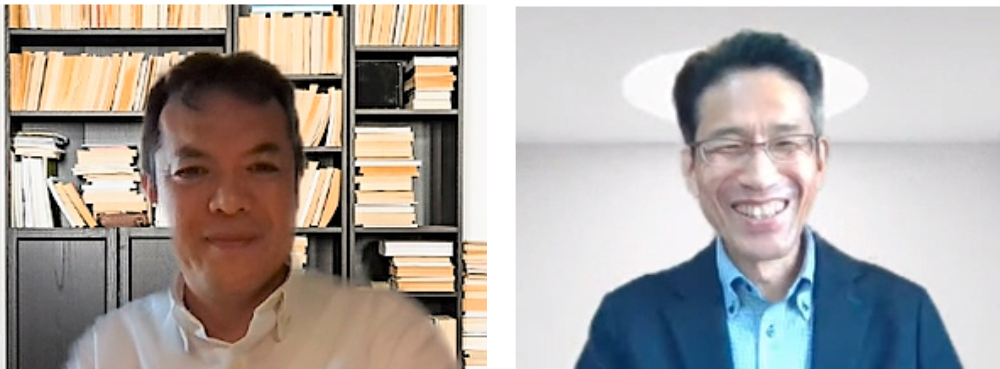
Interview participants
From left: Mr. Tsutomu Ide (Manager, Technology Planning Office, Technology & Intellectual Property Division)
Mr. Kazuki Suzawa (Manager, Technology Planning Office, Technology & Intellectual Property Division)
Unifying Information to Turn Research Results into Company Assets
-Please tell us about the background of your decision to introduce a project management system.
Mr. Ide:
When considering our company's future research and development, we thought it was necessary to increase awareness of the budget by creating a system that allows the company to fully utilize research results as assets by making it possible to centrally store and share results and related documents, etc., and also by creating a system that can be shared within the organization in terms of forecast and actual management for each research theme. In addition, we believe it is necessary to raise awareness of the budget by creating a system for sharing within the organization in the management of the budget and actual results for each research theme. We also thought it necessary to create a mechanism to analyze development costs from the start of a theme to its completion.
Mr. Suzawa:
In our R&D organization, most of the managers are playing managers who do both R&D and management. Therefore, the management work while advancing research themes was just too complicated. In order to analyze the status of personnel, progress, costs, deliverables, etc., the work of compiling the current status required opening several files in different storage locations, which took up a considerable amount of time even though the work was not related to research and development. If we continued to rely on human resources, we would not be able to accumulate the information as a company asset, and the centralization and digitization of information was an urgent issue.
Works' proposal and enthusiasm filled a need that could not be met by existing products.
-What were the reasons for choosing HUE CPJ?
Mr. Ide:
When I thought about what I wanted from the introduction of a project management system and where we should aim for as an organization, first, I wanted the members who operate research themes to be cost-conscious and capable of taking charge of management. To achieve this, we decided that the following three functions were necessary for digitization: (1) a database function, (2) a development cost management and forecasting function, and (3) a workflow function. From there, we were introduced to several project management systems, including those from other companies, but we were unable to find a product that satisfied all of our desired functions, and we spent more than two years considering them. After understanding our needs, Mr. Works gave us a demo of HUE CPJ, saying, "This is a product for system development vendors, but it might be able to meet our needs. As we continued to communicate with Mr. Works about how we could improve this part of the system and how we could make it better, we began to think that this was indeed the way to go, and we were encouraged by his enthusiasm and decided to introduce it.
Introduction project proceeded completely remotely without any disadvantages
-I understand that the project was implemented at Corona Disaster, and that everything was done remotely except for the initial kick-off meeting.
Did you find it inconvenient compared to the face-to-face style?
Mr. Ide:
I never felt any disadvantages. I honestly felt that we could do this kind of project remotely as well as in person. I think it was good that we were able to work on the project with clear shared objectives between the two companies and our project members. In addition, I feel that we were able to proceed successfully because Works had a deep understanding of what could and could not be done, and what elements could not be excluded in the course of the project.
Mr. Suzawa:
I joined the project around this time, but we were able to talk face-to-face at least once at the kick-off meeting, and I think we both felt that we were on the same team. Even if we continued to work remotely, we had a relationship of trust as a base, so we could communicate with each other without anxiety.
The key to smooth progress was the agile progression in which the client and vendor worked as one.
-What did you do to ensure that each member of the project team took the initiative?
Mr. Ide:
First of all, we asked each other, "Why do we need to do this project?" and we started by getting them to empathize with the issues. Once the issues were recognized within the organization, we all had a thorough discussion on how to improve them so that we could all move toward the same vector. Once the project was underway, I made sure to confirm in detail any comments that caught my attention or seemed odd during the meetings so that there would be no discrepancies in where we landed. When looking back on the project, Mr. Works likened the way we corrected the course of the project to that of a conductor. We were able to accomplish this project because the members on site communicated closely with each other and worked hard while drawing out a time line.
-How was the communication with vendors?
Mr. Suzawa:
I believe I also learned how to proceed with the project itself through this project. The project team and Works and I were able to work as one without feeling any barriers between companies. We were using an agile approach to the project, starting with the system and repeating hypothesis/testing, and the two companies agreed in advance on what to do when gaps in the hypothesis/testing occurred. As a result of the team's collaboration, we were able to complete the implementation project smoothly and without delay.
Adoption of task progress management service actually used in the implementation project
-How did you come to adopt the "HUE Project Board," which was just announced in July 2021?
Mr. Ide:
The predecessor to the HUE Project Board, WBS (Work Breakdown Structure), was used by WORKS in the "HUE CPJ" implementation project. We also thought about introducing it a few years ago, and there was a time when we tried using WBS for several themes. However, perhaps because there were too many things that could be done, some people used it, but it did not spread throughout the organization. With this background, I felt that "HUE CPJ" was a little lacking in WBS functions, such as how to schedule research themes and report them to the top. At that time, I was given the opportunity to use Works' WBS, which is simple and easy to use, just like the spreadsheet software I am used to using, and I thought it would be great to combine the two. So, from an early stage, I asked Works, "Aren't you going to commercialize this WBS? (laugh).
Mr. Suzawa:
When we were discussing tasks at a meeting between the system developer and the project manager, Works quickly input the task contents and due date into the WBS on the spot. After that, when I came back to this project after doing other work, I took a quick look at the WBS and was able to easily understand "Oh, this task has to be done by the end of this week," just from the visuals. After actually using it, I thought it would be better to have this function.
-How are you currently using the "HUE Project Board"?
Mr. Ide:
We are still considering specific ways to use the system, including the content of management items, but we would like to manage various information in a centralized manner similar to "HUE CPJ," partly because it can also be saved in ILOG. In particular, the Mention function allows me to look back at instructions and comments from my supervisor when I want to check them, which will reduce the time and effort required to open and check my e-mail each time. In fact, in addition to research themes, we are beginning to deploy this system in projects that include other departments within the company. The intuitive design allows anyone to quickly become familiar with the HUE Project Board. Since it makes sharing the progress of themes very smooth, I would like to continue to share and use it widely within TDK, including with sales division representatives and overseas offices.
HUE CPJ" not only shows the progress status at a glance, but also provides detailed insights
-Let's go back to the "HUE CPJ". It has been six months since its introduction.
Mr. Ide:
It is difficult to get a new system to take root, but I feel that it is finally starting to flow smoothly. One of the major benefits of the introduction of the system is that we can now see the entire theme at a glance and understand the progress at a glance. HUE CPJ" contains all the necessary information, so I can check it immediately with a single click. When I was working with Excel, it used to take about a week for monthly totals and analysis of KPIs, etc., but now it takes only a day. (Laughs) Besides, spreadsheet software is just a list of numbers, but "HUE CPJ" allows me to ask myself, "Is this part OK? Is this part OK? (laughs). In fact, at the research department's review meetings, we have begun to use "HUE CPJ" to share information on the progress of themes and the budgets associated with them. We have started by making them cost-conscious, and I feel that awareness is growing, but whether or not it can be connected to management is the next phase.
Mr. Suzawa:
It varies from person to person, but I am starting to hear conversations like, "What does it mean when it says this in HUE CPJ? I am getting to hear conversations like, "What does it mean when it says this in HUE CPJ? Even if the administrative department's workload is reduced, it will be worthless if the workload of those on site who input information increases. In this respect, "HUE CPJ" is designed to be easy to input information, and the burden on the on-site theme leaders has not increased, which may be a factor in the fact that the system is beginning to spread within the company. Nevertheless, we believe that there is still plenty of room to bring out the benefits of introducing the system. Our challenge is to make sure that people are aware of the ease of use and that the system permeates the company.
The incorporation of a budget mechanism will revitalize the entire organization.
-How is the status of the forecast management using "HUE CPJ"?
Mr. Ide:
The budgeting and actual management part is being done by an accountant, who is enthusiastically providing input to the theme leaders on how to understand the budget and how to properly tie and manage it. I want them to be able to do R&D not just to manage money, but also to maximize cost-effectiveness, maximize the team's performance, and deliver products to customers as quickly as possible.
Mr. Suzawa:
Prior to the introduction of the system, communication between the accounting staff and field personnel was conducted on an e-mail basis and was not shared with the entire team. Now, everyone can see the comments from the accountant, so they know why this was sent back and what they need to pay attention to. Now that we are able to work closely with accounting, I expect that this will inevitably lead to the revitalization of the entire organization.
Expect further speed-up of sharing and innovation
-What is your outlook for the future?
Mr. Suzawa:
TDK conducts R&D activities under a quadripolar global development system. The "HUE Project Board" is already available in English, and we expect that the "HUE CPJ" will also be available in multiple languages in the future, so we can speed up the sharing of information by operating in English.
Mr. Ide: The introduction of the
system is not the end of the process, but rather, we continue to evolve the system as we use it, communicating with Works on a case-by-case basis regarding modifications such as detailed presentation and selection of elements. I think that the more seamless operation of "HUE CPJ" and "HUE Project Board" will lead to more innovations.
A presence that continues to think and work closely with the client
-What do you expect from Works in the future?
Mr. Ide:
It will be no different than before. I hope that you will understand what we need and think together with us about how we can achieve it with "HUE CPJ" and "HUE Project Board" that we have introduced.
Mr. Suzawa:
If we introduce the system and that's it, it may become obsolete. We hope that Works will continue to be close to us so that we can consult with them at any time.
-Thank you very much for your time today.
This article is current as of October 2021.
Related Case Studies
Standardized project management with HUE Project Board
Actus IT Consulting Corporation

Centralized management of R&D themes in the manufacturing industry with HUE CPJ
TDK Corporation