
Fixed Assets
Central Research Institute of Electric Power Industry
Dramatic Improvement in Efficiency of Japanese-Specific Operations in the Fixed Asset Management Domain Using HUE, which is Optimized for Japanese Companies

The Central Research Institute of Electric Power Industry (CRIEPI) is a joint research institute of electric utilities that contributes to electric utilities and society through scientific and technological research. CRIEPI conducts research in a wide range of fields covering the electric utility supply chain, including power generation technology, power transmission and distribution technology, energy efficiency, renewable energy, and environmental protection.
In August 2023, the Central Research Institute of Electric Power Industry replaced the fixed asset management function of a foreign ERP by implementing HUE Classic Assets Management ("HUE"), a fixed asset management system from Works Applications Corporation ("WAP"). In this interview, we asked the accounting department members who were actually in charge of implementing the system about the effects of the system after its introduction.
Interview participants:
Mr. Taeki Ito, Senior Manager, Accounting, Accounting Group, Central Research Institute of Electric Power Industry
Ms. Taeko Namiki, Accounting Group
Ms. Kumiko Nakamine, Accounting Group
The old system operation was a challenge in the area of fixed asset management, where there are many rules that are unique to Japan.
-First of all, please tell us about the background of your decision to implement HUE.
Mr. Ito:
Since our institute had previously introduced a foreign ERP for company-wide unification, we were also using the functions of the foreign ERP in the area of fixed asset management. However, when we actually started using the system, we found that it was difficult to operate the system in accordance with Japanese tax laws and business characteristics, and we found many points where operational efficiency was greatly reduced.
For example, the system's settings for the depreciation method for lump-sum depreciable assets and the format of electronic tax return files for depreciable assets differed from Japanese rules, which required a lot of visual checks and manual work to adjust to Japanese operations.
In order to eliminate this inefficient work and create an environment in which we could concentrate on more essential tasks, we considered revamping our fixed asset management system.
Mr. Nakamine:
In terms of support, it was difficult to decipher the direct Japanese translation from English on screen items and manuals, and it took a lot of time and effort to understand the meaning of error messages, make inquiries, and resolve them.
Dramatically streamlined operations with products that are compliant with laws and regulations and easy to use, as well as a full range of services
-What were the deciding factors in selecting HUE?
Mr. Ito:
We actually compared several products before making our decision. Although HUE was not the cheapest, we evaluated various points overall and made our decision.
The most significant was the fact that the standard functions covered all the requirements of our firm, including a solid support of Japanese tax laws and accounting standards.
It was important to us not only that the current functionality was extensive, but also that major version upgrades would be handled within the maintenance contract, so that we would not have to migrate the system or repurchase licenses each time an upgrade was made.
Another important factor was the security of the proposal. An engineer with experience in product development participated from the proposal stage and clearly explained what was feasible and what was not. This allowed us to get an idea of the actual operational improvements at an early stage, and even after the implementation project started, there were almost no discrepancies and the product implementation proceeded smoothly.
In addition, during the proposal process, WAP provided us with information in a fair and organized manner so that it would be the best solution for our firm.
-What are the changes and effects after the introduction of HUE?
Mr. Namiki:
The first thing I would like to mention is that the depreciation calculation is now done in accordance with Japanese tax law, which has greatly reduced unnecessary work.
The depreciation method for lump-sum depreciable assets is set according to Japanese tax law from the beginning, so there is no need to make any corrections.
In addition, the system can now automatically switch between the old straight-line method and the declining-balance method for residual depreciation, which has greatly reduced the amount of time and effort required.
In addition, the convenience of input has also improved. Previously, the person in charge had to make detailed corrections on the screen to correct the ledgers during inventory, but now, batch corrections can be made by importing files, and we feel that this has improved efficiency.
Mr. Nakamine:
The work of declaring depreciable assets has also been greatly improved. It used to take three to four days to file a return, but now it takes less than a day.
The Depreciable Assets Portal displays a list of necessary tasks, so the process goes smoothly as long as you follow the instructions, and files for e-filing can be imported directly into eLTAX, making it much easier.
Another point where we feel the system has improved is that the manuals and Q&A on @SUPPORT (*) are well-developed, so if there is something we don't understand, we can quickly find a solution ourselves. Furthermore, when I make an inquiry, at the same time as writing, they present me with relevant information, saying, "Here are some Q&As," which sometimes solves my problem there. The response to our inquiries is quick and courteous, and we feel that our work is less slow now.
*WAP provides a free support site where support is available 24 hours a day, 365 days a year
[Inquiry input screen for @SUPPORT].

-What factors contributed to the success of the implementation project?
Mr. Nakamine:
When WAP first told us that our firm would be responsible for the setup work as part of the implementation project process, we were a little concerned, but we were reassured by the solid support we received during the implementation.
Thanks to the fact that we had a system in place for immediate inquiries at the regular weekly meetings, and to the fact that the progress was closely monitored, I think we were able to get the system up and running on schedule. Furthermore, because we set up the system ourselves, we understood the details and process, which was extremely helpful even after the system went into operation.
Mr. Ito:
The schedule for the implementation was set by WAP's consultants, and looking back, I feel that it was a very easy and risk-free way to proceed. The pace of the initial configuration definition seemed very fast, but we were able to repeat the trial and error process many times during the subsequent testing period, so we were able to proceed with the configuration until we were satisfied with the specifications.
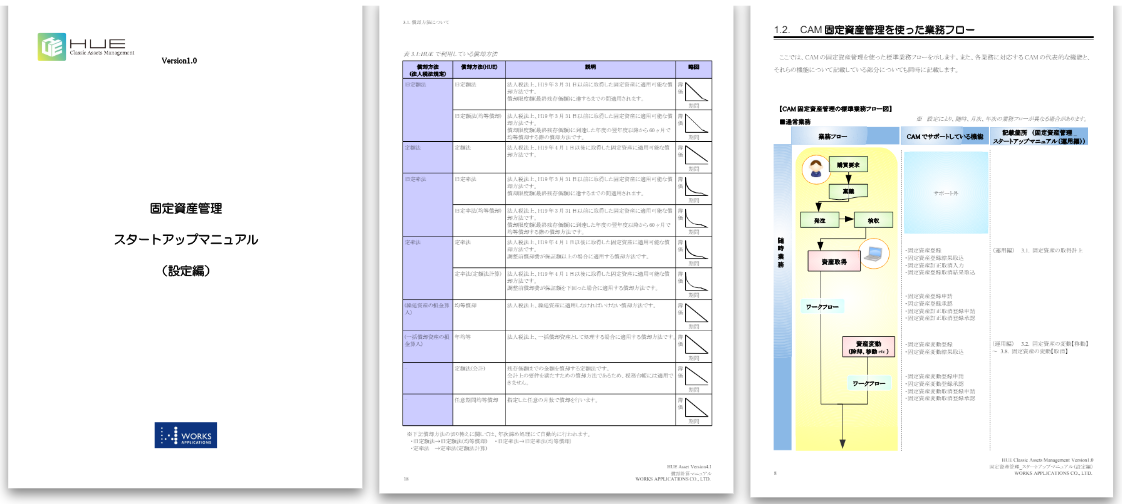
Another point we made during the implementation was to read through the product manual as much as possible.
The manuals available on @SUPPORT were comprehensive and easy to understand, so we read them in the early stages of implementation. We were able to grasp the details of the functions at an early stage, and we feel that the implementation project went smoothly. I also believe that our proactive stance toward the project increased our commitment to each other, resulting in a better project as a result.
Realization of an environment that allows you to focus more on the work you need to focus on
-Please tell us about your future plans.
Mr. Ito:
HUE is a great system that is stable and convenient, and we will continue to use it for a long time. Updating the system is very time-consuming and labor-intensive, and it is not the core business that accounting should be engaged in. by continuing to use HUE for a long time, we hope to be able to consistently reduce unnecessary work and focus on more essential tasks.
License in use
・HUE Classic Assets Management
*This article is as of June 2024
Related Case Studies
Nankai Electric Railway x WAP talks about the "overwhelming return generated by 'add-on zero ERP'".
Nankai Electric Railway Co.

Nankai Electric Railway introduces HUE DI and upgrades HUE, Building a Management Foundation that Continues to Adapt to Change
Nankai Electric Railway Co.
Inventory preparation man-hours drastically reduced. HUE" in a few hours
Huis Ten Bosch Corporation