
Digital Invoice
Coop Deli Consumers Cooperative Union
Unifying the entire group's financial accounting platform HUE Classic x RPA streamlines business processes

The Co-op Deli Consumers' Co-operative Union, which brings smiles to dining tables through its home delivery business, storefront business, and other services with a priority on food safety and security, has seven member co-ops in Tokyo and seven prefectures and is chosen by more than 4.85 million members (as of June 2018).
As a federation of co-ops in the Kanto region, the Co-op Deli Co-operative Union (hereinafter referred to as "Co-op Deli Union") has developed a common infrastructure for products, logistics, production, systems, accounting, and personnel training, and has jointly created headquarters functions for the home delivery business, store business, and service business.
In this interview, we asked about examples of "HUE Classic" AC series utilization, RPA implementation, and its specific effects for the entire group, including nine subsidiaries.
Promoting digitization of business operations and unifying the entire group's financial accounting platform with "HUE Classic
How did you proceed with the project to introduce "HUE Classic" AC series?
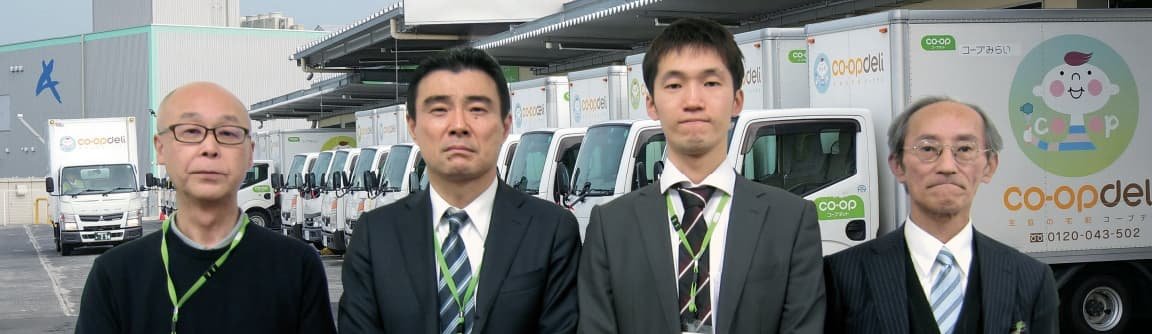
Mr. Nobuji Matsuhashi (Mr. Matsuhashi), in charge of the Accounting Department, Settlement of Accounts Section, Co-op Deli Consumers' Co-operative Union:
We selected the system due to the end of maintenance support for the accounting system we were using at the time of 2016. The project was expected to be a challenging one, with a grace period of less than one year to implement the system for the Co-op Deli Federation, six member cooperatives, and nine subsidiaries, all of which were to be operational at almost the same time. The selection was based on various evaluation criteria, including suitability of standard functions for business requirements, future scalability, economic efficiency, and project structure, with HUE Classic receiving the highest overall score.
Mr. Taira Hasebe (hereafter, Mr. Hasebe), in charge of planning, Accounts Settlement Section, Accounting Department, Co-op Deli Consumers' Co-operative Union:
For the introduction project, we decided to start small and gradually expand the scope of use. Therefore, in the early stages of the project, we were conscious of formulating a business design and usage policy with a view to future development. We also reflected on the fact that the previous accounting system was not able to cope well with operational changes after the system went live, so we often found ourselves unable to use certain functions that we wanted to use.
Mr. Matsuhashi:
Although the system was introduced in a short period of time, we focused on holding extensive explanatory meetings for end-users. The areas of expense reimbursement and budget management, which were the target of the system replacement, are used by the people in charge on site. Therefore, I carefully and carefully explained to them how HUE Classic would improve their work and how we were planning to improve their work.
Please tell us about the benefits of using HUE Classic.
Mr. Matsuhashi:
We were able to unify our financial accounting infrastructure, including subsidiaries, with HUE Classic. We consider this to be a very significant advantage, as we were unable to achieve this with our previous accounting system.
Another significant benefit is the systemization of budget management and fund management. For example, with regard to budget management, we had previously used spreadsheet software and database management tools to create budgets. We used to spend an enormous amount of time distributing budget formats to several hundred people, collecting them, tabulating them, and so on. By using HUE Classic, we have been able to reduce the amount of time and manpower spent on these tasks.
The same applies to cash management. By being able to realize financial accounting, receivables and payables, and cash management in one package, all data is seamlessly connected, and cash management results can now be automatically generated from voucher data.
Mr. Hasebe:
I feel that the fixed asset system area that I am in charge of has also been renewed to "HUE Classic" and that we have been able to reduce the amount of work related to fixed assets by half.
The previous fixed asset system was complicated and did not function well, and was used exclusively for calculating monthly depreciation expenses. With HUE Classic, we were able to systematize our tax operations, such as impairment accounting and depreciable asset reporting.
Mr. Masatoshi Honda, Manager, Accounting Department, Co-op Deli Consumers' Co-operative Union:
When we want to create our own original forms, we can easily change the layout and create our own original forms without the need for individual development, which is very helpful. For example, we can create a checklist. The checklists are output on paper after data entry, but since the necessary information can be output in any layout, work efficiency has been greatly enhanced.
Mr. Matsuhashi:
We believe that the introduction of the new package system was also an opportunity to review our existing operations and streamline them to match the system, which was also very effective.
Even after the system went live, we have continued to expand the scope of its use, and recently released a management dashboard for management accounting within the company. The system has been highly evaluated by users because of its fast processing speed without the need for data processing. In the past, analysis of the difference between the forecast and actual results (analysis of the difference between the budget and actual results) required gathering and checking data dispersed throughout the company at each time. Now, it is very convenient because it can be displayed graphically on a single screen, from which detailed information such as breakdown and journal entries can be checked by drill-down.
HUE Classic" × RPA streamlines the business process; a task that used to take one hour to complete takes only five minutes.
RPA is used in accounting operations. How was it introduced?
Mr. Minoru Yoshida, Deputy Manager, Accounting Department, Co-op Deli Consumers' Co-operative Union (hereinafter Mr. Yoshida)
About 100 people are involved as the accounting department for the entire Coop Deli Federation group. Looking at the situation from a long-term perspective, such as 10 years from now, it is expected that personnel will be replaced and that operations will become more sophisticated and diversified. This is the reason why we decided to eliminate the use of RPA and equalize the workload.
Mr. Hasebe:
We decided on our own which business processes should be converted to RPA. Our policy was to introduce RPA in the areas of already routine tasks where it would have the greatest time-saving effect. Currently, RPA is being used to output a list of account statements and convert them into a spreadsheet file format, as well as to create voucher data for inclusion.
Mr. Honda:
When we actually introduced RPA, we wanted to eventually bring everything from robot creation to operation in-house, but at the time we did not have much know-how regarding RPA tools. Therefore, we decided to use Works' "Robot Creation Service".
With the robot creation service, Works created a robot for us within a period of about one month, and we also received a lecture so that we could maintain the robot by ourselves. Now, I am able to create the robot by myself.
What were the effects of the actual use of RPA?
Mr. Hiroyuki Kitazawa (hereafter, Mr. Kitazawa), Senior Manager in charge of Settlement of Accounts Section, Accounting Department, Co-op Deli Consumers' Co-operative Union:
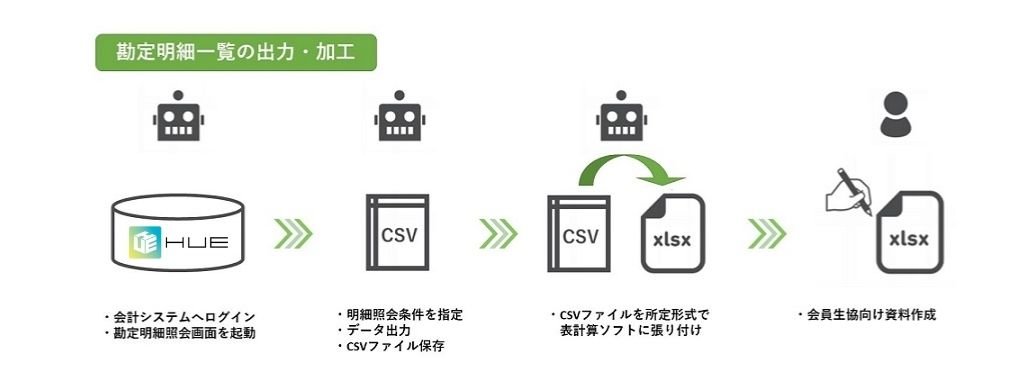
First of all, the use of RPA to output a list of account statements is necessary in the process of creating documents to be provided to member cooperatives. I logged into "HUE Classic," outputted the data for the list of account statements, saved it as a CSV file, and then pasted it into a spreadsheet with a specified format and saved it automatically using RPA.
Previously, these tasks took approximately one hour to complete, but now they can be completed in about five minutes thanks to the use of RPA.
Mr. Honda:
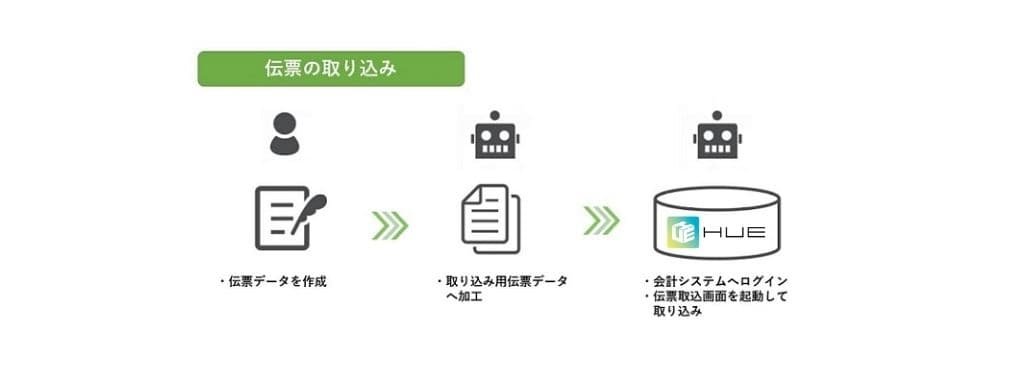
In the past, the creation of data to be imported was done manually. Therefore, we created a robot that performs a series of tasks from the creation of the data to be captured, system login, automatic capture, and checklist output.
This way, the data capture process is done with the push of a single button on the RPA. The robot only needed to confirm that the process was completed correctly, which significantly reduced the man-hours required.
Mr. Yoshida:
When we were first considering the introduction of RPA, we thought that it would be better to eliminate handwritten vouchers altogether. However, eliminating handwritten slips would also change on-site operations, which would place a heavy burden on the company. Considering the entire process, we concluded that the best process would be to use OCR to read handwritten slips, create data for import, and import the data into the system. We are now in the process of introducing OCR, and the latter part of the process has been converted to RPA.
Mr. Matsuhashi:
There are many requests for RPA for this type of data capture within the group. We believe that if we can organize operations by unifying input formats and other means, the number of tasks that can be automated by RPA will further increase.
*This article is current as of March 2019.
Related Case Studies
Nankai Electric Railway introduces HUE DI and upgrades HUE, Building a Management Foundation that Continues to Adapt to Change
Nankai Electric Railway Co.

Peppol streamlines both sending and receiving invoices
HAMASPI Corporation
Works Applications, Inc.
Unified the financial accounting platform for the entire group, including 9 subsidiaries, with HUE
Coop Deli Consumers Cooperative Union