
Notices
JGC Holdings Takuya Hanada's presentation is now available
"CrossTalk "Wow!"" Implementation Report
2024/12/16
CrossTalk "Wow!" is a "Cross Talk" event that invites guests from Japan's leading companies to introduce what they are doing to innovate their companies and Japanese society on fresh and practical topics, and to engage in an interactive and heated discussion. This is a "Cross Talk" event.
Our goal is to help promote mutual growth through the sharing of ideas and values that will leave participants with a "Wow!
In this "CrossTalk "Wow!"" session, Mr. Takuya Hanada, Senior Managing Executive Officer and CHRO of JGC Holdings Corporation (JGCHD), who has been implementing specific measures under its unique strategic human resources program "Funachu Hakusaku," spoke on the topic of "human capital management," which has become an important theme for companies in recent years. JGC Holdings, Inc.
This article introduces the contents of Mr. Hanada's talk on strategic human resource management at JGC Holdings and the "CrossTalk" with the participants on the same topic.
Outline of Speech
Speaker: Mr. Takuya Hanada, Senior Managing Executive Officer, CHRO, JGC Holdings Corporation
The future of human resource management will shift from a "heaven-driven" to a "earth-driven" organization.
Mr . Hanada's Biography
Senior Managing Executive Officer, CHRO, JGC Holdings Corporation
Mr. Hanada joined JGC Corporation in 1982 and participated in overseas plant projects as an engineer. 2002, he established "Triumph 21" with NTT Group and became CEO. Later, after serving as CEO of JGC's Algerian subsidiary, General Manager of Business Development Division, and General Manager of Human Capital and Organizational Development Department, he was appointed CDO of JGC Group in 2018. 2021, he became President of JGC Global's Engineering Center and has been in his current position since April 2022.
Moderator: Mr. Kazunori Saito, COO, Exponential Japan K.K.
Human Resource Portfolio Formulation is the First and Foremost
As Chief Human Resource Officer (CHRO), I would like to talk about the JGC Group's challenging approach to human capital management. Since its establishment in 1928, the JGC Group, as a company that supports the foundations of industry and society, has focused on the issue of "harmony between energy and the environment," but the environment surrounding us, including decarbonization, has changed considerably. Against this backdrop, we formulated our long-term management vision "2040 Vision" in 2021 in order to change the direction and scope of our business. We are currently implementing eight key programs, "Eight Strategies for the Ship," in order to implement our strategic human resource management. First, I would like to talk about "HR strategy linked to management strategy.
First of all, in order to manage the organization from the organizational aspect after assuming the position of CHRO, I formed the HRO (Human Resource Officer) Council within the organization as the highest promotion body for human resource strategy. The HRO was appointed at the level of vice president of each operating company, who had managerial authority. Until now, human resource management has been more of a "naturalistic" type of organization, in which people receive clear requests from the people around them and then perform their duties appropriately. However, from now on, HR is expected to be linked to management strategy based on the concept of HR strategy. In other words, HR itself needs to change to a "geocentric" organization that understands the needs of each business and thinks and acts on its own.
The mission of the CHRO is basically different from that of the head of HR. The HR Director attends the HRO meetings as the Executive Director. The CHRO is responsible for the factorization of the management strategy into the HR strategy, and the HR manager is responsible for the implementation of the HR strategy and beyond. This is the "HR strategy linked to management strategy.
A Quartet Approach to Support Human Resource Development
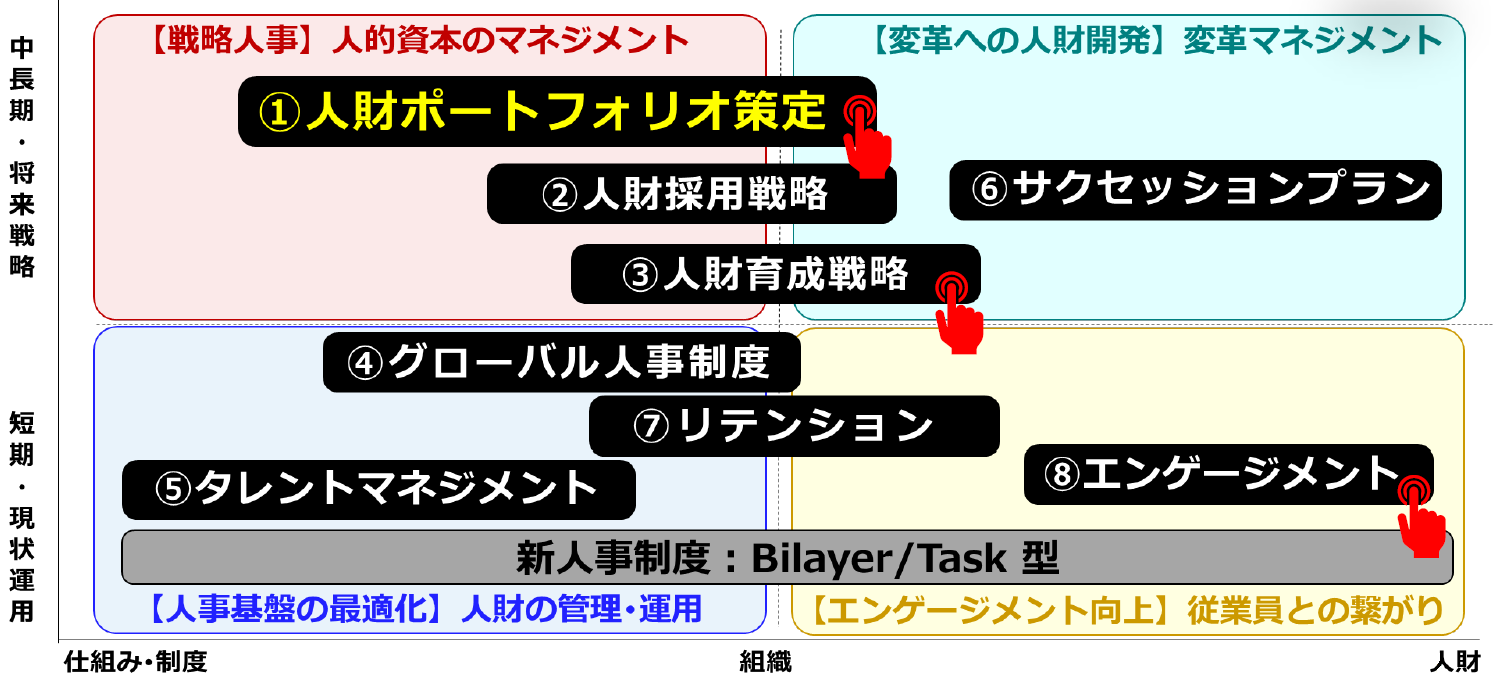
At the HRO meeting, we listed eight important HR issues. We then decided on the name "Funaka Hachisaku" (Eight Strategies for the Ship), which represents "reform" similar to the Meiji Restoration proposed by Ryoma Sakamoto. We wanted to make the name familiar so that each and every employee would have a sense of ownership in the program.
Of the eight programs, the first item is "1) Human Resource Portfolio. This is followed by "2) Human Capital Recruitment Strategy," "3) Human Capital Development Strategy," "4) Global HR System," "5) Talent Management," "6) Succession Plan," "7) Retention," and finally "8) Engagement. In this issue, we will pick up three of these areas, (1) Human Capital Portfolio, (2) Human Capital Development Strategy, and (8) Engagement, and explain them.
Next is "(2) Human Resource Development Strategy. With so many different layers, it would be difficult for employees to go through all kinds of training. As a company, we call this a quartet, meaning that we should formulate a human resource development plan and strategy centered on four themes.
The first violin is the "department head," who is the nexus between management and employees. The head of the department is required to take the management strategy and create an operating policy based on the management strategy, design the organization, and focus on these issues based on the fact that his/her department will be properly structured to fulfill its mission in three or five years. This is in addition to human resource development and the assignment of people to major projects, which can be exhausting for the department head. Therefore, we have decided to divide the work of department heads into three evolving areas. We created two new positions: CDM (Career Development Manager) for education and career, and PCM (Project Coordination Manager) for project assignments.
And the second fiddle is "Successor" (next generation manager). In terms of the value of human capital, knowledge, ability, and, again, qualities are important. We designed the Succession Plan to have an optimal balance between these three.
Next, Viola is a "career hire". Against the backdrop of mobility and other factors, a little more than 40 percent of our new hires are now career hires. In the past, many of the career hires around us were able to teach the career hires, but now we have many career hires, and on the other hand, we do not have an onboarding program in place, so we are not in a position to immediately demonstrate our own strengths. Therefore, we have created an opportunity to gather our new recruits to learn the basics of "What is JGC? We have a "Networking Program" (named "Nets Hub") that provides an opportunity to learn the basics of "what is JGC" by bringing together new hires, and also encourages horizontal connections through social gatherings and other events. If business connections are vertical, then making other horizontal and diagonal connections can broaden the scope of learning.
The cello that plays the last note is "reskilling. In engineering, which is what we are working on now, certain parts can be done digitally through DX, and it is becoming commoditized, and eventually one area will no longer be sufficient. In the past, an engineer was considered a full-fledged engineer after 10 years, but that will not be enough. Nowadays, a new young engineer will work in one area for three years, which will become his/her background, and after the fourth year, he/she will gain experience in a different area. We have been implementing such a rotation "Baysix System" for the past three years.
Returning to the "Eight Strategies for a Better Life," the last of the "Eight Strategies for a Better Life" is "8) Engagement. How can we raise the level of engagement? We thought that even if our employees are aware of our company's Purpose (raison d'etre), "Enhancing planetary health," they may not be able to see what changes need to be made. Therefore, around 2021, we started an initiative called "Purpose Journey" to match the company's own personal paths with the personal paths of individual employees and to "jibun-goto" the company's own personal paths. Of course, we believe that it is fundamentally impossible to perfectly match corporate and individual personal paths. However, each of these paths is an "n" order equation that is a multiplication of several factors, and by working on each person's path journey to find common factors through factorization, I believe that one's own value in a company and what one must do in a company will be brought into relief. This is what we mean by "matching the company and the person". This is the journey of matching the company and the person's path.
This is my introduction to the "Eight Strategies of the Shipbuilder.
[CrossTalk] Strategic Human Resource Management
Moderator Saito:
You spoke of your knowledge and experience in a very broad range of areas. Now, I would like to hear some comments from the participants.
Participant A:
I think this may be the first time I have heard a story that has been analyzed and organized so well in the area of human resources. In our company's attempt to do innovation, two mechanisms are in motion. First, we have a system in which all people who aim to manage the company report to the top so that they can see each other's weekly reports. Second, we have a training camp. We stay overnight and communicate with each other to a certain extent on a cycle to adjust our awareness. It is a corporate culture. As a succesion, I thought it would be good if the system to leave behind is systematized like JGC's.
Participant B:
At JGC Corporation, is there any difference between new graduates and mid-career hires, or do you have any special follow-up for mid-career hires?
Mr. Hanada:
We do have a so-called onboarding program. To be honest, we have not been very generous in the past. The tendency has been for employees to seek their own value in their first or second year, but to quit after the third year. I felt that this may be due in part to a lack of understanding of the good qualities of JGC, so I put in place an onboarding program. I think it is important to understand the DNA of JGC as a company, and we are incorporating this into our new menu.
Participant C:
We are also trying to do the human capital plot, but we are still in the middle of the road. Our challenge is how to develop human resources.
Mr. Hanada:
In the succession plan, there are knowledge based on experience, project management skills, and competencies, and recently I myself have been feeling that it is really important to visualize the competencies. I think competencies should be broken down into qualities and abilities. Qualities can vary from physical strength, influence, insight, curiosity, and so on. We need to be looking closely at the qualities of our employees. I think the idea of the right person for the job is also necessary from now on. Wherever I talk to, I hear that ability and qualities are multiplied. When we are able to extract and visualize only the qualities, I would like to share it with you again.
Saito:
So, you talked about something close to the field, but I would like to ask the person in charge of development personnel about the situation as well.
Participant D:
We are in a situation where we are encouraging people to come to work overall based on company policy after the Corona disaster. This is because we have a business that provides services, and there is a view that it is difficult to generate innovation, including communication, without face-to-face meetings.
Saito:
How about JGC Corporation?
Mr. Hanada:
Basically, this is an industry that requires remote management to some extent, regardless of the Corona disaster. In engineering, basic areas are handled at the head office, but detailed areas are handled by overseas subsidiaries. However, in principle, 100% of the work is done at the head office in Japan. In order to implement a project, three-dimensional communication and community are necessary, so it is necessary to come to the office and have F2F discussions.
Participant E:
Since we are an IT company, we share the common belief that people are our assets. We believe that so-called employee satisfaction is very important in health management. In our company, 70 percent of our employees work remotely after the Corona disaster. Our stance is to encourage employees to work in the most efficient way anyway.
The fact that the company has such a system is more of a blessing for employees. Even in the IT industry, which is said to have a high turnover rate, our company's turnover rate is 2%. However, while vertical communication has been established through weekly gatherings, the challenge is the horizontal connection. We have a get-together once a month at the company with a beer server, and last year we had a birthday party. Also, reskilling is very important. Our company also encourages employees to acquire qualifications.
Saito:
Since we are here, we would like to hear from various people. Please ask anyone who has questions.
Participant F:
I was particularly impressed by what you said about being able to factorize the HR system that much. I have been working for Japanese subsidiaries of Western companies for some time, and what I feel is that Japanese companies overwhelmingly do not spend much money on employees compared to Western companies. I had the impression that in Europe and the U.S., they spare no expense in investing in their employees to help them achieve their per-pass. I wanted to ask you, you mentioned vertical, horizontal, and diagonal fascias.
Mr. Hanada:
First of all, I compared the measures to factorization, but in fact, we have not been able to do much until now. I think that is why we are now working on it. Regarding Successor, it was also based on human senses. Also, our company works on a project basis, but the project manager has a defined goal, which is somewhat different from the management environment. Therefore, we had to break down the differences, and the need for a succession plan arose.
The other reason is that while it is true that Japanese companies may not invest much in training, there is a culture in which people teach others. Even if it were other companies, I believe that there are places where people are able to pass on skills in a natural way, so comparisons with other countries are not simple. Fascia is one of the diagonal materials. For example, when a project is formed, diagonal relationships are naturally fostered among the members through practical work. I also think it is possible in a community through drinking and communicating.
Participant G:
We recognize that people are an asset, but we have not been able to find an effective way to address this issue, and the high turnover rate of young people is a problem. We would like to know if there is any countermeasure or training for young people.
Mr. Hanada:
We don't have any special remedy for young people in particular, but for young people in their third to fifth year, especially those who joined Corona Disaster Relief, we have implemented the networking program I mentioned earlier because they don't have many horizontal connections, and for career employees hired at the same time, we have conducted a "personality journey" as I explained in the first half. We also conduct the "Purpose Journey" program for employees hired at the same time.
In fact, for 90 years since our founding, we have had a human resources manager with a liberal arts background. However, more than 80% of our employees are engineers (technical staff). If we are to strengthen our strategic human resources, it is necessary to have a person with an engineering background to encourage and encourage our engineers. To be honest, there is a limit to how far I can go in nurturing people with just my intuition, experience, and courage, which is why I have come up with measures such as the "HRO Conference" and the "Eight Strategies for Funaka". Therefore, we are still in the middle of the road.
20241216.png"
*This article is current as of November 2024.
Company names, product names and service names are trademarks or registered trademarks of their respective companies.
*The information in this release is current as of the date of publication, and is subject to change or withdrawal without notice. Please be aware that the forecasts and other forward-looking information in this release are uncertain and may differ from actual results.
About Works Applications
Works Applications was founded in 1996 as an ERP package vendor in Japan. With innovative solutions such as no-customization and free version upgrades, we have supported the growth of our customers, mainly major Japanese companies. Believing in the potential of each individual, we aim to be a "growth engine" that maximizes the value of companies and individuals, and we will continue our pursuit of turning "work" into "creation" and making "work" fun.
Theme: The Essentials of Human Resource Strategy Linked to Management Strategy - "Eight Strategic Strategies" and "Human Resource Grand Design
For inquiries regarding this article, please contact
Public Relations, Works Applications Corporation
TEL : 03-3512-1400 03-3512-1400
FAX : 03-3512-1401
E-mail: [email protected]