
Notices
The world's first third-party assurance of ISO30414 SRA standard
The lecture by Mr. Denji Sakurai, Japan Information Communication
Report on the "CrossTalk "Wow!
2024/02/20
CrossTalk "Wow!" is a "Cross Talk" event that invites guests from Japan's leading companies to introduce what they are doing to innovate their companies and Japanese society on fresh and practical themes, and to engage in an interactive and heated discussion. This is a "Cross Talk" event.
Our goal is to help promote mutual growth through the sharing of ideas and values that will leave participants with a "Wow!
In this "CrossTalk "Wow!"" session, Mr. Denji Sakurai, President and Chief Executive Officer of Nippon Information Communication Corporation, who is pioneering management that incorporates "human capital," which will become mandatory to disclose from the fiscal year ending March 31, 2023, participated in the discussion.
This article highlights Mr. Sakurai's presentation on "Human Capital Management to Create Corporate Value" and the "CrossTalk" with Mr. Hata, CEO of NICHIA, and other participants immediately following the session.
Outline of Speech
Theme: "Human Capital Management for Creating Corporate Value" - From the world's first acquisition of third-party assurance of ISO30414 SRA standard
Speaker: Mr. Denji Sakurai, President and CEO, Nippon Information Communication, Inc.
Mr. Sakurai's Biography
President and Chief Executive Officer, Nippon Information & Communications Corporation
Mr. Sakurai joined Nippon Telegraph and Telephone Public Corporation in April 1984. He has served as General Manager of Marketing Department, Solution Division Planning Department, and General Manager of Business Model Promotion Office, Corporate Planning Department at NTT Communications Corporation, In June 2019, he was appointed President and Representative Director of NTT Com Solutions K.K. In June 2020, he was appointed President and Representative Director and Executive Officer of Japan Information & Telecommunications Corporation, a position he currently holds. He was appointed President and Chief Executive Officer of Nippon Information & Communications Corporation in June 2020, where he remains to this day.
Corporate value comes from areas that do not appear in financial statements, such as human capital.
I joined Nippon Telegraph and Telephone Public Corporation (now NTT) in 1984, focusing on corporate sales, and in 2007 I was appointed President and Representative Director of NTT Comcheo, a member of the same group. At that time, I began to think about the importance of how employees should work, so I became certified as a labor and social security attorney to study labor compliance and other issues.
After that, I worked at NTT Communications in charge of the OCN Service Department, Corporate Sales Division 4, etc., and served as President and Representative Director of NTT Com Solutions before assuming my current position as President and Representative Director of Nippon Information & Communications Corporation ("NI+C") in 2020.
NI+C was jointly established by NTT and IBM Japan in 1985, and I received the baton as president when the shareholding ratio changed in 2020 and the company became a consolidated subsidiary of NTT. When I arrived at the company, it was in the midst of the Corona disaster, and when I came to the office, there was no one there. I began to think about what policies and initiatives I wanted to pursue at this company, listening to the people involved, doing my own research, and so on. Among them, I read "THE HAPPINESS ADVANTAGE" and "Reinventing organizations", which triggered me to aim for the realization of human capital (Happiness) management. This is why human capital is now the focus of attention.
The reason why human capital is attracting attention now is because of Japan's declining competitiveness. What investors pay attention to in a company is its intangible assets. In other words, the intangible assets that do not appear in financial statements, such as human capital, patents, brands, and customer bases, are the areas of corporate value that cannot be quantified.
In other words, the future potential and growth of a company cannot be evaluated without looking at these areas, but many Japanese companies have a low ratio of intangible assets to market capitalization.
The following are the key points that I have decided to address in my own company to realize human capital management.
- Make the company a place where employees can work happily and healthily (health management)
- Develop autonomous employees and transform into an agile company
- Promote reskilling to keep up with new technologies
- Toward a corporate culture of trust, respect, appreciation, and praise
- Trust and pride in the company
- Strengthening of self-contained organizational management skills
The first is the Next Generation Board Unit, which assigns the managers in charge of the next generation to meet once a week to discuss and implement measures to deal with management issues. The second is the Technical Advisory Board, which brings together the company's most technically astute people. Through these two boards, participating employees are able to understand the management perspective and the context of management decisions, and I am able to understand the issues and reactions to decision-making in the field.
A good company needs two things: "ease of work" and "job satisfaction
In human capital management, the first priority is employee happiness. When management resources are used to improve employee engagement, employees become HAPPY and customer service levels improve. In this way, customers become HAPPY and customer loyalty increases, leading to corporate growth and increased profits. Furthermore, by linking this to social contribution, a sustainable society will be realized, and society itself will become HAPPY. We have incorporated this process into our business model. What is important in this process is "ease of work" and "job satisfaction. A good company requires both of these.
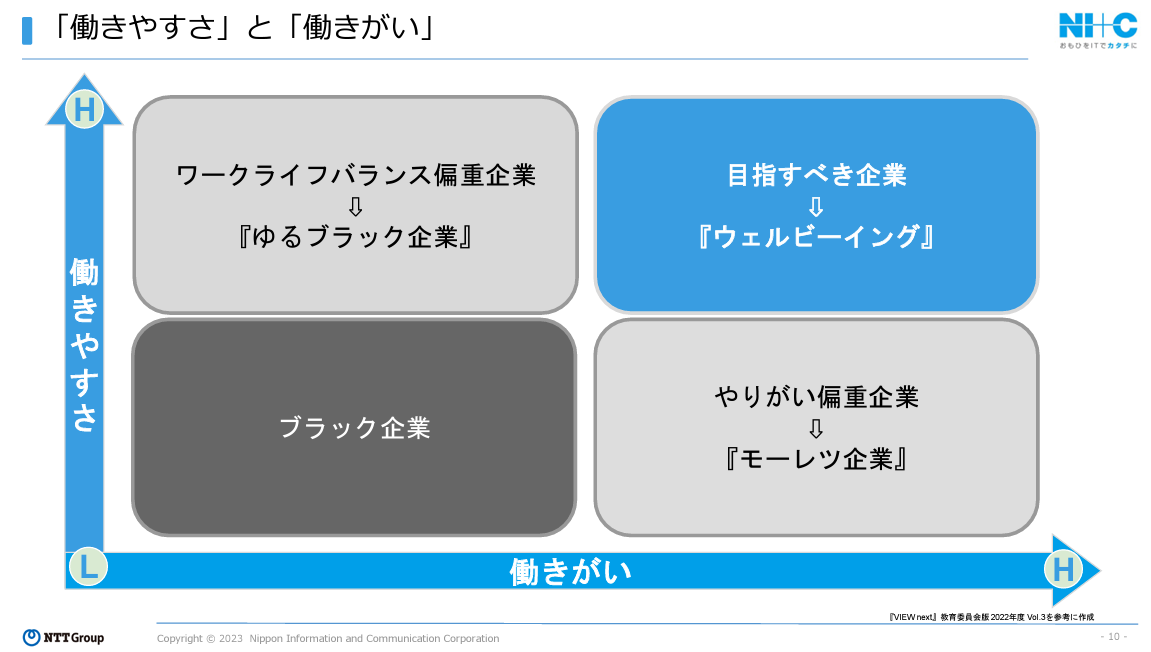
We started by removing restrictions on where and when employees can work in order to make it easier for them to work. We decided that productivity would not increase unless remote workers at Corona Disaster could work in a better environment than at the office, so we surveyed employees to find out what they would like to have when working remotely, and the company lent them displays, office chairs, and other items. Some employees said they had to come to work to exchange paper documents with customers, so we have thoroughly digitized the paper exchange. We also eliminated the hassle of travel expense reimbursement by utilizing Mobile Suica, which is charged from a corporate card.
The office was redesigned to be open, casual, and suitable for hybrid work, based on remote work, but also to facilitate communication across departments when employees come to work. We have also made satellite offices available for use when out of the office. We have also introduced the "Anywhere Office" system, which allows employees to work remotely while living in rural areas. We have a short-term model called "Chotto," which can be used when returning to one's parents' home or on a work vacation in units of several weeks, and a system called "Zutto," which allows employees to move to a rural area and work remotely on a full-fledged basis. The program is designed to provide employees with a place to work that allows them to feel free to consult with their employer.
We have also introduced a generation AI for easy consultation, and the younger generation in particular is actively using the system.
According to the results of our own survey on remote work, many employees say that their productivity has increased, but the results show that while there is good communication on the vertical line between supervisors and subordinates, communication with colleagues on the horizontal line and employees in other departments has diminished. We are currently in the process of seeking a mechanism to induce communication among employees across departments.
Next, "job satisfaction," we believe that a sense of growth, good human relations in the workplace, and contribution to others are important.
First of all, the company has created a reskilling system because we believe that by developing individual skills, employees can realize growth and enhance their sense of self-esteem. As a result of making it possible for all employees to learn as much as they want, we have acquired a total of 1051 new certifications as of the start of our third term.
In particular, 40% of our employees hold certifications in agile development, a field in which we are focusing our efforts, and productivity is increasing due to this agile approach to work. We have also started a career consulting service on a trial basis so that employees can feel free to consult with internal and external consultants when they are concerned about their career direction. Regarding 1-on-1 meetings, which are important for revitalizing internal communication, we have managers undergo training to learn what kind of communication should take place in such meetings. In addition, to foster a culture of mutual appreciation, praise, and encouragement, we have established a "Happiness Code of Conduct" and introduced a system of Thanks Points.
Growing Awareness of the World's First Third-Party Assurance of ISO30414 SRA Standards
To explain about the disclosure of human capital information, shortly before I arrived at the company, our HR staff started gathering information and preparing for it by attending seminars, etc. We did a survey of 11 human capital metrics in 2021 and attended a meeting organized by the BSI (British Standards Institution) group. In April 2023, BSI Group Japan granted us an endorsement of ISO 30414, the international standard for human capital information disclosure based on the SRA standard (AA1000), which BSI told us was the first case in the world of a third-party endorsement of ISO 30414 based on the SRA.
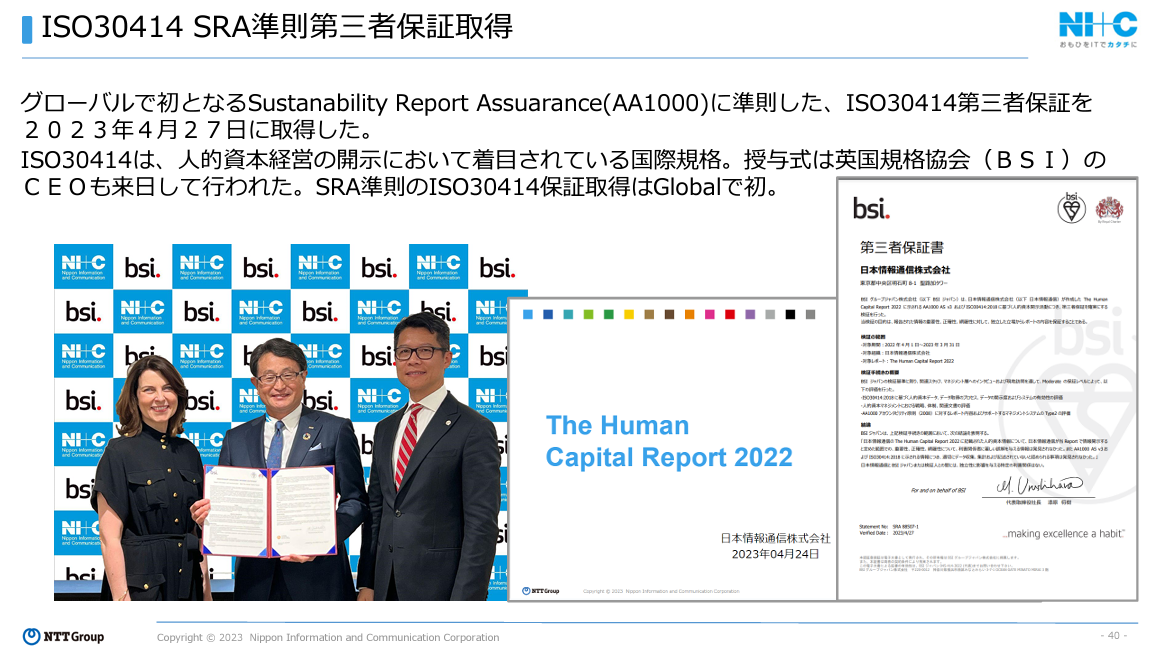
There are 58 items in the 11 human capital metrics. Of course, we will provide data on the bad as well as the convenient.
This is how the report gains credibility, and by submitting the data, it also increases our own awareness of the need for improvement. At our company, we apply the OODA loop. In the OODA Loop, it is called Observation. From there, we orientate, make decisions, take actions, and apply them to human capital management.
We are a privately held company, so we are not obligated to do anything. However, since it is still very difficult to secure DX personnel, we believe that this is an effective way to send a message to the hiring market that we are a company that values and nurtures people.
[CrossTalk]Promoting women's activities requires not only a system but also a change in awareness.
Qin:
We hear about the social issue that the ratio of female managers is not increasing. Is there anything special you are working on?
Mr. Sakurai:
I found out that there was an upper age limit for becoming a manager before I arrived at the company, so we changed the system so that we can evaluate people regardless of their age.
If a woman reaches the upper age limit after taking several maternity leaves, there is no longer any possibility for her to become a manager forever. Surprisingly, if you look at the details, I think there are still such systems that drag them down.
However, even if I told them that I had removed their disadvantage and that they should definitely become managers, there were cases where they backed down, saying that it was too early for them. I think it is necessary to have a system that encourages people to give it a try and see how it goes, and at the same time, it is necessary to change the mindset of people.
As for male employees taking maternity leave, it is not always the same workplace for both husband and wife, so I think it is important to think about this issue for Japan as a whole rather than just one company's efforts.
Participant:
Our company has a large number of female employees, but the percentage of female managers is low. When I frankly asked women their opinions about such disclosure, they told me that it was nonsense to specialize in women in the first place.
Originally, as a system, we have a system based on the principle of gender equality. As President Sakurai said, the timing is different for each person. If we properly work on creating a flat system rather than distinguishing between men and women, I think such a situation in Japan will change.
[CrossTalk]Remote work requires a relationship of trust between the employee and the company.
Qin:
There are some positive aspects to the spread of remote work, but may I dig deeper into the challenges? I think there are quite a few managers who say that the lack of visibility has made it more difficult to manage working hours. We would like to know if there is anything you are working on in this area.
Mr. Sakurai:
Before the Corona disaster, we were able to manage by work schedule and access logs, but with remote work, instead of access logs, we are looking at PC on/off. We need to make sure that we are not working long hours, especially if we lose track of time remotely.
Employees are expected to manage their time autonomously when working remotely. Some managers may be concerned that remote workers may be slacking off, but that is where the relationship of trust between the employee and the company comes first.
We have also focused on measures to prevent overwork and held a half-day seminar for all managers. In addition, more than 90% of managers have obtained the Mental Health Certification Test Type 2.
In addition, we recently implemented the "Work Interval Declaration. This is an attempt to ensure that employees have time to live and sleep by providing an 11-hour rest period between the end of the workday and the start of the next workday. After all, productivity will not increase unless employees work in a state where they can sleep and rest well and make correct decisions.
Hata:
Do you set a standard for the ratio of remote work?
Mr. Sakurai:
At Corona Disaster, we tried to make it more than 70%, and as a result, it was still more than 80%. Currently, we are asking employees to choose the way of working that is most comfortable for them and increases their productivity.
Participant:
80%! That's amazing. I have the impression that Japan today is too focused on reforming the way people work, but I think we should focus on thinking about what is needed to increase productivity. How do you feel about that?
Mr. Sakurai:
What I thought about while doing remote work at Corona Disaster is that a company is not about the physical value of the company office, but about the collaborative and intellectual production of the brains of employees connecting with each other in cyberspace.
In terms of productivity, remote work and face-to-face work each have their advantages and disadvantages. Remote work is of course suited for work that is done by one person, but in situations where people bring their ideas together and brainstorm, face-to-face interaction still seems to be better. However, tools for generating ideas remotely have become quite available recently, and in some cases, I think it is possible to generate new ideas more efficiently than in person.
I also think that one of the keys to increasing productivity is to start from scratch to see if there are any unnecessary things being done. It is necessary to start by questioning the idea that we are doing something because we have been doing it for a long time or because that is the way the regulations are written.
I also think that the helper from now on will be generative AI. It is evolving rapidly, and I feel that we are entering a phase where we need to figure out how to use it to our advantage.
This article is current as of January 2024.
About Works Applications
Works Applications was founded in 1996 as an ERP package vendor in Japan. With innovative solutions such as no-customization and free version upgrades, we have supported the growth of our customers, mainly major Japanese companies. Believing in the potential of each individual, we aim to be a "growth engine" that maximizes the value of companies and individuals, and we will continue our pursuit of turning "work" into "creation" and making "work" fun.
*Company names, product names and service names are trademarks or registered trademarks of their respective companies.
*The information in this release is current as of the date of publication, and is subject to change or withdrawal without notice. Please be aware that the forecasts and other forward-looking information in this release are based on uncertainties and may differ from actual results.
For inquiries regarding this article, please contact
Public Relations, Works Applications Corporation
TEL : 03-3512-1400 03-3512-1400
FAX : 03-3512-1401
E-mail: [email protected]