
Web Articles Other
2022/03/16
Developer Interview: Works Tokushima Artificial Intelligence NLP Laboratory that created HUE Chatbot
This article provides an overview of the "Works Tokushima Artificial Intelligence NLP Laboratory," a research and development institute specializing in natural language processing (NLP), which was established in February 2017 by Works Applications, Inc. and the advantages of introducing HUE chatbot, a product based on NLP technology developed at the institute.
This time, we interviewed Mr. Uchida, Director of the Works Tokushima NLP Research Institute for Artificial Intelligence. As the head of the institute, Mr. Uchida oversees domestic industry-government-academia collaboration projects as well as joint R&D projects with engineers from around the world.

Table of Contents
Profile
Director, Works Tokushima Artificial Intelligence NLP Laboratory
Yoshitaka Uchida
Completed his master's degree in the Graduate School of Information Technology, Kyushu Institute of Technology in March 2004. While a student, he was engaged in research and development of dialogue systems. In April of the same year, he joined JustSystems Inc. In July 2016, he joined Works Applications, Inc. and since February 2017, he has been the director of the Works Tokushima NLP Laboratory for Artificial Intelligence.
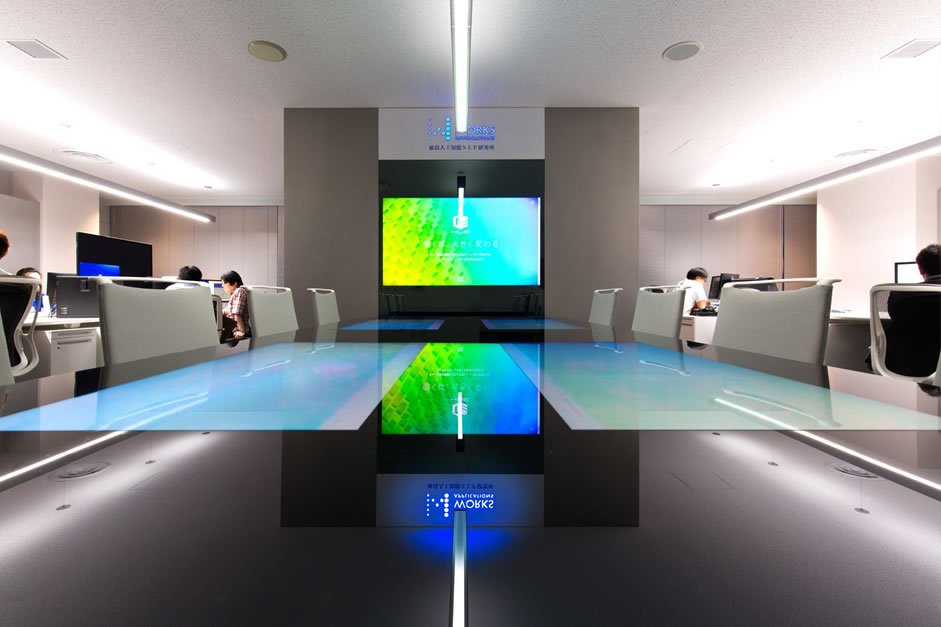
About Works Tokushima Artificial Intelligence NLP Laboratory
What is the Works Tokushima NLP Institute for Artificial Intelligence like?
It is a rare R&D institute in Japan that specializes in NLP (Natural Language Processing) technology within the field of AI (Artificial Intelligence).
The establishment of the institute was motivated by the desire to propose a "new way of working" by improving the productivity of people working in back-office operations. Many back-office tasks involve reading and writing Japanese, such as processing documents and responding to inquiries. Reading and writing Japanese is difficult to mechanize and has remained an area where human workers are inevitably required. At Works Applications, we wanted to provide a unique solution to this area, so we established a research and development organization focused on natural language processing, a research area that deals with characters and words.
What is the mission of the Institute?
Our mission is to research natural language processing technology and develop products that help solve social problems. We do not stop at research, but conduct research with a view to actually producing output for society. This is a basic policy that has not changed since our establishment.
NLP research in Japanese tends to be slower in returning the results of its research to society compared to research conducted overseas, mainly in English. This is because in the case of overseas research, major corporations are at the center of research, whereas in the case of Japanese language research, Japanese universities are at the center of research. In addition, since most of the research in Japanese is limited to research conducted by Japanese speakers, the number of research projects itself is inevitably smaller than that in English. The Institute hopes to promote the return to society of the results of its Japanese-language NLP research. To this end, we are actively engaged in industry-academia collaboration. We also release some of our research results as OSS (Open Source Software).
Please tell us about the research you are currently working on.
Most recently, we have focused on continuing to improve the HUE chatbot (see below) and advancing our research on AI image processing (OCR).
The HUE chatbot is a fully automated AI dialogue tool (with the largest dictionary in Japan).
By applying NLP technology, it handles language fluctuations, which have been considered an issue in the past, and responds to inquiries from inquirers with a high degree of accuracy, as if it were talking to a human being).
AI image processing is provided for customers with the high-precision AI-OCR Engine (already included in the ERP package "HUE"). We propose solutions based on RPA and system integration as well as digitization of various types of documents such as receipts and invoices).
Although these two technologies are different, the important meaning they share is the ability to digitize data that was previously analog. Natural language text, such as end-user inquiries, and information left on paper, such as receipts and statements, were analog data in the sense that they could only be read and verified by humans. These can now be stored as digital data that can be utilized by using HUE chatbots and AI image processing technology, respectively.

In 2017, the Japanese morphological analyzer "Sudachi" was released as OSS*1, and I hear that many major companies have adopted it.
Sudachi" is a high-quality morphological analyzer for commercial use. Morphological analysis is a technology that breaks down a sentence into its smallest meaningful units and determines its part of speech, changes, and so on. It is the most fundamental technology for Japanese NLP. There are several morphological analyzers for Japanese, but Sudachi has been well received for the high quality of its lexicon (goi) and the overwhelmingly large number of words it contains. It is also highly evaluated for its continuous maintenance and support of new words, and papers related to Sudachi have been accepted by LREC, an international conference (*2), and won the Best Paper Award at a domestic research conference (*3).
Sudachi has been adopted by many major Sudachi has been adopted by many major global companies. At a recent event hosted by our company, a medical service provider, an electronics manufacturer, and a research institute of a major human resource services company shared their use cases.
For what kind of applications is Sudachi often used?
Sudachi provides plug-ins, and I have the impression that many of them are using Elasticsearch, an OSS that is becoming a standard search engine on various platforms. I have the impression that it is often used on Elasticsearch, an OSS that is becoming standard on various platforms as a search engine.
*1) OSS stands for Open Source Software. It refers to software whose creator discloses its source code free of charge and whose use, modification, and redistribution are freely permitted.
*2) 2018 Adopted by the 11th International Conference on Language Resources and Evaluation (LREC/ELREC), the world's largest academic conference on language resources.
http://www.lrec-conf.org/proceedings/lrec2018/summaries/8884.html
*3) 2021 Best Research Award (Best Paper Award) from the Research Group on Language Understanding and Communication (NLC) of the Institute of Electronics, Information and Communication Engineers (IEICE)
https://www.ieice.org/iss/nlc/wiki/wiki.cgi?page=%B8%A6%B5%E6%BE%DE2020%C7%AF%C8%EF%C9%BD%BE%B4%BC%D4
Why did you release Sudachi as OSS?
Since the Works Tokushima NLP Laboratory for Artificial Intelligence was launched from a completely zero base, it was a difficult process from its establishment in 2017 to the development of the HUE chatbot. While my previous employer had various fundamental technologies for NLP research in Japanese, the Works Tokushima Artificial Intelligence NLP Laboratory lacked usable language resources with respect to Japanese, and this was perplexing. In order to proceed with research and development, it was first necessary to develop the basic technology. The first thing we developed was Sudachi, a morphological analyzer, which is the most basic infrastructure.
However, other companies were in the same situation. As mentioned above, NLP research in Japanese is mainly conducted at universities, and research at companies is not very active. Companies like my former company, which possesses a complete set of basic technologies on its own, are rather unique. However, it is inefficient for each company to develop its own technology from the base technology, if we look at Japanese NLP research as a whole.
The corporate philosophy of Works is to "improve the productivity of companies. In keeping with this philosophy, we have decided that the technology of an infrastructure such as Sudachi should be made available to the public so that anyone can use it. With high-quality NLP infrastructure technology freely available to everyone, corporate NLP researchers will be able to concentrate on research to solve social problems, and we can expect the development of NLP research in the Japanese language. We have also received feedback from various companies and users that they would like to have such functions, and we have been able to improve Sudachi by taking hints from them.

What is "HUE Chatbot," which also incorporates Sudachi's technology?
Let me ask you about the Institute's product, HUE Chatbot. First of all, please tell us what kind of product is the HUE chatbot.
AI dialogue tool for responding to inquiries. The HUE chatbot incorporates the results of our research, including Sudachi, which I mentioned earlier.
This Sudachi, what part of "HUE Chatbot" do you make use of?
Sudachi has been utilized to a great extent in the ability to respond to user inquiries with a very high degree of accuracy.
Sudachi has one of the largest vocabularies in Japan, and is highly resistant to shaky or ambiguous notation, which leads to high response accuracy.
For example, Sudachi can understand the same word with the same meaning even if it is written in different kanji, katakana, or hiragana, or in different kana, or even if it is written incorrectly. It can also recognize differences in proper nouns, such as Suica, ICOCA, and Kitaca, as generalized "transportation system IC cards.
You mentioned that one of the main features of HUE Chatbot is the high accuracy of its answers.
There is a "ask-and-answer" function.
For example, many end-users who want to ask about expenses on a business trip may ask questions by inputting only words rather than sentences into the chatbot, such as "accommodation expenses" or "transportation expenses. However, there are too many applicable FAQs with just words, and the AI may not be able to identify the FAQ that the user is seeking.
In such cases, HUE chatbot supplements the information needed to identify the FAQ by asking the user back the missing information. The content asked back to the user is automatically generated by analyzing the inputted words and registered FAQs by the AI.
Assuming that the user entered "lodging" and "transportation costs" as examples, the chatbot will identify and ask back options such as "I want to ask about receipts," "I want to ask about the maximum fee," and so on.
I understand that the accuracy of HUE Chatbot's answers is further enhanced by the "ask-again" function.
However, I have the impression that it would be difficult to set up in advance and maintain after installation in order to take advantage of the features you just mentioned.
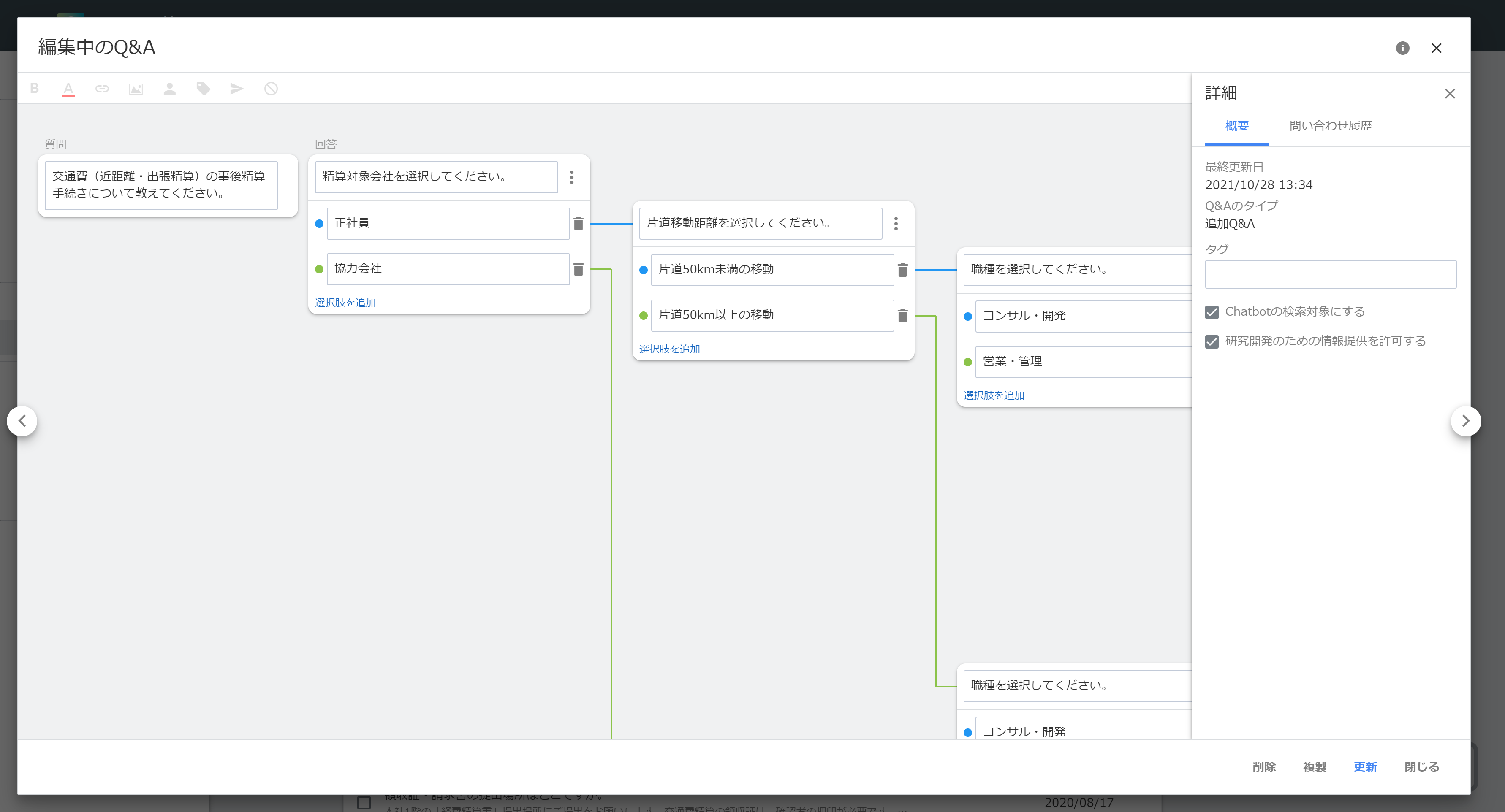
Although this is not a chatbot function, there is no need to worry about it as it has a full set of management functions to operate. There are many cases of failed introduction of chatbots, and one of the common causes is that the accuracy of the chatbot's answers deteriorates and it is no longer used due to lack of maintenance of the FAQs after the introduction. The HUE chatbot administration screen is designed with an emphasis on ease of management and operation by the customer, based on the premise that FAQs will be modified and added regularly after installation. We often receive comments from customers who have actually used HUE chatbot that the management screen is easy to use and operate. We would like to encourage companies that have tried other companies' chatbots in the past but were unable to operate them successfully to try HUE Chatbot.
What kind of management functions are available?
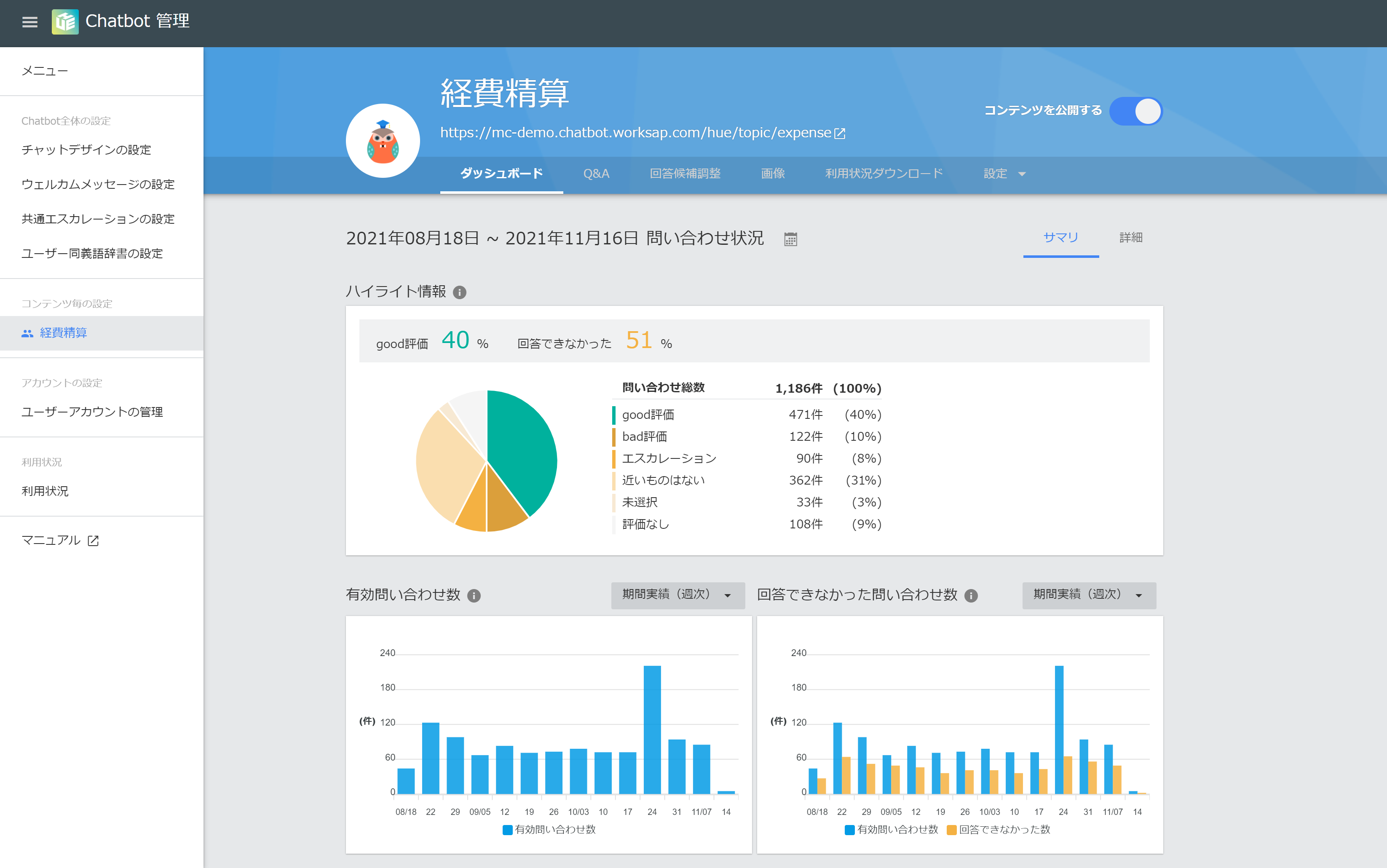
We have an "inquiry dashboard" that automatically aggregates and analyzes user inquiries, chatbot responses to those inquiries, and user reactions to the responses, and displays them. Customers can, for example, see trends in inquiries that the chatbot did not answer well, and add or modify missing FAQs.
They can also make simple adjustments to the chatbot's AI. For example, customers can check the list of candidate FAQs that the AI estimates for a particular query and adjust the order of priority, or set synonyms for the AI, such as "make the word 'PASMO' be treated as a 'transportation system IC card'". Yes.
I understand that we can immediately perform operations to improve the chatbot by ourselves.
Yes, we can do that. Customers can easily handle management functions such as adding and modifying FAQs, which need to be flexibly operated according to their business needs, by themselves without having to ask vendors to do it for them. The management screen is intuitive and easy to use, so no programming knowledge is required. Anyone who uses Word or Excel in the back office can use the management functions without any problems.
Of course, we also provide ongoing support.
We will provide ongoing updates to the standard Sudachi dictionary and AI functions free of charge.
Once again, what kind of changes can we expect to see in your on-site operations by introducing HUE chatbots?
First of all, the basic effect of introducing HUE chatbots is to streamline the inquiry process. In the inquiry process, many similar inquiries are generated, and HUE chatbot can automatically respond to them. The only human response required is for new inquiries that have not been registered in the FAQs. The new queries can be added to the FAQ as soon as they are resolved, so that the HUE chatbot can answer them the next time.
We have also seen an increase in the number of inquiries after operating the HUE chatbot within the company, compared to when the only contact point was email. This is thought to be due to the ease of use of the chatbot, which allows users to easily make inquiries that they would have hesitated to make with e-mail because they felt it was too much of a hassle or a hurdle. This may bring to light potential issues that had not been picked up before, or discover the seeds of new services. We intend to analyze whether this kind of effect can be achieved at various companies in the future through interviews with our clients.
To whom would you recommend the introduction of HUE Chatbot?
We would like to encourage our customers who have not yet introduced chatbots, as well as companies that have introduced chatbots from other companies in the past but were not able to successfully operate them, to experience HUE chatbots. Although this overlaps with the previous point, one of the most common reasons for introduction failures is that FAQs are not maintained properly, and the accuracy of chatbot responses deteriorates, causing the chatbot to stop being used. HUE chatbots are designed to be easy to maintain by the administration department, in addition to high basic Japanese processing accuracy. Of course, we will provide full support, but we would like many people to experience the ease of operation improvement by themselves and the ease of use of the administration screen.
What is your vision for the future of HUE Chatbot?
I would like to discuss our future prospects, dividing them into short-term and medium- to long-term goals.
First, as a short-term goal, we would like to respond to the various requests we receive from our customers, and we are upgrading the HUE chatbot version free of charge approximately once every three months. We will continue to respond to customer feedback and make it easier to respond to customers. We will continue to improve the product by responding to customer feedback.
One of our mid- to long-term goals is to expand the functionality of chatbots beyond inquiry response. If chatbots and business systems are well integrated, end users will be able to perform various applications and procedures simply by giving instructions to the chatbot in Japanese.
In addition, we are also working on a joint research project with a university. We are also working with universities to explore ways in which chatbots can contribute to improving the work efficiency of faculty and staff, as well as the motivation of students to learn, in response to the increasing number of universities that are adopting chatbots in response to the loss of face-to-face classes for the Corona disaster.
If you have any new topics you are currently researching, please let us know.
We are currently conducting research and development of chatbots that do not require FAQs. For example, there are customers in the manufacturing industry who have a wealth of documents such as past construction cases, but the volume is so large that it is difficult to create FAQs, or customers who are busy with back-office operations and do not have time to create FAQs in the first place. We would like to provide technology that allows chatbots to respond based on existing documents, manuals, or past inquiry emails, even if FAQs cannot be prepared, so that such customers can use the service without problems.
For more information about Sudachi and HUE chatbot, please contact us at
Related Useful Information
Web Articles
2022/05/24
What is the breakdown of costs and market prices for chatbot implementation and operation?

Web Articles
2022/05/24
Advantages of using chatbots as FAQs for internal use and points to keep in mind when introducing them

Web Articles
2022/05/24
How to Measure and Improve the Effectiveness of Chatbots to Correctly Know the Effectiveness of Chatbots